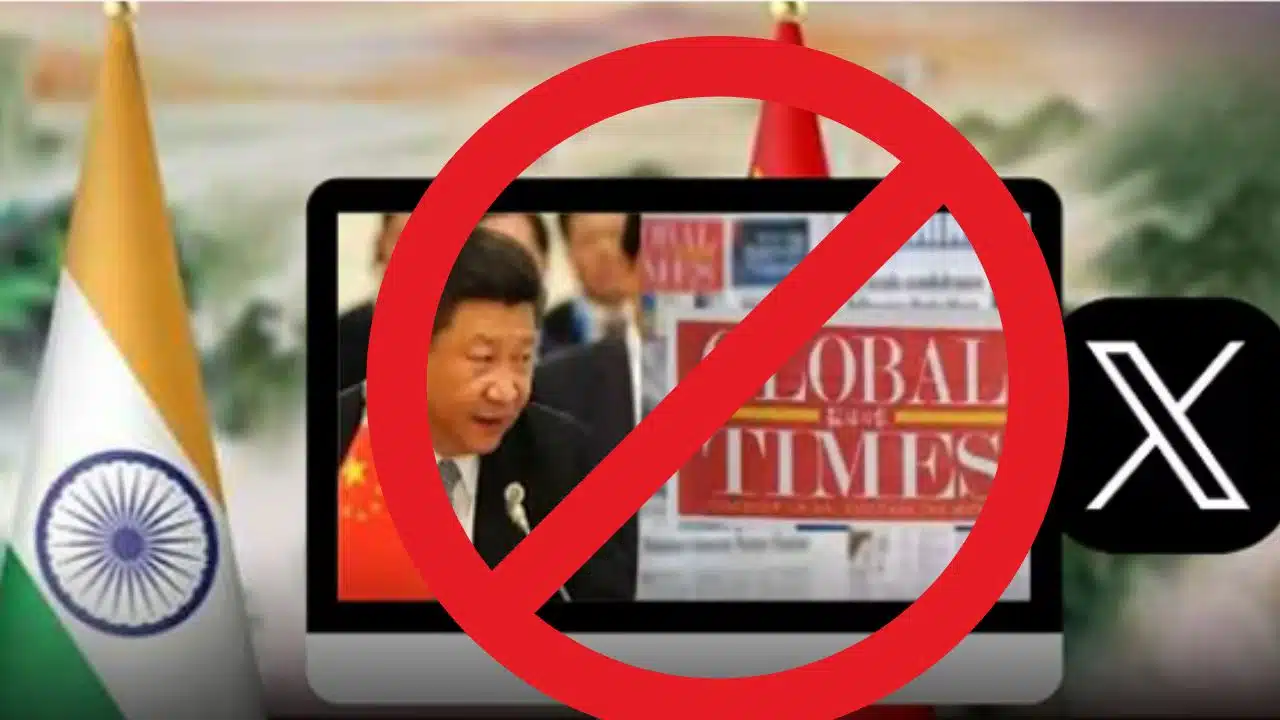
India has blocked the X (formerly Twitter) accounts of prominent Chinese and Turkish state-run news agencies — Xinhua, Global Times, and TRT World — as of Wednesday afternoon local time. This move follows mounting tensions with Pakistan and growing concerns over the spread of misinformation by foreign media outlets during the recent military conflict.
These accounts, operated by the Chinese state news agency Xinhua, China’s English-language Communist Party mouthpiece Global Times, and Turkey’s TRT World, were reportedly inaccessible for Indian users after the order. The government’s action is seen as part of a broader crackdown on what it terms “foreign disinformation campaigns” attempting to distort facts about recent clashes with Pakistan.
Rising Tensions Between India and Pakistan Spark Disinformation Crackdown
The decision to block these accounts comes amid heightened geopolitical tensions. On April 22, 2025, a brutal terrorist attack occurred in the Pahalgam area of Indian-administered Kashmir. Militants killed 26 civilians, most of whom were tourists. India quickly blamed Pakistan-based Islamist extremists for the attack and accused the Pakistani government of sheltering and supporting such groups — allegations Islamabad has categorically denied.
In the days that followed, the two nuclear-armed neighbors engaged in a series of retaliatory actions. These included missile launches, drone strikes, and artillery exchanges along the Line of Control (LoC). With civilian casualties on both sides, fears of a broader war escalated rapidly. The military standoff reached a peak by the first week of May.
Despite several rounds of artillery shelling and airspace violations, a ceasefire was agreed upon on May 10, 2025, following U.S. and Gulf nations’ diplomatic interventions. While the ceasefire has held since then, tensions remain high and both sides have continued to maintain military readiness along the border.
India’s Warning to Global Times Over Alleged Fake Reports
One of the key triggers for the blocking of Chinese media accounts was a post by Global Times, which cited Xinhua in claiming that Pakistan’s Air Force had shot down another Indian fighter jet during overnight air raids. The Indian government swiftly labeled the report as “fake news” and an attempt to mislead international observers.
On May 7, the Indian Embassy in China responded sharply via X, directly calling out Global Times. The embassy’s statement read:
“We would recommend you verify your facts and cross-examine your sources before pushing out this kind of disinformation.”
(1/n) Dear @globaltimesnews , we would recommend you verify your facts and cross-examine your sources before pushing out this kind of dis-information. https://t.co/xMvN6hmrhe
— India in China (@EOIBeijing) May 7, 2025
India’s Press Information Bureau (PIB) further clarified that circulating videos showing supposed wreckage of Indian fighter jets were fabricated and part of a coordinated attempt to create panic and damage India’s international image.
Pakistan, on the other hand, has claimed its forces shot down five Indian jets during the skirmishes. India firmly denied these claims, stating that all pilots involved in operations returned safely. Indian officials say such reports are an “information warfare tactic” used to manipulate global perception.
India Directs X to Remove Thousands of Accounts
This isn’t the first such action by the Indian government in response to online misinformation. In recent weeks, the Ministry of Electronics and Information Technology (MeitY) has instructed X to block more than 8,000 accounts allegedly spreading Pakistan-linked propaganda or unverified content about the ongoing military tension.
Among these blocked or flagged accounts were several belonging to Indian journalists and independent media platforms, including:
- Maktoob Media
- The Kashmiriyat
- The Wire
- Journalist Anuradha Bhasin
These moves sparked criticism from press freedom advocates within India and abroad, with concerns raised about overreach and the suppression of dissenting voices. Critics argue that such crackdowns blur the line between controlling false narratives and censoring free speech.
It remains unclear whether the Chinese and Turkish state media accounts were counted among the 8,000 blocked profiles. However, their inclusion fits the broader pattern of India’s information control efforts during the conflict.
China and Turkey’s Alignment with Pakistan Draws Scrutiny
Both China and Turkey are long-time allies of Pakistan and have voiced criticism of India’s actions during the latest border confrontation.
Turkey, via its foreign ministry, accused India of “provocative actions” and alleged attacks on civilians and public infrastructure in Pakistani-administered Kashmir. This strongly-worded statement came after Indian drone and artillery strikes reportedly targeted militant camps near the Muzaffarabad sector — an area under Pakistan’s control.
Beijing, for its part, reiterated that Pakistan is its “ironclad” and “all-weather” strategic partner. The Chinese Foreign Ministry expressed concern about the Kashmir conflict and offered to mediate, although it stopped short of openly criticizing India.
China also controls a portion of Kashmir known as Aksai Chin, which has been a long-standing source of territorial dispute between New Delhi and Beijing. The presence of Chinese troops near disputed zones and its growing military footprint in the region have further complicated the trilateral dynamics.
Press Freedom Concerns Grow as International Bodies Respond
International watchdogs and civil liberties groups, including Reporters Without Borders (RSF) and The Committee to Protect Journalists (CPJ), have voiced alarm over India’s increasing use of digital censorship to manage internal and external narratives during crises.
RSF stated in a public release:
“The Indian government’s move to block major international news accounts is deeply concerning and signals an alarming trend in restricting access to information, especially during periods of national conflict.”
Global digital rights organizations warn that India’s frequent directives to remove social media content under vague charges of “anti-national activity” risk undermining democratic principles and journalistic independence.
X Responds Quietly, Global Times Restored Temporarily
While X has complied with India’s requests, the platform did not make any official statement regarding the mass content takedown. A spokesperson for the company referred inquiries to the Indian government’s orders, citing local law compliance.
Some media outlets, like Global Times and TRT World, were briefly restored after takedown notices were temporarily revoked — though it is unclear if this was due to diplomatic backchannel talks or legal reconsiderations.
Meanwhile, Xinhua News Agency’s handle remains inaccessible in India at the time of reporting.
A Battle of Narratives Beyond the Battlefield
India’s decision to block the X accounts of Chinese and Turkish media organizations marks a significant escalation in the information warfare dimension of the broader India-Pakistan conflict.
While the government justifies its actions as necessary to counter foreign propaganda and protect national security, the move also raises important questions about freedom of the press, transparency, and the regulation of digital platforms in democratic societies.
As the South Asian region remains volatile and geopolitical rivalries deepen, the management of online information and misinformation is likely to remain a critical, contested battleground — just as vital as events unfolding on the ground.