Independent publishers have spent too long building on borrowed attention. That is the uncomfortable part of the independent publishers vs Google debate. For years, the deal seemed simple enough: publish useful content, follow search rules, improve technical SEO, earn rankings, and receive traffic. It was never a perfect deal, but it was workable. Google needed good pages to organize, and publishers needed discovery.
Now the balance feels different.
Google is no longer just pointing users toward answers. It is increasingly trying to answer the question itself, often before the reader reaches a publisher’s site. Featured snippets started that habit. People Also Ask boxes expanded it. AI Overviews pushed it into a much more serious phase.
For large media companies, this is painful. For independent publishers, it can be brutal.
A big publisher may have subscriptions, brand search, events, video teams, licensing deals, podcasts, apps, and direct audience channels. A smaller publisher often has a thinner safety net. One algorithm update can damage months of work. One AI summary can satisfy the user before the first organic result gets a fair chance. One traffic drop can turn a healthy site into a nervous spreadsheet.
This is not an anti-Google rant. Google still sends traffic. Search still matters. SEO is not dead, no matter how many lazy LinkedIn posts try to bury it every six months.
But independent publishers cannot keep treating Google visibility like a permission slip to exist.
That permission can be delayed, reduced, misread, revoked, or replaced by an answer box.
The Old Search Bargain Is Breaking
The old search model had a rough fairness to it. A user searched. Google showed links. The publisher competed for a click. Better pages had a chance to win attention.
That model was never pure. Ads sat above organic results. Big brands often had an advantage. SERP features pulled clicks away from websites. Still, the publisher had a visible path: create the best useful page, earn trust, and compete.
AI search changes the feel of that bargain.
When Google generates an answer directly on the results page, the publisher is no longer only competing with other publishers. They are competing with the interface itself. Their work may help shape the answer, but the click is no longer the natural next step.
That is the part many people outside publishing fail to understand.
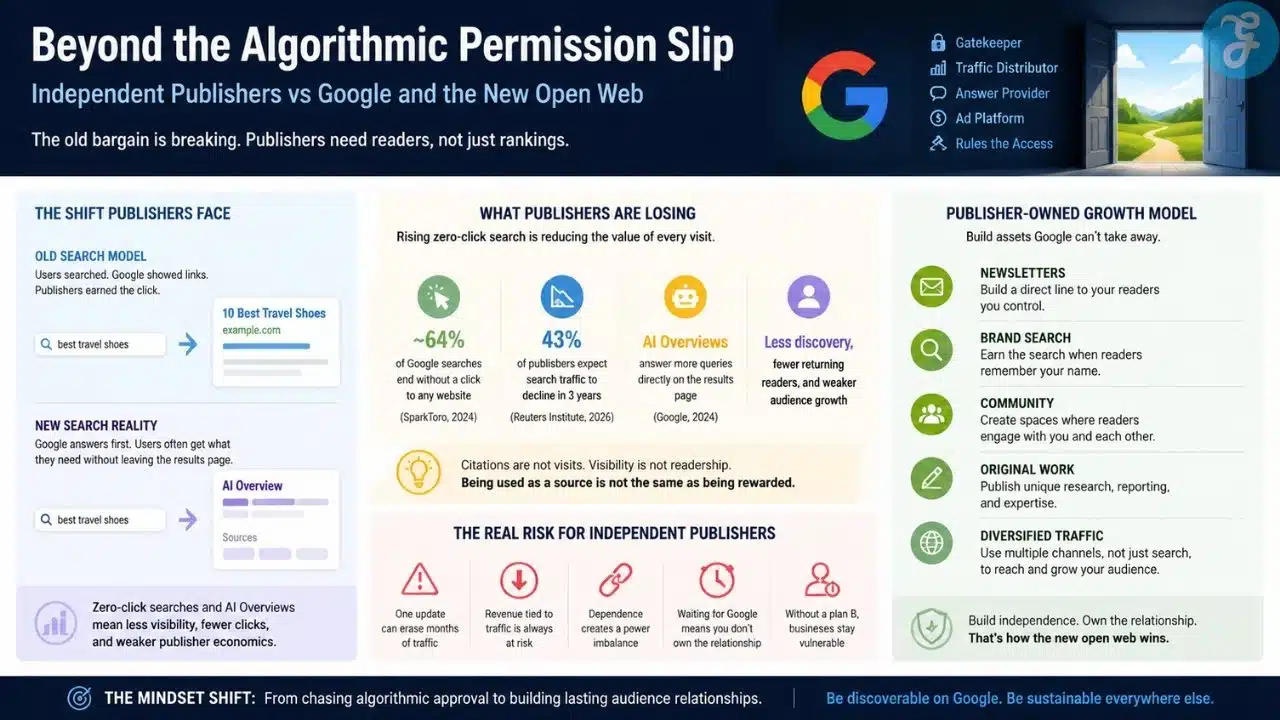
A citation is not the same as a visit. Visibility is not the same as readership. Being used as a source is not the same as being rewarded as one.
Independent publishers can appear in the information chain while still losing the relationship with the reader.
Why This Hits Independent Publishers Harder
A major media brand can survive more volatility than a small specialist site. That does not mean large publishers are safe, but they usually have more options.
Independent publishers have fewer layers of protection.
They often depend on search for:
- First-time discovery
- Affiliate revenue
- Display ad impressions
- Newsletter signups
- Product sales
- Lead generation
- Brand recognition
- Community growth
When search traffic drops, it does not only affect pageviews. It weakens the whole business funnel.
A product review site may lose affiliate clicks. A local guide may lose business leads. A niche education site may lose email subscribers. A small news site may lose ad revenue. A hobby publisher may lose the motivation to keep going because the work no longer reaches people.
That is why the independent publishers vs Google issue is not only about rankings. It is about who controls access to readers.
The Power Imbalance Is the Real Story
Google’s position is not simply that of a traffic partner. It is a gatekeeper, interface, ad platform, analytics source, discovery engine, and increasingly an answer provider.
That creates a power imbalance.
Independent publishers must care about Google’s rules because Google controls a major part of discovery. They must care about crawling, indexing, site speed, structured data, helpful content, canonical tags, internal links, schema, technical health, and every new SERP format that changes how users behave.
Google, on the other hand, does not depend on any one independent publisher.
That asymmetry shapes the entire relationship.
If a small publisher loses 40 percent of search traffic, it may become a business crisis. For Google, it may look like one tiny movement inside a massive product experiment. That is not personal. That is structural.
The problem is not that Google changes. Search has to change. The problem is that publishers often carry the risk of those changes while having very little control over them.
Zero-Click Search Taught the Lesson Before AI Did
AI Overviews made the issue louder, but zero-click search had already been training users not to leave Google.
Weather, definitions, sports scores, quick facts, calculations, lyrics, local packs, maps, shopping boxes, snippets, and knowledge panels all taught users that the search page itself could be the destination.
For users, that can be convenient.
For publishers, it slowly changes the economics of content.
If the answer sits at the top, many people will not click. If they do not click, the publisher does not get ad revenue, email signups, brand recall, comments, conversions, or any real chance to build loyalty.
This matters because many independent publishers do not produce content for fun alone. They need revenue to pay writers, editors, hosting bills, research costs, tools, images, legal review, reporting expenses, and time.
The internet likes to pretend content should be free, instant, accurate, and endless. That fantasy only works when someone else quietly pays the cost.
AI Overviews Raise the Stakes
AI Overviews are not just another SERP feature. They make Google feel less like a directory and more like an editorial layer.
That shift is serious.
The AI answer decides what to include, what to simplify, what to omit, and which sources appear visible enough to count. A publisher may have the most useful page on a topic, but the user may never see it if the overview satisfies the intent early.
This does not mean AI Overviews are always bad. Some users ask complex questions and genuinely need a starting point. Some AI results may send users toward sources they would not have found otherwise. Google argues that AI features can help people explore and discover a wider range of sites.
That may happen in some cases.
But publishers are right to ask a harder question: does the system send enough valuable traffic back to the people creating the information?
If the answer is not clear, publishers should not build their future around hope.
The Permission Slip Problem
The worst habit independent publishers can develop is waiting for Google to validate every move.
Publish the article, then wait.
Wait for crawling.
Wait for indexing.
Wait for ranking.
Wait for the update.
Wait for recovery.
Wait for Search Console to explain nothing clearly enough.
Wait for Google to decide whether the content is helpful, whether the site is trusted, whether the query deserves an AI Overview, whether the page gets a citation, whether users still see the result, whether the next update changes everything again.
This is what I mean by the algorithmic permission slip.
It is not that SEO is useless. SEO is still one of the most important skills a publisher can build. Technical health, search intent, topical authority, page experience, internal linking, and structured content still matter.
But SEO cannot be the entire business model.
If a publisher’s only route to the reader is Google, then the publisher does not really own the audience relationship. They rent it.
And rent can go up at any time.
Where Publishers Still Have Control
The open web is not dead, but independent publishers need to stop treating it like a single-lane road from Google to their homepage.
There are still areas where publishers can build control.
The practical split looks like this:
| Rented Attention | Owned or Stronger Attention |
|---|---|
| Google rankings | Newsletter subscribers |
| Social feed reach | Direct community participation |
| Algorithmic referrals | Brand search |
| One-time visitors | Returning readers |
| Platform-dependent traffic | Bookmarked resources |
| Generic informational articles | Original reporting and useful tools |
The goal is not to abandon search. That would be unrealistic and honestly foolish for most publishers.
The goal is to make search one channel, not the whole oxygen supply.
Newsletters Are Not Optional Anymore
A newsletter is not magic. A bad newsletter is just another ignored inbox item.
But a good newsletter gives independent publishers something search cannot provide: a direct line to readers who asked to hear from them again.
That matters.
A reader who subscribes is different from a reader who lands from search, scans one answer, and leaves. The subscriber has given permission to continue the relationship. That is more durable than a ranking.
Independent publishers should treat newsletters as editorial products, not leftovers.
A strong newsletter needs:
- A clear reason to exist
- A consistent publishing rhythm
- Useful context, not just links
- A recognizable voice
- Strong subject lines that do not trick readers
- A simple path back to the site
- Occasional original material that is not available everywhere else
Too many publishers use newsletters as article dumps. That wastes the channel.
The better approach is to make the newsletter feel like a compact editorial experience: what matters, why it matters, what the reader should do next, and what is worth reading in full.
Brand Search Is a Quiet Survival Metric
Independent publishers talk a lot about keyword rankings. They should talk more about brand search.
When readers search for a publication by name, that is a different kind of signal. It means the reader remembers the source, not only the topic.
That is a stronger position.
A publisher ranking for “best budget laptops” is useful. A publisher being searched by name for laptop advice is better. The first depends heavily on the search results page. The second suggests trust.
Brand search grows from repeated usefulness. It comes from clear editorial identity, strong author voices, original angles, reliable updates, and a site experience that does not make readers regret clicking.
It also comes from restraint.
If every headline sounds the same, every article copies the same structure, every review feels thin, and every guide is stuffed with generic advice, readers have no reason to remember the site.
Independent publishers do not need to sound bigger than they are. They need to sound worth returning to.
Original Work Is Harder to Replace
Generic informational content is the easiest to summarize.
That does not make it worthless. Many readers still need clear explainers, practical guides, and beginner-friendly articles. But publishers should be honest about the risk. If a page only answers a common question in a common way, AI search can compress it quickly.
Original work is harder to replace.
That includes:
- Interviews
- First-hand reporting
- Original data
- Local expertise
- Expert analysis
- Product testing
- Strong opinion with evidence
- Useful tools
- Visual explainers
- Community-driven insight
- Industry-specific examples
This is where independent publishers can still compete.
They may not outspend large media companies. They may not outrank big domains every time. But they can be closer to a niche, faster to notice real problems, more trusted by a specific audience, and less trapped by corporate blandness.
A small publisher with real expertise can beat a large generic site in usefulness.
Not always in rankings. But in reader trust, yes.
Communities Can Protect the Reader Relationship
Community is another word that gets abused. A comment box with spam is not a community. A dead Discord server is not a community. A Facebook group where nobody talks unless an admin drops a link is not a community.
A real community gives readers a reason to stay near the publisher when they are not actively searching.
That could be:
- A private group for professionals in a niche
- A reader Q&A thread
- A members-only discussion space
- A local audience group
- A Slack or Discord for serious users
- A recurring live session
- A comments section with actual moderation
Community is work. It needs rules, moderation, prompts, and a reason to exist beyond “please engage with our brand.”
But when it works, it creates something Google cannot fully copy: relationships between readers, editors, experts, and the publication.
That relationship is valuable because it does not begin with a keyword. It begins with trust.
Social Platforms Help, but They Are Not Freedom
Publishers should diversify into social distribution, but they should not confuse social traffic with independence.
Social platforms are also rented land.
Facebook can throttle reach. X can change incentives. LinkedIn can reward shallow hot takes. TikTok can shift attention overnight. Instagram can bury links. YouTube can change monetization. Any platform can decide that the content format that worked last month is now less valuable.
Use social platforms, but do not worship them.
The best use of social is not just traffic extraction. It is audience memory. A good post can make readers remember the publication. A smart thread can turn into a newsletter signup. A short video can introduce a deeper article. A creator-led account can build trust around an editorial voice.
The point is to move some of that attention toward channels the publisher controls.
Social reach is useful.
Owned audience is safer.
The Open Web Needs Better Publisher Habits Too
It is easy to blame Google for everything. Some criticism is fair. The power imbalance is real. AI search raises serious questions about attribution, traffic, and value exchange.
But publishers also need to be honest about their own mistakes.
Many sites trained readers to distrust them.
Too many pages are overloaded with ads. Too many recipes hide the recipe. Too many articles bury the answer under filler. Too many affiliate reviews feel like commission funnels. Too many news sites interrupt the reader with popups, autoplay video, newsletter modals, push alerts, cookie walls, and layout shifts.
Then publishers wonder why users prefer a clean answer box.
That does not excuse Google’s power. It does explain part of user behavior.
If independent publishers want readers to choose the open web, the experience has to respect the reader.
That means faster pages, cleaner layouts, fewer tricks, clearer authorship, better sourcing, and content that gets to the point without treating the reader like an ad impression with legs.
What Independent Publishers Should Actually Build Now
The practical path is not glamorous. It is not one hack. It is a set of habits.
Independent publishers should keep doing SEO, but with a wider strategy around it.
They should build topic authority, but not by mass-producing thin articles around every keyword variation.
They should create newsletters, but not as dumping grounds for links.
They should use social platforms, but not as the final home of their audience.
They should publish original work where possible, even if it takes longer.
They should track returning readers, branded search, direct traffic, email growth, and engagement quality, not just organic sessions.
They should build pages worth bookmarking.
That last point matters more than people think.
A bookmark is a stronger compliment than a click. It means the reader expects to return. Independent publishers should ask more often: would anyone save this page, share it, cite it, print it, forward it, or come back to it next month?
If the answer is no, the page may be search content, but it is not durable publishing.
The New Open Web Should Not Mean Anti-Google
The new open web should not be built around pretending Google does not matter. It does.
Search will remain important. Many independent publishers still need it. Users still rely on it. Google still helps good content get discovered. Ignoring that would be unserious.
The better argument is balance.
The open web needs publishers who can be found through search but do not collapse when search changes. It needs sites with direct audiences, recognizable voices, cleaner experiences, and original value. It needs business models that do not depend entirely on one company’s interface choices.
That is not rebellion.
It is basic risk management.
Stop Waiting for the Algorithmic Permission Slip
The independent publishers vs Google debate is not going away. AI search, zero-click results, core updates, platform volatility, and changing user habits will keep reshaping discovery.
Independent publishers can complain about that forever, or they can build differently.
The smarter move is not to abandon Google. It is to stop needing Google’s approval for every meaningful reader relationship.
That means turning one-time visitors into subscribers. Turning generic traffic into brand memory. Turning articles into assets. Turning expertise into trust. Turning social reach into direct audience. Turning search visibility into only one part of a stronger publishing system.
The open web does not need nostalgia. It needs publishers willing to act like they own their future.
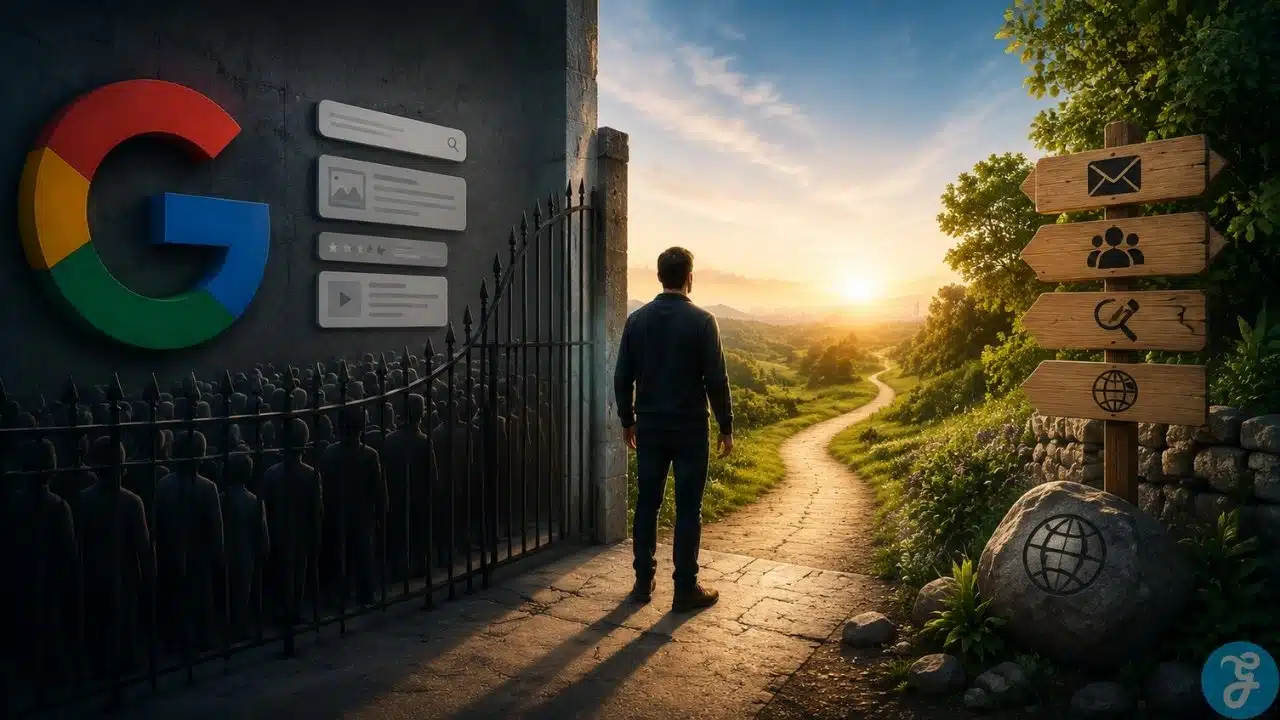
Google may still open the door.
But independent publishers should stop building houses where Google owns every key.