

As of the end of 2024, there are around 1.1 billion websites on the internet. With approximately 252,000 new websites created every day, that’s a lot of online real estate that’s been used up. This, perhaps, is why it has become so much more of a challenge to pick a domain.
With so many websites already established, finding a unique and memorable domain name has become increasingly difficult, with many of the most desirable short and keyword-rich domains having been long claimed.
For you and your brand, this could be a bit of an issue. Because a domain name is so much more than just a simple web address – in 2025, it has become a crucial part of your online identity, working to establish your own digital real estate and shape how your audience finds and perceives you.
Representing Authority
So why exactly is this the case? To understand how the right domain name can be the perfect kickstarter early in your business career, it’s first important to go back to 1985, when the first domains were dealt out.
At this point in time, the internet was still in its infancy, which meant domains were freely available. During this period, it would have been easy enough to simply register the name of your business with no trouble at all, but as the internet grew throughout the 1990s, businesses started realising their importance.
The Gold Rush
This led to a gold rush of registrations, with companies and individuals snapping up short, keyword-rich, brandable domains, with the mission to sell them later for a profit – a practice now recognised as ‘domain flipping’ or ‘cybersquatting’.
Only the top companies – with a budget that allowed for expensive domain buys – could afford to acquire the ‘perfect’ domain, and this soon created a distinct divide between top-level companies with premium domains, and small businesses that had to compromise.
Not an ideal situation, given the internet quickly became the go-to method for online shoppers to learn more about – and buy from – new brands. It soon became clear that companies with appropriate, brand-representing domains were the most authoritative companies, with a stronger online presence and greater consumer trust.
Even now, 81% of consumers are more likely to click on trusted, simple .com domains rather than alternative domains with complicated URLs, and this is simply because the evolution of the internet has instilled in us that: a ‘premium domain’ means a ‘premium company’, and a ‘premium company’ equals ‘authoritative and trustworthy’.
Search Engine Rankings
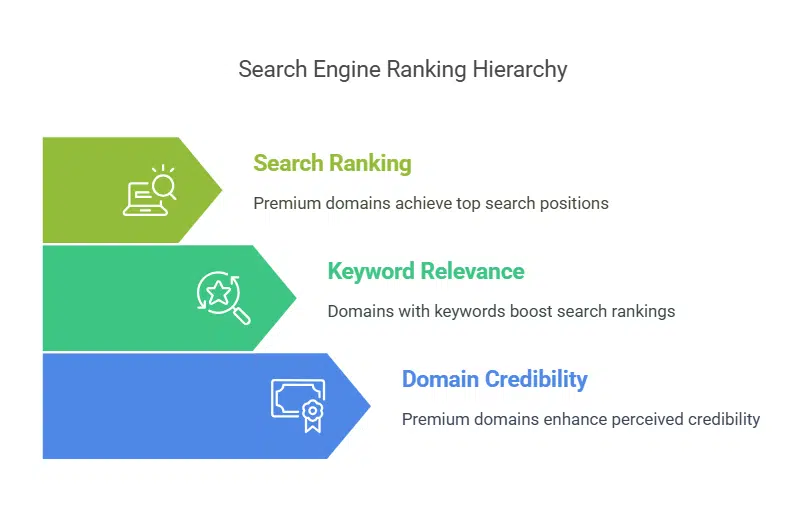
Even in the eyes – or algorithmic eyes, if you will! – of Google, a premium domain is looked more kindly upon. Because a premium domain enhances a website’s perceived credibility, it positively impacts how search engines view and rank that site, with the Google algorithm taking into account a variety of factors, including trustworthiness and authority.
Another thing that Google obviously takes into account is keyword relevance. Because many premium domains include relevant keywords for the business or industry they’re associated with, the website itself can get a substantial boost in search rankings, improving its chances of ranking high for brand-related search enquiries.
With this in mind, many brands with premium domains come up top, achieving prime digital real estate – often on the first page of Google – and far quicker indexing, helping them gain more visibility and authority in their field.
Finding the Right Domain
Credibility, authority, indexing – leading to more customers and better user engagement. These are the key results of finding the right domain, and while this might have been very difficult – if not impossible – fifteen years ago, it’s fair to say things have switched around.
Over the last decade, more lesser-known brands have had to think hard about how they find their place on the internet, bypassing the limitations of the landscape by embracing alternative domain extensions.
For those unaware, domain extensions – or TLDs – refers to the suffix that follows the main part of a domain name, such as .com or .net. In the first three decades of the internet, these extensions were rather limited, with .com and .net being the main two extensions, alongside .gov, .edu, and .org.
As the digital space has become more crowded, however, businesses have turned to using a wider variety of domain extensions, giving them the space to pick a suitable domain name by utilising an industry-specific or creative TLD where the name is still available.
For example, if you were running a brand called ‘TechForYou’, but that domain name is already taken with a .com extension, you could bypass this disadvantage simply by using a .tech extension instead, or perhaps .io, which has become particularly common for startups in the tech world.
Additionally, these alternative domain extensions can often be more affordable, making them an attractive option for your brand as a startup, even if the premium name was available with a ‘.com’ extension too.
How to Secure Real Estate
With this in mind, securing prime digital real estate has become just as much about the domain extension as the domain name itself. As a result, the last ten years of the internet has become far more inclusive, with brands of all sizes able to establish their online presence in a way that marks their credibility, trust, and authority, and also gives Google a reason to favour their website and ensure it is put in front of the right people. In terms of your brand, however, how exactly do you go about making the right choice?
Well, the first thing to do is to consider your brand identity and target audience. Your domain name should reflect what your business does, be easy to remember, and align with your industry, so start by asking yourself what message you want to convey and what specific TLD could make your brand stand out.
Once you have a clear vision, the next step is to research domain availability. If your name is particularly unique, it could mean that you get lucky, and a premium domain name – which perfectly matches the brand – is available with the widely used .com extension.
If not, however, you will have to be creative, and look for an appropriate variation that matches your industry-type. Even if this is the case, the important thing is to make sure your domain is short and simple, avoiding numbers or hyphens, and including relevant terms that make it keyword-friendly.
It’s also important to think about your audience and whether they’d be familiar with certain domain extensions over others. A young and tech savvy audience, for instance, would be familiar with .tech and .ai, but an older and less technologically-entuned audience would have an easier time with a .net or .org.
Conclusion
In order to survive in the busy online world of 2025, it has become more important than ever to be flexible and creative. As mentioned before, there is now a distinguishable way to establish a premium domain and secure your digital real estate, but only if you take the time to strategically plan your approach and choose a domain that aligns with your brand’s long-term vision. So start considering your domain name now, and work to find a name and extension that gives you the authority your brand deserves.