

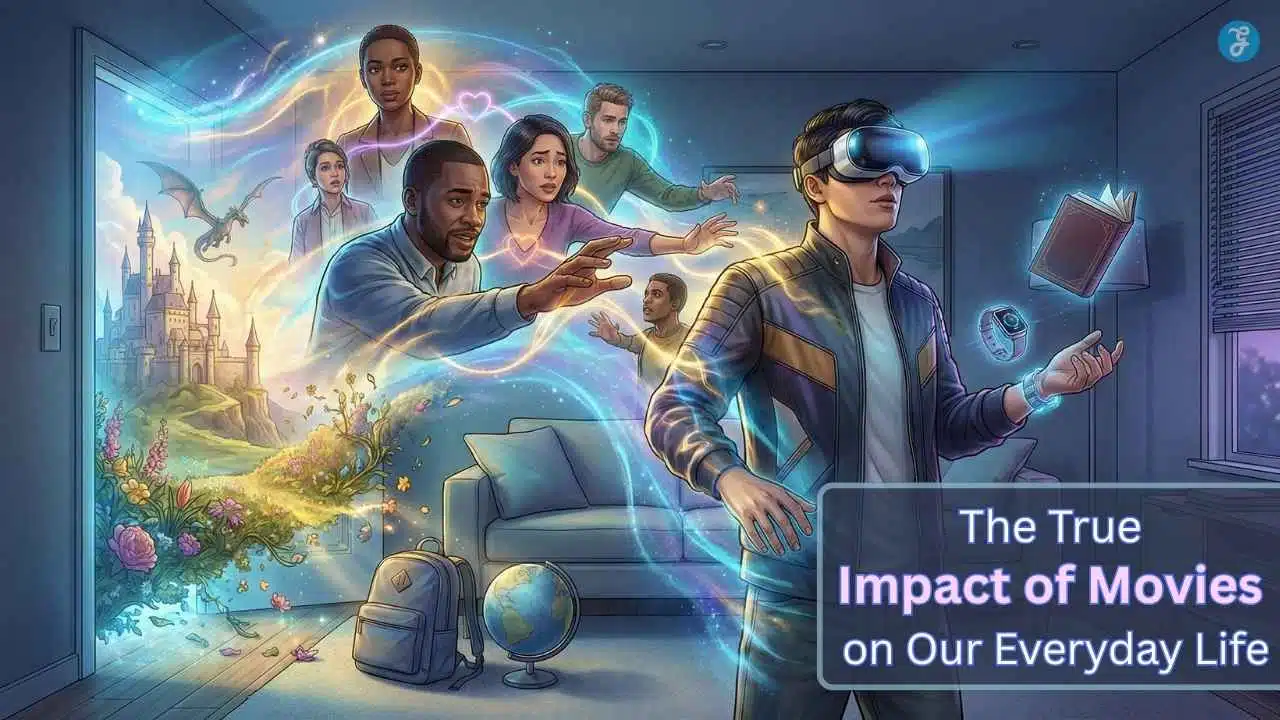
We often mistake cinema for a simple escape—a dark room, a bucket of popcorn, and two hours of forgetting the world. But looking closer, the relationship is actually the opposite. Cinema doesn’t just let us escape reality; it actively constructs it. From the clothes hanging in our closets to the slang we use in texts, the impact of movies on life is profound, pervasive, and accelerating.
As we move toward 2030 and beyond, this influence is shifting from passive observation to active integration. We are no longer just watching stories; we are beginning to live inside them. This article explores the nine most significant ways movies will transform our everyday existence, merging technology, psychology, and culture into a new reality.
Key Takeaways: The Impact of Movies on Life
-
From Passive to Active: We are moving from watching flat screens to entering “living stories” through VR and 4D technology.
-
Therapeutic Power: “Cinematherapy” is emerging as a legitimate tool for building emotional intelligence and processing trauma.
-
Economic Force: Movies are becoming the primary driver for travel trends (“Set-Jetting”) and instant fashion consumption (“Shop-the-Screen”).
-
Social Engineering: Film narratives are the fastest way to normalize complex social issues and break down cultural barriers.
-
The Hidden Cost: While beneficial, this immersion comes with risks, including the “Reality Gap” (unrealistic expectations) and a significant digital carbon footprint.
The Evolution of Influence: Why This Shift is Happening Now
Before we dive into the futuristic tech of VR and AI, it is important to understand why the impact of movies on life is accelerating right now. For most of the 20th century, the relationship between the audience and the screen was distant. We sat in the dark, we watched, and we went home. The influence was slow and subtle.
Today, that distance has collapsed. We carry cinema in our pockets via smartphones; we binge-watch entire seasons in a weekend; and we discuss plot twists globally in real-time on social media. The barrier between “entertainment” and “reality” has thinned. We are no longer just consumers of content; we are active participants in a feedback loop where movies shape our culture, and our culture immediately reshapes the movies.
This article categorizes this massive transformation into three distinct pillars: the Technology of how we watch, the Psychology of how we feel, and the Lifestyle of how we live.
Part I: The Technological Shift (How We Watch)
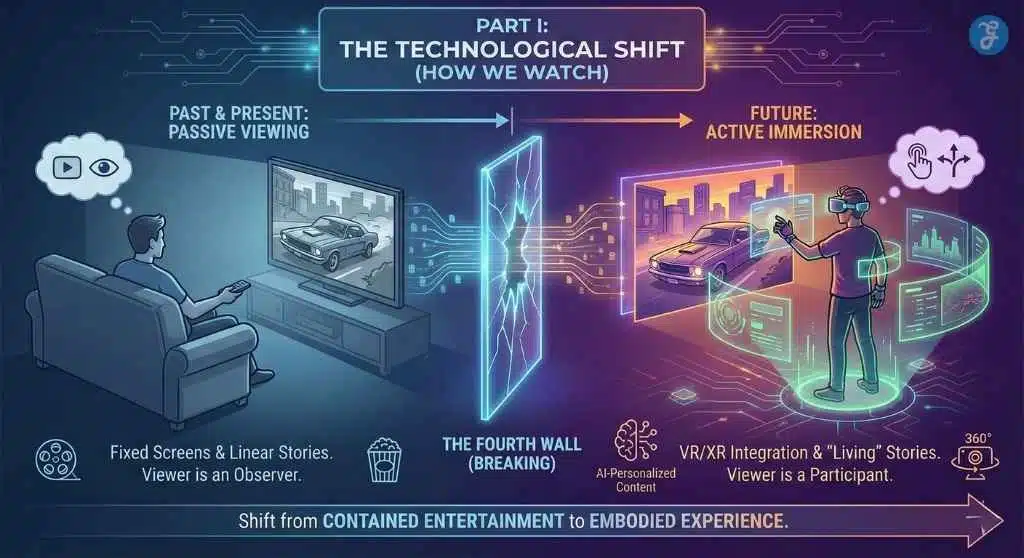
The most immediate change isn’t in what we watch, but how the content interacts with our physical space. The screen is no longer a barrier; it is becoming a portal.
1. The Rise of “Living” Stories (VR & XR Integration)
For a century, the “fourth wall” has been the defining rule of cinema. You sit here; the movie stays there. That wall is crumbling. With the rapid advancement of Virtual Reality (VR) and Extended Reality (XR), the impact of movies on life will soon mean stepping inside the narrative.
Imagine watching a mystery thriller where you aren’t just observing the detective; you are standing in the room with them, inspecting the clues yourself. This isn’t just 3D; it is “volumetric presence.” Filmmakers are beginning to shoot with 360-degree cameras and spatial audio that reacts to your head movements.
Everyday Transformation: Entertainment will evolve from a passive leisure activity into an active, physical experience. Families might not “sit down” to watch a movie; they might “gear up” to participate in one.
2. Hyper-Personalized Blockbusters (AI & Generative Film)
We are accustomed to the idea that a movie is a fixed object—the director cuts it, and we all see the same version. Artificial Intelligence is poised to shatter this constant.
Streaming services are already using algorithms to recommend what to watch. The next step is Generative AI that tweaks the content itself. Future platforms could subtly adjust the pacing, color grading, or even background details of a film based on your biometric data (heart rate, pupil dilation) or personal preferences. If you prefer high-intensity action, the AI might tighten the editing of a chase scene in real-time.
| Feature | Traditional Cinema | AI-Enhanced Future Cinema |
| Storyline | Fixed and Linear | Dynamic and Branching |
| Pacing | Director’s Cut (One size fits all) | Biometric-led (Adapts to viewer boredom/excitement) |
| Language | Dubbing/Subtitles | AI Lip-Sync (Actors appear to speak your native language) |
This creates a solitary but tailored experience, raising questions about shared culture. If we all see slightly different versions of the same film, the impact of movies on life becomes deeply personal rather than communal.
Part II: The Psychological & Social Shift (How We Feel)
Beyond the tech, movies are the software that runs on the hardware of the human mind. They are powerful empathy engines that rewire how we relate to one another.
3. “Cinematherapy” as Standard Mental Health Care
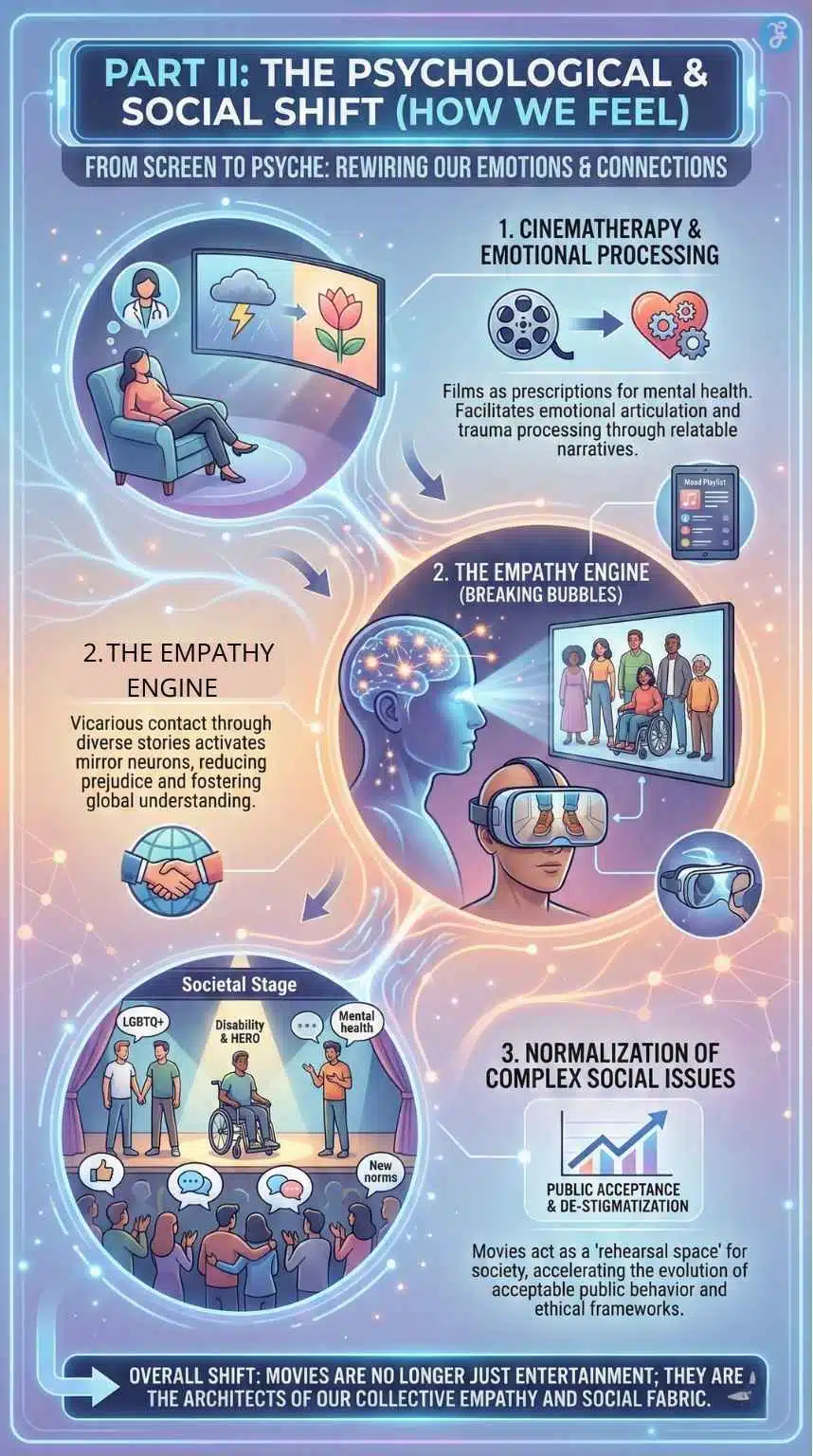
Psychologists have long known that stories help us process trauma. This is now formalizing into “Cinematherapy.” Therapists are increasingly prescribing specific films to help patients articulate feelings they cannot speak.
A grieving client might be asked to watch A Monster Calls to understand the complexity of letting go. A couple struggling with communication might watch Marriage Story not for entertainment, but as a safe proxy to discuss their own friction points.
The Future Shift: We will likely see “Mood Playlists” on streaming services curated not by genre, but by psychological need (e.g., “Movies for Anxiety,” “Films for Grief”). The impact of movies on life here is medicinal; the screen becomes a digital pharmacy for the soul.
4. The Empathy Engine (Breaking Social Bubbles)
In a polarized world, cinema remains one of the few tools capable of piercing our social bubbles. When we watch a character from a different race, religion, or economic background, our brain’s mirror neurons fire as if we were experiencing their struggles.
This “vicarious contact” hypothesis suggests that high-quality narratives reduce prejudice more effectively than lectures or statistics. As global cinema (like Korean or Indian films) becomes more mainstream, our exposure to diverse worldviews increases.
Everyday Transformation: Movies will act as a lubricant for social friction, accelerating the acceptance of marginalized groups and normalizing diverse lifestyles faster than legislation ever could.
5. Normalization of Complex Social Issues
Consider how rapidly the public perception of mental health, LGBTQ+ rights, or neurodivergence has shifted in the last two decades. Much of this heavy lifting was done by screenwriters.
Movies provide a “safe rehearsal space” for society to test new norms. When a beloved character struggles with depression or comes out, it de-stigmatizes the issue for millions of viewers simultaneously. The impact of movies on life is visible in how casually we now discuss topics that were taboo only twenty years ago. Future films will likely tackle bioethics, AI rights, and climate migration, pre-loading society with the ethical frameworks needed to handle these coming crises.
Part III: The Economic & Lifestyle Shift (How We Live)
Finally, the influence of cinema bleeds into our wallets, our classrooms, and our passports.
6. “Shop-the-Screen” Consumerism
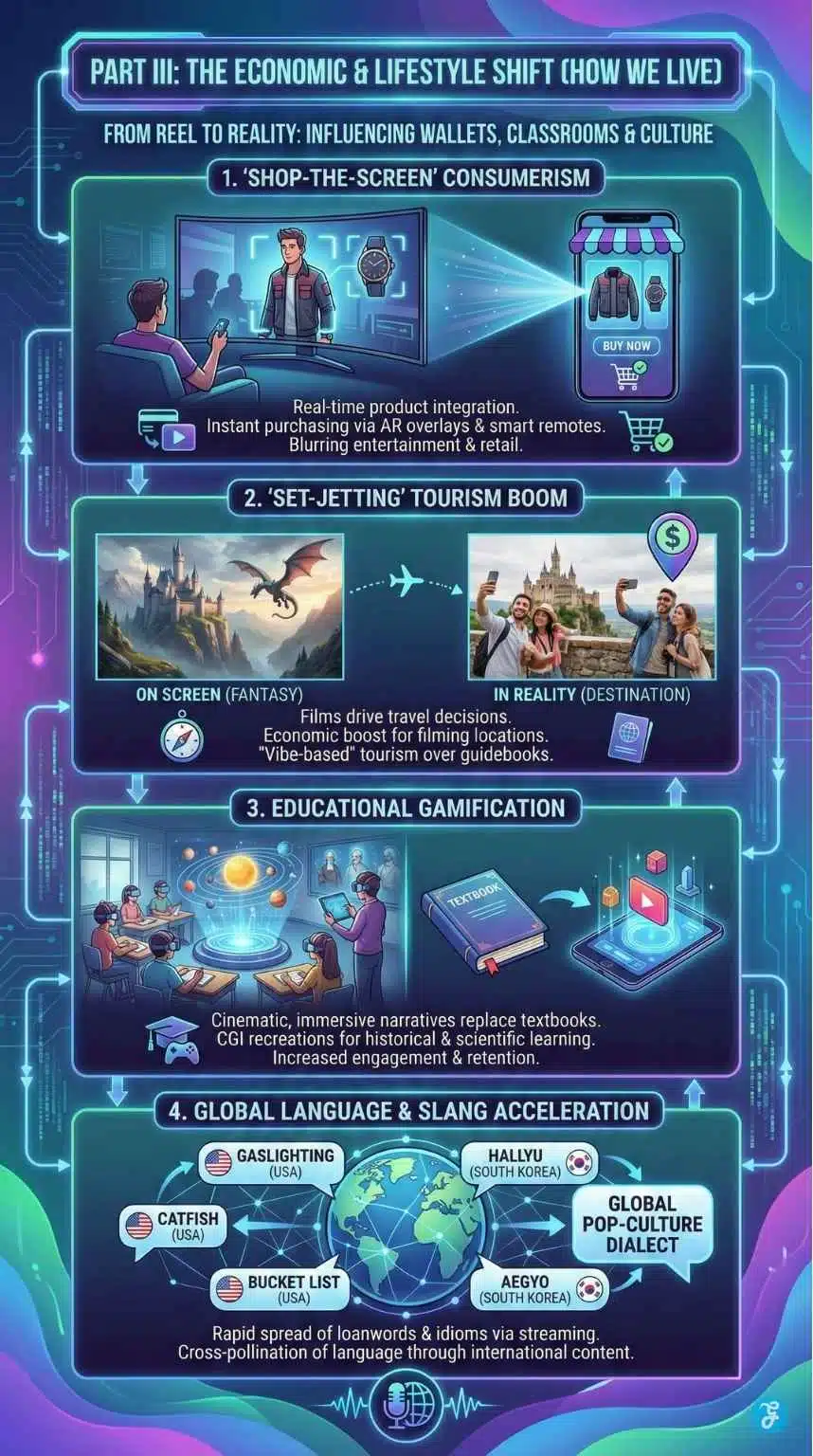
Product placement is about to get an upgrade. Currently, if you see a nice jacket in a movie, you have to Google it. In the near future, “shoppable video” technology will allow you to pause a scene, tap the jacket, and order it instantly.
This blurs the line between storytelling and retail. Movies will become the ultimate catalog, curated by costume designers and set decorators.
Everyday Transformation: Our homes and wardrobes will increasingly mirror the “aesthetic” of popular streaming hits. The impact of movies on life becomes literal: we will dress like our heroes and furnish our homes like their sets, with zero friction in the purchasing process.
7. Set-Jetting 2.0 (The Tourism Boom)
“Set-jetting” (traveling to filming locations) is a massive economic driver. The “Frodo Economy” transformed New Zealand; Game of Thrones revitalized tourism in Northern Ireland and Dubrovnik.
As films become more visually spectacular, they serve as high-budget travel brochures. Travelers are increasingly choosing destinations based on the “vibe” they felt in a movie rather than traditional travel guides.
The Data: Recent travel surveys indicate that for Gen Z and Millennials, a hit TV show or movie is the number one influencer for travel destination choices, surpassing Instagram and family recommendations.
8. Educational Gamification
Why are textbooks dry when movies are gripping? Education is finally catching up to cinema. The future classroom will utilize “cinematic learning”—high-budget, narrative-driven educational films that use CGI to recreate historical events or visualize cellular biology.
Instead of reading about the Roman Empire, students will watch historically accurate, immersive narratives that prioritize retention through storytelling. The impact of movies on life here is a smarter, more engaged generation that learns through emotional connection rather than rote memorization.
9. Global Language & Slang Acceleration
Have you noticed how fast new words enter the dictionary? Cinema acts as a particle accelerator for language. Terms like “catfish,” “gaslighting,” “bucket list,” and “friend zone” all cemented their place in English through film and TV.
As we consume more international content (thanks to the Squid Game effect), we are seeing a cross-pollination of language. We are moving toward a global pop-culture dialect, where metaphors and idioms from Seoul, Mumbai, and Los Angeles blend into everyday conversation.
The Hidden Costs (The “Reality Gap” & Environment)
While the technological and social advancements are exciting, a complete understanding of the impact of movies on life requires looking at the invisible costs—both to our minds and our planet.
The “Reality Gap” (Mental Health & Expectations)
Cinema is designed to be “hyper-reality”—brighter, faster, and more dramatic than actual life. However, psychologists warn of a growing “Reality Gap,” where constant exposure to polished narratives creates subconscious dissatisfaction with our mundane lives.
-
The “Rom-Com” Effect: Research suggests that heavy consumers of romantic comedies are more likely to believe in “destiny” and “mind-reading” in relationships. This sets unrealistic standards for partners, leading to increased friction when real-life conflict doesn’t resolve itself in a witty 90-minute montage.
-
Lifestyle Dysmorphia: Movies often depict struggling artists living in spacious loft apartments or junior employees wearing designer wardrobes. This visual distortion warps our perception of financial normalcy, contributing to a culture of inadequacy and overconsumption.
Everyday Transformation: We are moving toward a society that requires higher “media literacy” to survive. Just as we learned to read nutrition labels, the next generation must learn to read “reality labels” on media to protect their mental well-being.
The “Invisible Footprint” (Environmental Impact)
We tend to think of streaming as “clean” because it has no physical product like a DVD. In reality, the digital impact of movies on life leaves a massive carbon footprint.
-
The Cost of “Bingeing”: Streaming video currently accounts for approximately 1% of global greenhouse gas emissions—roughly the same as the entire country of Spain. Every hour of streaming generates about 55g of CO2, equivalent to boiling an electric kettle three times.
-
Green Production: On the flip side, the industry is reacting. Green Production” is becoming the new standard, with film sets banning single-use plastics and using solar generators.
The Future Shift: Expect to see “Carbon Labels” on your Netflix or Disney+ menu soon, showing you the environmental cost of that 4K blockbuster versus a standard definition stream.
Frequently Asked Questions (FAQ)
1. How does the impact of movies on life affect children’s development?
Movies are a primary source of “vicarious learning” for children. They model social skills, emotional regulation, and conflict resolution. However, unchecked exposure can also desensitize children to aggression or establish unrealistic beauty standards early on. Psychologists recommend “active mediation”—watching with your child and discussing the themes—to ensure the impact is positive.
2. Can movies actually change public opinion on political issues?
Yes, significantly. This is known as the “CSI Effect” or “The Day After Tomorrow” effect. Films can frame complex political issues (like climate change or judicial fairness) in emotional terms that statistics cannot match, often shifting public polling numbers and even influencing jury verdicts in real court cases.
3. Will VR movies replace traditional cinemas?
Not entirely. While VR offers immersion, traditional cinemas offer “collective effervescence”—the shared social energy of laughing or screaming with a crowd. The impact of movies on life values both: VR will likely dominate home entertainment, while theaters will evolve into premium, social event spaces.
4. What is “Cinematherapy” and is it effective?
Cinematherapy is a therapeutic technique where mental health professionals assign films to patients. It is considered effective for “externalizing” problems—allowing patients to discuss their own issues by talking about a character’s struggles. It is particularly useful for grief, trauma, and communication building.
5. Does streaming really damage the environment?
Yes. The massive data centers required to store and transmit video consume immense amounts of electricity, often generated by fossil fuels. While one movie seems negligible, the global aggregate of billions of hours streamed daily makes it a significant contributor to digital carbon emissions.
Final Thought: Impact of Movies on Life
The impact of movies on life is no longer a debate about “screen time.” It is a discussion about how we design our reality. As technology merges with storytelling, movies are becoming the architects of our empathy, the drivers of our economy, and the mirrors of our inner selves.
We are entering an era where we don’t just watch movies; we wear them, we travel to them, and we learn through them. The screen is widening, and soon, it will encompass the world itself.





















