

The question of how much does green energy cost has become increasingly relevant as renewable energy continues to dominate global energy discussions.
As of 2025, the costs of green energy sources like solar and wind have fallen significantly, with solar photovoltaic (PV) and onshore wind now averaging between 5 to 6 US cents per kilowatt-hour (kWh). These reductions make renewable energy not only environmentally beneficial but also economically competitive with traditional fossil fuels.
The Current State of Green Energy Costs
In 2025, the renewable energy landscape has evolved dramatically, with costs continuing to fall across various technologies. Here’s a breakdown of the current pricing for different green energy sources:
Solar Power
Solar PV has seen the most dramatic price drops in recent years. By 2025, the global weighted average cost of electricity from solar PV has fallen by 56% compared to 2023 levels. This translates to an average cost of around 4 cents per kWh for utility-scale solar projects.
Wind Power
Both onshore and offshore wind have experienced significant cost reductions:
- Onshore wind: The cost has decreased by 26% since 2023, with an average price of 4.4 cents per kWh.
- Offshore wind: While still more expensive than its onshore counterpart, offshore wind costs have fallen by 35% since 2023, averaging 6.7 cents per kWh.
Other Renewable Sources
- Hydropower: Remains competitive at an average of 4.8 cents per kWh.
- Geothermal: Costs around 6.4 cents per kWh.
- Biomass: Slightly higher at 6.6 cents per kWh.
Factors Influencing Green Energy Costs
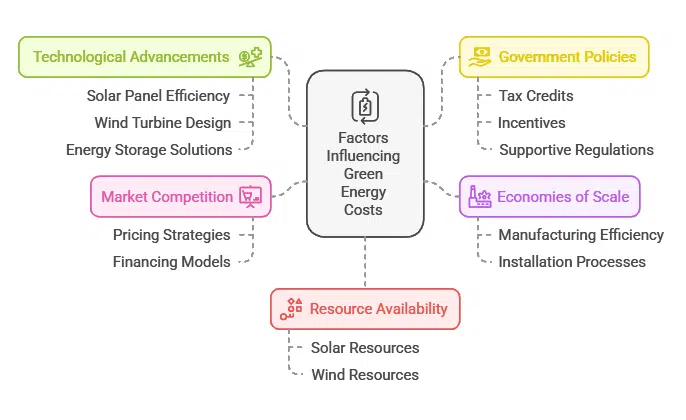
Several key factors contribute to the pricing of renewable energy:
- Technological Advancements: Continuous improvements in solar panel efficiency, wind turbine design, and energy storage solutions have driven down costs.
- Economies of Scale: As more renewable energy projects are deployed, manufacturing and installation processes become more efficient, reducing overall costs.
- Government Policies: Incentives, tax credits, and supportive regulations have played a crucial role in making renewable energy more affordable.
- Market Competition: Increased competition among renewable energy providers has led to more competitive pricing and innovative financing models.
- Resource Availability: The abundance of solar or wind resources in a given location can significantly impact the cost-effectiveness of renewable projects.
Comparative Cost Analysis: Green Energy vs. Fossil Fuels
To better understand how green energy costs stack up against traditional energy sources, let’s look at a comparative table:
| Energy Source | Average Cost (cents/kWh) in 2025 |
| Solar PV | 4.0 |
| Onshore Wind | 4.4 |
| Offshore Wind | 6.7 |
| Natural Gas | 12.9 |
| Coal | 11.4 |
This table clearly illustrates that renewable energy sources, particularly solar and wind, have become significantly cheaper than fossil fuel alternatives in many markets.
Regional Variations in Green Energy Costs
It’s important to note that the cost of green energy can vary considerably depending on the region:
United States
In the U.S., utility-scale solar projects are expected to cost between 3 to 5 cents per kWh by 2025, while onshore wind ranges from 2.7 to 7.5 cents per kWh.
Europe
European countries have seen similar trends, with renewable energy costs falling below those of fossil fuels. In many European markets, wind and solar power are now the cheapest sources of new electricity generation.
China
As the world’s largest renewable energy market, China has driven down costs significantly. By 2025, solar PV in China is projected to cost as low as 2.8 cents per kWh.
Developing Countries
Many developing nations are leapfrogging directly to renewable energy technologies. In countries with abundant solar resources, such as parts of Africa and South America, solar PV costs can be as low as 3 cents per kWh.
Future Projections: Green Energy Costs Beyond 2025
Looking ahead, the cost trajectory for renewable energy remains promising:
- Solar PV: Projected to see further cost reductions of 15-25% by 2030.
- Wind Power: Onshore wind costs could fall by an additional 10-15% by 2030, while offshore wind may see reductions of 20-30%.
- Energy Storage: Battery costs are expected to continue declining, potentially reaching $50-60 per kWh by 2030, further enhancing the competitiveness of variable renewable energy sources.
The Impact of Green Energy Costs on Global Energy Markets
The declining costs of renewable energy are reshaping global energy markets:
- Increased Adoption: Lower costs are driving higher adoption rates across residential, commercial, and utility-scale sectors.
- Grid Parity: In many regions, renewables have achieved grid parity, meaning they can generate electricity at a levelized cost equal to or less than the price of power from the electricity grid.
- investment Shifts: Lower costs are attracting more investment in renewable energy projects, with global investment in clean energy technologies outpacing fossil fuel investments.
- Job Creation: The growing renewable energy sector is creating new job opportunities, with solar and wind industries becoming significant employers in many countries.
- Energy Independence: Countries with abundant renewable resources are becoming less dependent on imported fossil fuels, enhancing energy security.
Challenges and Considerations
Despite the positive trends in green energy costs, several challenges remain:
- Intermittency: The variable nature of solar and wind power requires investment in energy storage or grid balancing technologies, which can add to overall system costs.
- Infrastructure Requirements: Upgrading existing grid infrastructure to accommodate higher levels of renewable energy can be costly.
- Policy Uncertainty: Changes in government policies and incentives can impact the cost-effectiveness of renewable energy projects.
- Raw Material Costs: Fluctuations in the prices of raw materials used in renewable energy technologies can affect overall costs.
- Geographic Limitations: Not all regions have equal access to renewable resources, which can impact the viability and cost of green energy projects.
Takeaways
So, how much does green energy cost? In 2025, renewable energy sources such as solar and wind are among the most affordable options for electricity generation globally, averaging between 4 to 6 US cents per kWh for utility-scale projects.
This affordability, combined with environmental benefits, positions green energy as a cornerstone for future global energy systems.






















