


Writers on my team ask me the same question again and again. Why did Google’s AI Overview cite a page that ranked below ours? Our page was higher. Our answer was longer. Still, the link went to someone else. After studying Google’s own documents and the newest research, I can say this: how AI Overviews choose citations is not random.
It follows a few clear steps. Your page must be allowed to show. It must match the smaller questions Google searches for in the background. And it must answer one of those questions in clean, plain text. In this guide, I walk through each step, show what the latest data says, share a real result from one of my own articles, and give you the checklist I now use before we publish.
How AI Overviews Choose Citations: The Short Answer
Here is the process in plain words:
- Eligibility. The page must be indexed and allowed to show a snippet in Google Search.
- Query fan-out. The model turns your search into several related searches and runs them at the same time.
- Matching. It pulls passages from those results that answer a part of the question and support its summary.
- Spread. Pages that show up across many of those related searches have the best odds of being cited.
Step One in How AI Overviews Choose Citations: Passing the Basic Gate
Before any ranking signal matters, your page has to pass a basic test. Google’s guidance is short. A page must be indexed and eligible to appear in Search with a snippet. There is no separate AI index. There is no form to submit.
It is the first thing I check when a strong page never gets cited. The usual problems are small:
- A
nosnippettag left over from an old test. It blocks the page from AI features too. - A low
max-snippetvalue that limits how much text Google can quote. - A theme or plugin that wraps the main answer in
data-nosnippet. - Key facts placed inside images, sliders, or tabs instead of plain HTML text.
- A robots.txt rule that blocks Googlebot from a folder you forgot about.
Query Fan-Out Is the Biggest Part of How AI Overviews Choose Citations
When someone types a query, the AI does not run just that one search. Google calls it “query fan-out.” The model creates a set of related searches, runs them together, and collects results from all of them.
Google’s own example is about lawn weeds. A question about weeds can also trigger searches about weed killers and how to prevent weeds.
Here is how I explain it to my writers. Say someone searches “best project management tool for a small team.” Behind the scenes, the model may also look at:
- free plan limits for popular tools
- Asana vs. Trello for small teams
- how long each tool takes to learn
- pricing per user
A page that ranks 40th for the main query can still be cited if it gives the clearest answer on “Trello free plan limits.” And a page that ranks third can be skipped if it never answers any of the side questions well.
This changed how I plan articles. I used to build one page around one keyword. Now I list the follow-up questions a reader would ask next and give each one a short, direct answer under its own heading. We covered this shift in more depth in how AI Overviews are changing SEO strategy.
What the Data Says About How AI Overviews Choose Citations
The Ahrefs ranking study: In July 2025, Ahrefs found that 76% of AI Overview citations came from pages ranking in Google’s top 10. In March 2026, they ran the study again on 863,000 keywords and about 4 million cited URLs. The number dropped to 38%.
| Where the cited page ranked | Share of AI Overview citations (March 2026) |
|---|---|
| Positions 1 to 10 | 38% |
| Positions 11 to 100 | 31.2% |
| Beyond position 100 | 31.0% |
Top rankings still help a lot. But almost a third of citations now come from pages that do not rank in the top 100 for the main query at all. Ahrefs gave two reasons. Part of the change came from better tracking on their side. The other part is fan-out, where the pages that show up most across the related searches get cited. The timing also lines up with Google making Gemini 3 the default model for AI Overviews worldwide in January 2026.
The Pew Research study: Pew tracked the real browsing of 900 US adults in March 2025. Out of 68,879 Google searches, 18% showed an AI summary.
- 88% of the summaries cited three or more sources. Only 1% cited just one.
- Wikipedia, YouTube, and Reddit together made up 15% of cited sources.
- Government sites were cited more often in AI summaries (6%) than in regular results (2%).
- Users clicked a regular result in 8% of visits with an AI summary, compared with 15% without one.
- Users clicked a link inside the AI summary in just 1% of visits.
Being cited is not the same as getting traffic. It is mostly a visibility win, so you need a way to track it. Google counts AI feature traffic inside the normal “Web” numbers in Search Console, with no separate filter. That is why I also use the methods in our guide to measuring brand visibility in AI.
A Real Case Study on How AI Overviews Choose Citations
Big studies are useful, but here is the process on one of my own pages. I wrote a plain explainer on LinkedIn: What Is MataRecycler?. The target search was “what is matarecycler.”
This is a new term, and the results page is crowded. Dozens of small blogs have published pages on it, many with almost the same title and the same points.
Google’s AI Overview for that search now cites my LinkedIn article. The first line of the overview, a one-sentence definition, links to LinkedIn. So do the “How It Works” points. My article is also the first card in the source panel on the right. The only other named source is The Business Standard, which backs the point about community benefits.
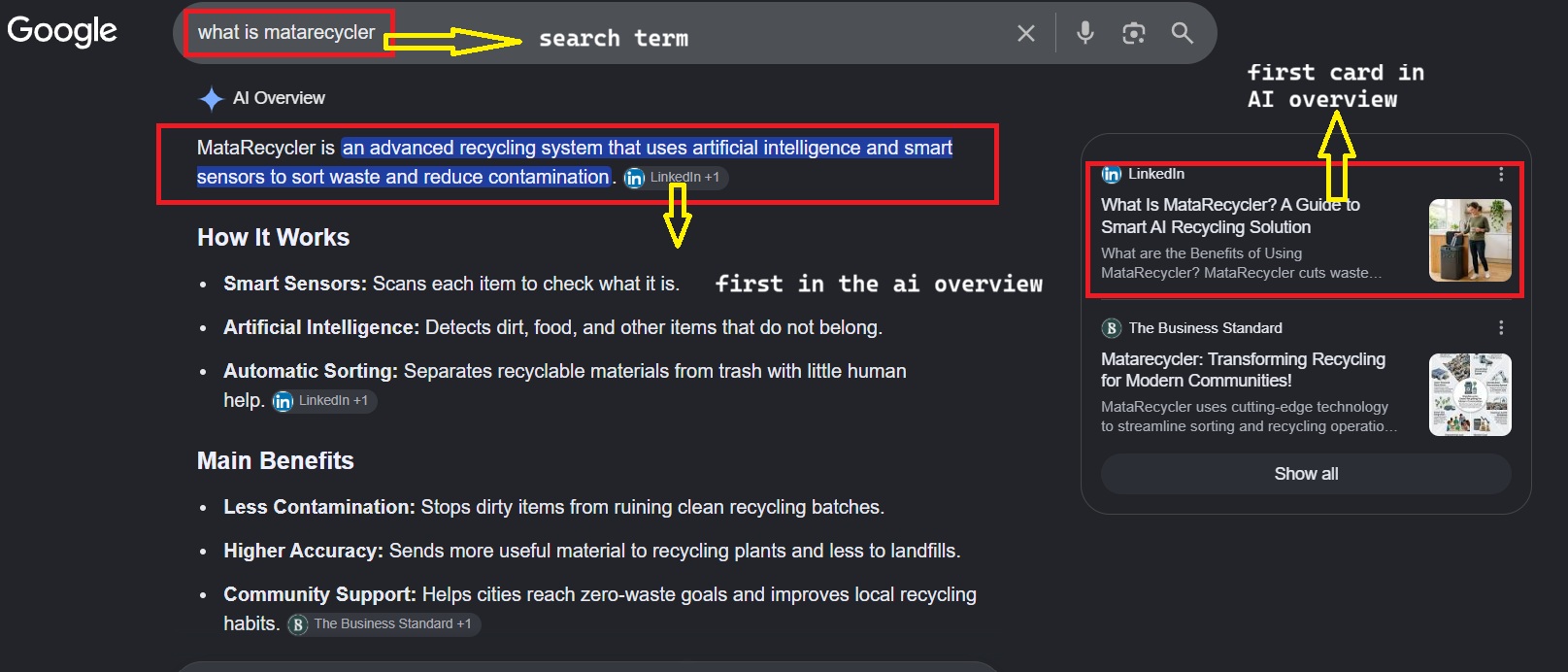
Here is how this result lines up with the steps above:
- Short, plain definitions get quoted. The overview opens with one clear sentence taken from the cited sources. A one-line answer is the easiest passage for the model to lift.
- Question headings match fan-out. The preview on my source card shows the heading “What are the Benefits of Using MataRecycler?” followed by a direct answer. The overview itself is split into “How It Works” and “Main Benefits.” Those are the follow-up questions the model looks for.
- Trusted domains stand out in a crowded field. When dozens of pages say the same thing, the model still needs sources it can rely on. LinkedIn and The Business Standard are large, well-known sites. Most competing pages were small blogs. The platform’s reputation likely helped.
- Each source does a different job. One source backs the definition. Another backs a benefit. This matches Pew’s finding that most summaries use several sources.
One honest limit: Google does not say which of these signals mattered most. I can see the result, not the scoring. Still, the pattern is worth copying. Answer the core question in one sentence. Give each follow-up question its own heading. Publish where the page can be found and trusted.
My Checklist Based on How AI Overviews Choose Citations
This is the list I run on every important page before it goes live. None of it is a trick. It is good SEO, shaped around how sources get picked.
1. Put the answer first. Under each heading, answer the question in the first two or three sentences. Then add detail. You do not need to chop content into tiny chunks. A clear answer at the top of a section is just good writing, and it is easy to quote.
2. Cover the follow-up questions. Write down five to eight questions a reader would ask next. If your page skips them, other pages will get cited for them.
3. Add something others do not have. Real numbers, dates, test results, and screenshots. If your page repeats everyone else, the model has no reason to pick yours.
4. Keep facts current. Out-of-date prices and feature lists are an easy way to lose a citation to a fresher page.
5. Check your snippet controls. Go back to the list in the eligibility section. One wrong tag can undo everything else.
6. Link your pages together. Google lists internal links as a best practice for AI features. A cluster of related pages also gives you more chances to match fan-out searches. Our guide on how to optimize for AI-generated search overviews covers page-level fixes in more detail.
7. Show up where the model already looks. YouTube, Reddit, and trusted platforms like LinkedIn are cited often. A helpful video or post can put your brand in front of the model. Spam will not. If you use AI tools to speed up this work, keep a human edit at the end, as we explain in generative AI for SEO.
Common Myths About How AI Overviews Choose Citations
A lot of paid “GEO” advice pushes extra work. Google’s 2026 guide on generative AI features says:
- You do not need an
llms.txtfile or any special AI text file. - You do not need special schema markup for AI overviews. Structured data is still useful for rich results, but it is not required here.
- You do not need to break your content into tiny pieces.
Google’s own words are that optimizing for generative AI search “is optimizing for the search experience, and thus still SEO.” You do not need a second strategy. You need one good one.
Final Thoughts on How AI Overviews Choose Citations
Once you see the steps, how AI Overviews choose citations stops feeling like a mystery. Your page must be allowed to show. It must answer the smaller questions the model searches for. And it must say something clear and specific that others do not.
Here is a simple next step. Pick your ten most important pages. Check each one for snippet blocks, list the follow-up questions it misses, and add the answers in plain text. Then track which queries start citing you over the next few weeks.





















