If you were to take a magnifying glass to the calendar, you would quickly realize that some dates carry an inexplicable weight in the grand theater of human history. November 8 is precisely one of those days. As an expert historian and cultural anthropologist, I invite you on a journalistic journey through time to explore the political upheavals, scientific breakthroughs, and cultural milestones that have occurred on this very date.
Whether you are a history enthusiast, a student of global politics, or simply someone looking for fascinating dinner table conversation, this detailed archive will provide you with a profound understanding of why November 8 matters today.
The Bangalee Sphere
The Indian subcontinent is a tapestry of ancient traditions, colonial struggles, and rapid modern development. November 8 holds significant weight in this region, marking both political shockwaves and cultural brilliance.
Historical Events:
-
2016 – The Great Indian Demonetization: At 8:15 PM on November 8, 2016, Indian Prime Minister Narendra Modi delivered an unscheduled television broadcast that shook the nation. He announced the immediate demonetization of all ₹500 and ₹1,000 banknotes, effectively stripping 86% of the country’s cash of its legal tender status overnight. The stated goal was to paralyze the shadow economy, destroy counterfeit currency funding terrorism, and push the nation toward a digital economy. The immediate aftermath saw massive lines at banks and temporary economic paralysis. However, this singular event fundamentally accelerated India’s digital payment infrastructure (like UPI), transforming the startup and fintech landscape in South Asia forever.
-
1947 – The Junagadh Accession Crisis: In the chaotic aftermath of the British partition of India, the princely state of Junagadh became a geopolitical flashpoint. In early November, the Nawab fled to Pakistan, and by November 8-9, the Indian government had officially stepped in to take control of the administration following requests from the state’s diwan. This event was a critical precursor to the larger integration of India and the subsequent conflicts over Kashmir.
-
2017 – The Great Delhi Smog: Highlighting the modern environmental crises facing the subcontinent, all schools and colleges in Delhi, India, were forced to close for a week on November 8, 2017. The air quality had deteriorated to hazardous levels due to crop stubble burning and urban pollution, sparking a massive national debate on sustainable development and public health in South Asia.
Famous Births:
-
L. K. Advani (born 1927): Born in Karachi (in undivided India, now Pakistan), Lal Krishna Advani became a towering figure in modern Indian politics. He served as the 7th Deputy Prime Minister of India and was a principal co-founder of the Bharatiya Janata Party (BJP). His political mobilization in the late 1980s and 1990s permanently altered the secular-nationalist fabric of Indian democracy.
-
Sitara Devi (born 1920): A legendary Indian classical Kathak dancer, singer, and actress. Rabindranath Tagore famously described her as Nritya Samragni (Empress of Dance). She was instrumental in bringing classical Indian dance from the courts to global stages.
Famous Deaths:
-
Subroto Mukerjee (died 1960): Widely revered as the “Father of the Indian Air Force,” Mukerjee was the first Indian Commander-in-Chief of the IAF. His untimely death in a choking accident at a restaurant in Tokyo, Japan, was a profound loss for the post-colonial Indian military establishment.
Cultural & Festivals:
-
Diwali / Deepavali (Variable Dates): Depending on the lunar calendar, the grand Hindu festival of lights often falls on or around November 8 (such as in 2026). It is a celebration of the spiritual victory of light over darkness, celebrated vigorously across India, Bangladesh, and the global diaspora.
International Observances & Holidays
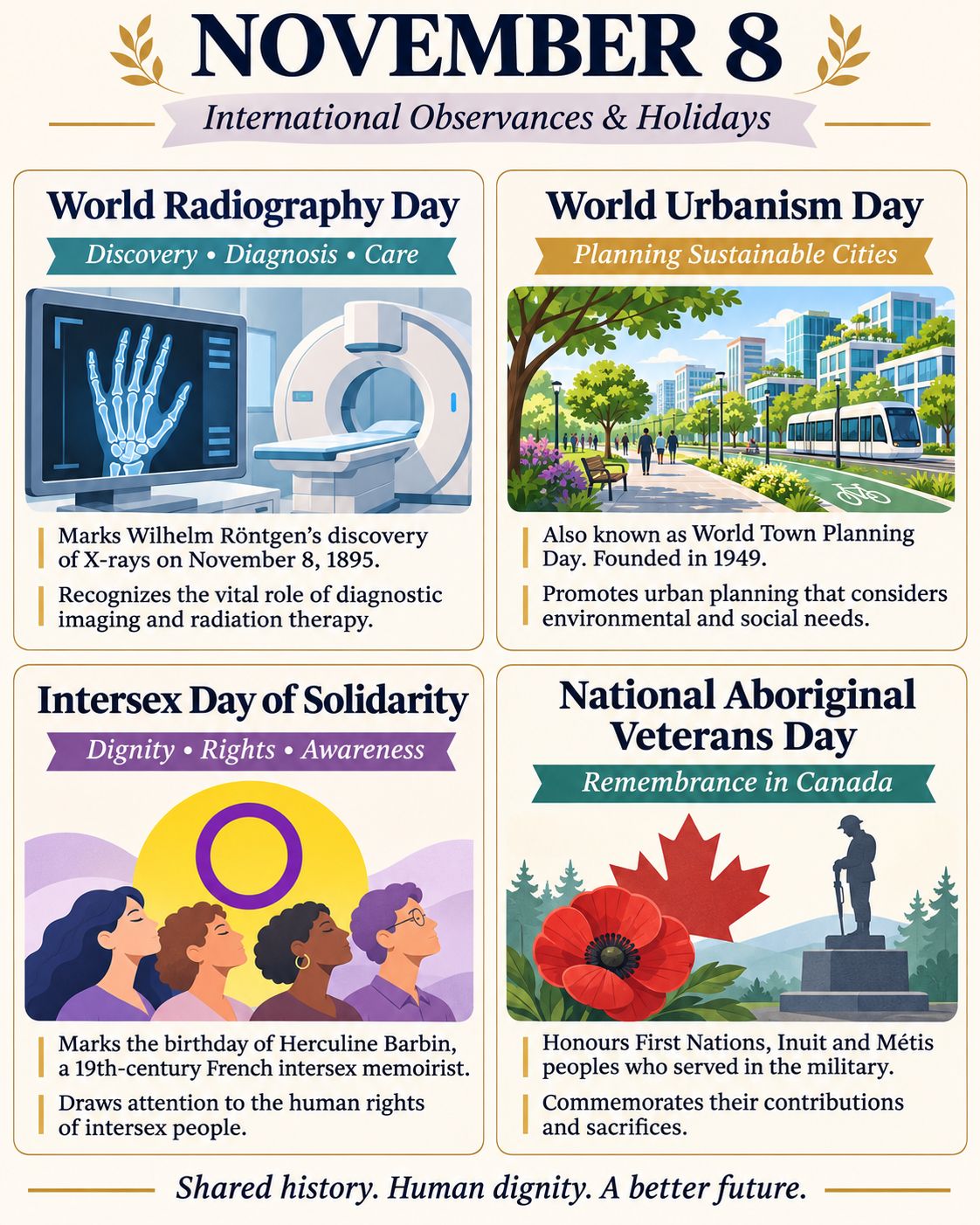
Global observances serve as a unified heartbeat for humanity, reminding us of shared challenges, historical sacrifices, and medical triumphs.
| Observance | Focus / Significance | Global Impact |
| World Radiography Day | Marks the discovery of X-rays by Wilhelm Röntgen on November 8, 1895. | Raises awareness about the crucial role of diagnostic imaging and radiation therapy in modern healthcare. |
| World Urbanism Day | Also known as World Town Planning Day, founded in 1949. | Focuses on the environmental and social impacts of global urban development, urging sustainable city planning in an era of rapid globalization. |
| Intersex Day of Solidarity | Primarily observed in Europe and internationally. | Highlights the human rights issues faced by intersex individuals, marking the birthday of Herculine Barbin, a 19th-century French intersex memoirist. |
| National Aboriginal Veterans Day | Observed primarily in Canada. | A day of remembrance and commemoration of the contributions and sacrifices made by First Nations, Inuit, and Métis peoples in military service. |
Global History
History is rarely isolated. The events that occurred on November 8 across different continents have often cascaded across borders, influencing global politics, technology, and civil rights.
United States
-
1932 – The Election of Franklin D. Roosevelt: Amidst the suffocating grip of the Great Depression, the American public voted out Herbert Hoover and elected FDR as the 32nd President. This election was a monumental paradigm shift. It ushered in the “New Deal,” which fundamentally transformed the US federal government’s role in economic regulation, infrastructure creation, and social welfare.
-
1960 – John F. Kennedy’s Narrow Victory: JFK narrowly defeated Richard Nixon to become the 35th President. Kennedy’s election marked a generational shift in American politics, initiating an era defined by the Space Race, the Cuban Missile Crisis, and the burgeoning Civil Rights Movement.
-
1972 – The Dawn of Premium Television (HBO): Long before the streaming wars of Netflix and Hulu, Home Box Office (HBO) was launched on November 8, 1972. Starting with a broadcast of an NHL hockey game to just 365 subscribers in Pennsylvania, HBO laid the foundational business model for subscription-based, ad-free digital media consumption.
-
1889 – Montana Joins the Union: The vast, resource-rich territory of Montana was officially admitted as the 41st state of the United States of America.
Russia / USSR
-
1943 – The Order of Victory: As the tide of World War II began to turn definitively against the Axis powers, the Soviet Union established the Order of Victory and the Order of Glory. These became the highest and most revered military decorations awarded for extreme strategic brilliance and bravery against Nazi Germany, symbolizing the immense human cost and ultimate resilience of the Soviet forces.
China
-
2002 – The 16th National Congress of the CCP: On this day, the 16th National Congress of the Chinese Communist Party opened in Beijing. This event was of massive geopolitical consequence as it facilitated the peaceful transition of absolute power from Jiang Zemin to Hu Jintao. This leadership change ushered in a decade of unprecedented, export-driven economic expansion that solidified China’s status as a modern global superpower.
United Kingdom
-
1602 – Opening of the Bodleian Library: One of the oldest libraries in Europe, the Bodleian Library at the University of Oxford, officially opened its doors to the public. It remains a global sanctuary for literature, academia, and historical preservation.
-
1965 – The Abolition of the Death Penalty: The Murder (Abolition of Death Penalty) Act 1965 received Royal Assent. This historic legislation effectively suspended and eventually abolished capital punishment for murder in Great Britain, marking a massive leap forward in European human rights and penal reform.
Europe
-
1895 (Germany) – The Discovery of X-Rays: German physicist Wilhelm Conrad Röntgen inadvertently discovered X-rays while experimenting with cathode rays in a darkened laboratory. Because he did not fully understand the mysterious electromagnetic radiation, he used the mathematical symbol for the unknown, “X”. This medical revolution earned him the first-ever Nobel Prize in Physics in 1901.
-
1923 (Germany) – The Beer Hall Putsch: In Munich, Adolf Hitler and the Nazi Party launched a violent, unsuccessful coup d’état against the Weimar Republic. Though the putsch failed and resulted in Hitler’s arrest, it brought him to national prominence. During his imprisonment, he wrote Mein Kampf, pivoting his strategy from armed rebellion to democratic subversion, which eventually plunged the world into World War II.
-
1939 (Germany) – Assassination Attempt on Hitler: On the anniversary of the Beer Hall Putsch, a German woodworker named Johann Georg Elser planted a sophisticated time bomb in the Bürgerbräukeller in Munich. Hitler delivered his speech but left the hall 13 minutes earlier than expected. The bomb detonated, failing to kill Hitler but altering the course of history. Elser was sent to Dachau concentration camp.
Australia
-
1907 – The Harvester Judgment: A landmark decision in Australian labor law was delivered. It established the revolutionary concept of a “living wage,” declaring that a worker’s wage must be sufficient to support a human being in a “civilized community,” regardless of the employer’s profit margins or capacity to pay. This set a global precedent for minimum wage laws.
Canada
-
1946 – Viola Desmond’s Stand: A decade before Rosa Parks in the United States, Viola Desmond, a Black Canadian businesswoman, defied racial segregation by refusing to leave a “whites-only” section of the Roseland Film Theatre in Nova Scotia. Her subsequent arrest and legal battle sparked the modern civil rights movement in Canada.
Rest of World
-
2013 (Philippines) – Typhoon Haiyan: One of the most powerful tropical cyclones ever recorded, Super Typhoon Haiyan, made landfall in the Philippines. It claimed the lives of over 6,000 people and displaced millions. The sheer devastation of Haiyan became a grim focal point in global climate change discussions.
-
2004 (Iraq) – The Second Battle of Fallujah: Operation Phantom Fury commenced. It was the bloodiest, most intense urban combat of the Iraq War for American and coalition forces, leaving a deep, controversial legacy in the geopolitics of the Middle East.
Notable Births & Deaths (Global)
History is entirely shaped by the individuals who dare to think differently. November 8 has witnessed the birth of literary geniuses and technological pioneers, as well as the passing of iconic figures.
Famous Births on November 8
| Name | Year | Nationality | Legacy / Fame |
| Bram Stoker | 1847 | Irish | The brilliant gothic novelist who created the modern vampire mythos with his iconic 1897 novel, Dracula. |
| Margaret Mitchell | 1900 | American | Pulitzer Prize-winning journalist and author of the culturally massive American Civil War epic, Gone with the Wind. |
| Christiaan Barnard | 1922 | South African | The pioneering cardiac surgeon who stunned the medical world in 1967 by performing the first successful human-to-human heart transplant. |
| Jack Kilby | 1923 | American | Nobel Prize laureate and electrical engineer who co-invented the integrated circuit (microchip) and the handheld calculator, laying the physical foundation for the modern digital age. |
| Gordon Ramsay | 1966 | Scottish/British | Multi-Michelin starred chef, restaurateur, and fiery television personality who transformed modern culinary entertainment. |
| Aaron Swartz | 1986 | American | Computer programmer, entrepreneur, and brilliant internet hacktivist. He co-developed the RSS web feed format and was a passionate advocate for open-access information. |
| Dorothy Day | 1897 | American | Influential journalist, social activist, and co-founder of the Catholic Worker Movement who tirelessly advocated for the poor and marginalized. |
Famous Deaths on November 8
| Name | Year | Nationality | Legacy / Fame |
| John Milton | 1674 | English | One of the greatest poets in the English language, celebrated for his epic blank-verse poem Paradise Lost, which profoundly shaped Western literature. |
| Doc Holliday | 1887 | American | A dentist-turned-gambler and gunfighter, best known for his role in the legendary Gunfight at the O.K. Corral alongside Wyatt Earp in the American Wild West. |
| Ivan Bunin | 1953 | Russian | The first Russian writer to win the Nobel Prize for Literature, noted for the strict artistry with which he carried on the classical Russian traditions in prose and poetry. |
| Norman Rockwell | 1978 | American | The iconic painter and illustrator whose Saturday Evening Post covers defined 20th-century Americana and beautifully captured the everyday lives of the working class. |
| Vyacheslav Molotov | 1986 | Soviet/Russian | A leading Soviet politician, diplomat, and Minister of Foreign Affairs under Joseph Stalin. He was a principal signatory of the Nazi-Soviet non-aggression pact (Molotov-Ribbentrop Pact). |
| Alex Trebek | 2020 | Canadian-American | The beloved, intellectual, and culturally ubiquitous host of the game show Jeopardy! for a record-setting 37 seasons. |
“Did You Know?” Trivia
Every date holds secrets that rarely make it to the front pages of history books. Here are a few fascinating, lesser-known facts about November 8 to share over coffee:
-
A Fortunate Mistake: When Wilhelm Röntgen discovered X-rays on November 8, 1895, he wasn’t looking to revolutionize medicine. He was simply experimenting with electrical discharges in a glass vacuum tube (a Crookes tube). He noticed that a piece of barium platinocyanide paper lying on a bench across the room began to glow mysteriously, leading to a discovery that changed human anatomy research forever.
-
The Middle Earth Scribble: While grading seemingly mundane university exam papers in the early 1930s, J.R.R. Tolkien reportedly found a blank page in an answer booklet on a November day. Overcome by a sudden burst of inspiration, he scribbled the iconic opening line: “In a hole in the ground there lived a hobbit.” This small act of procrastination birthed one of the greatest fantasy franchises in human history.
-
A Near Miss from Space: On November 8, 2011, Asteroid 2005 YU55 came dangerously close to hitting the Earth. Sizing up as large as an aircraft carrier, the asteroid whizzed past us at a distance of just 201,700 miles (324,600 km)—which is actually closer to Earth than the Moon’s orbit. It was the closest a space object of that size had come to us since 1976.
Final Thoughts
From the shifting political landscapes of the United States and the economic reinventions of the Indian subcontinent to the accidental scientific discoveries in a dark German laboratory, November 8 is a day etched deeply into the annals of global history. It is a date that reminds us of the fragility of peace, the relentless march of technological innovation, and the enduring power of human resilience.
By looking back at the tragedies, the triumphs, the brilliant minds born, and the profound legacies left behind by those who passed, we gain a much clearer perspective on the present. History is not merely a record of the past; it is the blueprint of our future. As we observe the events of November 8, we are reminded that every single day holds the potential to change the world forever.