
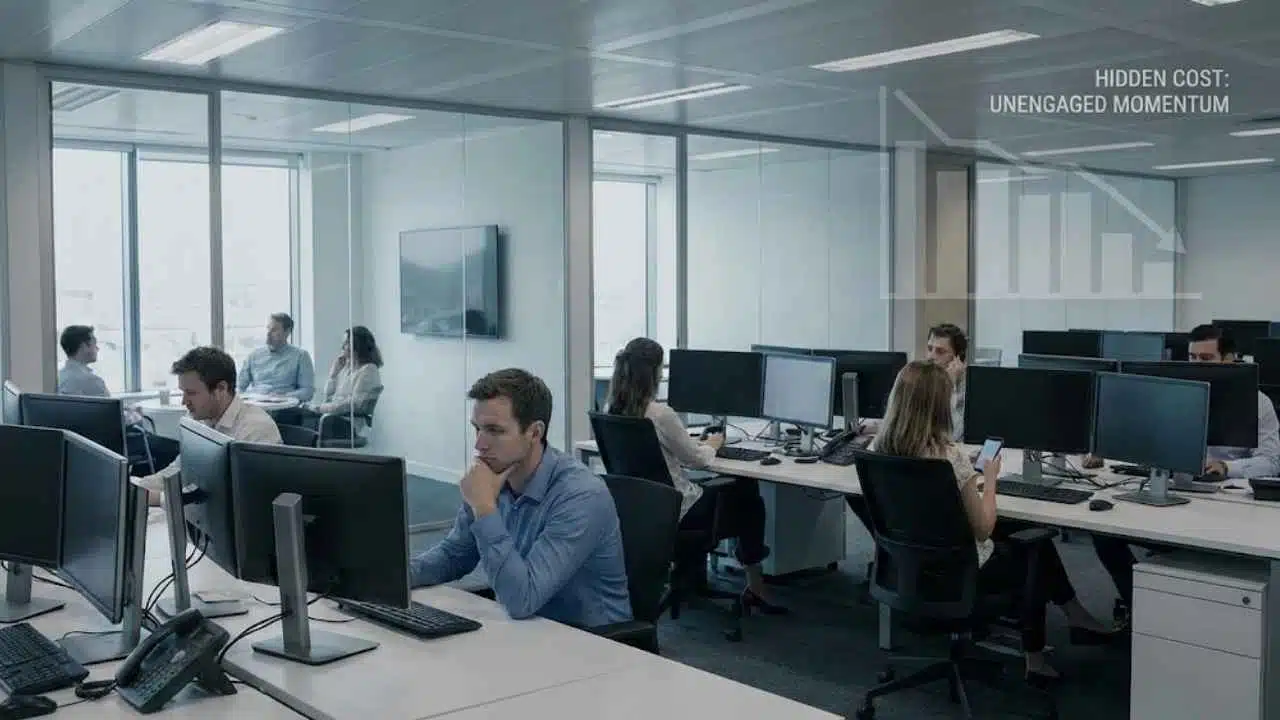
Most companies can tell you exactly how much they spend on software licenses, office space, consultants, and cloud infrastructure. They track hours, margins, utilization rates. They can spot inefficiencies down to the decimal point.
Almost no one tracks boredom. That’s because boredom doesn’t show up as a crisis. It doesn’t look like conflict or failure. It looks like stability. Meetings happen. Deadlines are met. People are polite. Slack messages get answered. From the outside, everything seems fine.
But boredom is not laziness. It’s not a lack of ambition. It’s what happens when capable people are underused, unstimulated, and mentally disengaged for too long. The work gets done, but without edge. Without urgency. Without care.
And that’s precisely why boredom is dangerous. It hides in plain sight, quietly draining momentum while leaders focus on more visible problems. By the time the cost shows up on the balance sheet, it’s already too late.
The Real Cost of Boredom
Boredom doesn’t explode. It erodes.
When teams are disengaged, decision-making slows down. Not because people are incapable, but because nothing feels worth the effort. Risk aversion creeps in. Why push an idea forward if no one seems to care? Why challenge assumptions if the safest move is silence?
Over time, ownership turns into passive compliance. People do what’s asked, no more, no less. They stop anticipating problems. They stop connecting dots. They stop thinking like owners and start thinking like spectators.
High performers are especially vulnerable. They don’t quit the moment they get bored. They disengage first. They keep delivering, but the spark is gone. Their best ideas never leave their heads. Their curiosity gets redirected elsewhere. Side projects. External conversations. Exit options.
The real cost shows up later. Lost momentum. Missed opportunities that no one even noticed. A culture that feels technically functional but emotionally flat. When change is finally required, the organization discovers it no longer has the reflexes to respond quickly.
Boredom isn’t neutral. It compounds quietly, like interest working against you.
Why Traditional Motivation Doesn’t Work Anymore
When leaders notice disengagement, they often reach for the obvious tools. Bonuses. Perks. Wellness apps. Offsites with inspirational speakers. Short-term fixes designed to produce a burst of enthusiasm.
They work, briefly. Dopamine always does.
But the effect fades because the problem isn’t a lack of rewards. It’s a lack of stimulus. Smart people don’t stay engaged because of incentives alone. They stay engaged because the environment demands something from them.
Remote work has amplified this issue. It removed friction, contrast, and spontaneous tension. Days blur together. Context collapses into a single screen. Even high-impact roles can start to feel strangely flat when every challenge arrives through the same interface, in the same chair, at the same time.
Motivation is still treated as an internal flaw. As if people are failing to care enough. In reality, it’s often an external design problem. The system no longer creates urgency, consequence, or novelty.
Talented professionals don’t need to be “motivated.” They need to be challenged in ways that feel real again. They need situations that force choices, trade-offs, and presence. Without that, even the best people will drift.
Environment as a Performance Multiplier
Humans are far less rational and self-directed than we like to believe. Context shapes behavior more than intention ever could. Change the environment, and thinking changes with it.
A shift in setting disrupts patterns. It breaks automatic routines. It forces the brain to reorient. Conversations become sharper. Relationships accelerate. Perspective resets because the usual cues are gone.
This isn’t new. Leaders, creatives, and strategists have always understood the power of deliberate displacement. Retreats, residencies, war rooms, temporary task forces. High-stakes environments compress time and clarify priorities. They strip away noise and expose what actually matters.
When the surroundings change, people show up differently. They listen more closely. They decide faster. They take responsibility because the context demands it.
This is not about comfort or entertainment. It’s about designed pressure. The right amount of friction, novelty, and consequence to wake people up. To remind them that their choices matter.
Environment doesn’t replace strategy. It amplifies it.
Target Motivation as an Observer
Some companies have begun treating disengagement not as a morale issue, but as a design flaw. Italy-based specialists Target Motivation have observed this shift while working with international teams to rebuild focus and momentum by changing the conditions in which people think and interact. Rather than relying on incentives or workshops, their work centers on engineered environments, using place, culture, and structured experience to reintroduce friction, perspective, and challenge. The insight is simple but often overlooked: motivation doesn’t scale through slogans. It emerges when capable people are placed in situations that demand presence and decision-making again.
The Leadership Blind Spot
Boredom is uncomfortable to talk about because it implicates leadership. It’s easier to blame individuals than to question the system they’re operating in.
Engagement is not about keeping people entertained. It’s about creating conditions where their skills are actually required. Where their judgment matters. Where their absence would be felt.
If your best people feel nothing, you’re already paying for it. You’re paying in hesitation. In diluted ambition. In opportunities that never quite get pursued.
The question isn’t how to motivate your team. It’s what kind of environment you’re asking them to perform in. Does it demand their full attention, or does it quietly encourage them to coast?
Boredom doesn’t announce itself. It settles in when no one is looking. And by the time it becomes visible, the damage is already done.
The uncomfortable truth is this: if everything feels fine, it might be worth asking whether that’s actually the problem.