


The SEO industry has a strange habit: when Google changes the rules, everyone pretends the game is still fair. Traffic falls. Click-through rates shrink. Publishers lose visibility. Google answers more questions directly on its own results page. Then the industry gathers around the same comforting script: make better content, improve E-E-A-T, build topical authority, optimize for intent, adapt to AI search, and please do not panic.
Some of that advice is useful. Some of it is recycled coping.
The deeper problem is not that SEO professionals are unaware of what is happening. Many see it clearly in their dashboards. The problem is the denial of Google itself. Too much of the industry still talks as if Google is a neutral traffic referee that occasionally makes confusing updates, rather than a platform with its own business incentives, product ambitions, and growing power to keep users inside Google’s own environment.
That distinction matters. If Google is simply improving search, the answer is better optimization. If Google is turning search into a self-contained answer layer, the answer is much harder: publishers, brands, and SEO professionals need to stop treating organic traffic as a stable public road. It is a private toll road, and the owner is building more exits that lead back to itself.
Google Is Not Accidentally Becoming an Answer Engine
Let’s be careful about the word “purpose.”
Nobody outside Google’s leadership meetings can honestly claim to know every internal motive behind every search change. But we do not need a secret memo to understand the direction. Google’s own public messaging around AI Overviews has been clear: Search should do more of the work for the user.
That sounds helpful. Often, it is helpful. If someone wants a quick answer, a summary, a comparison, or a starting point, Google can reduce friction. Users like convenience. That is not the scandal.
The scandal is pretending this does not change the basic economic agreement that built the open web.
For years, publishers accepted a difficult bargain. They created pages, guides, reviews, explainers, recipes, tutorials, investigations, and analysis. Google crawled and organized that content. In return, Google sent users outward through links. The relationship was never equal, but at least there was a visible exchange: websites gave Google indexable knowledge; Google gave websites discoverable traffic.
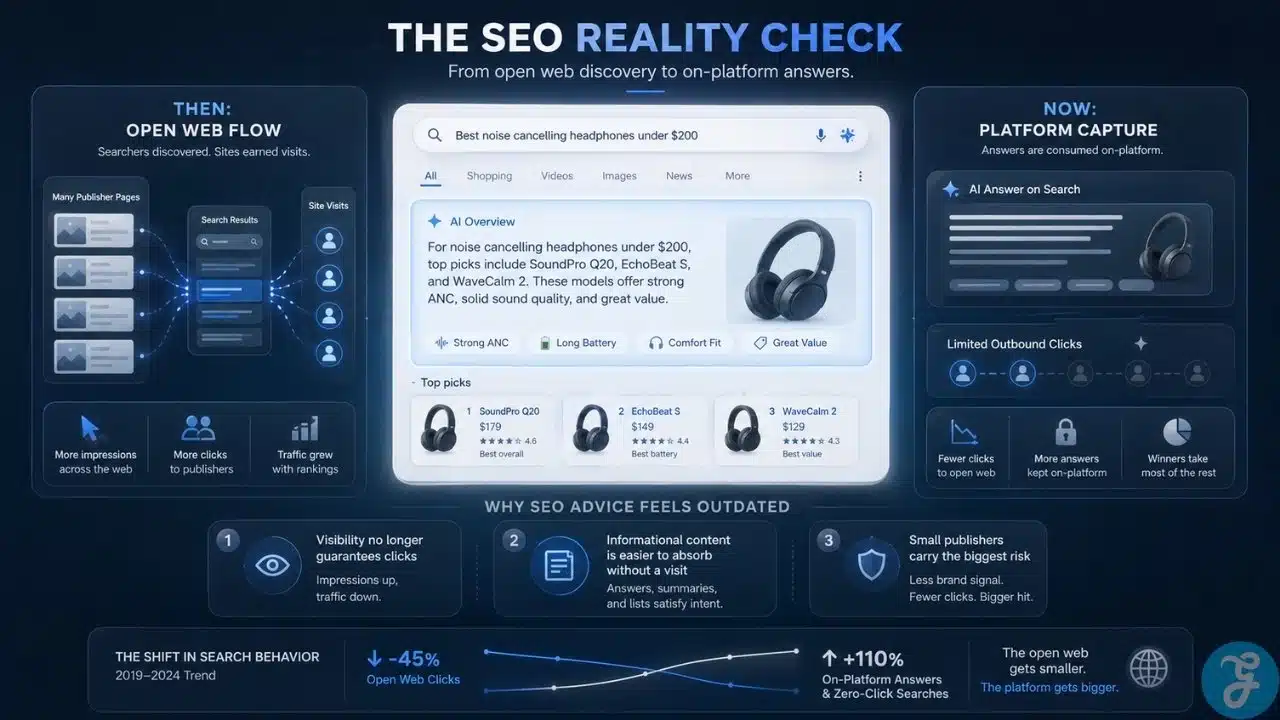
AI Overviews weaken that exchange. The content still feeds the system, but the user’s need can be satisfied before the click. The search page becomes not a doorway but a destination.
That is not a minor interface change. It is a change in who captures the value of information.
Denial About Google Has Become an SEO Business Model
There is a reason the SEO industry struggles to say this plainly. A large part of the industry sells the idea that every traffic problem has an optimization solution.
Lost rankings? Improve content quality.
Lost clicks? Rewrite titles.
Hit by an update? Strengthen topical authority.
AI Overviews appearing above you? Become citation-worthy.
Again, none of this is useless. Good SEO still matters. Technical health still matters. Original reporting, useful product experience, strong editorial standards, and brand trust still matter. But there is a difference between giving practical advice and selling false reassurance.
The denial about Google becomes dangerous when it turns structural loss into individual blame.
If publishers lose traffic because users get answers directly inside Google, telling them to “write better content” is incomplete at best and insulting at worst. Some sites are losing not because they failed to answer the question, but because they answered it well enough for Google to summarize the useful part.
That is the uncomfortable part many SEO conversations avoid. The better your informational content is, the more useful it may be as raw material for an answer box that reduces the need to visit you.
This is why the industry’s favorite optimism now sounds thin. “AI search will create new opportunities” may be true for some brands, especially large trusted entities, software companies, platforms, and sites with strong direct demand. But for many independent publishers, niche websites, and smaller informational businesses, the opportunity looks suspiciously like doing unpaid work for a richer interface.
Zero-Click Search Was the Warning. AI Overviews Are the Acceleration
The open web did not start bleeding only when AI Overviews arrived. Zero-click search had already trained users to get answers without leaving Google.
Weather, definitions, sports scores, currency conversions, quick facts, flights, hotels, local listings, calculators, song lyrics, featured snippets, knowledge panels, the pattern has been visible for years. Google gradually turned more search journeys into Google-owned experiences.
AI Overviews are different because they expand that pattern into messier territory. They do not only answer “What is the capital of Japan?” They can summarize multi-step questions, comparisons, explanations, health-adjacent topics, buying research, tutorials, and broad informational searches.
That shift cuts directly into the content categories that many publishers depend on. The business model of informational publishing was already under pressure from social media volatility, ad market weakness, affiliate changes, and platform dependency. AI Overviews did not create all of that. But they intensify the worst part: the reader can now consume the compressed value of a page without becoming a visitor.
For the user, that can feel efficient.
For the publisher, it can feel like watching the store window become the store.
The SEO Industry Keeps Mistaking Visibility for Value
One of the industry’s most comforting claims is that being cited in AI Overviews can still create value. Sometimes, yes. A brand mention in a prominent AI-generated answer may help awareness. A cited link may send highly qualified visitors. Certain complex queries may lead users to explore more deeply.
But visibility is not the same as traffic. Traffic is not the same as revenue. And a citation is not the same as a sustainable publishing model.
This is where SEO reporting has become strangely evasive. We need to stop celebrating impressions when clicks are disappearing. We need to stop calling a brand mention a win when the business depends on ad revenue, subscriptions, lead generation, affiliate conversions, or reader relationships. A publisher cannot pay writers with “visibility” unless visibility produces measurable business value.
There is also a measurement problem. Google’s own reporting does not give site owners the clean separation many of them actually need. If AI feature appearances and traditional search performance are blended too neatly, publishers are left arguing with shadows. They can see traffic loss, ranking weirdness, and changing click behavior, but the platform controls the clearest data.
That is not a healthy market relationship. It is dependency with a dashboard.
Where Google’s Defenders Have a Point
The strongest argument against this view is simple: users want answers, not a scavenger hunt.
That argument deserves respect. A search engine that forces users to open six thin pages stuffed with ads, pop-ups, affiliate tables, and reheated paragraphs is not serving the public well. Many publishers helped create the very environment that made AI summaries attractive. Too much SEO content became bloated, defensive, and written for ranking systems before readers.
Google can also argue that AI Overviews include links, that AI search may help users ask more complex questions, and that strong original content can still earn discovery. There is truth there. The open web has never had a right to automatic clicks. Bad content should not survive just because it once ranked.
But this defense has limits.
User convenience does not erase the economic question. If Google uses the web’s content to satisfy more searches inside Google, then publishers are not merely competing with each other. They are competing with the platform that organizes, summarizes, and monetizes the same attention.
That is not normal competition. That is the referee joining the match, keeping the stadium, selling the ads, and then telling the losing teams to train harder.
What Most People Get Wrong About Google Killing the Open Web
What most people get wrong about Google killing the open web is that they imagine it as a dramatic event.
It will not look like a shutdown. It will not look like Google deleting websites from the internet. It will not look like one brutal update that everyone can point to and say, “That was the day the web died.”
It looks quieter than that.
A publisher loses 12 percent of search traffic here. A niche site loses its best informational queries there. A review site keeps rankings but loses clicks. A local business gets impressions but fewer site visits. A media company sees AI referrals rise, but not nearly enough to replace lost search traffic. A small independent blog gets cited, but the user never arrives.
Everyone explains their own loss as a separate problem. The SEO industry turns each case into a tactical puzzle. The broader pattern gets softened into conference language: disruption, adaptation, new search behavior, changing user journeys.
No. The plain version is better.
Google is reducing the need to leave Google.
That does not mean every website dies. It means the open web becomes less central to how people consume information. The web still exists, but more of its value is extracted, summarized, and displayed at the platform layer.
That is the real open web death: not disappearance, but demotion.
Small Publishers Are Being Asked to Win a Game Built for Giants
The worst advice in modern SEO is often technically correct and strategically useless.
Build a brand. Create original content. Become an authority. Diversify traffic. Grow a newsletter. Produce video. Build community. Offer tools. Create proprietary data. Become indispensable.
Fine. Good advice.
Also, wildly uneven advice.
A major publisher can build apps, newsletters, podcasts, events, data products, licensing deals, and direct subscription funnels. A software company can turn search visibility into product demand. A large brand can survive declining informational clicks because people already search for the brand directly.
Small publishers do not have that cushion. They built businesses around the old promise that useful pages could earn discovery. Now they are told to become media companies, product companies, community platforms, and first-party data machines while also surviving traffic declines caused by the platform they depend on.
That is not adaptation. That is a survival obstacle course.
The industry needs to be honest about this. AI search does not hurt everyone equally. It rewards entities that already have trust, recognition, resources, and direct demand. It punishes websites whose main asset is answering questions better than everyone else.
That should worry anyone who claims to care about the open web.
A More Honest SEO Framework for 2026
The SEO industry does not need to abandon optimization. It needs to stop treating optimization as a religion.
A more honest framework starts with three questions.
First, is this content creating demand or merely harvesting existing demand? If a page only answers a simple informational query, it is vulnerable. If it gives people a reason to remember, subscribe, compare, buy, return, or trust, it has a better chance.
Second, does this page offer something Google cannot safely compress? Original reporting, lived expertise, proprietary data, strong opinion, interactive tools, community insight, visual evidence, local knowledge, and genuinely useful product judgment are harder to replace than generic explainers.
Third, can the business survive if Google sends fewer clicks next year? If the answer is no, the SEO strategy is not a strategy. It is exposure.
This is not anti-SEO. It is adult SEO.
Rankings still matter. Search visibility still matters. But the old mental model, which is: publish useful content, rank, earn traffic, monetize attention, is no longer dependable enough to carry a serious publishing business by itself.
The Practical Takeaway for Publishers and SEO Professionals
Publishers should not respond to Google’s shift with panic. Panic produces bad content, desperate affiliate plays, and sloppy AI spam. That will only make the web worse.
But calm is not the same as denial.
Publishers should start treating Google traffic as rented attention. Useful, valuable, sometimes powerful — but rented. They should build stronger direct channels, clearer editorial identities, better newsletters, better repeat-visit habits, and more content that cannot be reduced to a neat summary.
SEO professionals should also change how they talk to clients and editorial teams. Stop promising that every lost click can be recovered through better optimization. Stop pretending AI search is just another SERP feature. Stop using “adapt” as a magic word when the economics of the channel are changing.
The better conversation is harder but more useful:
- Which content types are most exposed to answer-engine substitution?
- Which pages still earn clicks because users need depth, trust, tools, or judgment?
- Which queries create business value even if impressions rise and clicks fall?
- Which audiences can be moved from search dependency into direct relationships?
- Which editorial investments build assets Google cannot easily absorb?
That is where the real work is now.
Final Thoughts
The SEO industry’s denial about Google is not harmless optimism. It delays necessary decisions.
Google is not merely updating search. It is redesigning the web’s attention economy around its own answer layer. That may be convenient for users. It may be profitable for Google. It may even improve some search experiences. But it also weakens the old bargain that allowed independent publishers to create useful work and receive visitors in return.
The open web does not need nostalgia. It needs honesty.
If the industry keeps pretending this is just another optimization challenge, it will keep offering better deck chairs on a shrinking ship. The smarter response is to admit what has changed: Google is no longer just the map to the web. Increasingly, Google wants to be the destination.
And once the destination owns the answer, the people who created the answer need a business model that does not depend on being thanked with a click.






















