
You search for something practical now and page one often feels decided before you arrive. The bouncer already knows who gets in. Familiar publishers, giant retailers, official institutions, massive platforms, and household-name brands move to the front. Smaller sites wait outside with better details in their pockets.
That is the strange tension behind Google and big brands. Search needs trust. Nobody wants financial scams, medical nonsense, fake product reviews, or scraped articles sitting above serious information. But when trust starts to look too much like size, age, and brand recognition, search becomes less like discovery and more like reputation management.
The result is not always bad. Often, it is clean. Safe. Sensible.
It is also flatter than it used to be.
Search Has Become Cautious, and Not Without Reason
The web made this problem for itself. Too many publishers chased traffic with thin pages, copied reviews, recycled advice, and keyword-stuffed answers that existed only because a tool said the search volume was good.
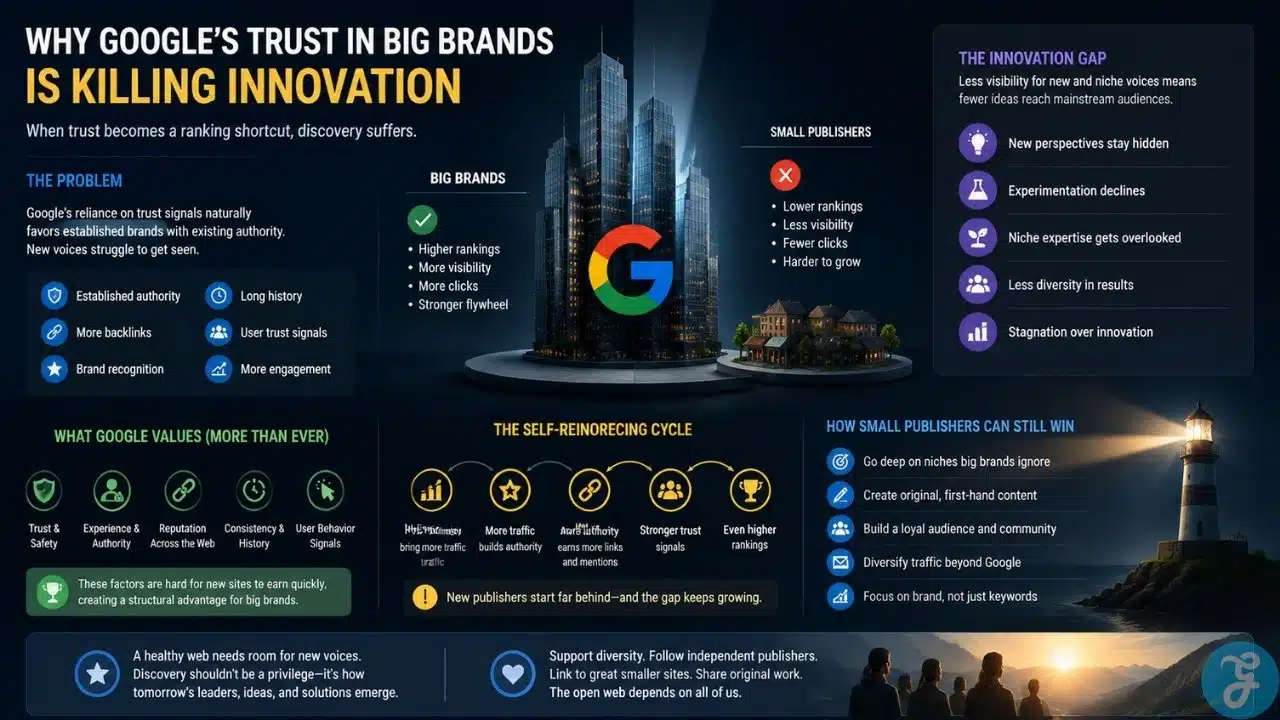
Search engines had to defend the results page. They began relying more heavily on signals that suggest reliability: strong backlinks, brand mentions, domain history, clear site identity, consistent publishing, author credibility, and signs that other people already trust the source.
That logic makes sense. A known medical institution should usually outrank a random health blog with no author, no review policy, and no visible expertise. A government site should usually be trusted more than a thin legal explainer written to capture ads. A major retailer with customer service, return policies, and real inventory has a different trust profile from a mystery affiliate site.
The trouble starts when this caution hardens into habit.
A smaller publisher may have the sharper answer. A niche expert may understand the subject better than a generalist media team. A local site may know a city better than a national travel brand that rewrote the same list from a distance. But search systems are not great at recognizing that kind of value early.
They prefer a paper trail. Big brands have one. Newer sites often do not.
The Ranking Game Now Starts Before the Article
A good article still matters. But it no longer carries the whole argument by itself.
Search now asks a larger question before it fully trusts the page: who are you?
That question changes everything. A big publisher can publish a new guide and borrow trust from the rest of its domain. A known retailer can create a category page and immediately start from higher ground. A legacy media brand can enter a topic and be treated as plausible before the first paragraph proves much.
Small publishers do not get that softness. They have to prove the page, the author, the site, the topic history, and the wider identity around the work. Every article arrives like a job applicant with no references.
This is why many independent sites feel stuck. They need visibility to earn links, mentions, return readers, and authority. But they need those same things to win visibility.
It is a neat little trap. Too neat, frankly.
Big Brands Are Not Always the Villain
It would be lazy to pretend that every large brand ranks only because the system is unfair. Many of them do the boring work well. They hire editors. They update old pages. They fix technical problems. They understand compliance. They carry legal risk. They have teams that make content less chaotic and less dangerous.
That matters, especially in areas where bad advice can hurt people.
But size can also disguise mediocrity. A large publisher can produce a perfectly acceptable article that says nothing new. A giant review site can rank with a buying guide that feels assembled from product pages, not lived knowledge. A major brand can publish a safe explainer that answers the query but leaves the reader no smarter than before.
This is the quiet cost of the big-brand advantage. Search may protect users from the worst of the web, but it also pushes a lot of strange, useful, imperfect voices out of view.
And the web needs some of those voices.
Not every good page looks like it came out of a polished editorial machine. Some of the best niche work looks a little narrow, stubborn, local, or oddly specific. That is often why it is valuable.
The Results Page Is Getting Cleaner, But Less Interesting
A lot of modern search results have the same smell: well-lit office carpet.
The pages are readable. The formatting is tidy. The headings are predictable. The advice is safe enough for a brand manager, a compliance reviewer, and a nervous editor to sign off on.
That can be helpful. It can also be dull.
Look at competitive topics such as software, travel, personal finance, fitness, home products, and digital marketing. The same kinds of pages keep appearing. “Best” lists with similar picks. Explainers with similar structures. Guides that feel less written than processed.
The smaller web used to provide more awkward surprises. A forum thread with one brilliant answer. A hobbyist who knew far too much about one tool. A local blogger who actually visited the place. A small publication willing to say that a popular product is overrated. A specialist who cared more about accuracy than affiliate conversion.
Some of that still exists. Much of it is harder to find.
That matters because discovery is not only about finding a correct answer. Sometimes it is about finding a different angle, a sharper warning, or a voice that has not been sanded down by a content calendar.
E-E-A-T Helped, Then Became a Checklist
Google’s emphasis on experience, expertise, authoritativeness, and trust pushed publishers in a better direction. Anonymous, flimsy pages should have a harder time ranking, especially when the topic affects health, money, safety, or major life decisions.
But the publishing industry did what it always does. It turned a useful idea into a checklist.
Add an author bio. Add a reviewer. Add an “updated on” date. Add an About page. Add a few credentials. Add editorial policy language. Add the same trust badges everyone else added last quarter.
Some of those things are useful. Readers should know who wrote a page and why they should trust it. But surface-level trust signals can become theater. A weak page with a polished author box is still a weak page.
For independent publishers, the better lesson is simpler and harder: make the work traceable.
Show who is behind the site. Explain what the publication knows well. Stay close to the topics where the site has a reason to exist. Publish things that reveal judgment, not just research. Update pages when the facts change. Admit limits when the subject is uncertain.
Trust is not decoration. It is an accumulated behavior.
The Small Publisher’s Mistake: Imitating the Giants
Many independent publishers respond to big-brand dominance by copying big-brand content. That is understandable. It is also often fatal.
They use the same headings, the same neutral tone, the same roundup format, the same careful nothingness. They remove the very things that made them worth reading in the first place. Then they wonder why Google prefers the bigger version.
A small site should not try to look like a miniature Forbes, Healthline, NerdWallet, Wirecutter, or TripAdvisor. Those brands already exist. They have authority, teams, systems, and distribution. A small publisher competing with them on their exact terms is bringing a bicycle to a shipping lane.
The better route is narrower and more uncomfortable.
A small publisher can go deeper into one corner of a topic. It can serve a reader group that large brands treat as a footnote. It can publish examples that come from real workflows, local knowledge, expert interviews, community questions, or careful teardown-style analysis. It can be less bland because it has fewer internal committees to please.
That is not a romantic solution. It is hard work. It also does not guarantee quick rankings.
But it gives the site a reason to exist beyond “we also wrote an article about this keyword.”
Where Smaller Sites Can Still Win
Broad commercial keywords are usually a brutal place to start. A new site targeting topics like best credit cards, best laptops, weight loss tips, cheap flights, or best project management software is entering a market where authority, compliance, money, and brand familiarity all matter.
Smaller sites need to find thinner doors.
A general guide to project management software is hard to win. A detailed guide to project management tools for small architecture studios is more plausible. A broad travel guide to Italy is crowded. A practical guide for vegetarian travelers using regional trains in southern Italy has more shape. A generic article about SEO tools is forgettable. A comparison of SEO workflows for small news publishers has a clearer reader.
Specificity is not a weakness. It is one of the few advantages left.
Small publishers should also build proof that does not depend only on search:
- A newsletter readers actually open
- A small community with useful discussions
- Original examples, screenshots, templates, or interviews
- Clear author and editorial pages
- Repeat coverage of a narrow topic
- Direct relationships with sources, customers, readers, or practitioners
- Content that answers questions large publishers ignore because the audience is too small
This is slower than chasing high-volume keywords. It is also more defensible.
Search traffic is borrowed attention. A direct audience is sturdier.
What Google Should Do Better
Search engines have a miserable job. They are trying to sort a web that now contains spam, scraped content, low-effort affiliate pages, synthetic images, automated summaries, fake reviews, and confident nonsense at industrial scale.
So caution is understandable.
But caution should not become a moat for the already famous. If the same trusted domains keep earning visibility because they are trusted, and they become more trusted because they keep earning visibility, the system starts feeding itself.
That loop is bad for small publishers. It is also bad for readers.
Readers should not have to choose between unsafe junk and institutional sameness. Search should be better at finding pages that show real work before the publisher becomes a household name. A smaller site with original reporting, detailed testing, careful sourcing, or serious niche knowledge should have more room to break through.
Big brands do not need to be punished. They just should not get a permanent chair at the front of every room.
A More Honest Search Strategy for Independent Publishers
The reality of Google and big brands is not cheerful, but it is workable. Small publishers need to stop writing as if one polished article can overcome every authority gap. Sometimes it can. Usually, it cannot.
The stronger approach is to build a publication that is hard to confuse with anyone else.
Choose a tighter lane. Publish with more evidence. Show the people behind the work. Add details large brands would skip. Say when something is overrated. Say when a popular answer is too neat. Do not hide every edge in the name of sounding safe.
Before publishing, ask a harsher question than “Is this optimized?”
Ask this:
Would a reader remember this page if five bigger sites answered the same query?
If the answer is no, the page probably needs more than SEO polish. It needs a clearer point of view, better examples, stronger proof, or a narrower reader.
Search may keep favoring the familiar. That does not mean smaller publishers should become quieter. It means they need to become more distinct, more useful, and less replaceable.
The open web does not need more perfect articles that feel rinsed clean. It needs pages with fingerprints on them.