


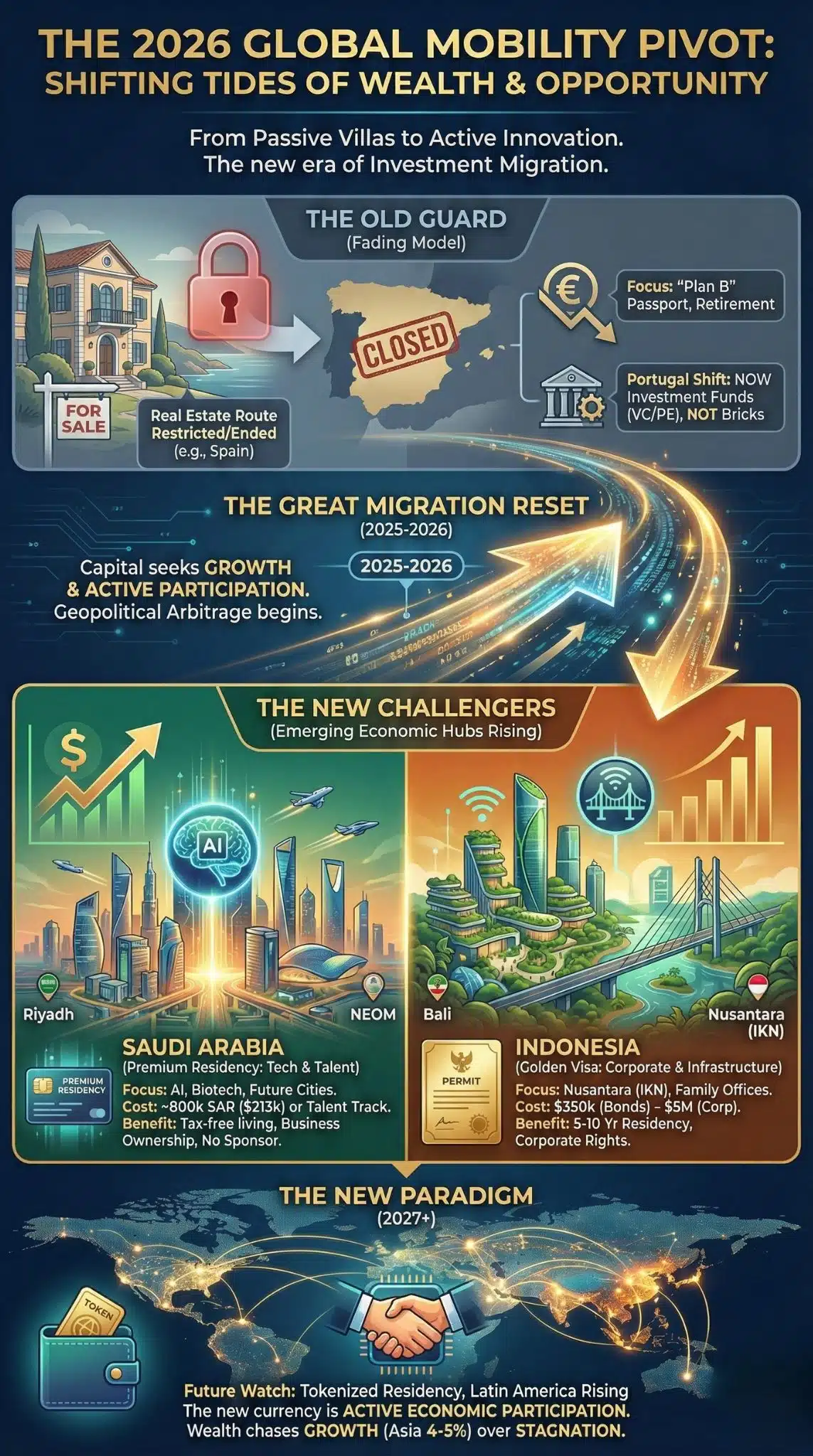
The era of buying a Mediterranean villa to secure an EU passport is ending. As 2026 unfolds, a seismic shift in investment migration is redirecting billions of dollars from the “Old World” to the “New Economic Frontiers.” From Saudi Arabia’s tech-focused Premium Residency to Indonesia’s infrastructure-driven Golden Visa, the new currency of global citizenship is no longer just passive wealth—it is active economic participation.
This analysis explores why the world’s wealthy are trading Spanish sunsets for Saudi innovation and Balinese growth, and what this signals for the future of global sovereignty.
The Great Migration Reset: How We Got Here
To understand the landscape of 2026, we must look at the turbulence of the preceding two years. For over a decade, the “Golden Visa” narrative was dominated by Southern Europe. Portugal, Spain, and Greece offered a simple transaction: buy real estate, get residency. However, 2025 became the year of the “Great Closure.” Citing housing crises and political pressure, Spain ended its real estate route, and Portugal aggressively pivoted toward investment funds, effectively shutting the door on passive property buyers.
Simultaneously, the Global South and East were preparing their own “Grand Opening.” Recognizing that high-net-worth individuals (HNWIs) sought not just a “Plan B” passport but also high-growth investment environments, nations like Saudi Arabia, Indonesia, and Thailand overhauled their immigration frameworks. They moved away from the “retirement haven” model toward attracting “active capital”—funds that build cities, fund startups, and drive AI adoption. By January 2026, the data confirmed a new reality: the center of gravity for investment migration has shifted East.
The Middle East Pivot: Saudi Arabia’s “Premium” Proposition
The most aggressive newcomer in 2026 is undoubtedly Saudi Arabia. Once considered a difficult jurisdiction for expatriates, the Kingdom’s Premium Residency program has become a cornerstone of Vision 2030. Unlike the UAE’s Golden Visa, which was largely a reward for existing residents or property buyers, Saudi Arabia has engineered a program specifically designed to import human capital for its post-oil economy.
Why It Matters: The January 2026 update to Saudi property laws was a game-changer. Premium Residency holders were granted broader non-Saudi property ownership rights, including in Holy Cities (with specific restrictions), signaling a level of permanence previously unthinkable.
- The Tech Talent Magnet: The “Special Talent” track is not just checking boxes for degrees; it is actively recruiting for the Kingdom’s AI and biotech sectors. With 8,000+ permits granted in 2024 and a surge in 2025, Saudi Arabia is effectively “poaching” talent that might have otherwise gone to the UK or Canada.
- Sponsor-Free Autonomy: The elimination of the local sponsor (Kafeel) system for these residents addresses the biggest historical friction point for expats in the Gulf.
Key Insight: Saudi Arabia is not selling a visa; it is selling equity in its national transformation. Investors are buying into the growth story of NEOM and Riyadh, viewing their residency as a venture capital bet rather than a retirement plan.
The “Bali Effect”: Indonesia’s Corporate Play
While Saudi Arabia targets tech, Indonesia has positioned its Golden Visa (launched late 2024/2025) as a tool for infrastructure and corporate relocation. The January 13, 2026, update to the Nusantara (IKN) investment thresholds—lowering the corporate entry to $5 million—demonstrates a nimble, responsive policy approach that European bureaucracies currently lack.
- Beyond Tourism: While the “Second Home” visa caters to the digital nomad crowd in Canggu, the true economic engine is the corporate investor track. With over 1,000 Golden Visas issued by late 2025, bringing in nearly $3 billion (IDR 48 trillion), Indonesia is proving that Southeast Asia can attract institutional-grade wealth.
- The Family Office Hub: Bali is evolving from a backpacker paradise to a boutique hub for Family Offices looking to diversify away from Singapore’s rising costs. The Golden Visa provides the regulatory certainty these entities require.
Asian Tigers 2.0: Hong Kong & Thailand
The resurgence of the “Asian Tiger” economies in the migration sector is characterized by two distinct strategies: Financial Dominance (Hong Kong) and Lifestyle Arbitrage (Thailand).
Hong Kong’s Comeback (CIES): The New Capital Investment Entrant Scheme (CIES), revamped in March 2025, has successfully capitalized on the “wealth pivot.” By allowing investment in non-residential real estate and financial assets, Hong Kong has re-attracted mainland Chinese and Southeast Asian wealth that had briefly flirted with Singapore. The accumulation of over HK$37 billion in pending investments by mid-2025 proves that despite geopolitical noise, Hong Kong remains the premier financial gateway to China.
Thailand’s LTR Evolution: Thailand’s Long-Term Resident (LTR) visa struggled at launch due to impossibly high barriers. However, the pragmatic revisions in January 2025—specifically targeting “Work-from-Thailand Professionals”—corrected this. By 2026, Thailand has successfully branded itself as the “Premium Workspace” of Asia, offering tax concessions that Western nations (increasingly aggressive on wealth taxes) cannot match.
Europe’s New Reality: Funds Over Bricks
 Europe has not exited the stage, but it has changed the script. The “Golden Visa” in Europe is now a financial product, not a real estate transaction.
- The Rise of the “Fund Route”: In Portugal, the shift to Investment Funds (Private Equity/VC) has matured. In 2026, we see a sophisticated ecosystem of funds investing in Portuguese agriculture, renewable energy, and tech, catering specifically to American investors who want a “hands-off” path to EU citizenship.
- Greece’s Price Hike: Greece remains the last bastion of the real estate route, but with entry thresholds hiked to €800,000 in prime areas, it has become a luxury product, filtering out the middle-class investor and changing the demographic profile of applicants.
Comparative Analysis: The 2026 Landscape
The following data highlights the stark contrast between the “Old Guard” (Europe) and the “New Challengers” (Emerging Hubs).
| Feature | Saudi Arabia (Premium Residency) | Indonesia (Golden Visa) | Portugal (Golden Visa 2026) | Thailand (LTR Visa) |
| Primary Investment | 800k SAR (One-time) or Talent | $350k (Bonds) / $5M (Corp) | €500k (Venture Funds) | None (Income Based) or $500k |
| Key Benefit | Tax-free living + Business Ownership | 5-10 Year Residency + Corp Rights | Path to EU Citizenship (5 Yrs) | 17% Flat Tax Rate |
| Real Estate Rights | Yes (Freehold in most areas) | Leasehold / Right to Use | No (for Visa eligibility) | Restrictions apply |
| Target Audience | Tech Talent, Investors, regional HQs | Corp Investors, Wealthy Retirees | US/UK “Plan B” Seekers | Digital Nomads, Wealthy Pensioners |
| Processing Speed | Fast (Digital Platform) | Moderate (Improving) | Slow (Bureaucratic backlog) | Moderate |
Winners & Losers of the 2026 Shift
The policy changes of 2025 have created clear market winners and losers by the start of 2026.
| Winners (2026) | Why? | Losers (2026) | Why? |
| Investment Funds | Portugal’s shift funneled billions into VC/PE funds. | Spanish Real Estate Agents | 2025 closure decimated foreign buyer demand in coastal areas. |
| Tech Talent | Saudi & Thailand offering specific “Talent Tracks” with perks. | Passive Retirees | High income thresholds in EU/Asia pushing them out. |
| Emerging Markets | Capital is flowing into “real” economy (infrastructure/tech). | Caribbean CBI | Pressure from EU/UK on visa-free access is devaluing these passports. |
Expert Perspectives: The Rise of “Geopolitical Arbitrage”
Analysts in 2026 are coining the term “Geopolitical Arbitrage” to describe the modern investor’s mindset.
- The Bull Case for Emerging Hubs: Dr. Aris K., a Singapore-based migration economist, notes, “Investors in 2026 are not looking for a place to retire; they are looking for a place to grow. The stagnant growth forecasts of the Eurozone contrast sharply with the 4-5% growth in Southeast Asia and the non-oil explosion in Saudi Arabia. The visa is just the entry ticket to the growth party.”
- The Counter-Argument (Security Risks): Conversely, EU policymakers warn that the rapid approval rates in emerging hubs may lead to security oversights. The “Golden Visa” debate in Brussels has shifted from “money laundering in real estate” to “security risks in rapid naturalization,” hinting that the EU may soon restrict visa-free travel for holders of certain emerging market Golden Visas.
Future Outlook: What Lies Ahead for 2027?
As we look toward 2027, the trajectory suggests three major developments:
- The Rise of Latin America: With Argentina approving its CBI law in 2025 and Panama refining its offering, 2027 will likely see Latin America challenge the Caribbean as the dominant “Western Hemisphere” option, offering better lifestyle and larger economies.
- Taxation as the Final Frontier: As the OECD pushes for global minimum taxes, the “tax-free” allure of the Gulf may evolve. Expect Golden Visas to be bundled with specific “Special Economic Zone” tax holidays to remain competitive.
- Tokenized Residency: We are beginning to see the first experiments with blockchain-based residency credentials in tech-forward nations (like Palau and potentially El Salvador), moving toward a future where your visa is an NFT in your digital wallet, verifiable instantly at borders.
Final Words
In 2026, the Golden Visa is no longer about escaping from something; it is about migrating to opportunity. The rise of emerging economic hubs like Saudi Arabia and Indonesia proves that capital goes where it is treated best—not just tax-wise, but where it is invited to build the future. For the global investor, the map has been redrawn, and the most valuable passport stamps are now found in the cities building the next century, not the ones resting on the history of the last.






















