

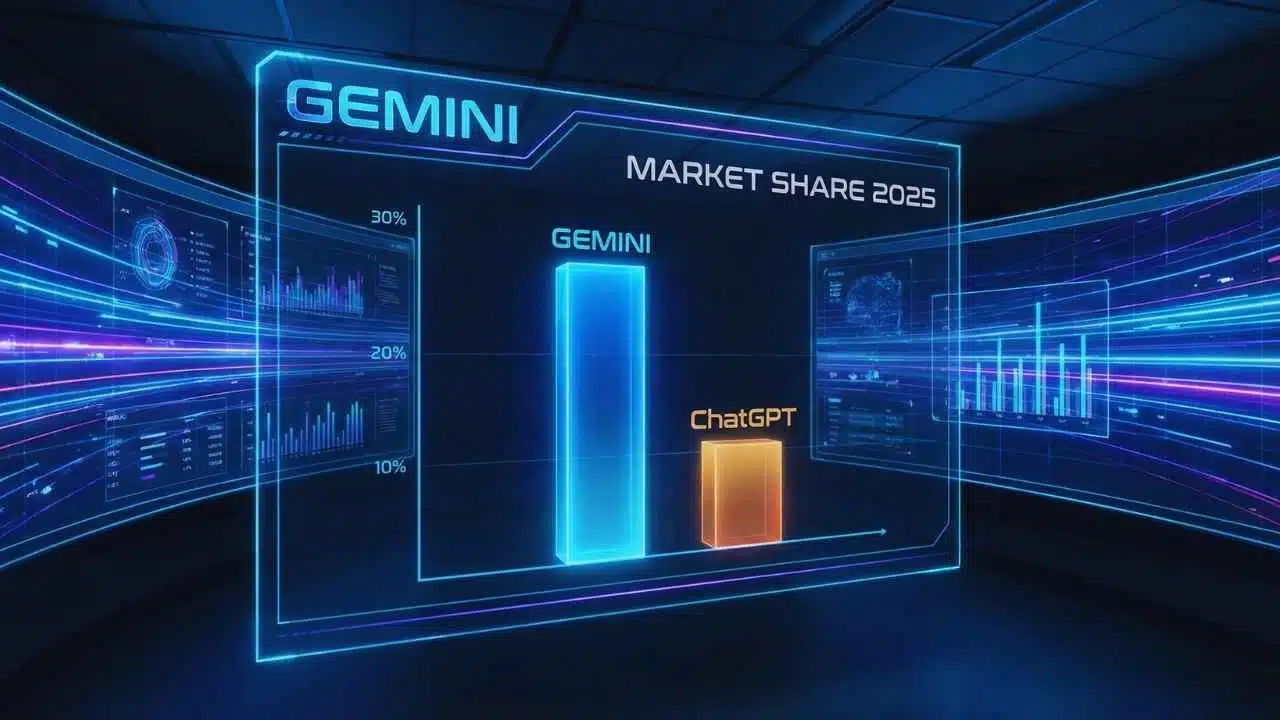
Gemini triples market share in generative-AI web traffic over the past year, as ChatGPT’s dominance eases and the chatbot market shifts from a one-platform era to a multi-tool routine.
The latest snapshot: who’s gaining, who’s slipping, and what “market share” means
The clearest sign of change is in web traffic distribution across major generative-AI destinations. Recent estimates based on web visits show Google’s Gemini rising from about 5.4% of generative-AI web traffic to about 18.2% over roughly 12 months, while ChatGPT’s share falls from about 87.2% to about 68% in the same window. Those numbers still leave ChatGPT in first place, but they mark a sharp shift in how people split their AI time.
It’s important to define the measurement. This “market share” is not revenue share, enterprise seat share, or model quality. It is a share of web traffic among leading GenAI platforms. It is a useful signal because it reflects real user behavior at scale, but it also has limits: usage inside operating systems, native apps, and embedded product features may not be captured in the same way as open-web visits.
Even with those caveats, the direction is hard to miss. A year ago, the category largely looked like “ChatGPT and everyone else.” Now it looks like a top tier with at least two major players, plus several fast-growing challengers competing for specific use cases.
Generative-AI web traffic share (approx., 12-month comparison)
| Platform | ~12 months ago | Most recent snapshot | Change (direction) |
| Gemini | 5.4% | 18.2% | Up sharply |
| ChatGPT | 87.2% | 68.0% | Down notably |
This does not mean ChatGPT is “losing” in absolute use. Both major products can grow in total users while one loses share. What the change strongly suggests is fragmentation: people are increasingly using different AI tools for different tasks instead of staying loyal to a single destination.
Why Gemini is climbing: distribution, habit, and “one-tap” access?
Gemini’s rise aligns with a classic advantage in consumer software: being present where users already are. Many people don’t “choose” an AI assistant every time they need help. They use the one that appears in the flow of their work, phone, and browsing.
A major driver is integration across everyday Google surfaces. When an assistant is accessible from common entry points—such as a phone’s operating system experience, a browser environment, or productivity tools—users face fewer steps between intent (“help me write, summarize, plan, or generate”) and action (“ask the assistant”). That reduction in friction matters, especially for casual users who may not open a standalone chatbot app every day.
Another factor is that Gemini’s growth has increasingly been linked to engagement, not only reach. Downloads and visits can spike during hype cycles, but market share movement suggests repeat use is rising, too. Recent app-market measurements show the time users spend inside Gemini increasing, which is a strong indicator that at least some first-time users are returning.
Gemini has also benefited from product moments that spread quickly. Image generation and other multimodal features often travel faster than text features because they are easier to share on social feeds and messaging apps. When a tool produces something instantly “showable,” users invite others into it without needing a tutorial. That kind of social distribution can add meaningful momentum in a short period.
None of this guarantees long-term leadership. Distribution can put a product in front of users, but it cannot force trust. The more meaningful signal is whether those users keep coming back—and whether the assistant becomes a default habit for common tasks like email drafting, quick research, document cleanup, and image creation.
What Alphabet’s own metrics say: Gemini at massive scale beyond the web?
Independent traffic estimates are one side of the story. The other side is what the company itself says about usage across its ecosystem.
In late October 2025, Alphabet publicly cited three numbers that help explain why Gemini’s footprint is expanding so quickly:
- The Gemini app has 650 million+ monthly active users.
- Gemini queries increased 3× quarter-over-quarter.
- Google’s first-party models process 7 billion tokens per minute via direct API usage by customers.
These figures matter because they point to something bigger than a consumer chatbot destination. They suggest Gemini is increasingly used as infrastructure—embedded into products and accessed through APIs—where usage scales rapidly once integrations ship. In other words, Gemini’s growth is not only about attracting people to a website. It is also about powering experiences across a very large product ecosystem.
Alphabet-reported Gemini scale indicators (as stated in Q3 2025 updates)
| Indicator | What was stated | Why it matters |
| Gemini app monthly active users | 650M+ | Indicates mainstream reach, not niche adoption |
| Query growth | 3× QoQ | Suggests rising frequency of use, not only installs |
| Tokens processed via APIs | 7B per minute | Shows large developer/enterprise usage at scale |
There is also a strategic implication: when an AI model becomes embedded across multiple products, its growth can become less dependent on marketing and more dependent on product rollouts. Each new surface becomes an on-ramp. That creates a compounding effect that standalone apps often struggle to match.
The competitive picture: ChatGPT still leads, but the market is fragmenting fast
Despite the share decline in web traffic estimates, ChatGPT remains the category leader across several important measures, including broad usage and brand recognition. In many regions, “ChatGPT” is still used as a generic label for AI chatbots, which shows how deeply the product has entered public consciousness.
At the same time, newer data suggests ChatGPT’s growth rate on mobile may be slowing compared to earlier phases, while Gemini’s growth rate is accelerating in key windows. One recent market-intelligence snapshot found:
- ChatGPT is still the leader in global mobile downloads and global monthly active users among AI chatbots.
- ChatGPT’s global monthly active users rose by about 6% over a recent multi-month period, reaching roughly 810 million.
- Over the same period, Gemini’s monthly active users rose by about 30%, and Gemini users’ daily time in-app rose notably, reaching around 11 minutes per day in one recent estimate.
The bigger story is not a single data point. It is the pattern ChatGPT appears to be entering a phase where growth is harder because it has already reached a vast audience, while Gemini still has more headroom, especially in markets where default placement and Android distribution can accelerate adoption.
Recent mobile momentum indicators (selected estimates)
| Metric (approx.) | ChatGPT | Gemini | What it suggests |
| Global monthly active users | ~810M | Rising rapidly | ChatGPT leads on scale; Gemini closing some gap |
| Recent growth window | ~6% | ~30% | Slower growth vs. faster catch-up |
| Daily time spent (recent estimate) | Modest change | ~11 min/day | Engagement improving for Gemini |
This is also where definitions matter. “Monthly active users” for apps can be measured in different ways depending on the data provider, device coverage, and methodology. The safest interpretation is directional: Gemini is improving on growth and engagement, while ChatGPT remains ahead on absolute scale.
Another reason the market is fragmenting is that users are segmenting their behavior:
- Some users prefer one platform for long writing and brainstorming.
- Others prefer a different platform for quick, search-like queries.
- Developers may choose tools based on API performance, pricing, and integration support.
- Teams may pick assistants that fit their productivity stack and security requirements.
That behavior naturally reduces the chance that any one assistant holds 85–90% share forever.
What happens next in 2026 and what readers should watch?
Gemini triples market share on the web is a meaningful milestone, but it is best understood as a sign of a broader shift: generative AI is moving from a single dominant destination to a more competitive, multi-platform ecosystem.
Three developments will likely shape the next phase:
First, default access and embedded AI will matter as much as model quality. Assistants that appear inside the operating system, the browser, and the tools people already use will continue to gain share, especially among casual users who want “fast help” without context switching.
Second, the category is entering a habit battle, not a hype battle. The winners will be the assistants that feel reliable for everyday tasks: summarizing, drafting, planning, translating, creating images, and helping with work workflows. The best metric to watch is not a single viral feature, but whether people return daily.
Third, expect rapid product cycles to keep reshaping the scoreboard. Big releases—especially in multimodal capabilities, personalization, speed, and safety controls—can change adoption quickly. As both leaders ship more features and integrate them deeper into consumer products, market share can shift again.
For readers, the practical takeaway is simple the “best” AI assistant may increasingly depend on the job you’re trying to do. The market is no longer converging on one default tool. It’s splitting into a set of everyday utilities—and Gemini’s rapid rise is one of the strongest signals yet that the AI race is entering a new, more competitive chapter.





















