

In a major move to strengthen its presence in the artificial intelligence space, Meta Platforms has officially launched a standalone AI app that directly competes with OpenAI’s ChatGPT. Powered by the company’s newly unveiled Llama 4 large language model, the Meta AI app introduces a range of features that blend conversational AI with social media dynamics—something Meta is uniquely positioned to offer.
The launch, which took place during Meta’s first-ever LlamaCon developer conference in Menlo Park, California, highlights how CEO Mark Zuckerberg is positioning Meta as a long-term leader in open-source AI and community-driven AI interaction.
What Is the Meta AI App and How Does It Work?
Meta’s new AI app is designed to be more than just a chatbot. Available on iOS, Android, and desktop, it features several capabilities that go beyond simple question-answer exchanges:
1. Discover Feed: AI Meets Social Networking
One of the app’s standout features is the Discover Feed, a section where users can see how others are using AI in creative or helpful ways. Users can browse, like, comment on, and remix AI interactions—similar to scrolling through a Facebook or Instagram feed, but with a focus solely on AI prompts and responses.
According to Mike Proulx, Research Director at Forrester, this feature is a clever way for Meta to leverage its social media DNA. “The app’s Discover Feed is like a version of the OG Facebook Feed but only focused on AI use cases,” Proulx said, adding that it offers a new kind of shared AI experience.
2. Voice Mode: Real-Time AI Conversations
The app also features a voice mode that supports natural, real-time, and even overlapping dialogue. This is what Meta calls full-duplex audio, allowing users to have seamless back-and-forth conversations with the AI, much like talking to a human assistant. This makes Meta AI more interactive and accessible, especially for users who prefer voice over text.
3. Facebook and Instagram Integration for Personalization
Users can optionally link their Meta-owned social accounts, including Facebook and Instagram, to the AI assistant. This allows the AI to personalize responses based on the user’s activity, preferences, and connections on those platforms. According to Meta, this kind of integration gives them a “leg up” in providing tailored, meaningful answers from the first interaction.
Meta’s Strategy: Open Source, Broad Reach, and Smart Devices
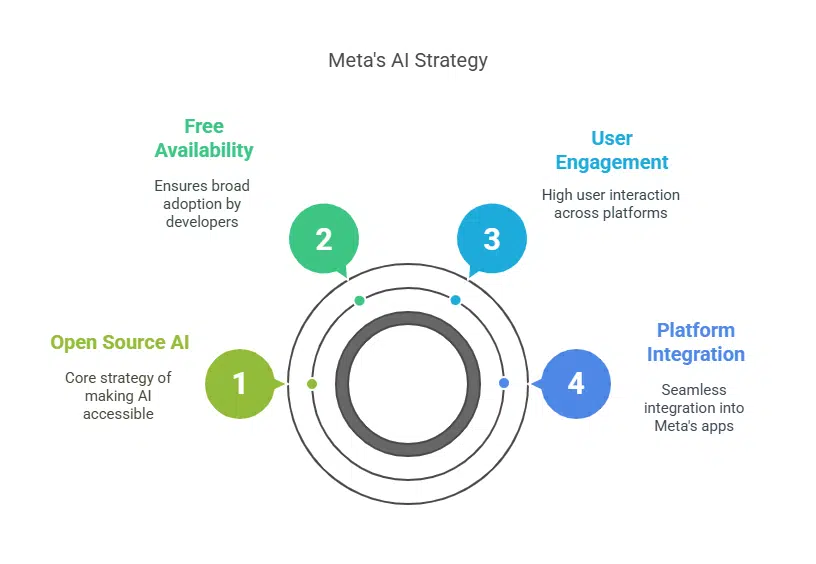
Meta is taking a significantly different approach to AI compared to competitors like OpenAI and Google. While others restrict access to their models or monetize aggressively, Meta continues to make its AI models like Llama 4 open-source, available for free to developers and businesses.
The company claims that more than 1 billion people interact with Meta AI tools across Facebook, Instagram, WhatsApp, and Messenger every month.
Smart Glasses and Web App
The new app also integrates with Ray-Ban Meta Smart Glasses, replacing the older Meta View app. This means that features like object recognition, translation, and AI conversations are now accessible via smart eyewear. Additionally, a web version of Meta AI is available with similar functionality, including Discover Feed and voice mode, giving users a cross-platform AI experience.
Creator Engagement: Building a Community from Day One
To make the Discover Feed engaging from the start, Meta collaborated with influencers, meme creators, and tech content specialists to generate content showcasing AI use cases. These include everything from productivity hacks and poetry to image generation and fitness advice.
This creator-first strategy is part of Meta’s broader vision of turning AI interaction into a shared experience, instead of an isolated one.
Highlights from LlamaCon: Zuckerberg and Nadella Talk AI’s Future
At the center of Meta’s AI event, LlamaCon 2025, was a fireside chat between Meta CEO Mark Zuckerberg and Microsoft CEO Satya Nadella. The two tech titans discussed how artificial intelligence is transforming not just their companies, but also the global economy and labor landscape.
“If this is going to lead to massive increases in productivity, that needs to be reflected in major increases in GDP,” Zuckerberg said during the discussion. “This is going to take multiple years, maybe many years, to play out.”
Nadella responded by drawing a historical parallel: “AI is like electricity. It has the promise, but it won’t deliver change unless we also rethink how people work with it.” He added that it took decades before industries truly transformed their processes to align with electric power. “Software and management must evolve too,” Nadella emphasized.
Zuckerberg replied optimistically, “We’re all investing as if it’s not going to take 50 years. So I hope it doesn’t take that long.”
Their conversation reflected the high-stakes optimism and long-term vision shared by industry leaders as AI reshapes everything from software engineering to customer service.
Meta and AI in the Regulatory Spotlight
While Meta is doubling down on innovation, it’s also facing scrutiny. The European Union recently fined Meta €200 million in separate digital privacy cases, while Apple was fined €500 million. These actions underscore the increasing regulatory pressures facing big tech companies as they push into AI and digital services.
Meta’s open-source strategy may help it fend off regulatory concerns, positioning it as a company committed to AI transparency and community collaboration.
Where Is the App Available?
As of now, the Meta AI app is available in select countries including:
-
United States
-
Canada
-
Australia
-
New Zealand
More regions are expected to gain access soon, though Meta hasn’t shared a global rollout timeline yet.
What’s Next? Monetization and Advanced Features
Although the app is currently free, Meta has hinted at a future subscription model for premium features, including more advanced AI capabilities and tools. These monetization efforts are expected to begin impacting Meta’s financial results by 2026.
For now, Meta is focused on building adoption and improving the app’s utility across both everyday and enterprise scenarios.
Meta’s AI Bet Is Big, Bold, and Social
Meta’s AI app is not just another chatbot—it’s a new kind of AI platform that blends personalization, community engagement, and social interaction. With strong integration across Meta’s ecosystem, advanced features like voice mode, and a transparent open-source approach, the company is setting a unique course in the race for AI dominance.
By combining the power of its Llama 4 model with social media dynamics, Meta aims to make AI usage visible, social, and personalized—an approach that could reshape how billions of users interact with artificial intelligence in the coming years.





















