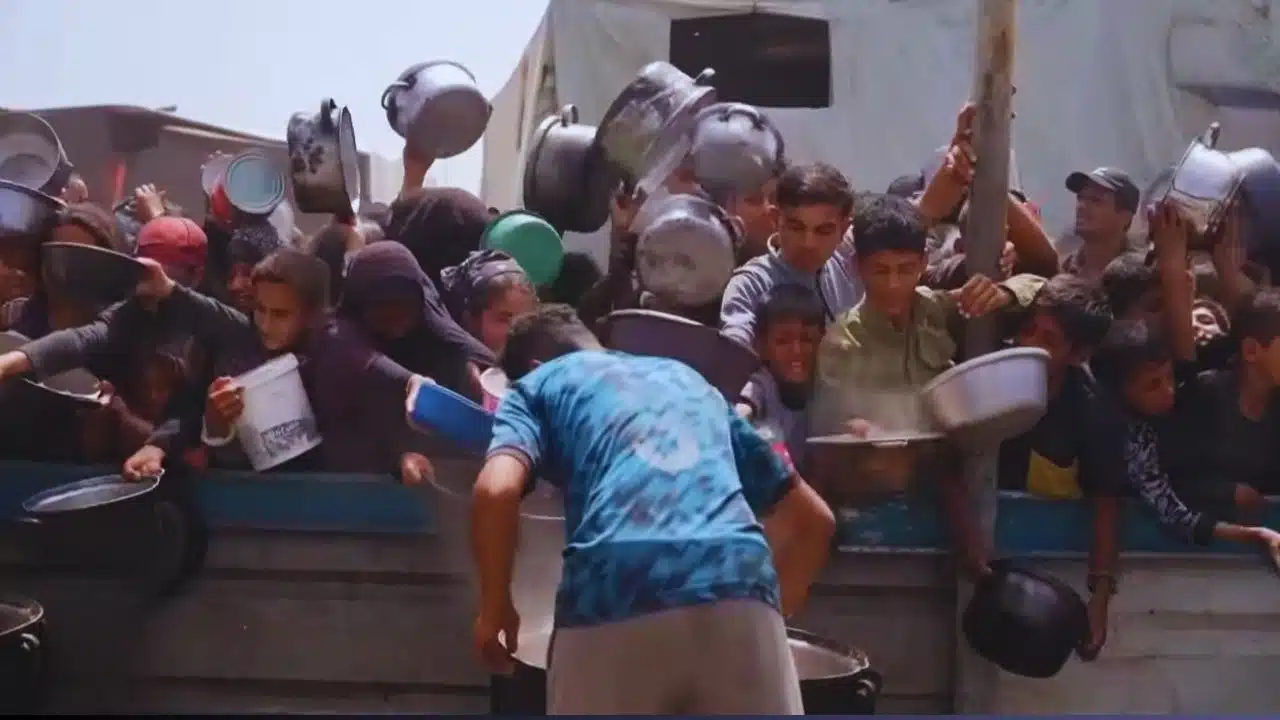
The United Nations World Food Programme (WFP) announced that it has officially run out of food supplies in Gaza, amid a worsening humanitarian crisis caused by Israel’s blockade of aid deliveries, now in its seventh consecutive week.
On Thursday, the WFP confirmed that it had distributed its final stocks to community-run hot meal kitchens. “Today, WFP delivered its last remaining food stocks to hot meals kitchens,” the agency said in a statement, warning that “these kitchens are expected to fully run out of food in the coming days.”
The warning comes at a time when conditions inside Gaza have rapidly deteriorated, pushing the civilian population into a state of extreme hunger and deprivation.
Israel’s Blockade and Ceasefire Breakdown
Israel imposed the blockade on March 2, 2025, following the collapse of a two-month ceasefire agreement with Hamas. Israeli authorities justified the move by stating it was necessary to increase pressure on Hamas to release the remaining Israeli hostages still held captive in Gaza since the October 7, 2023, cross-border attack.
Despite growing international pressure, Israel has insisted that it is acting within the framework of international law and has rejected accusations that it is causing a humanitarian crisis. According to the Israeli Foreign Ministry, “there is no shortage of aid in Gaza,” and Israel claims it has facilitated extensive aid deliveries during the ceasefire.
However, multiple United Nations agencies and humanitarian groups on the ground have presented a drastically different picture, describing a situation where food, water, medical supplies, and basic necessities have become almost impossible for ordinary Palestinians to access.
Food Systems Collapse as Markets Crumble
The WFP warned that Gaza’s food systems, already fragile after months of bombardment and displacement, have been pushed to the brink of collapse by the blockade. Food prices have soared by up to 1,400% compared to prices during the ceasefire, making essential goods unaffordable for most of the population.
Even before the latest restrictions, Gaza’s economy was heavily dependent on humanitarian aid, with many residents unable to earn income due to destroyed infrastructure, closed businesses, and continued displacement.
The closure of WFP-supported bakeries at the end of March — when wheat flour and cooking fuel ran out — represented another blow to food security. Bakeries were previously essential for providing affordable bread, a dietary staple for Gaza’s 2.1 million people.
The WFP stated that the humanitarian gains made during the temporary ceasefire have been almost entirely undone. Without urgent action to open borders for aid and trade to enter, WFP’s critical assistance may be forced to end,” the agency said.
Rising Rates of Severe Malnutrition
The United Nations and health organizations have sounded the alarm over a sharp increase in malnutrition, particularly among young children. According to the UN, a recent screening conducted by humanitarian partners of 1,300 children in northern Gaza revealed more than 80 cases of acute malnutrition — double the number reported just weeks earlier.
Experts warn that with continued restrictions, child malnutrition could soon reach catastrophic levels. Children suffering from acute malnutrition are at heightened risk of death, infectious diseases, and long-term developmental problems.
Dr. Tedros Adhanom Ghebreyesus, Director-General of the World Health Organization (WHO), called the current conditions “an awful and grim moment” for Gaza, emphasizing that immediate humanitarian access is needed to save lives. “This aid blockade must end. Lives depend on it,” he said.
Severe Shortages of Medical Supplies and Fuel
In addition to food scarcity, Gaza faces a dire shortage of medicines, medical supplies, and operational hospitals. OCHA reported that hospitals are overwhelmed with casualties from ongoing Israeli airstrikes but have dwindling resources to provide even basic care.
Fuel shortages have crippled essential services. Water production and distribution systems, which rely on electricity and fuel, have almost completely collapsed in many areas, leaving residents with little or no access to safe drinking water.
Medical experts warn that preventable deaths from untreated injuries, infections, dehydration, and hunger-related complications are rising sharply as a direct result of the blockade.
Aid Stockpiled at Borders, Awaiting Entry
The WFP confirmed that more than 116,000 tonnes of food — enough to feed one million people for up to four months — is currently stockpiled in aid corridors near Gaza’s borders. These supplies are ready for immediate distribution but remain inaccessible due to the continued closure of crossing points.
Antoine Renard, WFP’s Country Director for Palestine, said the agency was doing everything possible to keep hot meal kitchens operational, but resources were running out. “More than 80% of the population has been displaced during the war,” Renard said. “Since the offensive resumed on March 18, another 400,000 people have been displaced again. Every time people move, they lose what little they have left.”
Despite best efforts, the hot meal kitchens were only able to serve about half of the displaced population, and the meals provided met just 25% of daily nutritional needs, according to the WFP.
Desperation at Unprecedented Levels
The humanitarian situation in Gaza has reached levels of desperation rarely seen before. According to the Norwegian Refugee Council’s humanitarian access manager, Gavin Kelleher, once the kitchens run out of food, there will be no alternative means of organized food distribution.
Families are resorting to extreme survival strategies — reducing their food intake, bartering whatever possessions they still own (such as diapers for lentils), or selling furniture and personal belongings to get enough cash to buy scarce food items.
Kelleher also described widespread begging, noting that even people who once could offer help to others are now themselves without food or money. “The desperation is really, really severe,” he said.
International Condemnation and Israeli Response
Several international actors, including the United Kingdom, France, and Germany, issued a rare joint statement earlier this week, describing the Israeli blockade as “intolerable” and calling for it to be lifted immediately.
The Israeli Foreign Ministry pushed back against the criticism, stating that during the ceasefire, Israel allowed more than 25,000 lorries carrying almost 450,000 tonnes of aid into Gaza. The ministry also reiterated claims that Hamas has misappropriated aid supplies for its military activities, insisting that Israel is under no legal obligation to facilitate aid to Hamas-controlled territories.
However, the United Nations and reputable humanitarian organizations have strongly denied these accusations, stating that aid distributions are closely monitored through robust supply chains. The UN stressed that “a very good chain of custody” exists for all its aid deliveries and that no credible evidence has emerged that Hamas has systematically diverted humanitarian aid.
Stalled Peace Talks and Rising Civilian Death Toll
Efforts to negotiate a new ceasefire have stalled. Last week, Hamas rejected an Israeli proposal offering a six-week pause in hostilities in exchange for Hamas agreeing to disarm and release 10 hostages.
Hamas countered by reiterating that it would only release all hostages in exchange for a complete Israeli military withdrawal from Gaza and a permanent end to the war.
The conflict has taken an immense toll on civilians. Israel launched its military campaign in Gaza after Hamas’ October 7 attack, during which about 1,200 Israelis were killed and 251 others taken hostage. In retaliation, Israel has conducted extensive airstrikes and ground operations across Gaza.
According to Gaza’s Hamas-run health ministry, at least 51,439 Palestinians have been killed since the war began. Human rights groups warn that the actual number of civilian casualties could be even higher, as many bodies remain trapped under the rubble of destroyed neighborhoods.
The Information is Collected from BBC and CNN.