


Grain production is a key sector in Australia’s agricultural industry, with the country playing a significant role in global grain trade.
With the rise of technological advancements, climate challenges, and evolving market conditions, the future of grain production in Australia will witness a blend of innovative solutions and strategic planning to ensure sustainability, resilience, and growth.
This article will provide an in-depth look at the current state of grain production, emerging trends, and predictions for its future, offering valuable insights to farmers, investors, policymakers, and others interested in the industry’s trajectory.
Introduction to Grain Production in Australia
Australia’s grain industry is a crucial element of its agricultural landscape, generating billions of dollars annually in exports and local production. Australia is globally recognized for its high-quality grains, including wheat, barley, canola, and sorghum, and is a leading exporter of these crops to international markets.
The future of grain production in Australia will be heavily shaped by advances in farming technology, sustainability efforts, and climate change. This comprehensive guide explores the current state of grain farming in Australia, the challenges and opportunities that lie ahead, and how the industry is poised to evolve in the coming decades.
Overview of Australia’s Grain Industry
The grain industry is one of Australia’s most vital agricultural sectors, contributing significantly to the national economy. Australia is known for its diverse and extensive grain production, making it one of the world’s top exporters.
The country’s grain farming regions benefit from a variety of climatic conditions that support different types of crops, from wheat in the south to sorghum in the north.
Australia produces several key grain crops:
- Wheat: The dominant crop in Australia, primarily used for human consumption [bread, pasta] and animal feed.
- Barley: A staple for both food production and brewing industries, particularly in markets such as China and Europe.
- Canola: Grown mainly for oil extraction and animal feed.
- Sorghum and Oats: Important for both local use and export, particularly in countries with arid climates.
Australia’s grain industry is highly export-oriented, with a significant portion of production sent overseas, particularly to Asia, the Middle East, and Europe.
Importance of Grain Production to the Australian Economy
Grain production is essential not only for domestic food security but also as a key export commodity. The Australian grain sector supports approximately 140,000 jobs across farming, logistics, research, and other related industries. The export value of grain products is substantial, generating over $15 billion annually from crops like wheat, barley, and canola.
The grain industry’s importance extends beyond agriculture. The grain trade supports vital infrastructure such as ports, railways, and storage facilities, creating a ripple effect through local economies and global markets.
Additionally, Australia’s reputation for producing high-quality grains has made it a preferred supplier in global food and feed markets, boosting its standing as a key player in global food security.
Current State of Grain Production in Australia
Australia’s grain production is dominated by a few key crops, each of which plays a critical role in both the domestic and international market. Below is a closer look at these crops, including some interesting facts and figures:
1. Wheat:
- Australia is the world’s 4th largest exporter of wheat, producing around 25 million tonnes annually.
- Major export markets include Indonesia, the Philippines, and Japan.
- Australian wheat is known for its high quality, with a reputation for consistency in both domestic and international markets.
2. Barley:
- Barley production in Australia reaches up to 10 million tonnes annually.
- It is a significant crop for both the food industry [e.g., for malting purposes] and animal feed.
- Major export destinations for Australian barley include China, Saudi Arabia, and the United Kingdom.
3. Canola:
- Australia is a leading producer of canola, with production levels exceeding 3 million tonnes annually.
- This crop is primarily used for oil extraction, a vital product for cooking oils, biodiesel, and animal feed.
- The canola industry is a key driver of export revenue, particularly in markets such as China and the European Union.
4. Oats and Sorghum:
- While smaller in volume, oats and sorghum play significant roles in Australia’s agricultural portfolio, particularly in the export market for feed grains.
Regional Distribution of Grain Production
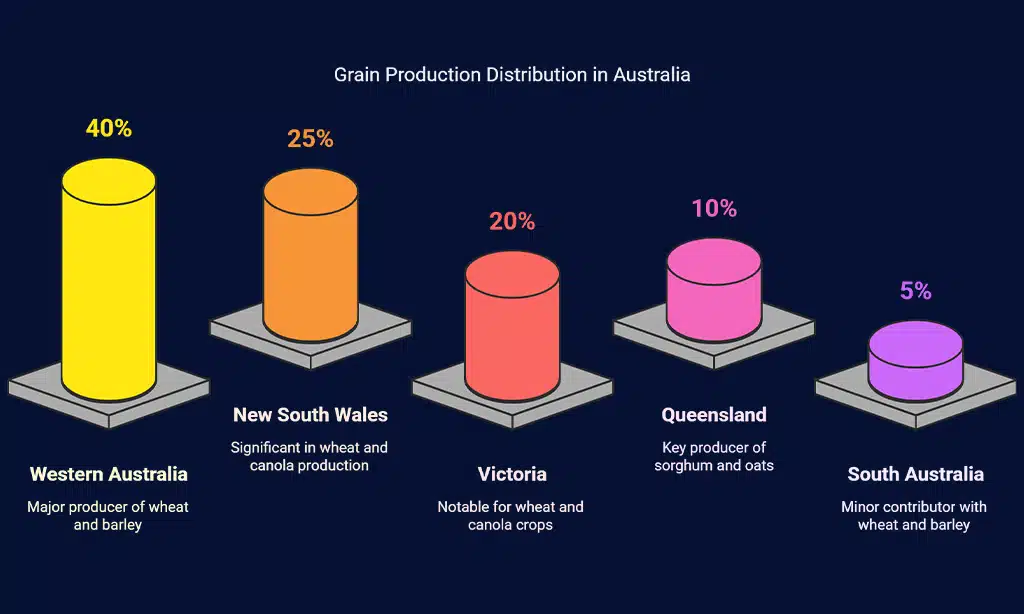
Australia’s vast size and diverse climates mean grain production is distributed across various regions. Here’s a closer look at the top grain-producing regions in Australia:
| Region | Key Crops | Percentage of Total Production |
| Western Australia | Wheat, Barley, Canola | 40% |
| New South Wales | Wheat, Canola, Sorghum | 25% |
| Victoria | Wheat, Barley, Canola | 20% |
| Queensland | Sorghum, Oats | 10% |
| South Australia | Wheat, Barley, Canola | 5% |
Western Australia leads the charge in terms of total grain production, contributing the highest volume of wheat and barley. Other states like New South Wales, Queensland, and South Australia also play critical roles in the nation’s grain output, each focusing on specific crops suited to their climatic conditions.
Key Producers and Leading States in Australia
Australia’s grain production is driven by both large-scale commercial farms and smaller family-owned operations. Major producers include farming regions in Western Australia, New South Wales, and South Australia.
The GrainGrowers Association represents a significant portion of grain farmers, and industry leaders such as CBH Group [a cooperative of Western Australian farmers] are integral in processing and exporting grain.
Emerging Trends in Grain Production
The future of grain production in Australia will be significantly shaped by ongoing advancements in technology. These innovations aim to improve productivity, reduce environmental impact, and ensure sustainability. Below are key technologies influencing the grain industry:
Automation and Precision Agriculture
Precision agriculture uses technology to enhance farming efficiency, utilizing tools like GPS, drones, and sensors to collect real-time data from crops. These technologies allow farmers to make data-driven decisions on planting, irrigation, fertilization, and harvesting. By reducing resource inputs and increasing efficiency, precision agriculture contributes to higher yields and sustainable farming.
| Technology | Benefits | Examples |
| Drones | Crop health monitoring, pesticide application | Using drones for aerial crop inspection |
| GPS Technology | Efficient field mapping, variable rate technology | Automating planting and fertilization |
| Soil Sensors | Real-time soil moisture and nutrient data | Precision irrigation based on soil data |
Case Study: John Deere’s Smart Farming Solutions
John Deere, a global leader in agricultural machinery, has pioneered advancements in precision farming. Their equipment, which includes GPS-controlled tractors and autonomous harvesters, is designed to maximize yield while minimizing resource usage. This technology allows farmers to optimize their operations, reducing costs and environmental impact.
Sustainability Practices in Grain Production
As the demand for environmentally conscious farming practices grows, Australian grain producers are adopting sustainable strategies to improve efficiency and reduce the environmental footprint.
Water Management Strategies
Australia faces recurring droughts, making water management one of the most critical aspects of grain farming. Innovative water-saving techniques such as drip irrigation, soil moisture sensors, and rainwater harvesting systems are increasingly being used to conserve water resources while ensuring healthy crop growth.
| Strategy | Benefit | Example |
| Drip Irrigation | Efficient water use, reduced evaporation | Used for irrigating high-value crops |
| Moisture Sensors | Real-time soil moisture monitoring | Optimizing irrigation schedules |
Reducing Carbon Footprints in Grain Farming
Many farmers are implementing carbon-reducing techniques such as no-till farming, cover cropping, and rotational grazing. These practices improve soil health, sequester carbon in the soil, and reduce the need for synthetic fertilizers and pesticides.
Example: Australian Grain Growers Association [AGGA]
The AGGA is actively supporting farmers in adopting sustainable practices, providing resources and educational opportunities on reducing emissions. Through projects like “Grains for the Environment,” farmers are educated on reducing soil compaction and improving organic matter content, which enhances soil carbon sequestration.
Climate Change and Its Impact on Grain Yields
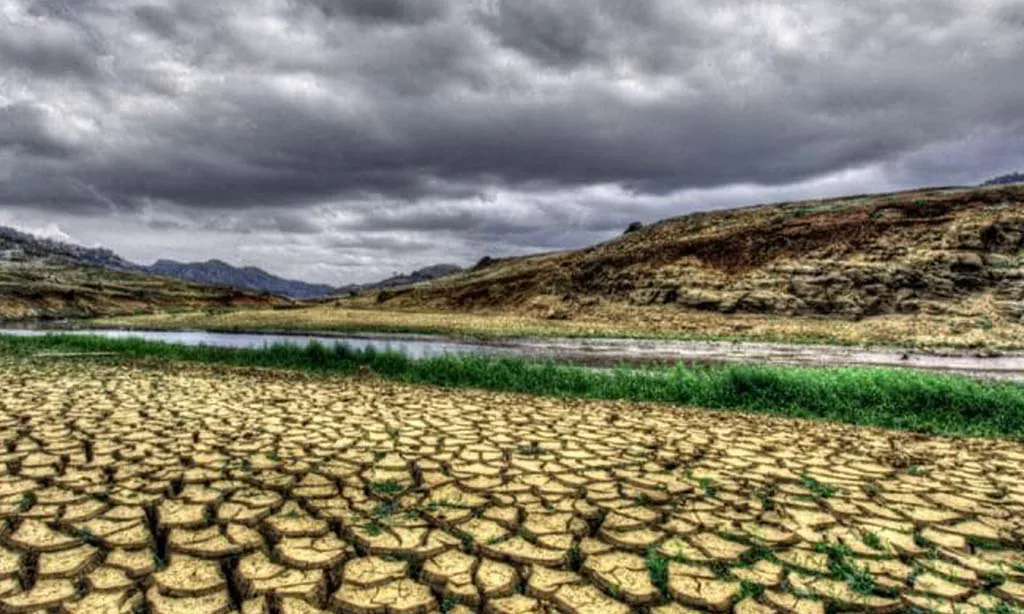
Australia is already experiencing the effects of climate change, with fluctuating rainfall patterns, rising temperatures, and extreme weather events impacting crop yields. Farmers are adapting by selecting drought-resistant crops and employing new farming techniques.
Shifting Growing Seasons and Crop Selection
Changing climate patterns are affecting traditional growing seasons. Regions that once supported wheat may no longer be suitable for it, prompting farmers to consider alternative crops such as sorghum and millet, which are more resilient to heat and drought conditions.
| Crop | Ideal Growing Conditions | Benefits |
| Sorghum | Heat and drought tolerance | Ideal for hot, dry regions |
| Millet | Drought-resistant, short-growing season | Suitable for arid conditions |
Predictions for the Future of Grain Production
The future of grain production in Australia is expected to grow steadily by up to 5% per year, driven by demand for both food and industrial uses. Innovations in agricultural technology, biotechnology, and sustainable farming practices are expected to increase yields and enable grain farmers to meet global demand without further environmental degradation.
Impact of Global Markets on Australia’s Grain Industry
Australia’s grain exports are essential to the country’s economy, and the industry’s future growth will be heavily influenced by international market conditions. The ongoing demand for grains in Asia, the Middle East, and Africa will help drive exports. However, trade agreements and geopolitical shifts will have to be carefully managed to ensure continued market access.
Future Challenges Facing the Grain Sector
While the future looks promising, challenges remain:
- Labor Shortages: The agriculture sector, including grain farming, faces an ongoing labor shortage. Automation, drones, and robotics are expected to play an increasing role in addressing this issue.
- Competition for Water: As Australia’s population grows and water availability becomes more strained, grain farmers will need to develop innovative water-sharing agreements and more efficient irrigation systems.
Takeaways
The future of grain production in Australia is both promising and challenging. Technological advancements, sustainability practices, and global market trends will shape the industry in profound ways.
However, the sector must navigate climate change, water scarcity, and labor shortages to continue thriving.
By embracing innovation, sustainability, and strategic planning, Australian farmers are poised to maintain their global leadership in grain production, ensuring a steady supply of high-quality grains to meet the needs of both domestic and international consumers.
The path forward will require collaboration, investment, and resilience, but with these ingredients, the future of grain production in Australia remains bright.






















