

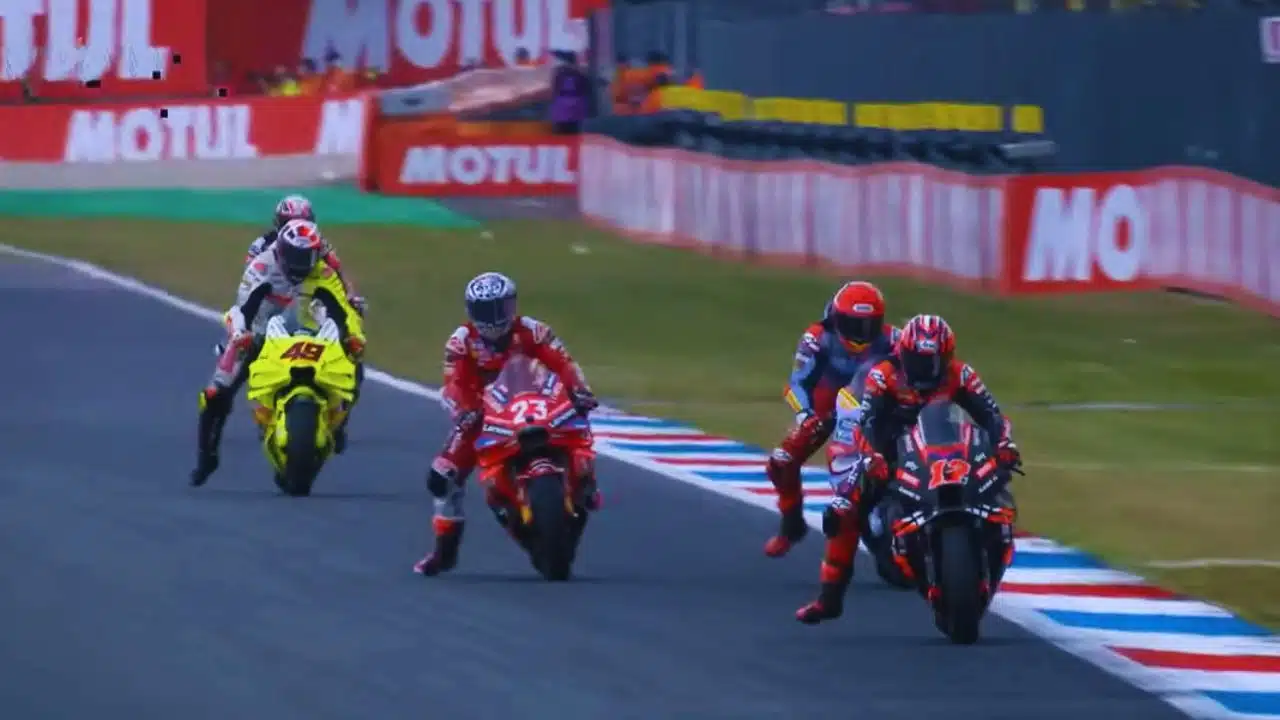
The Fédération Internationale de Motocyclisme (FIM) has officially announced a two-year engine freeze in MotoGP, starting from the 2025 season and extending through 2026.
Manufacturers made this decision to prepare for the upcoming regulatory changes set to take effect in 2027. The freeze will affect all manufacturers in MotoGP, marking a significant shift in how teams approach development in the premier class of motorcycle racing.
What Does the Engine Freeze Mean for MotoGP?
All teams and manufacturers will halt engine development for the two upcoming seasons starting in 2025. Current regulations permit teams to submit brand-new engine designs at the start of each season.
Teams would then seal these engines, ensuring they remained unchanged throughout the racing calendar.
However, with the freeze, the engines submitted by each team at the first race of the 2025 season—the Thai Grand Prix—will remain identical for the entire year.
This means manufacturers must rely on the same engine specifications for both the 2025 and 2026 seasons. There will be a limit of eight engines per season for each team.
Why the Engine Freeze?
The engine freeze is part of a larger strategy to control costs and help manufacturers focus on developing motorcycles for the 2027 regulations.
A smaller, 850cc engine will replace the current 1000cc engine format in the upcoming changes. Tighter restrictions on aerodynamics and a reduction in the use of devices like ride height adjusters, only permitted during race starts, will accompany these changes.
By freezing engine development, the FIM aims to stabilize budgets and avoid unnecessary investments by teams in a system that will soon become obsolete.
Who Benefits from the Engine Freeze?
The freeze will impact both factory and private teams. However, two manufacturers—Honda and Yamaha—currently enjoy concession status due to their recent underperformance.
These concessions allow them greater freedom in engine development, but this could change if their results improve significantly by the end of the current season.
For all other manufacturers, the engine freeze will provide an opportunity to redirect resources toward preparing for the new regulations rather than continuously investing in engine updates over the next two seasons.
A familiar strategy to control costs
This is not the first time MotoGP has implemented an engine freeze. The COVID-19 pandemic’s financial strain prompted the introduction of a similar freeze during the 2020 and 2021 seasons. The goal at that time was to help teams manage their budgets in the face of global uncertainty.
Despite past measures, the freeze hasn’t always been smooth. In August 2020, Yamaha requested special permission to make adjustments to the M1 engines of Valentino Rossi and Maverick Viñales due to issues with the valves.
This request caused friction within the Manufacturers’ Association (MSMA), leading to distrust among competing teams.
Exceptions and Adjustments for Safety
The FIM’s engine freeze isn’t entirely rigid. The organization has allowed for potential adjustments to engine specifications if there are proven safety or reliability concerns, as long as no performance gains are achieved.
The FIM clarified in a statement that manufacturers had the authority to make changes under specific circumstances:
“Certain allowances may be made concerning corrections for safety or reliability or proven nonavailability of components, provided no performance increase will be gained.”
This clause guarantees the safety of riders and the reliability of the machinery, without compromising cost control and stability.
Looking Ahead to 2027
With this freeze, MotoGP will move toward a new era in 2027, where the landscape of the sport will change dramatically. The switch to 850cc engines and stricter aerodynamic rules will reshape the competitive field, making it an exciting time for fans and manufacturers alike.
As the sport continues to evolve, this engine freeze provides a necessary buffer for teams to adjust and focus on the future without the pressures of continuous development.
The FIM’s decision to implement a two-year engine freeze in MotoGP from 2025 represents a pivotal moment in the sport’s development.
By pausing engine advancements, the FIM aims to ensure manufacturers are better prepared for the upcoming changes in 2027 while maintaining competitive fairness and controlling costs.
As teams adjust to this new dynamic, the racing landscape will undergo significant transformations, setting the stage for a thrilling future in MotoGP.
The Information is Collected from MSN and Motorsport.





















