


As of early 2026, the European residency-by-investment landscape is undergoing its most radical transformation since the 2008 financial crisis. Portugal and Greece, long-standing champions of the “Golden Visa,” have aggressively tightened rules to combat housing crises and EU-level security concerns.1 This shift marks the definitive end of the “cheap property for a passport” era, signaling a new age of high-threshold, innovation-led migration.
The concept of the “Golden Visa” was born out of economic desperation. Following the 2008 global financial collapse, Southern European nations—bruised by debt and stagnant growth—looked to the global elite to inject liquidity into their parched real estate markets. Portugal launched its program in 2012, followed by Greece in 2013.3 For over a decade, these schemes functioned as a “get out of jail free” card for economies struggling with high unemployment and devalued assets. Billions of euros flowed into Lisbon, Porto, and Athens, successfully revitalizing historic centers and propping up construction sectors.
However, the tide began to turn around 2022. The very success of these programs became their undoing. As foreign capital saturated urban markets, local residents found themselves priced out of their own cities.4 In Lisbon, rental prices surged by over 30% in a single year, while Athens saw a similar trajectory in popular neighborhoods. Combined with mounting pressure from the European Commission regarding money laundering and security risks—heightened by the geopolitical fallout of the Russia-Ukraine conflict—the “Golden Visa” transitioned from an economic lifeline to a political liability. By 2024 and 2025, both nations were forced to choose: keep the capital flowing or protect social stability.
The Death of the Real Estate Route and the Rise of Fund Investment
The most significant shift in the European Golden Visa Reforms 2026 is the decoupling of residency from residential real estate. For years, the simplest way to gain EU access was to buy a €250,000 apartment in a sunny coastal town. That door is now largely closed. Portugal led the charge by completely eliminating real estate as a qualifying investment category in late 2023 under its “Mais Habitação” (More Housing) bill.
In its place, the Portuguese government has funneled applicants toward “productive capital”—specifically regulated investment funds (FCR). These funds must invest in Portuguese companies or research, steering money away from speculative housing and toward the broader economy.8 Greece, while not banning real estate entirely, has effectively “gentrified” its own program by nearly tripling the entry price in high-demand zones.
| Investment Category | Portugal (2026 Status) | Greece (2026 Status) |
| Residential Real Estate | Closed | €400k – €800k (Minimum 120sqm) |
| Investment Funds | €500,000 (Non-real estate) | €500,000 (Capital Contribution) |
| Cultural/Heritage | €250,000 (Donation) | €250,000 (Restoration Only) |
| Job Creation | 10 Jobs (Minimum) | 2 Jobs (Start-up Route) |
| Stay Requirement | 7 Days per Year | 0 Days (Total Flexibility) |
The Social Contract: Solving the Urban Housing Crisis
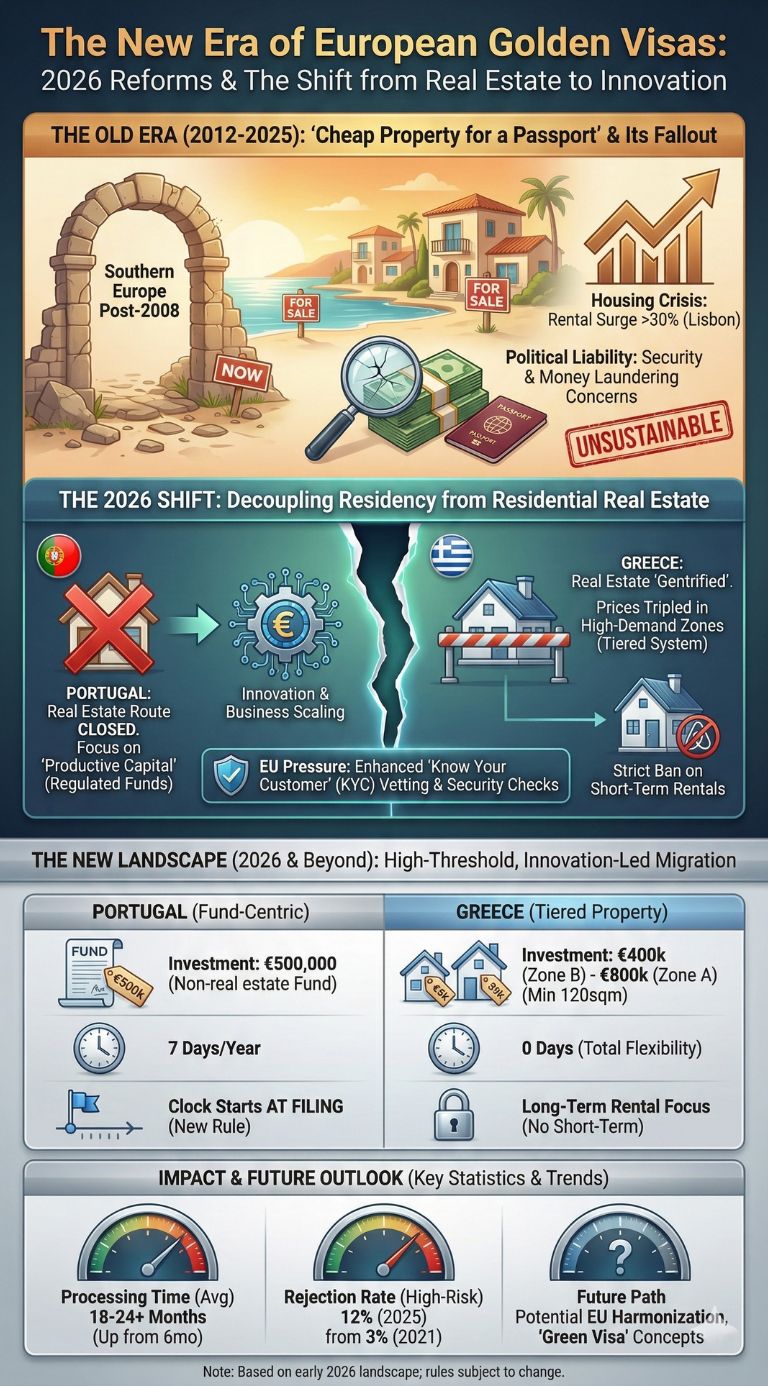
The primary driver behind these reforms is not economic failure, but social pressure. Governments in Lisbon and Athens are walking a tightrope between attracting high-net-worth individuals (HNWIs) and appeasing a frustrated domestic electorate.10 The European Golden Visa Reforms 2026 reflect a “local first” policy.
In Greece, the new tiered system (Zone A and Zone B) is a surgical attempt to move foreign buyers away from saturated markets like Athens and Thessaloniki toward less-populated regions.11 Furthermore, a strict ban on short-term rentals (Airbnb) for properties purchased under the Golden Visa scheme was implemented in late 2024.12 Investors found violating this rule face fines of up to €50,000 and the revocation of their residency permits. This is a direct attempt to return housing stock to the long-term rental market for locals.
Geopolitical Pressure and the “Brussels Effect”
The European Commission has long viewed Golden Visas as a “security backdoor” to the Schengen Area. In 2026, this pressure has culminated in stricter “know your customer” (KYC) protocols across all member states. The Commission’s 2025 report on Investor Residence Schemes highlighted that without harmonized standards, “risky” capital could simply flow to the country with the weakest checks.
Consequently, Portugal and Greece have enhanced their due diligence. Applicants now face multi-layered vetting involving Interpol, Europol, and national intelligence agencies. This has slowed down processing times—with Portugal’s Agency for Integration, Migration and Asylum (AIMA) managing a backlog of over 400,000 expressions of interest as of mid-2025—but it has also increased the perceived “legitimacy” of those who do eventually receive their cards.
The Citizenship Countdown: Portugal’s Regulatory Seesaw
For many investors, the Golden Visa isn’t about residency; it’s about the passport. Portugal has historically been the “Holy Grail” because of its low physical stay requirement (7 days/year) and a 5-year path to citizenship.15 However, 2026 has brought a massive shift in how these years are counted.
In a landmark legal update in late 2025, the Portuguese Parliament adjusted the “residency clock.”16 Previously, the 5-year countdown for citizenship only started once the first residence card was issued—a process that often took two years due to backlogs. Now, the clock starts from the moment the application is filed. While this is a win for efficiency, it is balanced by proposed reforms that might increase the total residency requirement from 5 to 7 or even 10 years for non-Portuguese speaking nationals to align with European averages.
Key Takeaways of the 2026 Reforms
- Threshold Hikes: The “entry-level” €250k real estate investment is dead in Portugal and restricted to niche restoration projects in Greece.
- Rental Restrictions: Greece now bans short-term rentals (Airbnb) for Golden Visa properties to protect local housing availability.
- Fund-Centric Future: Portugal’s transition to venture capital and private equity funds is the new blueprint for “responsible” investment migration.
- Security First: Enhanced vetting by EU-wide agencies is now mandatory, ending the era of “easy” approvals.
- Backlog Bottlenecks: Increased regulation has led to significant administrative delays, with some processing times reaching 24–36 months.
Comparative Analysis: The Cost of Entry (2026)
The following data reflects the updated minimum investment thresholds and the associated “hidden costs” of applying in the current regulatory environment.
Key Statistics: Investment Migration in 2026
- Record Highs: Despite the rules tightening, 2024 saw a record 4,987 Golden Visas granted in Portugal—a 72% year-on-year increase
- Economic Impact: The Greek program has generated over €8.5 billion since its inception, supporting approximately 100,000 jobs
- Rejection Rates: Due to stricter AML (Anti-Money Laundering) checks, rejection rates for applicants from “high-risk” jurisdictions have climbed from 3% in 2021 to 12% in 2025.
- Processing Time: The average time from investment to residence card issuance in Portugal is now 18–24 months, compared to 6 months in 2019.
| Metric | Portugal | Greece |
| Minimum Capital | €500,000 (Fund) | €400,000 (Property – Zone B) |
| Gov. Application Fee | €605 per person | €2,000 (Main Applicant) |
| Card Issuance Fee | €6,045 per person | ~€16 per card |
| Renewal Cycle | 2 years + 3 years | Every 5 years |
| Right to Work | Yes, fully permitted | No (Requires separate permit) |
Expert Perspectives: A Divided Market

Economists and migration experts remain divided on whether these reforms will ultimately benefit the host nations.
The “Skeptics” Argument:
Critics, including groups like the Portuguese Association of Real Estate Developers (APPII), argue that removing the real estate route will not lower housing prices. They point to data suggesting that Golden Visa transactions represent less than 2% of total real estate sales. Instead, they argue that the reforms will simply drive capital to other jurisdictions like Italy or Cyprus, leaving Portugal with a shortfall in foreign direct investment (FDI).
The “Reformist” Argument:
On the other hand, the European Commission and social housing advocates argue that the European Golden Visa Reforms 2026 are a necessary correction. They suggest that the “fund-based” model ensures that capital is used for innovation and business scaling rather than inflating property bubbles.23 By banning short-term rentals, Greece is attempting to solve a supply-side crisis that has turned historic neighborhoods into “tourist museums.”
“The Golden Visa is evolving from a transactional commodity into a strategic partnership.25 The era of ‘buying a flat to get a passport’ was a race to the bottom. The 2026 rules ensure that if you want the benefits of an EU residency, you must contribute to the host nation’s long-term economic or cultural fabric.” — Dr. Elena Pappas, Migration Policy Analyst.
Future Outlook: What Happens Next?
As we look toward 2027 and beyond, several milestones will determine the survival of these programs:
- The “Spain Effect”: With Spain already announcing its intention to scrap its Golden Visa entirely, all eyes are on whether Portugal and Greece will see a surge in “refugee capital” from investors who were previously eyeing Madrid or Barcelona.
- Harmonized EU Legislation: Expect a potential EU Directive by 2027 that mandates a minimum investment threshold across all member states to prevent “jurisdiction shopping.”
- The Rise of the “Green Visa”: There is growing discussion in the Portuguese Parliament about a “Climate Golden Visa”—a lower threshold for investments specifically targeting reforestation, carbon capture, or renewable energy infrastructure.
- Digitization of AIMA: Portugal’s current administrative bottleneck is the program’s biggest threat. If the 2026 push to fully digitize biometrics and application processing fails, the program may collapse under its own weight regardless of the rules.
The European Golden Visa Reforms 2026 represent a fundamental shift in the global mobility market. For the investor, it means higher costs and more paperwork. For the host nation, it represents a desperate attempt to reclaim its cities from the forces of global capital. The “Golden” era isn’t over, but it is certainly getting more expensive—and much more complicated.





















