Europe is drawing a digital line in the sand. As of January 2026, a quiet but seismic shift is reshaping the transatlantic technology landscape: major EU nations are effectively barring US-based AI agents from core public sector workflows.
With the EU AI Act’s “High Risk” compliance deadline looming in August 2026 and the rollout of the “Sovereign European Assurance Level” (SEAL), Europe is declaring that its government data—from healthcare records to tax infrastructure—can no longer reside in black-box models owned by Silicon Valley. This move signals the end of the “open global internet” era and the dawn of the “Sovereign Cloud,” a transition that forces CIOs and policymakers to choose between superior US capability and mandatory EU compliance.
Contextual Background: The Collision Course
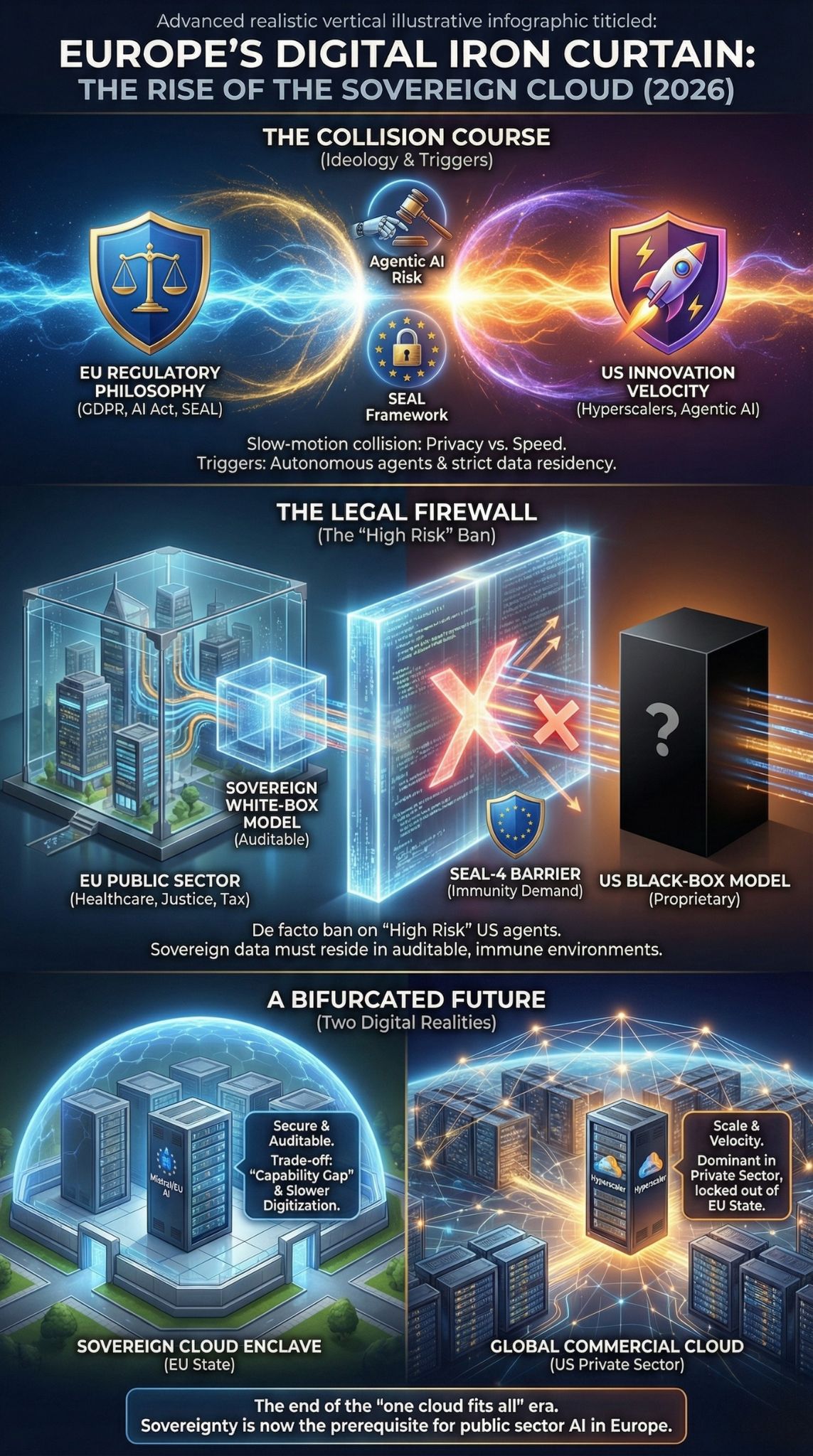
To understand why 2026 has become the breaking point, we must look at the slow-motion collision between US innovation velocity and EU regulatory philosophy. For the past decade, Europe has acted as the world’s “digital referee,” pioneering privacy laws like the GDPR (2018). However, the referee realized it wasn’t playing the game.
While the US dominated the cloud (AWS, Azure, and Google Cloud hold >70% of the EU market) and AI (OpenAI, Anthropic), Europe’s attempts to build alternatives largely struggled. The turning point arrived with two critical developments in late 2025:
- The Rise of “Agentic AI”: We moved from chatbots that talk to agents that act (executing bank transfers, updating criminal records). This terrified European regulators, as granting a US-hosted “black box” agency over European state functions was seen as a national security risk.
- The “SEAL” Framework: The European Commission introduced the Sovereign European Assurance Level (SEAL), a certification so strict on data residency and immunity from foreign laws (specifically the US CLOUD Act) that mainstream US hyperscalers physically cannot qualify for the highest tier without radical structural changes.
Core Analysis
1. The Legal Firewall: How “High Risk” Became a De Facto Ban
The “ban” on US AI agents is rarely explicit in a single line of legislation; rather, it is the cumulative effect of impossible compliance requirements. Under the EU AI Act, AI systems used in “essential public services” (healthcare, justice, social security) are classified as High Risk.
- The Conflict: High-risk systems require total transparency regarding training data and “traceability” of decision-making. US providers, protecting their IP, often refuse to disclose model weights or training sets.
- The Result: A de facto ban. Public sector CIOs in France and Germany are currently issuing directives that using US-hosted LLMs for citizen data constitutes a violation of data sovereignty. Agencies are migrating to locally hosted, “white-box” models (like Mistral or Aleph Alpha) running on sovereign infrastructure (like OVHcloud or T-Systems).
2. The “AI Factory” Strategy: Industrial Policy 2.0
Europe is no longer content with just fining US tech giants; it is trying to out-build them—or at least build “good enough” alternatives for the state.
- The Shift: The European Commission’s “AI Factories” initiative (launched late 2025) is pooling EU supercomputing resources (like LUMI in Finland and Leonardo in Italy) to train “sovereign” foundation models.
- The Mechanism: Unlike the commercial US model, these factories are publicly funded utilities. They offer startups and public agencies cheap access to compute power, provided the resulting models adhere to EU values and stay on EU soil.
- Why it Matters: This creates a bifurcated market. US tech remains dominant in the private sector, but the sticky, long-term public sector contracts are being fenced off for domestic players.
3. The “Black Box” Problem and Agency
The shift from Generative AI (chatbots) to AI Agents (systems that act) has fundamentally changed the risk calculus.
- The Fear: A chatbot answering questions is one thing; an AI Agent that can approve a visa or deny a welfare claim is another.
- The Sovereign Argument: If an AI agent makes an error in a US jurisdiction (e.g., denying a French citizen’s benefits based on a US-centric algorithm), the EU has no legal recourse against the model’s core logic if it resides on US servers under US law. Sovereignty here means “the right to audit the code that governs our citizens.”
4. The Transatlantic Rift: Geopolitical Risk
This move is risky. The US government has historically viewed digital protectionism as a trade barrier.
- Retaliation Risk: With protectionist sentiments rising globally, US trade representatives have flagged the “SEAL” requirements as discriminatory. We are seeing early signs of a “Digital Trade War,” where the US could retaliate with tariffs on European luxury goods or autos if US tech firms are completely shut out of the EU public sector ($300B+ market).
- The “NATO of Cloud”: Defense analysts are increasingly worried. If NATO relies on US cloud interoperability for joint operations, but EU member states ban those same clouds for their ministries of defense, it creates a dangerous interoperability gap during geopolitical crises.
5. The Infrastructure Gap: A Crisis of Capability
The most immediate crisis is practical: Europe doesn’t have the hardware yet.
- The Shortage: Banning US AI agents leaves European bureaucrats with inferior tools. European sovereign clouds often lack the seamless UI, massive GPU clusters, and advanced toolchains of Azure or AWS.
- The Consequence: A “Productivity Gap.” While a US agency might use an advanced Agent to automate 80% of paperwork, a German agency, restricted to a sovereign but less capable model, might only automate 20%. This technological divergence could hurt EU economic competitiveness in the medium term.
Data & Visualization
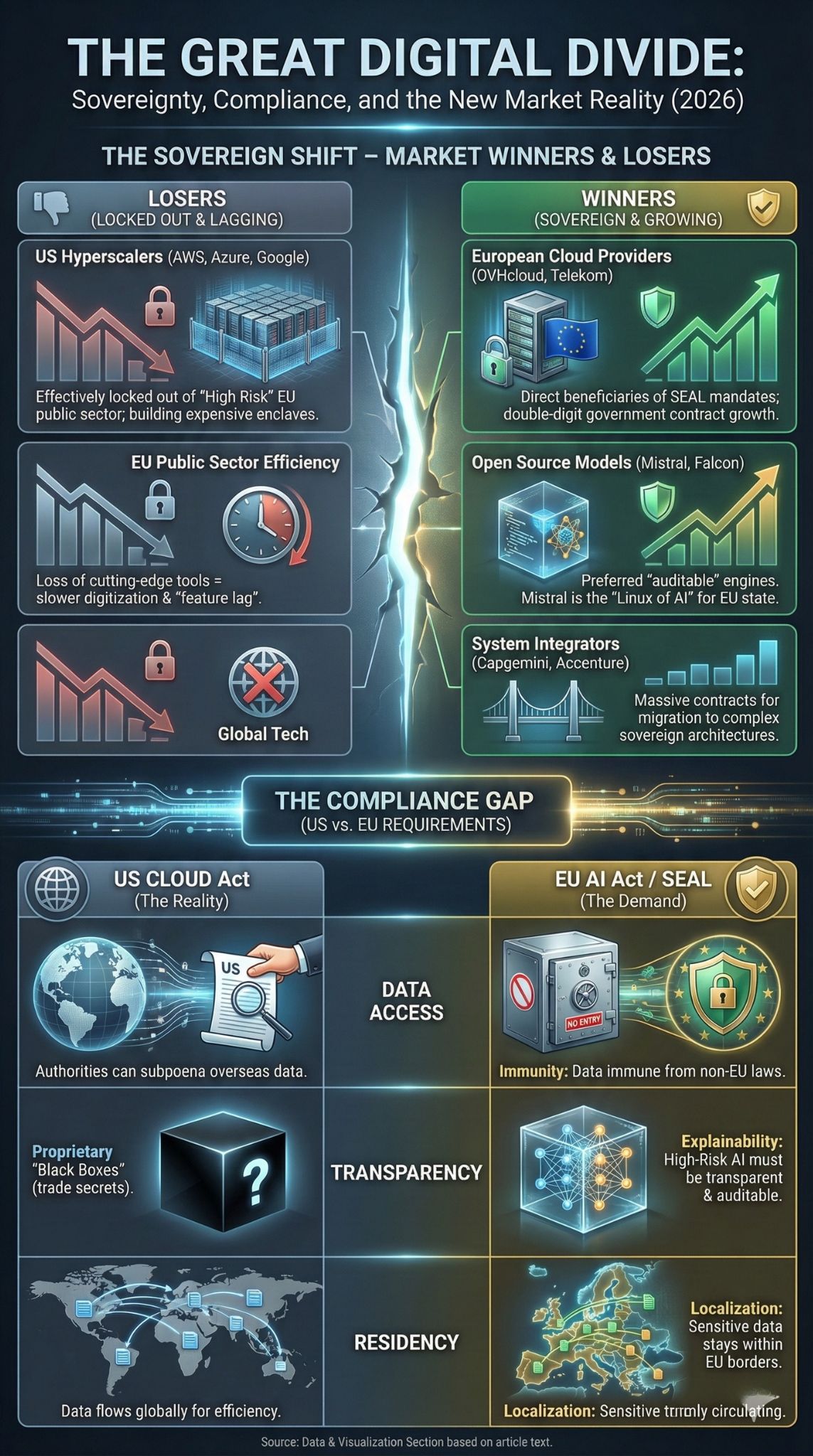
The Sovereign Shift – Winners vs. Losers (2026 Outlook)
| Entity | Status | Why? |
| US Hyperscalers (AWS, Azure, Google) | Loser | Effectively locked out of EU public sector “High Risk” use cases; forced to build expensive “sovereign” enclaves. |
| European Cloud Providers (OVHcloud, Deutsche Telekom) | Winner | Direct beneficiaries of the SEAL Level 3 mandates; seeing double-digit growth in government contracts. |
| Open Source Models (Mistral, Falcon) | Winner | The preferred “auditable” engines for sovereign clouds. Mistral is becoming the “Linux of AI” for the EU state. |
| EU Public Sector Efficiency | Short-term Loser | Loss of access to cutting-edge US tools leads to slower digitization and “feature lag.” |
| System Integrators (Capgemini, Accenture) | Winner | Massive contracts to migrate agencies from US public cloud to complicated EU sovereign architectures. |
The Compliance Gap (US vs. EU Requirements)
| Requirement | US CLOUD Act (The Reality) | EU AI Act / SEAL (The Demand) |
| Data Access | US authorities can subpoena data stored overseas by US companies. | Immunity: Data must be immune from non-EU extraterritorial laws. |
| Transparency | Proprietary models are “Black Boxes” (trade secrets protected). | Explainability: High-Risk AI must be transparent and auditable by EU regulators. |
| Residency | Data can flow globally for processing efficiency. | Localization: Sensitive data must strictly stay within EU borders (Data Residency). |
Expert Perspectives
To maintain objectivity, we must look at the conflicting views on this transition.
- The Sovereignty Hawks (France, Germany):
“We cannot allow the nervous system of the state to be hosted on servers we cannot inspect, governed by laws we did not write. Digital sovereignty is the prerequisite for political democracy in the 21st century.” — Senior EU Digital Policy Advisor (Synthesized View).- Argument: Dependence on US AI is a national security threat comparable to dependence on foreign energy (Russian gas).
- The Pragmatists (Business & Startups):
“By banning the best tools, we are fighting with one hand tied behind our back. A sovereign cloud that is 5 years behind the market standard is not a shield; it is a cage.” — CEO of a European Fintech Unicorn (Synthesized View).- Argument: The “Sovereign Cloud” is expensive and technically inferior. Isolating EU data stifles innovation and drives European AI talent to the US.
Future Outlook
As we look toward late 2026 and 2027, three distinct trends will likely emerge from this “Sovereign Cloud” push:
- The Rise of “Sovereign Enclaves”: US tech giants will not walk away. Instead, they will accelerate the deployment of “Sovereign Enclaves”—data centers physically located in Europe, disconnected from the global internet, and operated by European subsidiaries (or partners like Orange or T-Systems) to bypass regulations. Microsoft’s “Cloud for Sovereignty” is the prototype, but regulators may demand even stricter separation.
- Bifurcated AI Standards: We will see a split in AI development. “Global AI” (US/China) will optimize for scale and speed, while “Euro AI” will optimize for explainability, privacy, and small-model efficiency (SLMs). This could actually make European AI safer and more robust, even if it is less “smart” in raw benchmarks.
- The “Edge” Battlefield: As the Cloud and AI Development Act pushes for decentralized capacity, the battle will move to “Edge AI”—running agents directly on devices (laptops, phones) within government offices to avoid the cloud entirely, effectively sidestepping the data residency issue.
Conclusion
The ban on US AI agents in the EU public sector is not a temporary glitch; it is the new steady state. For US tech firms, the “one cloud serves all” model is dead. For European nations, the challenge is now execution: can they build a sovereign ecosystem fast enough to prevent a catastrophic technological lag? The “Sovereign Cloud” is no longer a concept—it is the only legal way forward for the European state.