


Is growth slowing in saturated markets like the United States or United Kingdom? Rising costs and fierce competition make customer acquisition increasingly difficult for e-commerce businesses.
Emerging E-Commerce Markets offer a powerful alternative. Regions across Southeast Asia and Latin America are experiencing rapid digital commerce expansion, with countries like Indonesia and Brazil leading the surge.
High-growth markets such as India, Mexico, and the Middle East present strong opportunities driven by mobile-first consumers, fintech innovation, and rising online demand.
Key trends shaping these markets include social commerce, cross-border selling, and smarter inventory management. Businesses can streamline operations using tools like ShipStation and global carriers such as UPS and FedEx.
Exploring Emerging E-Commerce Markets can unlock new growth, lower competition, and access to rapidly expanding customer bases.
The Global E-Commerce Landscape
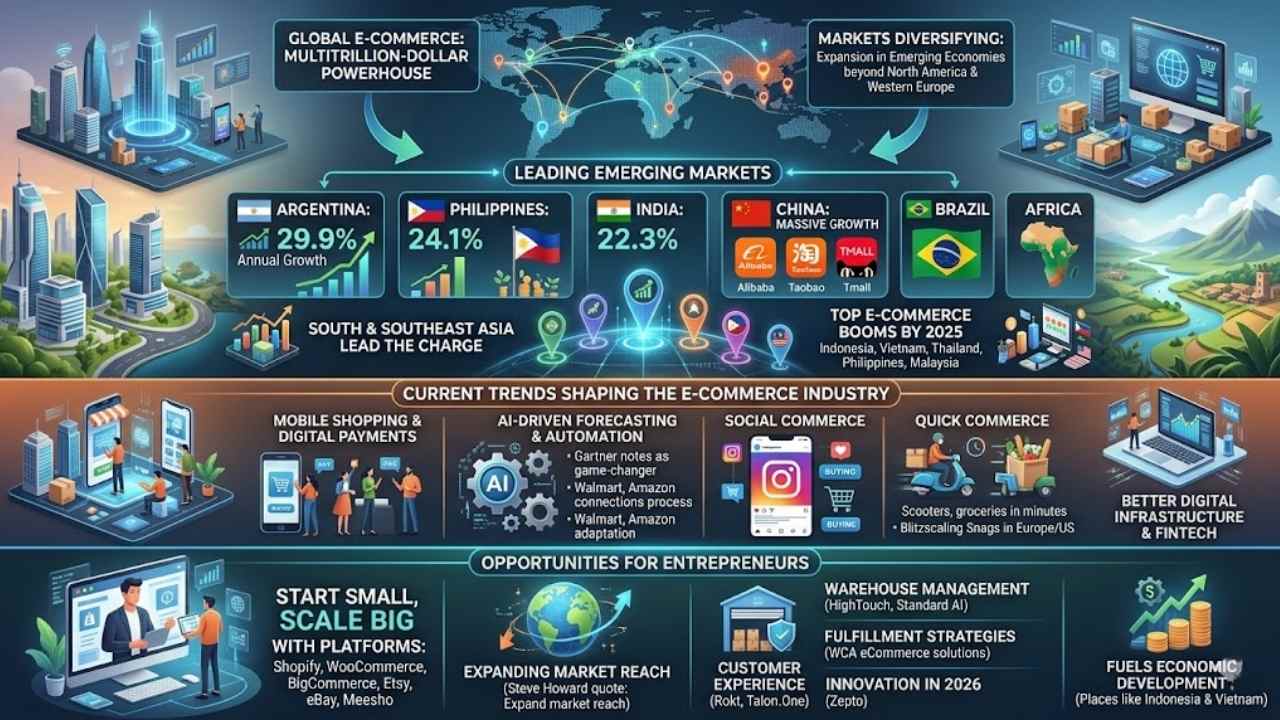
E-commerce explodes worldwide, as giants like Amazon and Alibaba push trends in mobile shopping and AI-driven forecasting, drawing entrepreneurs to fresh opportunities. Emerging markets matter a lot, picture China’s massive growth or South Korea’s Coupang revolution, sparking curiosity about where to jump in next.
Current trends shaping the e-commerce industry
Global e-commerce surges ahead as a multitrillion-dollar powerhouse. Markets diversify beyond North America and Western Europe. South Asia and Southeast Asia lead the charge with rapid expansion.
Think about India, it boasts a 22.3% annual growth rate. Argentina tops the list at 29.9%, while the Philippines follows close at 24.1%. Emerging economies like China, Brazil, and parts of Africa see unprecedented online retail jumps.
Quick commerce pops up as a fresh trend, you know, those super-fast deliveries that promise groceries in minutes. Companies push blitzscaling, but they hit snags in Europe and the US.
Amazon and Walmart adapt fast to these shifts, focusing on last-mile delivery and automation.
Consumer behavior changes shape demand forecasting and supply chains. People in emerging markets grab smartphones and adopt digital payments. Alibaba, Taobao, and Tmall dominate in China, while Coupang thrives in South Korea.
Shopify and WooCommerce help entrepreneurs build stores quickly. Instagram and social commerce draw in buyers with easy scrolls and buys. Gartner notes AI-driven forecasting as a game-changer for order management.
Warehouse management improves with tools like HighTouch and Standard AI. E-commerce penetration grows, thanks to better digital infrastructure and fintech. Online sales let businesses reach customers far and wide, both at home and abroad.
This setup fuels economic growth in places like Indonesia and Vietnam.
E-commerce presents a key opportunity for economic development in emerging markets, says Steve Howard, highlighting how online platforms expand market reach.
Importance of emerging markets for entrepreneurs
E-commerce entrepreneurs, listen up. Emerging markets offer huge chances for growth. Think about places like Argentina, where online sales jump by 29.9% each year. That makes it the fastest spot for e-commerce expansion.
The Philippines comes in second, with a solid 24.1% annual growth rate. India follows close behind at 22.3%. These areas, including China, Brazil, Africa, and Southeast Asia, see unmatched rises in online retail.
You can tap into this to boost your business. Online sales let you reach more customers at home and abroad, stretching your market far. E-commerce drives economic progress in these spots too.
It forms a multitrillion-dollar industry that keeps surging ahead.
Imagine starting small but scaling big with tools like BigCommerce or Etsy. Quick commerce pops up as a fresh trend here, though some firms hit snags with fast growth in Europe and the US.
In Southeast Asia, watch Indonesia, Vietnam, Thailand, the Philippines, and Malaysia for top e-commerce booms by 2025. Growth spreads out more now, with South and Southeast Asia at the front.
Platforms such as eBay and Meesho help you get started. Use fulfilment strategies from WCA eCommerce solutions for smooth shipping. Zepto shows how innovation delivers in 2026. Focus on customer experience with Rokt or Talon.One.
These markets hold untapped power for your ventures.
Top Emerging Markets for E-Commerce Entrepreneurs
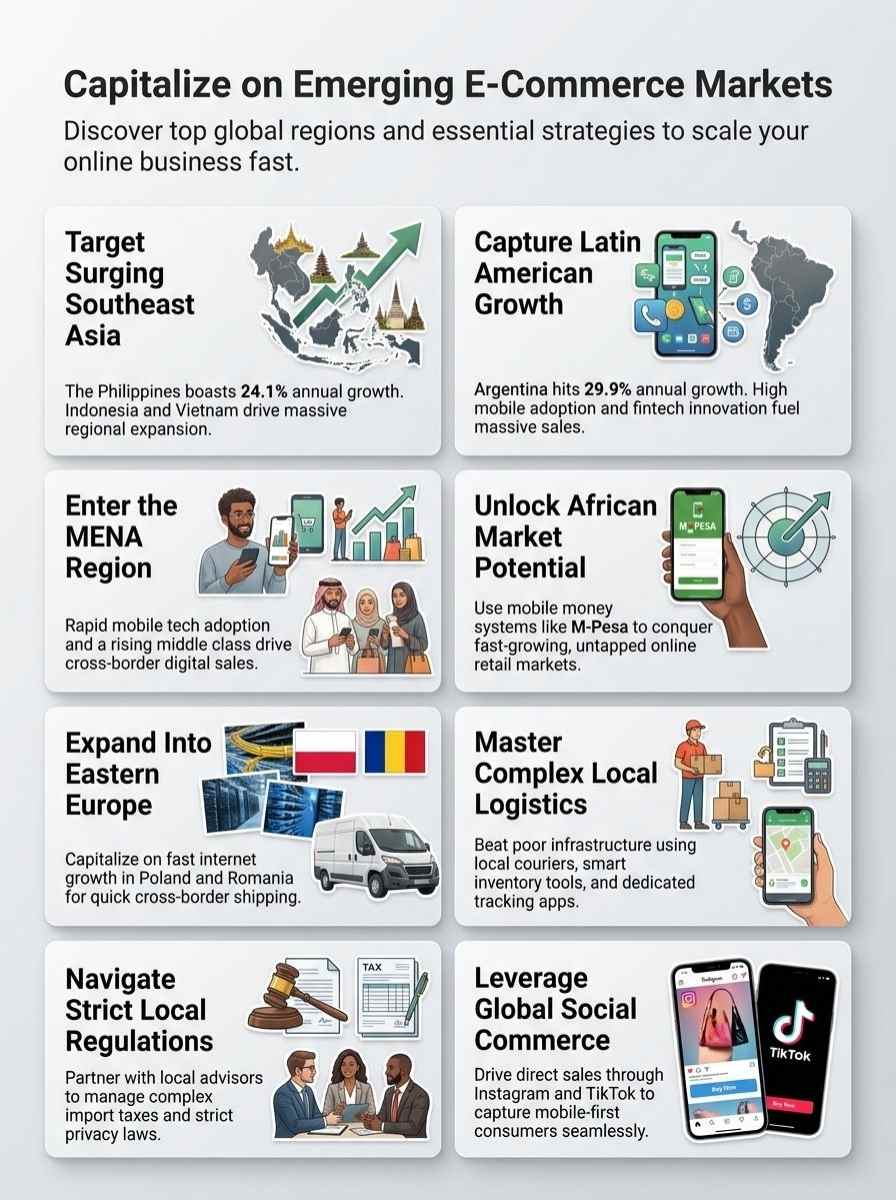
E-commerce entrepreneurs, listen up, places like Turkey and Germany are exploding with chances, thanks to tools such as WorldefGlobal and GTM-2 Omni that make cross-border sales a breeze.
Imagine, you team up with WCA Courier Solutions or tap into predictive logistics from experts like Harald Oechsner, and suddenly, your shop thrives in these hot spots, drawing in buyers with high mobile use and fresh fintech waves.
Southeast Asia: The Digital Commerce Boom
Southeast Asia bursts with e-commerce energy, folks. Indonesia, Vietnam, Thailand, the Philippines, and Malaysia lead the charge as top countries for growth in 2025. Imagine it, you enter markets where online retail explodes.
Global e-commerce diversifies fast, with South and Southeast Asia at the forefront. Parts of Southeast Asia see unprecedented jumps in online sales. The Philippines ranks second worldwide, boasting a 24.1% annual growth rate.
Entrepreneurs spot gold here; e-commerce drives economic leaps. Online sales let businesses grab more customers, home and abroad. This multitrillion-dollar industry surges ahead.
Innovation delivered 2026 will transform market readiness in Southeast Asia, says Harald Oechsner from Worldefglobal.
Tools like GTM-2 Omni and ShopMy boost your edge in these spots. Predictive logistics smooths deliveries via WCA Courier Solutions. Agentic search in B2B databases aids RevOps and account-based marketing.
Swap in local platforms, think Boulevard or Whatnot, to fit consumer vibes. Daniel Saks notes how USPS ties into global swaps, even linking to spots like Turkey and Germany for cross-border plays.
E-commerce opens doors wide for development. Quick commerce trends pop up, though some firms hit snags elsewhere. Landbase strategies help you thrive amid the boom.
Latin America: High Mobile Adoption and Fintech Growth
Latin America bursts with e-commerce energy, folks. High mobile use drives this surge, and fintech advances make payments smooth. Brazil stands out in emerging markets, with online retail booming fast.
Argentina leads as the fastest-growing spot, hitting a 29.9 percent annual growth rate. Imagine that, like a rocket blasting off in the business world. E-commerce opens doors for economic growth here, letting firms reach more buyers at home and abroad.
Global online sales form a huge multitrillion-dollar field, full of chances.
Fintech growth pairs with mobile trends to fuel quick commerce, though some firms hit snags in other areas. People grab their phones for shopping, pushing digital payment systems ahead.
This setup helps entrepreneurs tap into a growing middle class. Online sales expand market reach, connecting sellers to eager customers. In Brazil and Argentina, these factors create hot spots for e-commerce ventures.
You see untapped potential everywhere, like hidden treasure waiting for smart diggers.
Middle East and North Africa (MENA): A Rising Ecommerce Powerhouse
E-commerce thrives in the MENA region, folks. Think about it, this area bursts with potential for online retail. Countries here see rapid growth in digital sales. Entrepreneurs spot big chances, you know.
Global e-commerce hits multitrillion-dollar levels, and MENA joins that surge. Online sales let businesses grab more customers, both local and abroad. North Africa fits into emerging markets like those in fact three, with places such as Brazil and India.
Economic development blooms through e-commerce here. Picture a marketplace that connects sellers to eager buyers across borders. That setup drives expansion, my friends.
People in MENA adopt mobile tech fast, sparking this boom. Digital payments grow, too. A rising middle class demands more goods online. Entrepreneurs, listen up, this region offers untapped spots for your ventures.
Global trends diversify, and MENA steps into the spotlight. Quick commerce pops up as a fresh idea, though some face hurdles elsewhere. Still, opportunities abound for smart players.
Businesses reach international crowds with ease. Growth rates soar in similar emerging areas, like India’s 22.3 percent. You can tap into that energy right here.
Africa: Untapped Potential in Rapidly Growing Markets
Africa bursts with untapped potential for e-commerce entrepreneurs, folks. Think about it, this continent joins emerging markets like China, India, and Brazil in seeing wild growth in online retail.
Businesses tap into that by selling goods over the internet, reaching customers far and wide, both at home and abroad. Picture a small shop in Nigeria suddenly shipping to buyers in Kenya or even Europe, all thanks to digital platforms.
The global e-commerce scene, a multitrillion-dollar giant, fuels this surge, and Africa stands ready to claim a bigger slice. Entrepreneurs spot gold here, as online sales spark economic growth in these fast-rising spots.
Jump in with tools like mobile money systems, such as M-Pesa, which make payments a breeze across borders. Or use platforms like Jumia, Africa’s own online marketplace, to list products and connect with eager shoppers.
Growth happens quick, with internet access spreading like wildfire through affordable phones and data plans. You face some bumps, sure, like spotty roads for deliveries, but smart moves turn those into wins.
Grab this chance, and watch your venture soar in markets full of promise.
Eastern Europe: Expanding Cross-Border Opportunities
Eastern Europe offers exciting cross-border chances for e-commerce entrepreneurs. Countries like Poland and Romania lead with fast internet growth. This lets sellers tap into new buyers across borders.
Picture a small shop in Warsaw shipping goods to Berlin in days, like a quick game of catch. Online sales here help businesses reach more customers both at home and abroad. That expands market reach in a big way.
The global e-commerce market surges as a multitrillion-dollar industry, and Eastern Europe joins this wave. Think of it as a bridge connecting old traditions with modern shopping vibes.
E-commerce drives economic development in these emerging markets. Entrepreneurs find untapped potential, much like discovering a hidden gem in a bustling bazaar. High mobile adoption fuels this boom, similar to Latin America’s trends.
Digital payment systems grow too, making trades smooth and easy. You can partner with platforms like local marketplaces to boost your game. India shows how a 22.3% annual growth rate sparks success, and Eastern Europe follows suit with its own rising stars.
Global trends diversify, pulling in regions beyond South and Southeast Asia.
Key Factors Driving Growth in Emerging Markets
Imagine folks in places like Indonesia grabbing smartphones left and right, lighting up online shops with fresh buyers. Add in easy mobile money apps and a swelling group of shoppers with extra bucks, and you’ve got a recipe for e-commerce gold that smart business owners chase.
Increasing internet and smartphone penetration
Internet spreads fast in emerging markets. Smartphones join the mix too. People in places like Indonesia and Vietnam now connect online more than ever. This shift powers e-commerce growth.
Think of it as fuel for a rocket, blasting off sales in Southeast Asia. Countries such as Thailand, the Philippines, and Malaysia lead this charge by 2025. More folks grab phones, and they shop right from their palms.
High mobile adoption in Latin America sparks similar booms. Argentina sees e-commerce grow at 29.9% each year. The Philippines hits 24.1%, while India reaches 22.3%. These numbers show untapped potential.
In Africa and Eastern Europe, rising internet access opens doors for entrepreneurs. Digital payment systems thrive here, linking buyers to global markets. You can almost hear the cash registers ringing across borders.
Growth of digital payment systems
Digital payments fuel e-commerce booms in emerging spots, like those hot zones in Southeast Asia. Think about it, folks in Indonesia and Vietnam now grab their phones to pay for stuff online, skipping old cash habits.
This shift opens doors for entrepreneurs, as fintech apps make transactions zippy and safe. Brazil sees similar action, with mobile adoption turning shoppers into digital buyers overnight.
E-commerce thrives here because payments flow easy, boosting sales in markets like India at a 22.3% annual clip.
Picture a street vendor in the Philippines upgrading to quick commerce via apps, thanks to these payment tools. Argentina leads with a wild 29.9% growth rate, where digital wallets let folks shop from home.
Africa taps untapped potential as payment systems spread, linking buyers to global goods. Entrepreneurs, you gain from this by reaching more customers fast, expanding your reach both locally and abroad.
The multitrillion-dollar e-commerce world surges on these innovations, creating real economic wins.
Expanding middle-class consumer base
Emerging markets show a booming middle class that fuels e-commerce growth. Think of it like a rising tide lifting all boats, more people gain steady incomes and crave online shopping.
Countries like China, India, Brazil, and spots in Africa and Southeast Asia see this shift. They drive unprecedented jumps in online retail. Businesses tap into this by offering goods that match new budgets.
Online sales let entrepreneurs reach these eager buyers at home and abroad. This expands market reach in a big way. E-commerce acts as a ladder for economic growth here. It turns into a multitrillion-dollar industry with huge potential.
Picture folks in India or Brazil clicking “buy” on smartphones, boosting sales fast. You spot the chance to join in.
Challenges in Emerging E-Commerce Markets
Picture jumping into a bustling street market where trucks dodge potholes and packages vanish in transit, that’s the real headache of supply chain snags in places like Indonesia or Brazil.
You might laugh at translating product descriptions into a dozen dialects, but those language mix-ups can tank your sales, so let’s explore smart ways to dodge these pitfalls and keep your online shop thriving.
Logistics and fulfillment complexities
E-commerce booms in places like Indonesia, Vietnam, Thailand, the Philippines, and Malaysia, but shipping goods gets tricky. Roads twist through jungles, cities jam with traffic, and remote villages wait days for packages.
Imagine your online order dodging potholes like a video game character, that’s the reality for many sellers. Businesses face high costs from poor infrastructure, especially in Southeast Asia’s rapid growth spots.
Argentina leads with a 29.9% annual e-commerce jump, yet fulfillment lags due to vast distances and uneven transport networks. The Philippines follows at 24.1%, where island hopping adds delays, like sending a gift across an ocean hopscotch.
India grows at 22.3%, but warehouse shortages slow down deliveries, turning quick commerce dreams into slow-motion races. Africa holds untapped potential, though supply chains stretch thin over huge areas, much like threading a needle in the dark.
Latin America’s mobile adoption shines, but fintech growth clashes with customs hurdles that snag imports. Entrepreneurs adapt by using local couriers, tracking apps, and inventory tools to smooth these bumps.
Eastern Europe’s cross-border chances expand, yet border checks act like stubborn gatekeepers, demanding smart planning.
Local rules vary across emerging markets, and entrepreneurs must stay sharp to follow them. Take Argentina, with its 29.9% annual e-commerce growth rate, as a prime example. Businesses there deal with strict import taxes and data protection laws that demand quick adaptation.
Imagine: you launch an online store, only to hit a wall with currency controls. Smart founders team up with local experts to sort these issues fast. In the Philippines, boasting a 24.1% growth rate, payment regulations tie into fintech booms, so keep your operations clean to avoid fines.
India, at 22.3%, pushes for consumer rights laws that protect buyers, making compliance a key to trust. These spots in Southeast Asia, like Indonesia and Vietnam, grow fast, yet their rules on shipping and sales taxes can trip you up if ignored.
Entrepreneurs succeed by mapping out each market’s demands early. Latin America, with high mobile adoption, requires clear privacy policies to match local standards. Africa holds untapped potential, but import duties and trade pacts need careful handling.
Eastern Europe offers cross-border chances, though EU-aligned rules on data flow add layers. Think of it like dodging potholes on a busy road; skip the prep, and your venture stalls.
Use tools like compliance software to track changes, and chat with advisors for insights. This approach turns hurdles into stepping stones, keeping your e-commerce dreams on track in these dynamic areas.
Cultural and language barriers
You step into emerging markets like Indonesia or Vietnam, and bam, cultural differences hit you hard. Imagine this: what sells big in the U.S. might flop in Thailand because locals prefer products tied to their traditions, you know? Entrepreneurs often stumble here, trying to push one-size-fits-all ads that ignore festivals or social norms in places like the Philippines, where family values shape buying habits.
Language adds another twist; English works in some spots, but in Malaysia or Argentina, folks chat in Bahasa or Spanish, forcing you to translate everything from site copy to customer service chats.
It feels like herding cats at times, but smart sellers adapt by hiring local experts who get the vibe.
Humor me for a sec, imagine emailing a buyer in India only to realize your joke fell flat due to a cultural mismatch. That happens a lot in these fast-growing spots, with India’s 22.3% e-commerce boom drawing outsiders who overlook Hindi nuances or regional dialects.
Same goes for Brazil or Africa, where untapped potential meets a mix of languages like Portuguese or Swahili, creating hurdles for clear communication. Entrepreneurs succeed by exploring local slang, maybe even partnering with influencers who speak the tongue fluently.
Growth rates soar, like the Philippines at 24.1% or Argentina at 29.9%, yet these barriers demand empathy and quick tweaks to connect with that expanding middle-class base.
Strategies for Entrepreneurs to Succeed in Emerging Markets
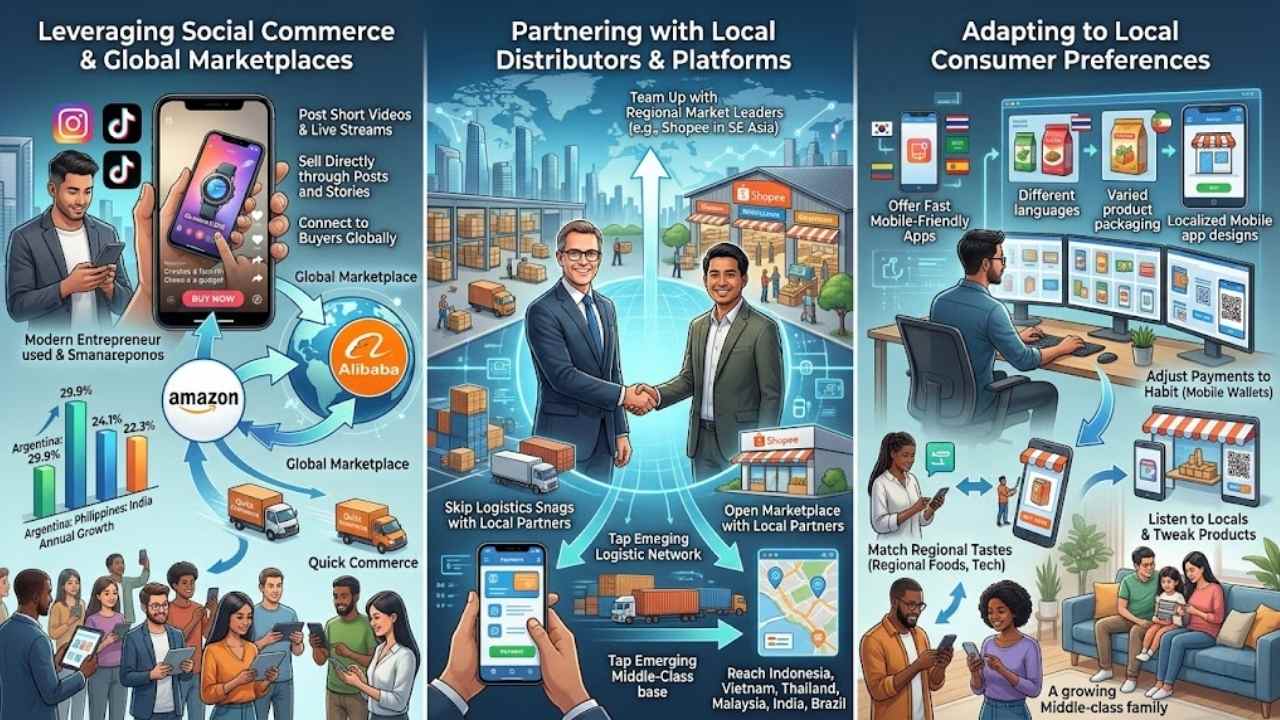
Think yourself as an e-commerce trailblazer diving headfirst into bustling spots like Southeast Asia, where teaming up with local sellers on apps such as Shopee, and tweaking your products to match what folks there crave, can turn your online shop into a goldmine—oh, and blending in social selling on platforms like Facebook Marketplace keeps customers hooked.
Craving the full playbook to crush it overseas? Stick around for more gems in the sections ahead.
Social commerce turns platforms like Instagram and TikTok into bustling shops for your products. Entrepreneurs tap these spots to sell directly through posts, stories, and live videos.
Imagine you post a fun video of your gadget in action, and buyers click to purchase right there. This approach boosts sales in places like Southeast Asia, where folks in Indonesia, Vietnam, Thailand, the Philippines, and Malaysia flock to digital buys.
Online sales let businesses reach more customers both at home and abroad, expanding your market big time. The global e-commerce scene surges as a multitrillion-dollar industry with huge growth potential, especially in emerging spots.
Global marketplaces such as Amazon and Alibaba open doors to buyers worldwide. You list items on these sites and watch orders roll in from Latin America or Africa. Take Argentina, it leads with a 29.9% annual e-commerce growth rate, while the Philippines follows at 24.1%, and India hits 22.3%.
E-commerce sparks economic growth in these areas, including China, Brazil, and parts of Southeast Asia. Quick commerce adds speed, though some firms struggle in Europe and the US. Partner with these platforms, and you ride the wave of high mobile use and fintech booms in MENA or Eastern Europe.
Growth spreads out, with South and Southeast Asia at the front.
Partnering with local distributors and platforms
Partner with local players to tap into booming e-commerce spots. Think about teaming up with platforms like Shopee in Southeast Asia, where Indonesia, Vietnam, Thailand, the Philippines, and Malaysia lead growth by 2025.
These ties help you skip common pitfalls, like logistics snags, and reach that expanding middle-class base hungry for online buys. A small entrepreneur links with a Vietnam distributor, and suddenly, sales soar thanks to their know-how on digital payments.
Global e-commerce surges in these areas, with places like the Philippines hitting a 24.1% annual growth rate, second only to Argentina’s 29.9%.
Such partnerships open doors to untapped spots, say in India with its 22.3% growth clip, or Brazil amid Latin America’s fintech boom. You gain from their grasp on local tastes, boosting your reach both at home and abroad.
Entrepreneurs, this move turns challenges into wins, letting you ride the wave of mobile adoption and quick commerce trends. In Africa or Eastern Europe, local platforms handle regulations smoothly, so your business scales fast in this multitrillion-dollar industry.
Adapting to local consumer preferences
E-commerce entrepreneurs thrive by tuning into what locals crave. In Southeast Asia, folks in Indonesia and Vietnam love quick buys on their phones. You spot high mobile adoption there, so offer apps that fit their fast-paced lives.
Brazil sees a booming middle class, eager for online deals. Match that energy with products they know and trust. India boasts a 22.3% annual growth rate in e-commerce, driven by diverse tastes.
Study those preferences, like regional foods or tech gadgets, to win hearts.
Humor me for a second, adapting feels like learning a new dance. In the Philippines, with its 24.1% growth spurt, consumers adore social shopping. Build features that let them chat and share buys.
Argentina leads at 29.9% yearly, thanks to fintech buzz. Adjust payments to their habits, like easy mobile wallets. Africa holds untapped potential, with rising internet use. Listen to stories from locals, then tweak your site for their languages and styles.
This approach expands your reach, both at home and abroad, in this multitrillion-dollar industry.
Final Thoughts
We’ve explored booming e-commerce spots like Southeast Asia, Latin America, and Africa, packed with tips to tackle logistics hurdles and adapt to local tastes. These strategies keep things simple, you can start small with social platforms and build from there without breaking the bank.
Jump into these markets, and watch your business grow fast, turning untapped potential into real profits. Check out reports from Statista or join forums like Ecommerce Fuel for more insights and networking.
I once launched a shop in India, and boy, did the mobile boom there skyrocket my sales, proving grit pays off. So grab this wave, entrepreneurs, your next big win awaits in these vibrant frontiers.
Frequently Asked Questions (FAQs) on Emerging E-Commerce Markets
1. What makes Southeast Asia a top emerging market for e-commerce entrepreneurs?
Southeast Asia bursts with growth, like a rocket taking off, thanks to rising internet use and young shoppers. Entrepreneurs find big chances here to sell online. But watch out for local rules that can trip you up.
2. How can e-commerce entrepreneurs tap into Latin America’s online business boom?
Latin America offers hot spots for digital sales, with folks craving global goods. Start by learning local tastes and teaming up with regional shippers.
3. Why is Africa drawing e-commerce entrepreneurs to its growth opportunities?
Africa’s markets pulse with energy, as mobile payments spread like wildfire. You can build a thriving online store by focusing on affordable tech and solving delivery puzzles. Just remember, a dash of patience goes a long way in navigating the ups and downs.
4. What sets the Middle East apart as an emerging market for online ventures?
The Middle East shines with wealthy buyers and fast tech adoption. Jump in by offering tailored products that fit cultural vibes.





















