

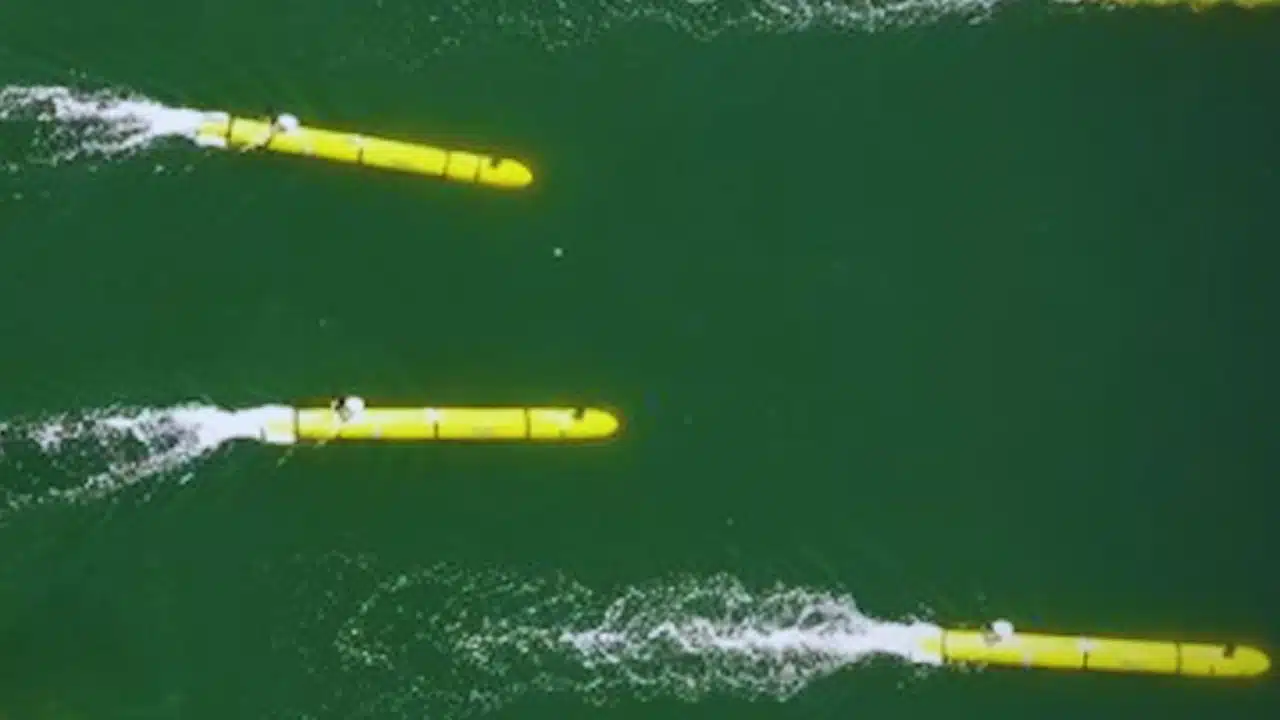
India has recently made a significant stride in enhancing its undersea warfare capabilities with the introduction of the Man‑Portable Autonomous Underwater Vehicle (MP‑AUV), a groundbreaking initiative by the Defence Research and Development Organisation (DRDO). This cutting-edge program, developed by the Naval Science and Technological Laboratory (NSTL) in Visakhapatnam, marks a major milestone in India’s naval technology. The MP‑AUV program utilizes artificial intelligence (AI) to create a more efficient, autonomous, and agile mine-hunting system, significantly improving India’s underwater defense systems.
The introduction of the MP‑AUV is a game-changer for mine countermeasure missions, which have traditionally relied heavily on large, crewed vessels and complex, manual systems. These missions, which are critical for protecting naval vessels and ensuring the safety of maritime trade routes, have historically been slow, resource-intensive, and risky. However, the DRDO’s new system is poised to change all of that.
The MP‑AUV is designed to be compact and portable, allowing it to be deployed by small naval teams without the need for large ships or heavy logistical support. This innovation is significant because it enables the Indian Navy to carry out mine-hunting missions from smaller vessels or even remote locations. As a result, the need for heavy equipment and significant resources is minimized, making the operation more cost-effective, efficient, and flexible.
This shift also improves operational agility. The ability to deploy these autonomous drones from smaller craft means the Navy can act quickly in situations where larger vessels would not be feasible, particularly in tight or shallow waters. Additionally, the compact nature of the vehicle allows for easier transportation and deployment, enabling naval teams to engage in missions with less preparation time.
At the heart of the MP‑AUV is a combination of cutting-edge technologies designed to make underwater mine detection faster, safer, and more accurate. These include advanced sonar sensors, deep-learning-based artificial intelligence, and resilient acoustic communication systems.
The system is equipped with Side Scan Sonar modules and underwater electro-optical cameras. These high-tech sensors allow the drone to create highly detailed maps of the seabed, capturing high-resolution images and acoustic signatures of underwater anomalies. This data is invaluable for detecting potential threats, including mines, which are often difficult to spot using traditional methods.
The MP‑AUV’s deep-learning algorithms are another major advancement. Once the system detects a potential mine, the onboard AI compares the object’s shape, reflectivity, and other characteristics with a pre-trained database of mine signatures. The AI then categorizes the threat, allowing naval operators to quickly assess whether the object poses a danger. This process drastically reduces decision-making time and allows for more efficient responses, increasing the speed of the mission and the overall effectiveness of mine detection.
One of the most important features of the AI-based system is its ability to operate autonomously, without human intervention. This reduces the reliance on human operators, decreasing the risk of human error and fatigue, especially during long and strenuous operations. It also enables the drone to continue working for extended periods, optimizing the overall mission time.
Moreover, the onboard deep-learning system ensures that the AI can improve over time, learning from previous missions and constantly refining its detection capabilities. This evolving intelligence makes the MP‑AUV a more sophisticated tool for mine detection than previous systems.
A standout feature of the DRDO’s MP‑AUV is its swarm capability, which allows multiple AUVs to work together seamlessly during missions. The drones are equipped with acoustic communication networks that enable them to exchange data in real-time. This allows for coordinated actions and decision-making among the drones, much like a “digital swarm.
When deployed together, the drones can navigate as a team, share situational data, confirm potential mine locations, and cover large operational zones more effectively. This decentralized, cooperative approach enhances the accuracy and speed of the mission, as the drones work in unison to map the area, detect threats, and reduce the time needed for mission completion.
The ability of the drones to communicate with each other during operations allows them to cover larger areas faster, providing more comprehensive surveillance and detection capabilities. This collaboration not only improves detection reliability but also ensures more precise mapping of the seabed and the identification of potential threats. By working together, the drones increase the overall operational efficiency of the mission, allowing naval teams to tackle larger and more complex areas with reduced manpower and fewer resources.
This swarm technology also makes the MP‑AUV adaptable to a variety of mission requirements, whether it involves mapping seabed terrain, detecting mines, or assisting in harbor defense. The drones’ ability to function in tandem allows for faster coverage of large operational areas, ensuring that missions are completed efficiently and effectively.
The MP‑AUVs recently underwent a series of extensive field trials at the NSTL facilities in Visakhapatnam, where key mission parameters were put to the test. These trials focused on evaluating endurance, classification accuracy, and underwater communication performance. The results were overwhelmingly positive, confirming the system’s capabilities in real-world conditions.
Following these successful trials, the DRDO is now moving forward with the production phase of the MP‑AUV project. Several private-sector partners have already been brought on board as part of the DRDO’s technology transfer and manufacturing ecosystem, which will help scale production and ensure that the system can be deployed in large numbers.
The collaboration between DRDO and private industry is a vital aspect of India’s ongoing efforts to develop indigenous defense technologies. With support from private companies, the MP‑AUV project can quickly move from the testing phase to full-scale production, enabling the Indian Navy to benefit from this advanced technology in the near future.
According to Dr. Samir V Kamat, Chairman of the DRDO, the MP‑AUV initiative is a significant milestone in the evolution of India’s undersea combat and surveillance systems. He emphasized that the system embodies the core principles of intelligent, low-risk, and networked operations, which are essential for modern naval warfare environments.
By dramatically reducing operational hazards and logistical requirements, the MP‑AUV will significantly enhance the Indian Navy’s readiness for missions involving mine detection, harbor defense, and seabed surveys. The technology is also expected to reduce the exposure of human operators to dangerous underwater conditions, making the system safer and more effective.
The success of this program also aligns with India’s broader defense goals, including the Make in India initiative, which focuses on developing and manufacturing indigenous technologies. The MP‑AUV project underscores India’s ability to develop world-class defense systems that meet the demands of modern warfare. It also positions India as one of the few nations capable of producing AI-driven, swarm-capable autonomous underwater vehicles for mine warfare and littoral operations.
The MP‑AUV program also highlights the growing role of private firms in India’s defense sector. The DRDO has created an ecosystem that fosters collaboration between the public and private sectors, enabling the rapid development and deployment of advanced defense technologies. India’s private sector is playing an increasingly important role in areas such as sensor development, battery technology, control electronics, and composite hulls.
With the DRDO’s industrial network valued at over ₹80,000 crore, the expansion of private sector participation is a key driver of India’s progress in the defense technology space. This collaboration not only strengthens India’s defense capabilities but also ensures the continued growth of its indigenous defense manufacturing sector, positioning the country as a global leader in autonomous underwater systems.
The AI-powered MP‑AUV is a significant step forward in India’s defense capabilities, particularly in the field of undersea warfare. By enabling faster, more efficient mine detection and underwater operations, the DRDO’s innovation is poised to enhance India’s naval readiness while reducing the risks to human life and the resources required for such operations.
As the MP‑AUV moves into production, it signals India’s growing self-reliance in defense technology and its continued progress toward becoming a global leader in autonomous systems. The combination of advanced AI, swarm technology, and collaborative capabilities makes the MP‑AUV a vital asset for the Indian Navy and further establishes the country’s strategic dominance in the undersea combat and defense sector.





















