Ever feel completely worn out just from deciding what to eat for dinner? Staring at an open fridge while even choosing a simple snack feels overwhelming is a common experience. That heavy mental feeling is known as decision fatigue—a state where repeated choices drain mental energy, making it harder to make good decisions as the day goes on.
Understanding how decision fatigue works can be the key to regaining focus and clarity. When mental energy is depleted, even small decisions begin to feel difficult and exhausting.
The following guide explains practical steps that can help reduce decision fatigue and make daily choices easier. The solutions may be simpler than expected and can quickly restore mental clarity and confidence in everyday decision-making.
Decision Fatigue: What Exactly Is It?
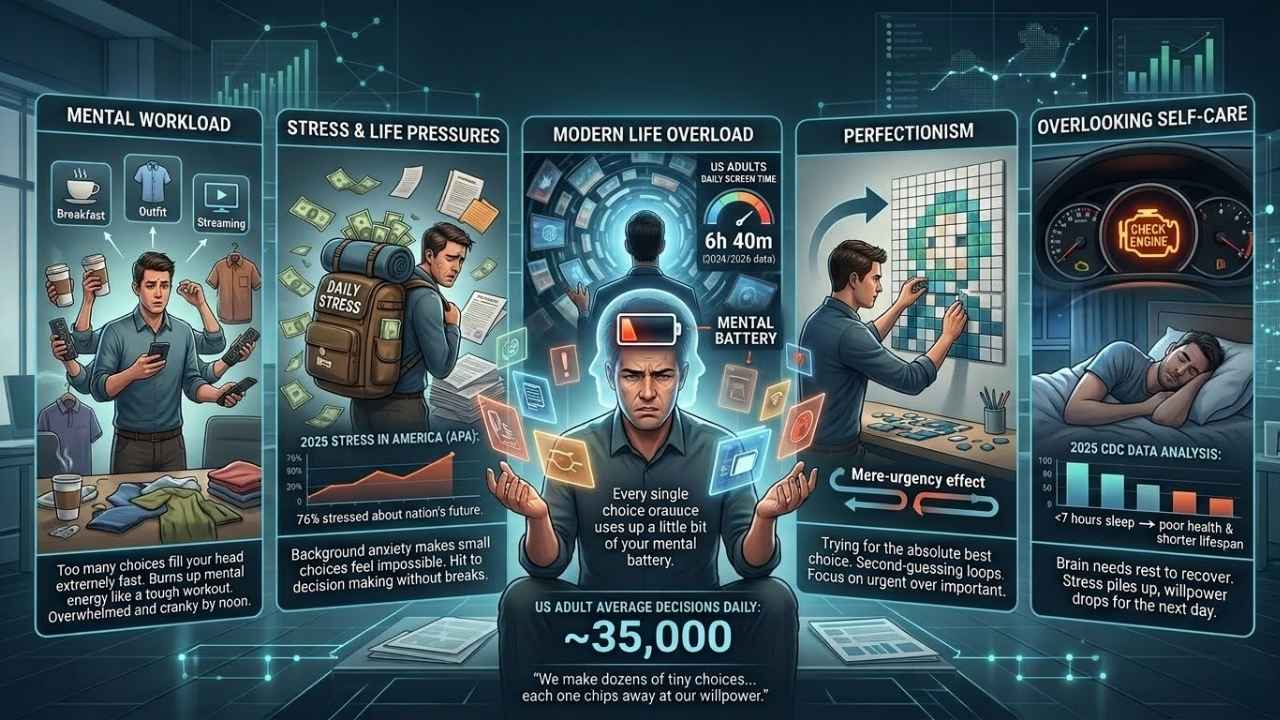
Decision fatigue happens when your brain gets exhausted from making too many choices. Every single choice uses up a little bit of your mental battery.
Did you know the average adult in the US makes around 35,000 remotely conscious decisions every single day? That is a staggering number of choices to process.
“We make dozens of tiny choices every minute, and each one chips away at our daily willpower.”
This is not just about big life choices. Simple questions like what shirt to wear or which email to answer first add up quickly.
Why Does Decision Fatigue Happen?
Life can feel like a circus with options flying at you from every corner. Let’s look at the main reasons your brain just wants to drop the balls and take a nap.
Mental workload
Too many choices fill your head extremely fast. Think about your average morning routine.
You pick a breakfast, choose an outfit, and scroll through streaming options before you even leave the house. That heavy cognitive load burns up mental energy just like a tough workout at the gym.
By the time noon rolls around, all those micro-decisions leave you feeling overwhelmed and cranky.
Stress and life pressures
Daily stress acts like a heavy backpack you can never take off. Bills pile up, and everyone seems to need your attention at the exact same moment.
A 2025 Stress in America report by the American Psychological Association found that 76% of US adults are stressed about the future of the nation. That heavy background anxiety makes even small daily choices feel impossible.
When you juggle work deadlines and family needs without proper stress management breaks, your decision making skills naturally take a huge hit.
Modern life overload
We have more options today than humans have ever had before. From picking a cereal to choosing a movie, every action demands focus.
To put this in perspective, data from 2024 and 2026 shows that US adults spend an average of 6 hours and 40 minutes a day just looking at internet-connected screens. That constant digital noise drains your resources quickly.
Here are the biggest culprits of modern choice overload:
- Endless scrolling on social media feeds.
- Reading hundreds of daily work emails.
- Browsing huge menus on food delivery apps.
- Picking something to watch on streaming platforms.
Perfectionism
Trying to make the absolute best choice every single time is a trap. Perfectionism tricks your brain into thinking one wrong pick could ruin everything.
This triggers what psychologists call the mere-urgency effect. We end up focusing on tasks that feel urgent right now, instead of tasks that are actually important for our goals.
Perfectionists get caught in endless loops of second-guessing, which adds massive cognitive load to simple things like replying to a text.
Overlooking self-care
Skipping self-care is exactly like ignoring the flashing check engine light on your dashboard. Your brain desperately needs rest to recover.
A massive 2025 analysis of CDC data covering over 3,000 US counties found that getting less than seven hours of sleep is one of the strongest predictors of poor health and a shorter lifespan. Sleep is not a luxury.
Without proper rest, your stress piles up and eats away at your willpower for the next day.
Signs and Symptoms of Decision Fatigue
Feeling tired in your mind sneaks up on you after a long day of choosing. Doctors see this frequently, and it makes simple tasks feel incredibly heavy. Here is how to spot it.
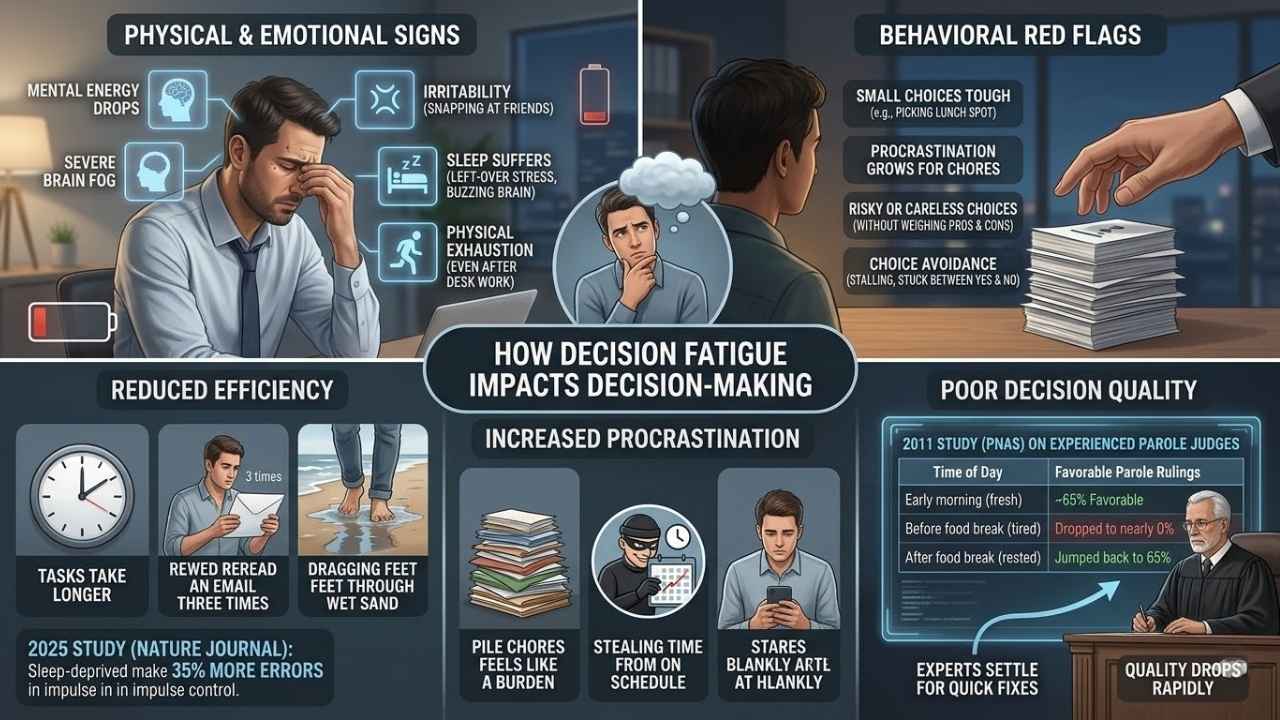
Physical and Emotional Signs
- Mental energy drops fast, leaving you with severe brain fog.
- Irritability kicks in, making you snap at friends for tiny things.
- Sleep suffers because leftover stress keeps your brain buzzing all night.
- You feel physically exhausted even if you sat at a desk all day.
Behavioral Red Flags
- Small choices become tough, like picking a lunch spot.
- Procrastination grows stronger for everyday chores.
- You start making risky or careless choices without weighing the pros and cons.
- You avoid making any choice at all, stalling completely because a simple “yes” or “no” feels too hard.
How Decision Fatigue Impacts Decision-Making
This kind of exhaustion slows your thinking and clouds your judgment. It leaves you second-guessing everything.
Reduced efficiency
Tasks simply take longer when your mental battery is flashing red. You might reread the same email three times or forget simple steps in a process.
A tired brain struggles to function well. A 2025 study published in the journal Nature discovered that sleep-deprived people make 35% more errors in basic impulse control tasks.
Making lots of small choices feels like dragging your feet through wet sand, slowing your efficiency to a crawl.
Increased procrastination
When choices pile up, small tasks start to feel like massive burdens. You end up putting them off until later.
Without recovery through sleep or solid habits, procrastination grows stronger each day. It acts as a sneaky thief stealing precious time from your schedule.
Instead of tackling your list, you might find yourself staring blankly at your phone.
Poor decision quality
Mental exhaustion leaves even the smartest people settling for quick fixes. Quality drops rapidly because your mind just wants the choosing to stop.
A famous 2011 study from the Proceedings of the National Academy of Sciences looked at experienced parole judges to see how their choices changed over a day.
| Time of Day | Favorable Parole Rulings |
|---|---|
| Early morning (fresh and rested) | Roughly 65% |
| Right before a food break (tired) | Dropped to nearly 0% |
| Right after a food break (rested) | Jumped back to 65% |
This proves that even experts make worse choices when they skip breaks and push through the fatigue.
Strategies to Overcome Decision Fatigue
Small tweaks can give your tired mind a much-needed break. You can protect your energy by building a few smart habits.
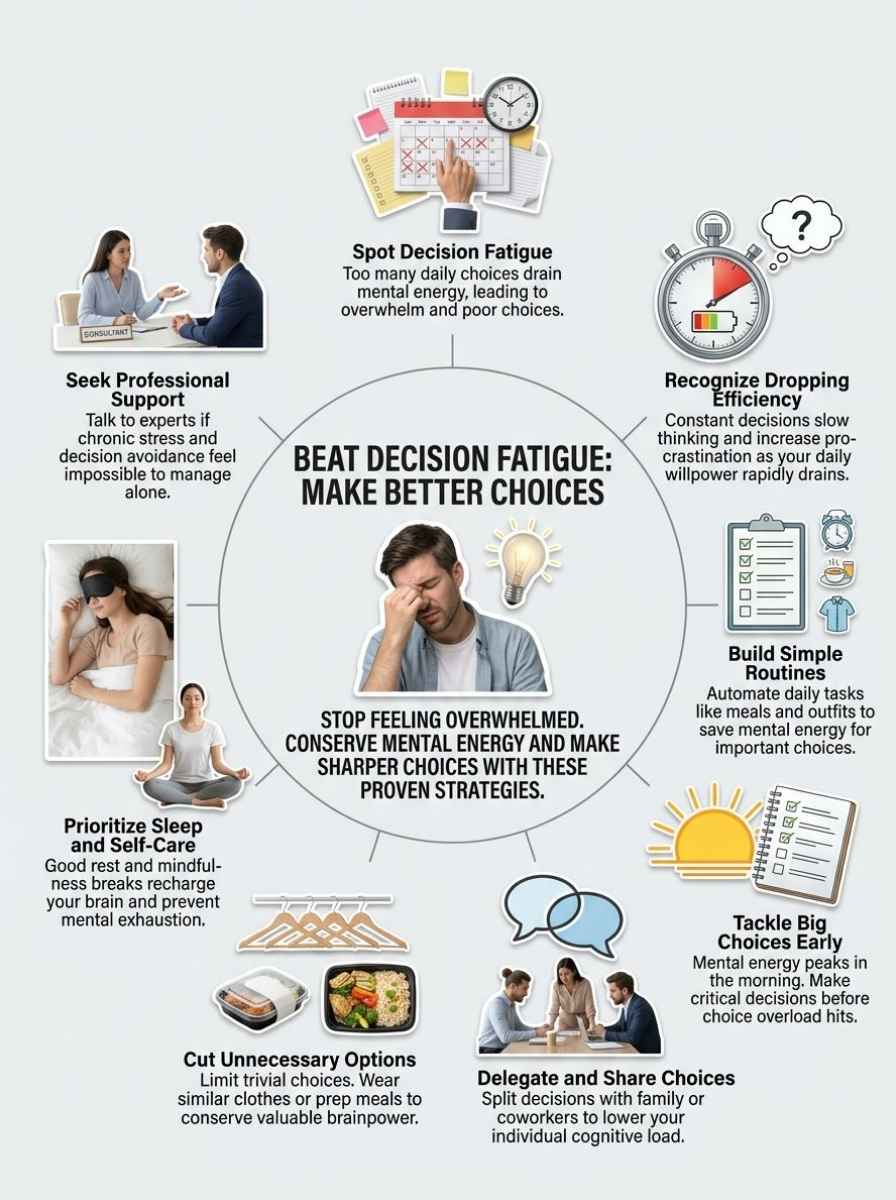
Create simple routines
Routines act like an autopilot setting for your morning. They cut down on options, so your brain saves energy for the bigger challenges ahead.
Getting dressed sounds easy, but picking out clothes eats away at your willpower. This is exactly why successful business leaders like Steve Jobs famously wore the same black turtleneck outfit every single day.
Set out your clothes tonight or eat the same healthy breakfast every weekday. These tiny routines stop mental exhaustion before noon even hits.
Prioritize decisions in the morning
Most people find their willpower is completely fresh after a good night of sleep. Mental energy peaks early, making it the perfect time for tough calls.
Try using the popular “Eat the Frog” method, popularized by productivity expert Brian Tracy. The idea is simple:
- Identify your hardest, most important task.
- Do that task first thing in the morning.
- Enjoy the rest of your day knowing the worst is over.
- Save easy tasks like replying to emails for the afternoon.
You do not have to make every call alone. Share the load with your family, friends, or coworkers to lower your cognitive load.
At work, try using the Eisenhower Matrix. This simple framework helps you sort tasks by urgency and importance so you know exactly what to delegate.
Productivity experts estimate that effectively delegating tasks with the Eisenhower Matrix can save busy managers up to 15 hours a month.
Limit unnecessary choices
The less noise you have in your day, the more clear-headed you will feel. Cut out small daily questions by streamlining your lifestyle.
If picking dinner stresses you out every night, try a meal prep kit. Services like HelloFresh can save the average American up to five hours a week on meal planning and grocery shopping.
Save your willpower for the tasks that actually matter, rather than burning it all on deciding what to cook.
Practice self-care and mindfulness
A good night of sleep is your absolute best defense against a tired mind. Drink plenty of water, eat real food, and step away from your screens.
Mindfulness quiets that endless inner chatter about what you should or could be doing. I highly recommend trying the 4-7-8 deep breathing technique:
- Inhale quietly through your nose for four seconds.
- Hold your breath for a count of seven.
- Exhale completely through your mouth for eight seconds.
This brief pause lowers stress and helps you make better choices without burning out.
When to Seek Help for Decision Fatigue
Feeling drained after a simple choice is a clear sign you might need some extra support. If daily routines feel impossible, talking to a professional can help.
Support systems give you new strategies to recover lost energy. Online therapy has made this easier and more affordable than ever.
Here are a few reasons online therapy is a great option to consider:
- Platforms like BetterHelp cost around $70 to $100 per week in 2026.
- This is often much cheaper than traditional in-person sessions that cost $150 or more.
- You can message a therapist right from your phone without leaving home.
- It provides a safe space to untangle your daily stressors.
Even seasoned pros admit that getting help leads to healthier prioritization.
Final Thoughts
Beating decision fatigue and figuring out how to make better choices really does start with a few small changes. Setting up a daily routine and sharing tasks will save you so much precious energy. These easy steps turn your daily chaos into calm. Your mind will finally feel rested and ready for whatever comes next. Give yourself that gift today, and tomorrow’s choices will thank you for it!