
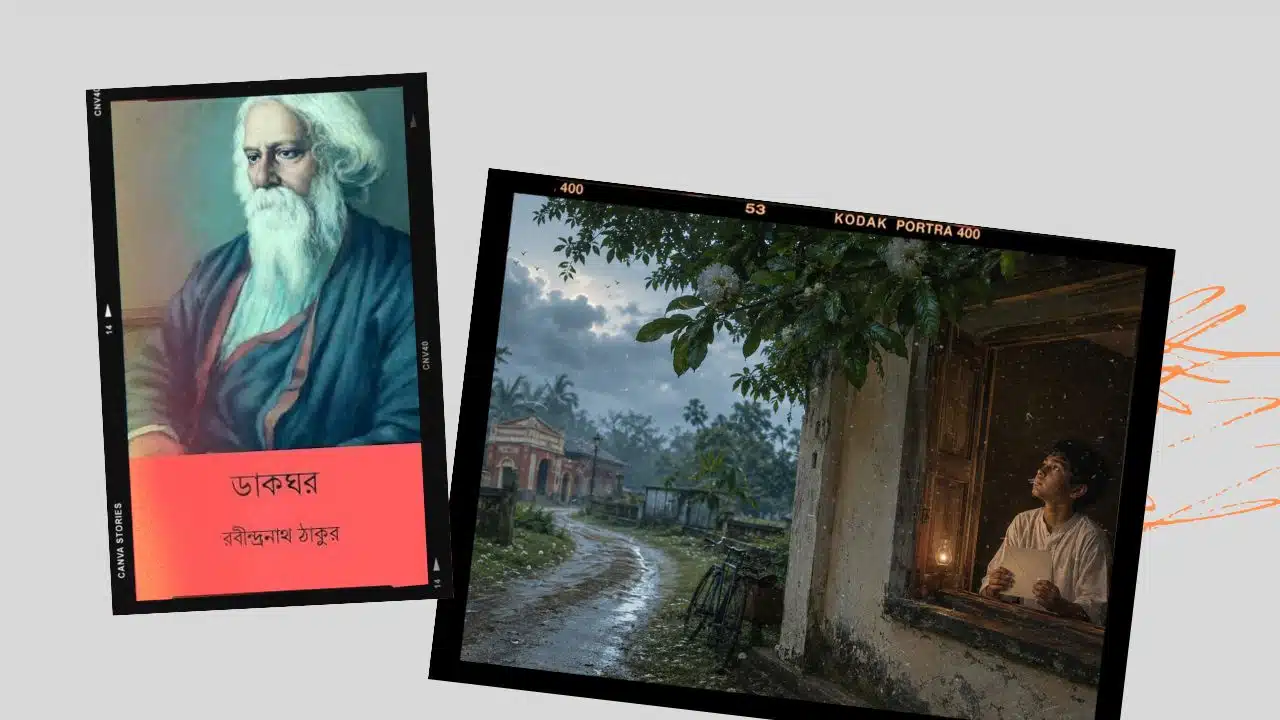
The rain has not stopped since morning, which feels right. On Baishe Shrabon the sky over Bangladesh usually turns the color of wet ash, and every year on this day I take down the same thin book from the shelf and read Dak Ghar on Baishe Shrabon again. It is barely an hour’s reading. Two acts, a handful of characters, and a boy at a window. And yet I have carried it with me since I first found it in my school library in 2001, and it has never once meant exactly the same thing twice.
Today is the day Rabindranath Tagore died. His 85th death anniversary today. The twenty-second of Shravan, Baishe Shrabon, and reading his play about a dying child on the anniversary of his own death should, by rights, be unbearable. It is not. That is the strange gift of the play, and it is what I want to sit with here.
What I First Found in Dak Ghar
I was a schoolboy when I pulled it off the library shelf, and I remember what struck me then, because it is the same thing that strikes me now. Amal, the sick boy shut inside a room by his doctor, spends his days talking to whoever passes by his window. The curd seller with his pots. The watchman with his gong. A little flower girl. To a healthy child running loose outside, these people would be nothing, part of the ordinary traffic of a village afternoon.
To Amal, kept indoors, each of them carries a whole world on their back. He asks the curd seller where the road goes, what the far village under the hills is like, and whether he might be taken there one day.
What I found at fifteen, and what I still find, is a boy who has been robbed of the outdoors and answers by turning the little he can see into something enormous. He does not sulk. He does not rage at the doctor who locked the door. He leans toward the window and befriends the world through a single frame, and he finds real magic in the plainest people walking past.
Amal, and Why His Spirit Stays With Me
The doctor’s logic is sound enough. Keep the boy in, away from the autumn wind and sun, and perhaps he mends. So the room becomes medicine and a cage in the same breath. Most of us would read that as pure cruelty done with good intentions, and it is. But Amal does not spend the play being a victim of it.
Here is my reading of him. Amal is confined, yet his spirit refuses to be locked away. That refusal is not loud. It is not rebellion. It is something gentler and, to me, much stronger. He simply keeps looking out, keeps asking, and keeps believing a letter will come for him from the king.
When the village headman mocks him by holding up a blank sheet of paper and calling it the king’s letter, Amal takes it as real and is grateful and offers to wipe the dust from the man’s feet. The joke curdles in the headman’s mouth. Even the bully cannot quite laugh at a child who meets contempt with that much trust.
I have met very few people, in books or out of them, who hold on to wonder like that while the walls close in. That is why, out of everything Tagore wrote, Amal is the one I keep coming back to. Not because he is dying. Because he is, in the way that actually counts, the freest person in the story.
Why I Read Dak Ghar When the Walls Close in
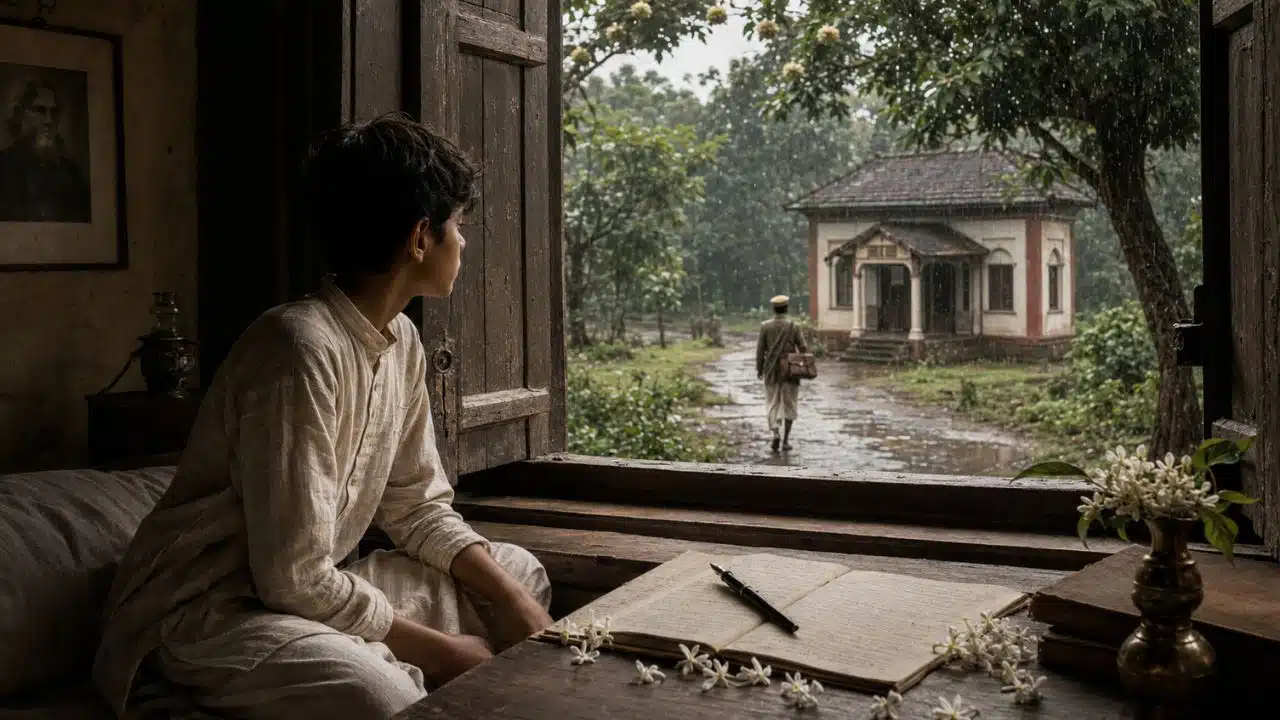
At fifteen I could not have told you why the play would keep pulling me back. I can now. I have had my own Amal moments, and I have had a lot of them.
The clearest was the lockdown. When Covid shut every door, I sat by my own window and watched an empty street, and the world outside carried on being a rumor. That was the literal version, the doctor’s-order version; the whole city was told to stay in its room. But if I am honest with myself, the lockdown only made visible something that runs quietly through ordinary life anyway.
There are stretches, and I move in and out of them, when family, work, and the private weight a person carries all press in at the same time. Nobody has ordered me indoors. The feeling is the same regardless: the world is going about its errands and its light is out there, while I sit on the wrong side of a wall I did not choose.
On days like that I do not reach for advice. I reach for Amal at his window, still asking the curd seller about the road under the hills.
A Play Performed Inside the Darkest Room
There is one staging of Dak Ghar I cannot get out of my head, and it is the reason I trust the play more than I trust most things written to comfort us.
In the Warsaw ghetto, in the summer of 1942, a doctor named Janusz Korczak, who ran an orphanage there, chose this play for his children to perform. He is said to have hoped it would help them meet death without fear. Within days, in the first week of August, Korczak and nearly two hundred children were loaded onto trains for Treblinka. He was offered his own freedom more than once, and each time he refused, and he went with them.
I think about those children acting out the story of a shut-in boy who is finally set free inside the most locked place the last century managed to build. And I think about how the anniversary of that deportation falls in these same early days of August, when we in Bengal are lighting our own quiet lamp for Baishe Shrabon. Rabindranath Tagore wrote a small play about a window. It became something people reached for at the very edge of the dark. A play does not travel that far, into that much grief, unless it knows something true.
The Door that Opens at the End
I should be careful describing the ending, because it is where the whole play has been walking the entire time. In the last scene, the king’s physician arrives in the night and orders every door and window of the room thrown open. The lamp is put out so that the starlight can finally come in. Amal, who has waited the whole play for his letter and his King, grows still, and the others understand that he has gone. Sudha, the little flower girl, comes with flowers and asks them to tell him she never forgot.
I know I am meant to find this heartbreaking. For years I tried to. But every time I read it, the ending arrives as release, and it comforts me. The doors are not thrown open onto death so much as onto everything the room had been keeping out all along: The stars, the night air, and the open road Amal kept asking about.
The confinement was never the true state of things. It was a temporary arrangement, a doctor’s order, and a wall. What was real was the sky that had been there the entire time, on the other side of a shut window.
That is how I can read a death, on a death anniversary, and come away lighter rather than heavier. The play never pretends the walls are not there. It simply refuses to let them have the last word.
Final Thoughts
I do not read Dak Ghar on Baishe Shrabon for a lesson. I read it because it says something I seem to need to hear once a year, in a season of rain, when my own rooms feel small. A locked door has never owned the wind, and freedom lives right where love breaks open the heavy walls we build. Tagore knew it well: the infinite finds its home not in escape, but in the quiet pulse of the ordinary world, in a curd seller on a road, a gong at dusk, or a girl with flowers.
Amal is still at his window somewhere, asking about the road under the hills. On this day of all days, I am glad to sit with him a while and then to watch the doors swing open.