


In competitive Counter-Strike 2 (CS2), climbing the ranks demands more than merely rudimentary knowledge of maps and gameplay; to truly elevate your rank, it is critical to embrace advanced techniques that professional players employ to dominate the scene.
Ergo, discerning and applying these approaches can result in conspicuous refinements in gameplay, nurturing players as they ascend through Counterstrike ranks more efficaciously.
Mastering Map Control
One of the root principles in competitive CS2 is map control; mastering the art of controlling key areas, such as chokepoints and bomb sites, can turn the tide of a match. Pro players consistently demonstrate that control of space (combined with strategic rotations) leads to sounder team coordination and overall performance.
Advanced players know how to take calculated risks to maintain pressure, forcing the enemy team into defensive positions; between holding aggressive angles or applying smoke and flashbang tactics, achieving map control is typically the foremost step towards victory.
The Importance of Aim and Crosshair Placement
In CS2, pro settings are integral in refining gameplay at the highest level. A significant stake of player success in CS2 is linked to their ability to aim accurately. However, raw aim is only one factor; the placement of the crosshair, particularly when transitioning between angles or anticipating enemy positions, can make a remarkable difference.
Advanced players position their crosshairs at head level and adjust them in anticipation of enemy movements, greatly improving reaction time. Thus, incorporating a routine that includes practising aim and crosshair placement lets players react faster and more effectively, augmenting the chances of success in gunfights.
Utilizing Utility Effectively
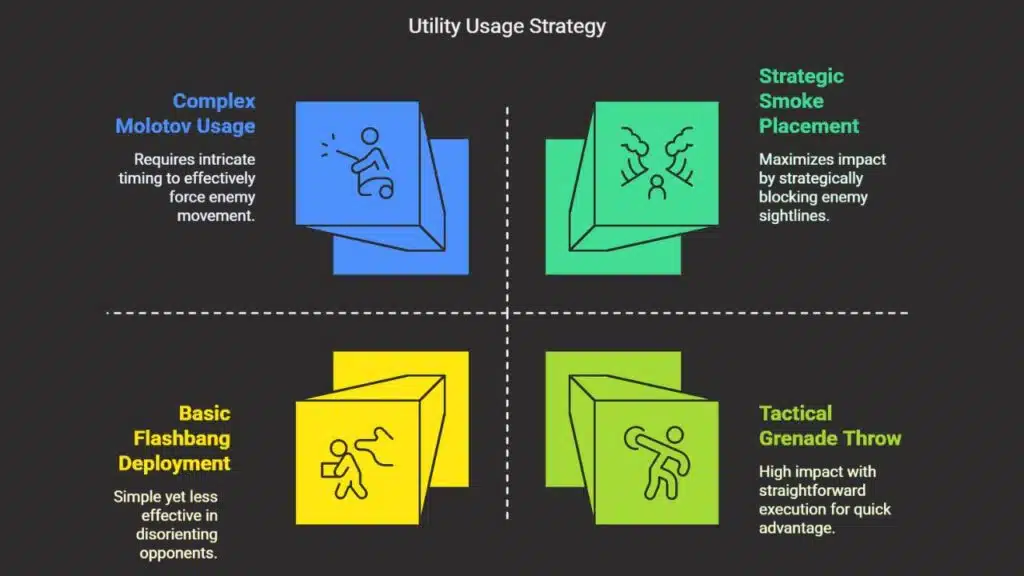
Utility items such as grenades, flashbangs, smokes and molotovs are commonly what separate average players from the pros. Here, understanding “when” and “where” to deploy these utilities is a hallmark of advanced play. Smokes can block enemy sightlines while flashbangs disorient opponents, lending your team a considerable advantage. Meanwhile, molotovs can force players out of common hiding spots, making them vulnerable to attacks.
Therefore, learning the most efficient ways to use these utilities (combined with understanding the timing and positioning) is vital for success at higher levels of competitive play. This is why many professional players spend hours perfecting their utility usage to maximize its potential impact in each round.
Positioning and Movement
Advanced movement techniques can be key in improving a CS2 rank—professional players make minimal noise when moving, using techniques such as counter-strafing and bunny hopping to throw off enemy predictions. Counter-strafing allows players to stop quickly and shoot with precision while bunny hopping enables smoother and faster movement across the map.
Understanding how to use these techniques in sync with map control strategies allows players to be more unpredictable and difficult to hit. Moreover, practising these movements in training maps or deathmatch servers can lead to smoother gameplay, aiding players in their quest to reach higher ranks.
Communication and Team Coordination
At the competitive level, individual skill is important; however, teamwork is frequently what truly leads to victory. Therefore, effective communication between teammates is essential in setting up strategies, calling out enemy positions and making informed decisions on rotations. Here, players must learn how to balance strategic calls with supportive actions, assembling a synergy that boosts overall team performance.
In this context, advanced techniques such as communicating through short, clear calls and using voice commands for key information accommodate teams to react quickly in high-pressure situations. Pro players are known for their ability to remain calm under pressure, providing concise calls that directly impact the game.
Adapting to Opponent Playstyles
An often-overlooked technique in advancing through Counterstrike ranks is adapting to the playstyle of the opposing team. Pro players are incredibly observant, quickly recognizing patterns in how their opponents approach the game. Regardless of whether the opposition favors aggressive pushes, executes slow strategies or relies on tactical setups, adapting to their style and countering it effectively can disrupt their rhythm.
Ultimately, recognizing these patterns allows players to make proactive adjustments in gameplay, turning potential disadvantages into opportunities. With this in mind, remaining flexible and adjusting strategies on the move is essential in competitive matches; it can mean the difference between success and failure in higher-level ranks.
Focusing on Game Sense and Decision Making
Developing game sense is arguably the most consequential factor in improving at CS2—this involves understanding not simply where opponents are, but why they are there. Overall, successful decision-making requires a player to assess the flow of the game, the position of their team and the tendencies of the opposition.
Pro players have finely-tuned game sense, allowing them to make decisions in split seconds that often result in advantageous situations—here, reviewing replays of matches, players can reflect on their decisions, pinpoint mistakes and learn how to avoid them in future matches. As a result, game sense becomes a critical factor in boosting gameplay, alongside individual mechanical skills.
Consistency and Mental Resilience
Perhaps the most underrated aspect of climbing through ranks is the ability to stay consistent. Indeed, partakers frequently experience dips in performance; however, the top-tier competitors are those who can maintain a high level of play despite these setbacks.
As a general rule of thumb, mental resilience is critical in pushing through rough patches and focusing on improving. In illustration, pro players rarely let losses affect their morale, instead using them as opportunities for growth. Thus, keeping a positive mindset, reflecting on mistakes and persistently working towards improvement can lead to steady rank progression over time.
























