
Cryptocurrency is shaking up the financial world. But with big changes come big questions. Many wonder how rules and laws are shaping this fast-moving space. Are these regulations helping or holding back crypto innovation?
One key fact stands out: in the U.S., there’s a major push to clear up gray areas in crypto regulation. Over 12 bills about digital currencies and blockchain technology are on the table in Congress.
These decisions will impact investors, developers, and how crypto grows globally.
In this blog, we’ll explain what’s happening with crypto regulations right now and why they matter. You’ll learn how lawmakers focus on things like stablecoins, decentralized finance (DeFi), and consumer safety.
Ready to explore what lies ahead? Keep reading!
Key Takeaways
- Over 12 bills on crypto rules are under review in the U.S. Congress, focusing on areas like stablecoins, DeFi, and investor safety.
- The White House’s January 23, 2025 order calls for clear crypto rules while blocking U.S.-based CBDC projects.
- Stablecoins make up $190 billion globally, with Congress debating two critical laws to regulate their use: The Clarity for Payment Stablecoins Act and The Lummis-Gillibrand Act.
- SEC and CFTC disputes over token classifications delay clarity; this affects how tokens follow securities laws.
- Global frameworks like MiCA encourage worldwide cooperation but often conflict with local priorities like the U.S.’s focus on sovereignty.
Current State of Crypto Regulations

Crypto regulations are changing fast. On January 23, 2025, the White House released an executive order called “Strengthening American Leadership in Digital Financial Technology.” This order pushes for clear rules while cutting down on contradicting guidance from federal agencies like the SEC and CFTC.
The goal is to help grow crypto assets without creating confusion.
The U.S. government has made bold choices regarding central bank digital currencies (CBDCs). They oppose a U.S. retail CBDC and foreign ones too. Agencies must stop work on any CBDC projects right away under this new rule.
The focus shifts to balancing innovation with concerns like money laundering and investor protection in digital markets.
Major Areas of Regulatory Focus
Rules are shaping how crypto works in key areas. These changes could affect markets, projects, and investors alike.
Stablecoins and Central Bank Digital Currencies (CBDCs)
Stablecoins, worth over $190 billion globally, are changing how money works. Most of them—98%—are tied to the U.S. dollar for stability. Over 80% of transactions using stablecoins happen across borders, making them key in global trade and finance.
Congress is discussing two bills: The Clarity for Payment Stablecoins Act and The Lummis-Gillibrand Payment Stablecoins Act. These laws aim to set rules for stablecoin use while keeping investor protection in mind.
Central bank digital currencies (CBDCs) face a tougher road in the U.S., as current policies block their creation. While other countries explore CBDCs to modernize payments, the administration backs regulated, dollar-backed stablecoins instead.
Central banks see CBDCs as tools for financial stability but worry about privacy risks and control issues. With different approaches worldwide, this topic sparks debates on innovation versus regulation limits.
Decentralized Finance (DeFi)
DeFi cuts out banks by using smart contracts on blockchains. This allows peer-to-peer lending, borrowing, and trading of crypto assets. Decentralized applications (DApps) power most DeFi platforms, offering services without middlemen.
This system raises concerns for cryptocurrency regulations. Issues like anti-money laundering (AML) and know your customer (KYC) rules often clash with DeFi’s open nature. Regulators want more oversight to protect financial stability and prevent financial crimes like fraud or terrorism financing.
Token Classification and Securities Laws
The SEC’s Crypto Task Force works to clarify if crypto tokens are securities. This decision depends on the Howey Test, which checks if an asset involves investment contracts. Tokens that qualify as securities must follow strict regulations for investor protection and transparency.
Disputes between the SEC and Commodity Futures Trading Commission (CFTC) over jurisdiction cause delays. While the CFTC oversees commodities like Bitcoin, the SEC handles security-related cases.
Clear rules could help projects register offerings or create staking programs without legal risks.
The Role of Technology in Regulatory Compliance
Tech tools help businesses follow crypto regulations. Blockchain technologies, like smart contracts, add transparency. They track transactions in real-time, reducing fraud risks. Governments use these tools to fight cryptocurrency fraud and improve cybersecurity.
The financial action task force (FATF) sets global standards for anti-money laundering (AML) efforts.
Sandboxing allows safe testing of digital assets under strict rules. This helps companies meet Know Your Customer (KYC) and AML policies better. Artificial intelligence (AI) speeds up checks on crypto asset reporting frameworks while spotting possible red flags quickly.
These advancements protect investors while boosting regulatory compliance efficiency worldwide.
The Impact of Regulation on Innovation and Competition
Tighter crypto regulations can slow innovation. Rules like Know Your Customer (KYC) and Anti-Money Laundering (AML) make it harder for small businesses to enter the market. High costs linked to compliance, such as capital requirements from SEC’s now-rescinded SAB 121, also create barriers.
Big companies often benefit from these rules. Smaller cryptocurrency exchanges or decentralized apps struggle to compete when faced with strict guidelines. The request for a 60-day stay by SEC in lawsuits against Coinbase and Binance shows signs of changing enforcement strategies but leaves uncertainty lingering over financial technology growth.
Global vs. Local Regulatory Frameworks
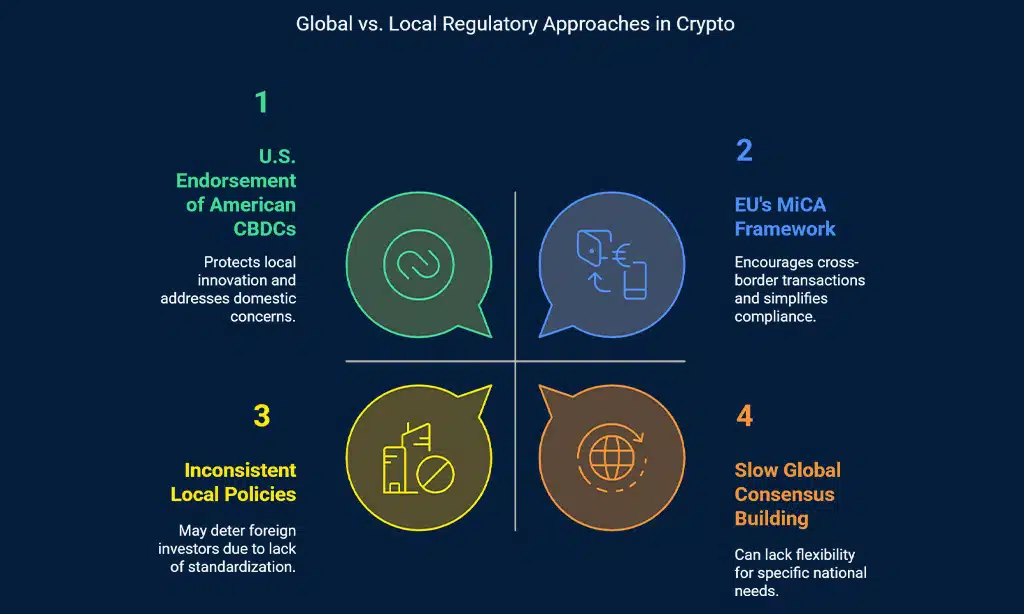
Global and local crypto regulations often clash like two sides of a coin. Each approach brings strengths and challenges. Here’s a quick breakdown to make sense of this complex dynamic:
| Aspect | Global Approach | Local Approach |
|---|---|---|
| Focus | Standardization across borders. | Adapts to national priorities. |
| Examples | EU’s MiCA Framework (2025). | U.S. rejection of foreign CBDCs, endorsing American dominance. |
| Benefits | Encourages cross-border transactions. Simplifies compliance for global players. | Addresses domestic security and fiscal concerns. Protects local innovation. |
| Challenges | Slow consensus building. Can lack flexibility for specific needs. | Inconsistent with global standards. May deter foreign investors. |
| Impact | 80% of stablecoin transactions remain cross-border, showing global need. | Local policies, like the U.S. approach, can drive centralization or barriers. |
Crypto’s borderless nature clashes with the territorial mindset of governments. Global frameworks such as MiCA aim to unify rules, helping companies scale faster. Yet, local rules often reflect cultural and political realities. The U.S. resisting foreign CBDCs underscores sovereignty concerns.
Tension runs deep. Global rules may benefit large markets, while smaller nations adapt to survive. Striking a balance, though, takes time and collaboration.
Strategic Considerations for Developers and Investors
Developers should focus on crypto compliance. Aligning with cryptocurrency regulations like KYC and AML is key. Ignoring these can stall projects or block access to financial markets.
Smart contracts must meet legal standards too, safeguarding digital assets.
Investors need to track updates from the SEC and the Financial Conduct Authority (FCA). Rules for exchange-traded funds (ETFs) or token classifications can open new paths for gains.
Assess risks tied to decentralized finance (DeFi) systems and stablecoins. Betting on non-compliant platforms could backfire badly.
Potential Narratives for the Future of Crypto
Bitcoin reserves could change national debt plans. Congress may discuss buying bitcoin to reduce debt. This idea ties crypto to government strategies, showing how digital assets might play a bigger role in finance.
Meme coins are gaining attention too. President Trump launched the $TRUMP coin, blending political branding with cryptocurrency. Moves like this reshape how people view virtual currencies, suggesting new ways crypto can connect to culture and public figures.
Takeaways
Crypto rules are shaping its future fast. They aim to protect users and push innovation. Stablecoins, DeFi, and token laws are key areas of focus. Clear rules can spark trust and fuel growth.
The path ahead blends tech, law, and creativity—change is coming!
FAQs
1. What is the role of crypto regulation in shaping digital assets?
Crypto regulation helps provide clarity for how digital assets like cryptocurrencies and non-fungible tokens (NFTs) can be used, traded, or taxed. It aims to protect investors while supporting financial stability.
2. How does the SEC impact cryptocurrency markets?
The Securities and Exchange Commission (SEC) oversees cryptoassets that may qualify as securities. It enforces rules on initial coin offerings and works to prevent fraud in cryptocurrency trading.
3. Why are anti-money laundering (AML) laws important for crypto compliance?
AML laws fight illegal activities like money laundering by requiring exchanges to verify users through Know Your Customer (KYC) processes. This builds trust in virtual currency systems.
4. What is decentralised finance (DeFi), and why does it face regulations?
DeFi uses blockchain technology for financial services without traditional banks. Regulations aim to address risks like systemic failures, consumer protection gaps, and cryptocurrency fraud prevention.
5. How do global organizations influence cryptocurrency policymaking?
Groups like the Financial Stability Board and International Organization of Securities Commissions work with governments worldwide to create consistent rules for digital currencies and consensus mechanisms such as proof of stake or proof of work.
6. Are central bank digital currencies (CBDCs) impacted by these regulations?
Yes, CBDCs fall under many regulatory frameworks since they are government-backed forms of electronic money designed to improve financial inclusion while maintaining oversight over balance sheets and transactions.