


Staring at a blank page can make crafting high-converting content feel challenging, especially in digital marketing. Many marketers struggle to create email campaigns and landing pages that truly capture attention and drive conversions.
Without the right approach, content often lacks impact, failing to engage audiences or turn readers into customers.
Copywriting Frameworks solve this problem. Proven models like AIDA (Attention, Interest, Desire, Action), PAS, and the 4Ps help structure persuasive messaging that connects and converts across platforms like LinkedIn.
Explores the most effective copywriting frameworks, how to choose the right one, and practical tips to boost engagement, strengthen calls to action, and improve conversion rates.
What Are Copywriting Frameworks?
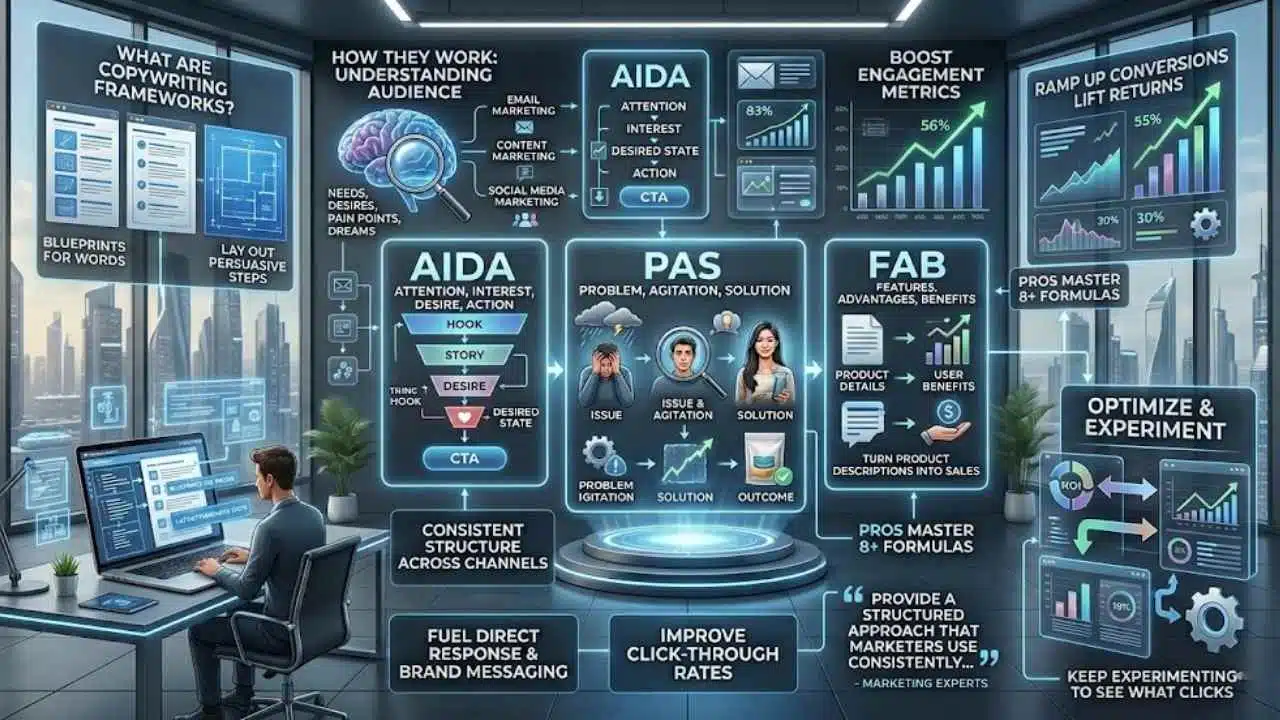
Copywriting frameworks act as structured guides for marketers. They help craft persuasive messages that grab attention and drive action. Think of them like blueprints for building a house; they lay out the steps to make your words work harder.
These tools push writers to dig into audience needs, desires, pain points, and dreams. Marketers use them across channels like email marketing, content marketing, and social media marketing.
In 2026, pros master at least eight major formulas for top results. They boost engagement metrics, ramp up conversion rates, and lift returns on efforts.
Copywriting frameworks provide a structured approach that marketers can use consistently to create sales messages across different marketing channels and campaigns. – Key insight from marketing experts.
Frameworks such as AIDA or PAS improve click-through rates and create high-converting copy. They fuel direct response copywriting and brand messaging. A marketer tweaking product descriptions with FAB; features turn into benefits that spark sales.
Tools like these drive business growth and conversion optimization. They fit into strategies for Google Ads or personal branding. Chase Dimond and others swear by them for email wins.
Keep experimenting to see what clicks with your crowd.
Why Copywriting Frameworks Are Essential for Marketers
Marketers face tough challenges in content creation these days. They need writing techniques that grab attention fast. Top copywriting frameworks step in as key tools here. These frameworks act like roadmaps, guiding you to understand your audience’s needs, desires, pain points, and aspirations.
Take AIDA, for example, it builds attention, interest, desire, and action to drive conversions on platforms like LinkedIn. Or think about PAS, which spots a problem, amps up its urgency, and offers a solution.
BAB shows the before state, the after dream, and the bridge to reach it. Marketers use these to craft compelling copy that boosts engagement. Such tools improve click-through rates, or CTR, and create high-converting messages.
They drive sales across social media, emails, and ads. In 2026, every marketer should master at least eight major formulas like these. Professionals rely on them for consistent marketing strategies.
Frameworks provide a structured approach for sales messages in various channels and campaigns. Social proof backs this up, just look at brands like Microsoft or Klaviyo using them for small business wins.
This setup turns features into advantages and benefits, like in FAB. Or consider the 4Cs for clear, concise, compelling, credible copy. Experts like Al Ries in positioning or Leo Burnett stress these for brand building.
They help boost engagement metrics and increase conversion rates. Marketers get better returns on efforts this way. Telling a story with PASTOR: identify the problem, amplify it, share a story, show transformation, make an offer, and call for response.
Tools like StoryBrand or hooks from digitaloft make copy pop. Copywriting tips from folks like Kurtis Pykes or JD Meier show how these drive results. Great leads come from formulas like problem-agitate-solve or star-story-solution.
Quality rater guidelines even nod to their power in search. These methods turn everyday writing into persuasive gold for any medium.
Most Popular Copywriting Frameworks
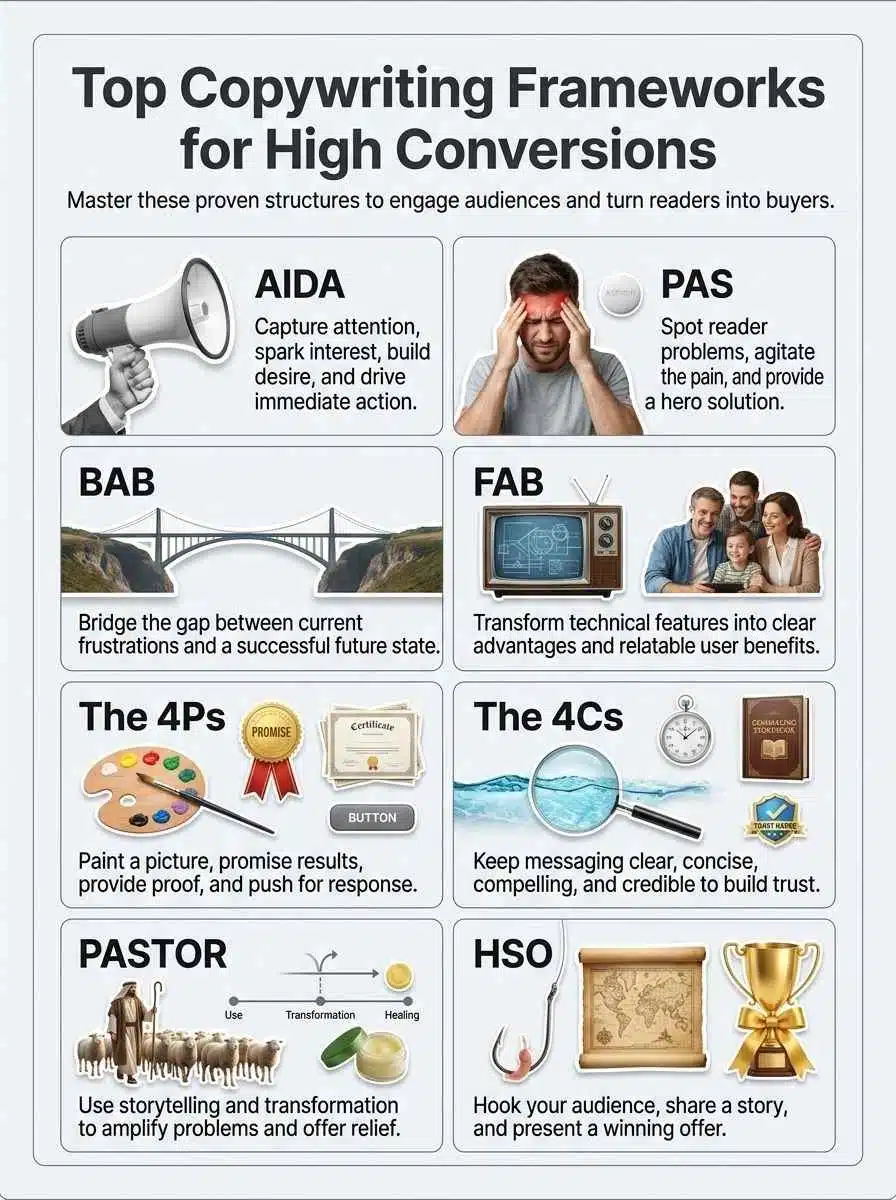
Ever feel like your ad copy falls flat, like a balloon losing air mid-party? Well, marketers swear by these time-tested structures to grab eyes and drive sales, from the classic attention-grabber that builds desire all the way to benefit-focused pitches that seal the deal—stick around to see how they can supercharge your next campaign.
AIDA: Attention → Interest → Desire → Action
Marketers, you know how tough it gets to grab attention in a crowded digital space. AIDA steps in as your trusty guide, Attention – Interest – Desire – Action, one of six proven copywriting frameworks that creates persuasive content and drives conversions on platforms like LinkedIn.
You hook readers right away with a bold headline, spark their curiosity with juicy details, build that burning want for your offer, and seal the deal with a strong call to action.
This setup boosts click-through rates, amps up engagement, and turns browsers into buyers, no sweat.
AIDA is the backbone of sales messages that actually sell, says a top copywriter at the digital PR summit.
Use it across channels, watch your conversion rates climb, and feel that satisfaction when sales roll in. Frameworks like this, with awareness – comprehension – conviction – action vibes, keep your messaging sharp and effective in 2026.
PAS: Problem → Agitate → Solution
PAS grabs your reader’s eye by spotting a tough spot first. Think of it like spotting a leak in your roof during a storm, you feel that drip, drip turning into a flood. This framework, known as Problem, Agitate, Solve, helps writers build messages that hit home.
It starts with naming the issue, like low sales or weak engagement. Then it stirs up the pain, making that problem feel urgent and real. Finally, it rolls out the fix, your product or idea as the hero.
Copywriters use this to boost click-through rates and craft high-converting copy that drives sales across channels.
Writers structure sales pitches this way to understand pain points deep down. For marketers in 2026, mastering this among eight key formulas lifts conversion rates and engagement. It provides a steady approach for campaigns, turning problems into wins with proof and push elements from the four Ps.
Readers, try it on your next LinkedIn post, watch those metrics soar.
BAB: Before → After → Bridge
BAB grabs your audience by painting their current mess, the “before” state full of frustrations and roadblocks. You show folks stuck in a rut, maybe drowning in low sales or weak engagement.
Then, you flip the script to the “after” glow, that shiny spot where problems vanish and success rolls in. Folks see the dream life, with boosted conversions and happy customers. This framework acts like a trusty map, guiding readers through a narrative journey from pain to paradise.
The “bridge” seals the deal, linking the tough “before” to the sweet “after” with your product as the hero. You lay out clear steps, like using attention – interest – desire – action to build desire, or tying in features-advantages-benefits to highlight real wins.
Marketers love this for crafting persuasive copy that drives sales across channels. It boosts engagement metrics and ramps up those click-through rates, turning casual browsers into eager buyers.
Think of it as your secret sauce for high-converting messages in 2026.
FAB: Features → Advantages → Benefits
FAB grabs your reader’s eye by breaking down what a product offers in clear steps. Features list what the item does, like a phone’s long battery life. Advantages show why that beats the competition, say, lasting all day without a charge.
Benefits tie it right to the user’s world, painting how it frees up time for fun stuff, no more hunting plugs mid-adventure. This setup acts like a roadmap, helping marketers craft messages that hit home on pain points and dreams.
Copywriters love FAB because it builds trust, much like sharing a secret recipe that always works. It pushes past plain facts to spark real desire, boosting click-through rates and sales across channels.
This framework in action on LinkedIn, turning dry posts into magnets for engagement. Marketers in 2026 count it among eight key formulas, a structured tool that amps up conversions by focusing on what folks truly need.
Mix it with ideas like Image – promise – prove – push for even stronger results, keeping things credible and compelling.
The 4Ps: Image → Promise → Proof → Push
Marketers, the 4Ps framework starts with painting a vivid image of what life looks like with your product. You promise big wins that grab attention and spark desire. Next, you back it up with solid proof, like testimonials or data, to build trust.
Finally, you push for action with a clear call that drives sales. This Image – promise – prove – push method turns bland messages into compelling ones that boost engagement.
Copywriters love how the 4Ps, with its promise, Image, proof, and push elements, creates effective sales pitches across channels. It helps you visualize benefits for your audience, make bold commitments, provide real evidence, and encourage quick responses.
Think of it as a bridge from problem to solution, much like attention – interest – desire – action but customized for fast conversions. Pros use it to lift click-through rates and sales in 2026 campaigns.
The 4Cs: Clear → Concise → Compelling → Credible
You know that moment when your message hits home, like a well-aimed arrow? That’s the magic of the four C’s of copywriting: clear, concise, compelling, credible. This framework acts as a trusty guide, helping marketers craft words that cut through the noise.
Your secret sauce for building trust, you start by making ideas crystal clear, no muddled thoughts allowed. Then, keep things concise, trim the fat so every word packs a punch.
Make it compelling, stir emotions that draw readers in, like a gripping story around a campfire. Finally, stay credible with solid proof, because trust seals the deal.
Marketers in 2026 need these top copywriting frameworks, including at least eight major ones like the four C’s, to master persuasive content. They boost click-through rates and drive sales across channels, from LinkedIn posts to email blasts.
Think of them as analytical tools that dig into audience pain points, desires, and needs. For instance, pair the four C’s with awareness-comprehension-conviction-action for even stronger results.
You create high-converting copy that engages, converts, and delivers real returns on efforts.
Advanced Frameworks for Modern Copywriting
Tired of basic copy that falls flat, marketers? Explore these powerhouse methods, like ones that spin tales and amp up pain points, to grab eyes in a crowded digital space.
PASTOR: Problem → Amplify → Story → Transformation → Offer → Response
Marketers love tools that make writing sales messages easier, and the PASTOR framework stands out in modern copywriting. You start with the problem your audience faces, like a common pain point that keeps them up at night.
Then, amplify it, you know, poke at that sore spot to show how bad things get without help. Share a story next, maybe an anecdote about someone just like them who struggled. That builds a connection, draws them in like a good yarn around a campfire.
Lead to transformation, paint a vivid Image of life after the fix, full of promise and relief. Present your offer as the bridge to that better place, and end with a clear response call, urging action right away.
This framework fits right into the top copywriting frameworks every marketer should know in 2026, joining classics like AIDA with its awareness, comprehension, conviction, action flow.
It boosts engagement metrics, amps up conversion rates, and helps create persuasive content across channels, much like the four Cs of copywriting keep things clear, concise, compelling, credible.
Think of it as a structured path, similar to papa or even the 5 Cs, guiding writers to understand audience needs deeply. Professionals master at least eight major formulas like this to drive sales and improve click-through rates.
You adapt it for LinkedIn posts or emails, focusing on pain points to craft high-converting copy that feels personal, almost like chatting with a friend over coffee.
HSO: Hook → Story → Offer
HSO grabs attention fast. You start with a hook that pulls readers in, like a bold question or surprising fact. This sets the stage. Next comes the story, where you share a relatable tale that builds emotion.
It connects with your audience’s pains and dreams. Then, you present the offer, showing how your product solves their issue. Copywriters love this for its simple flow.
This framework boosts click-through rates and drives sales. It acts as an analytical tool to understand audience needs. In 2026, marketers master at least eight major formulas like this one.
Pair it with ideas from awareness-comprehension-conviction-action for stronger results. Or blend in the four C’s to keep things clear and credible. Use it across channels for consistent wins.
RIDBUR: Refresh → Intent → Deepen → Boost → Update → Restructure
RIDBUR starts with refresh, where you grab your reader’s attention by updating stale ideas or sparking curiosity about their current challenges. You move to intent next, setting clear goals that align with what your audience truly wants, like boosting engagement on LinkedIn.
Deepen explores details, examining pain points to build a stronger connection, much like how AIDA uses awareness, comprehension, conviction, action to guide folks step by step.
Boost amps up the energy with compelling proof, showing real results that drive conversions and click-through rates. Update brings fresh twists to keep things relevant in 2026’s fast-paced marketing landscape, while restructure ties it all together for a smooth path to action.
Marketers love this framework because it helps create persuasive copy across channels, turning everyday messages into high-converting gems that match audience needs and aspirations.
The Question Ladder
You start with questions that spark awareness, then move to ones that build comprehension of the issue. Next, questions foster conviction by showing why your solution fits perfectly.
Finally, they push toward action, urging the reader to take that next step. Marketers love this setup because it boosts engagement and conversions, much like the top copywriting frameworks essential for pros in 2026.
This framework acts as an analytical tool, helping you understand audience needs and pain points with at least eight major formulas to master. You pose questions that agitate problems, then bridge to solutions, creating persuasive copy across channels.
It improves click-through rates and drives sales, just as proven structures like AIDA or the four C’s do. Chatting with a friend over coffee, asking, “Ever feel stuck in your marketing?” Then follow up with, “What if one simple ladder changed that?” Such natural dialogue keeps things credible and compelling, turning readers into buyers.
How to Choose the Right Copywriting Framework
Define your audience and goals
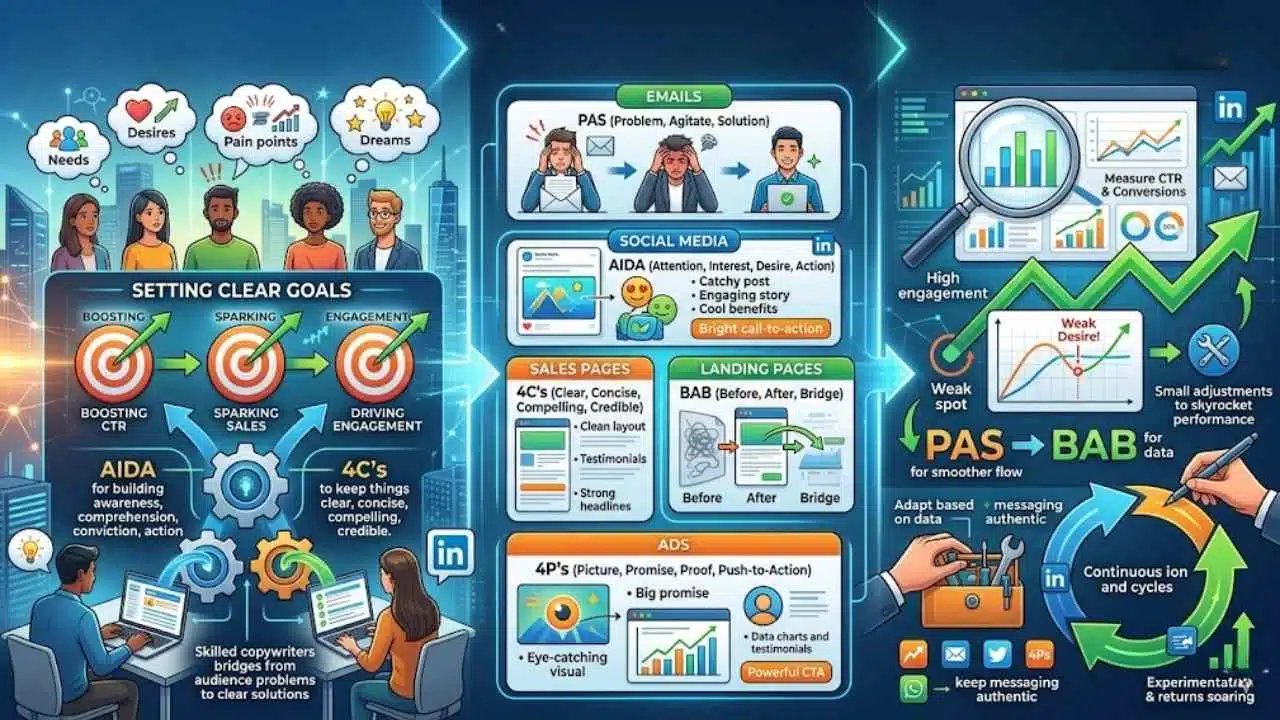
Start with your readers in mind, folks. Pinpoint who they are, what bugs them, and what they crave. Copywriting frameworks act as sharp tools here, pushing you to dig into audience needs, desires, pain points, and dreams.
Think of it like mapping a treasure hunt; you spot the X that marks their spot. This step sets clear goals, like boosting click-through rates or sparking sales across channels. Get this right, and your messages hit home, driving engagement and conversions in 2026’s fast marketing world.
Match goals to frameworks that fit, such as AIDA for building awareness, comprehension, conviction, action. Or try the four C’s to keep things clear, concise, compelling, credible.
Match the framework to your content type
Pick a copywriting framework that fits your content type, folks. Emails might shine with PAS, where you spot the problem, stir it up, and offer the fix. Social media posts? Try AIDA to grab attention, build interest, spark desire, and push for action.
That awareness-comprehension-conviction-action flow works like a charm on platforms like LinkedIn, boosting click-through rates and conversions. Sales pages often pair well with the four C’s, keeping things clear, concise, compelling, and credible.
These eight major formulas in 2026 help marketers understand audience needs, pain points, and goals. Test them out, adapt for your campaigns, and watch engagement soar with better returns.
Test and adapt for better performance
You try a copywriting framework like AIDA, which grabs attention, builds interest, stirs desire, and calls for action. Track your results right away. Measure click-through rates and conversions to see what works.
These frameworks boost engagement metrics and increase sales, just like pros aim for in 2026. Spot weak spots, say, if desire falls flat, and tweak it. Use at least eight major formulas, including the four C’s for clear, concise, compelling, credible copy.
Adapt based on data; it turns okay messages into high-converting winners.
Test across channels, from LinkedIn posts to emails, and watch returns soar. Awareness-comprehension-conviction-action guides you here, building understanding before the push. Keep experimenting; one adjustment can skyrocket performance without much hassle.
Tips to Maximize the Effectiveness of Copywriting Frameworks
You know that feeling when your words hit home, like a well-aimed arrow? Check out these tips, and watch your copy transform from flat to fabulous, pulling readers right into action with tools like strong hooks and clear calls.
Keep the message simple and clear
Keep your copy simple and clear, folks. That means ditching fancy words that confuse people. Stick to everyday talk, like chatting with a friend over coffee. Copywriting frameworks, such as the four C’s – clear, concise, compelling, credible – guide you here.
They push you to cut the clutter and hit home with your message. This approach boosts engagement, as these tools help writers grasp audience needs and pain points right away.
Frameworks like AIDA, with its awareness, comprehension, conviction, action flow, make this easy. You create persuasive content that drives conversions on spots like LinkedIn. Your words as a straight arrow, not a tangled web.
Marketers in 2026 master at least eight major formulas for this reason. They improve click-through rates and sales by keeping things direct. Use them across channels, and watch your returns grow.
Focus on audience pain points
Copywriting frameworks shine when you zero in on your audience’s pain points, like that nagging itch they can’t scratch. Take the PAS model, it starts by spotting the problem, ramps up the frustration, and then swoops in with a fix.
Writers use these as tools to dig deep into what keeps folks up at night, their needs, desires, and those pesky aspirations that feel just out of reach. Think your reader sighing over low click-through rates, you hit that spot, and suddenly your copy feels like a lifeline.
Empathy turns good copy into great, folks. Frameworks like AIDA, with its awareness-comprehension-conviction-action flow, push you to feel the hurt first, then guide toward relief.
Or try the four C’s for messages that stay clear, concise, compelling, credible, all while poking at real struggles. Marketers in 2026 master at least eight of these formulas to boost engagement and conversions, turning pain into action across channels.
Use strong calls to action
Strong calls to action push readers toward the next step, like clicking a link or buying a product. You craft a killer message using AIDA, building attention, interest, desire, and then boom, action seals the deal.
Marketers know this drives conversions on platforms like LinkedIn, as one of the six proven frameworks. Facts show these tools boost click-through rates and sales, turning casual browsers into loyal customers.
Go ahead, tell your audience exactly what to do, with words that spark urgency.
Mix in the four C’s to make those calls clear, concise, compelling, and credible. Awareness leads to comprehension, conviction, and action, much like that flow. You identify pain points, agitate them with PAS, then solve with a bold nudge.
Top frameworks in 2026, including at least eight major ones, help marketers create high-converting copy across channels. Test these in your campaigns, watch engagement metrics soar, and see better returns roll in.
Final Thoughts
You’ve explored top copywriting formulas like AIDA, which grabs attention and sparks action, along with PAS that spotlights problems and delivers fixes. These tools, from BAB’s story arc to the 4Ps’ promise and proof, make crafting messages a breeze for busy marketers.
They cut through the noise, boost click rates, and turn readers into loyal buyers. Check out books on sales writing or online courses for in-depth looks into formulas like the four C’s for clear, compelling copy.
Frequently Asked Questions (FAQs) About Copywriting Frameworks
1. What are the four C’s in copywriting?
The four C’s stand for clear, concise, compelling, and credible; they guide marketers to craft messages that grab attention without the fluff, like a sharp arrow hitting the bullseye.
2. How does the awareness-comprehension-conviction-action framework help in marketing?
You first spark awareness to get eyes on your product, then build comprehension so folks understand its value. Next, foster conviction to make them believe it’s a must-have, and finally drive action, like clicking that buy button. It’s like leading a friend through a fun story that ends with them joining the adventure.
3. Can beginners use the four C’s effectively?
Absolutely, even if you’re just starting out. The four C’s keep your writing simple and punchy, helping you connect with readers on a human level.
4. Why blend awareness-comprehension-conviction-action with other frameworks?
Blending awareness-comprehension-conviction-action with tools like the four C’s amps up your copy’s power; it turns bland text into a persuasive conversation that feels real and relatable, you know, like chatting over coffee with a buddy who needs your advice. This mix predicts what your audience craves, building trust step by step. Plus, it avoids those awkward sales pitches that flop like a bad joke at a party.

























