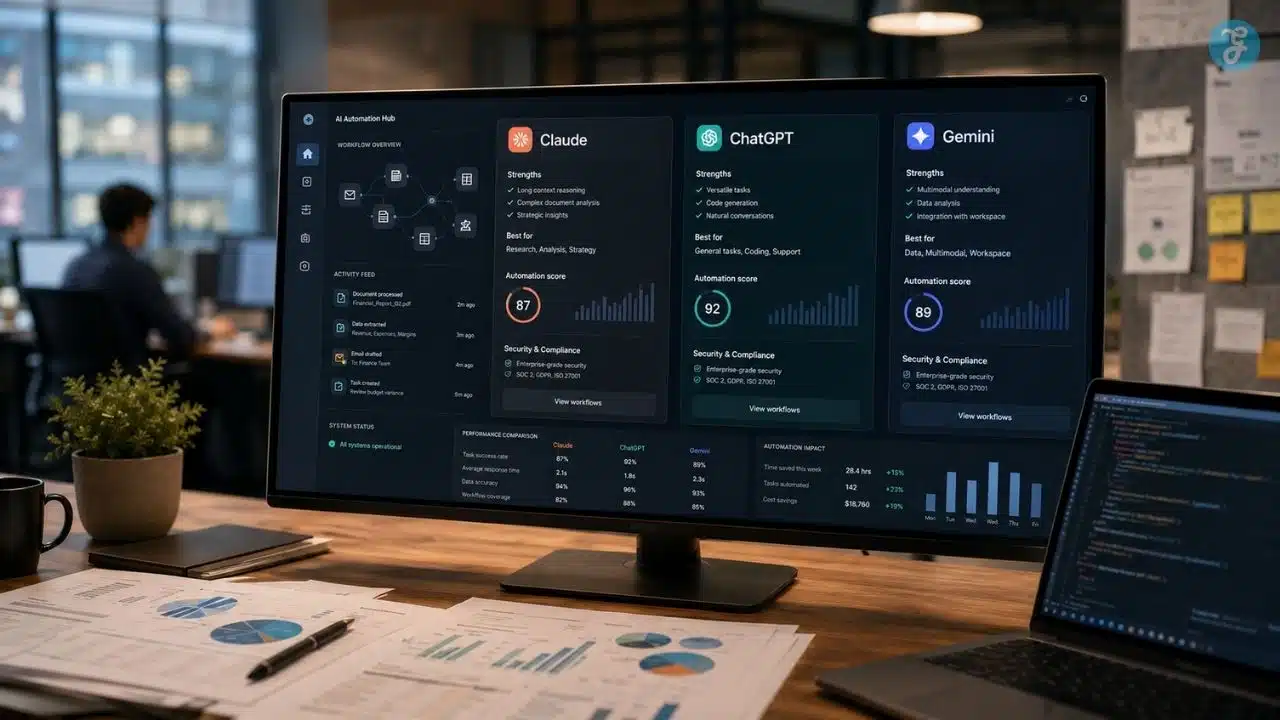
Claude vs ChatGPT vs Gemini is no longer a simple chatbot comparison. After reviewing all three through real enterprise workflow use cases, I found that the real question in 2026 is not “which model sounds smarter?” It is this: which one can help a business research faster, code better, summarize documents, connect tools, respect permissions, and avoid breaking things quietly in the background? And that last part matters.
In my review, I compared the three across practical workflow situations: document analysis, coding support, internal knowledge search, spreadsheet-style tasks, tool-connected automation, and human-review control. The result was not a clean one-model victory. Claude, ChatGPT, and Gemini each dominate a different lane.
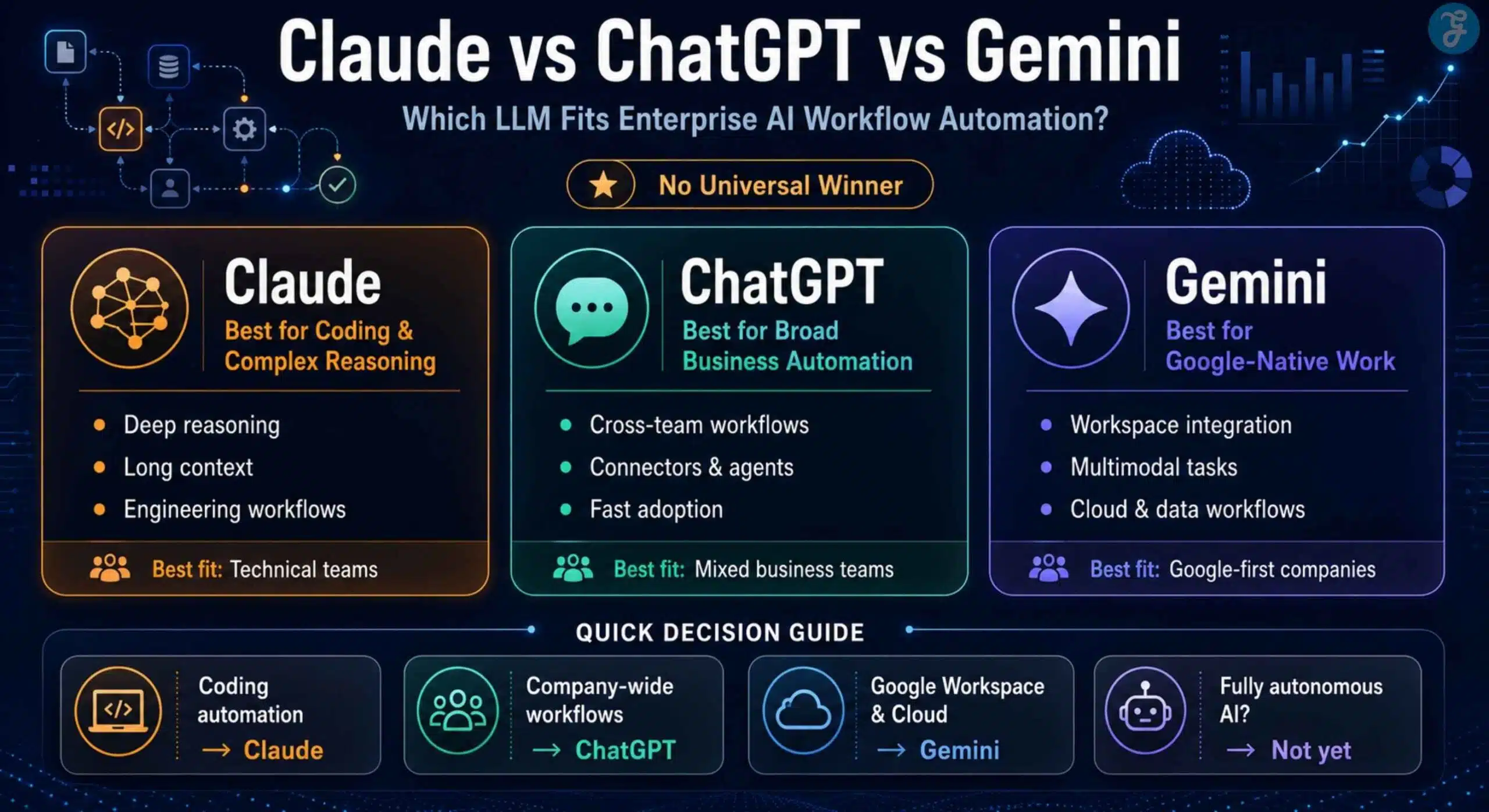
Claude felt strongest in coding and complex reasoning. ChatGPT felt like the best all-around workplace automation layer. Gemini made the most sense for companies already built around Google Workspace and Google Cloud.
Claude vs ChatGPT vs Gemini: My Personal Experience
In my opinion, the cleanest answer is also the most useful one.
| Enterprise Need | Best Fit |
| Coding and engineering automation | Claude |
| Broad workplace workflow automation | ChatGPT |
| Google Workspace and Google Cloud workflows | Gemini |
| Internal knowledge search | ChatGPT / Gemini |
| Long document and codebase reasoning | Claude / Gemini |
| Business-user adoption | ChatGPT |
| Google-native team adoption | Gemini |
| Fully autonomous workflows | No safe winner yet |
Claude has gained serious enterprise momentum, especially around coding and agentic software development. Menlo Ventures estimated that Anthropic held 40% of enterprise LLM spend in 2025, ahead of OpenAI at 27% and Google at 21%. The same report linked much of Anthropic’s rise to coding workflows, where Claude has become especially strong.
ChatGPT, however, remains the most natural choice for broad workplace automation because of its user experience, business connectors, workspace agents, compliance features, and general-purpose adoption across teams. OpenAI’s Workspace Agents are now positioned for Business, Enterprise, and Edu customers as agents that can work across tools and complete high-value tasks.
Gemini’s advantage is different. It is not just “another chatbot from Google.” Gemini Enterprise and Google Workspace Studio are designed around agents, Workspace data, Google Cloud, no-code automation, and enterprise governance. Google describes the Gemini Enterprise Agent Platform as a system for building, scaling, governing, and optimizing enterprise agents.
So the right question is not, “Which LLM is smartest?”
The better question is, “Which one fits the workflow my company actually runs every day?”
How I Compared Claude vs ChatGPT vs Gemini for Enterprise Workflow Automation
I treated the comparison like an enterprise workflow review, not a personality contest between three famous AI assistants. I looked at each platform through the things that matter in real business use:
- Can it complete multi-step work without losing context?
- Can it connect to company tools?
- Can it handle documents, spreadsheets, code, and internal knowledge?
- Can admins control access?
- Does it respect permissions?
- Can it explain its output well enough for review?
- Does it support human approval before risky actions?
- Is it useful for ordinary employees, not only engineers?
That last point is important. Enterprise automation does not succeed because one model wins a benchmark. It succeeds when teams actually use it without creating a governance nightmare.
The 7 Enterprise Workflows That Matter Most
To make this comparison practical, I would judge all three tools across seven workflow types:
| Workflow Test | What It Reveals |
| Lead research and CRM update | Can the AI gather, summarize, and structure business data? |
| Vendor risk summary | Can it review documents and produce usable risk notes? |
| Contract clause extraction | Can it handle sensitive legal-style workflows carefully? |
| Spreadsheet cleanup and analysis | Can it work with messy business data? |
| Multi-file coding task | Can it reason across a codebase? |
| Internal knowledge search | Can it retrieve company-specific context accurately? |
| Slack/email-to-task automation | Can it turn communication into action? |
This is where the comparison becomes clearer. Claude feels strongest when the workflow is deep, technical, and reasoning-heavy. ChatGPT feels strongest when the workflow touches many business teams and tools. Gemini feels strongest when the workflow already lives inside Google Workspace or Google Cloud.
Claude: Best for Engineering-Led and Complex Agentic Workflows
Claude’s biggest strength in enterprise AI workflow automation is not that it writes polished paragraphs.
Many tools can do that now. Claude’s real advantage is in complex reasoning, code-heavy work, and agentic software tasks. Anthropic’s Claude Code is described as an AI-powered coding assistant that can understand an entire codebase, work across multiple files and tools, build features, fix bugs, and automate development tasks.
That matters because enterprise automation often starts with engineering teams. Developers are usually the first people who can turn AI from “helpful assistant” into “actual workflow system.” Claude fits naturally into that world.
Where Claude Feels Strongest
Claude is the strongest choice when the work involves:
- Code review and refactoring
- Multi-file development tasks
- Technical documentation
- Engineering research
- Legal-style document analysis
- Policy-heavy knowledge work
- Long reasoning chains
- Careful explanation of trade-offs
Anthropic also says its commercial products do not use customer inputs or outputs to train models by default, which is important for companies handling proprietary code, legal documents, or sensitive internal data.
Claude Enterprise also includes enterprise-focused features such as Claude Code, connectors, SSO, SCIM, audit logs, and enterprise security and compliance features.
Where Claude Can Still Frustrate Teams
Claude is excellent for technical depth, but it may not always be the easiest default layer for a mixed business team. A marketing manager, HR lead, finance analyst, and sales operations user may find ChatGPT or Gemini more naturally connected to their everyday work environment. That does not make Claude weaker. It just means its best use case is more focused.
Best Enterprise Use Cases for Claude
Claude is best when the company needs:
- Engineering automation
- Codebase analysis
- Bug fixing support
- Internal developer agents
- Technical documentation
- Legal and financial document review
- High-stakes research support
- Complex knowledge-work workflows
My practical verdict: Claude is the best pick when automation begins with technical teams and complex reasoning.
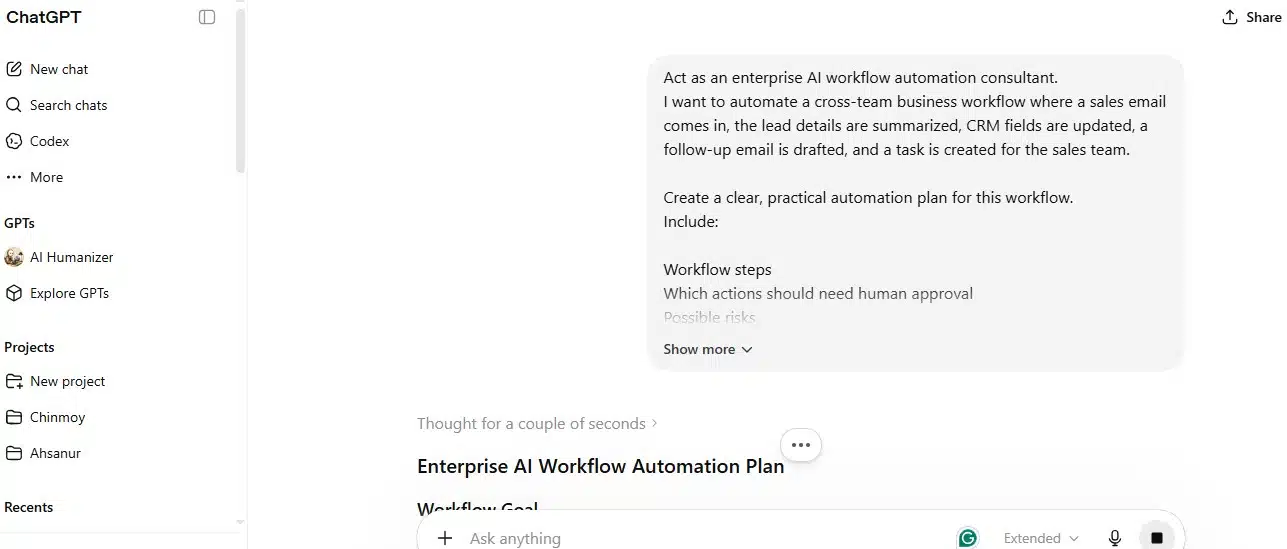
ChatGPT: Best All-Round Enterprise Workflow Automation Layer
ChatGPT’s advantage is not only model performance. Its advantage is that it has become a broad workplace layer.
For many companies, ChatGPT is the easiest tool to introduce across sales, operations, support, HR, finance, marketing, product, and leadership teams. It is flexible, familiar, and increasingly connected to business systems.
OpenAI says ChatGPT Enterprise connects to company data through built-in apps or custom apps, including Microsoft SharePoint, GitHub, Google Drive, Box, and more.
That matters because most enterprise workflow automation fails at the boring part: finding the right context. If the AI cannot access the right documents, tickets, notes, policies, or CRM records, it becomes just another smart intern asking for screenshots.
Where ChatGPT Feels Strongest
ChatGPT is strongest for:
- Cross-functional workplace automation
- Internal knowledge assistants
- Sales and marketing workflows
- Meeting notes and follow-ups
- Customer support summaries
- Slack-connected workflows
- Research and report drafting
- Reusable internal agents
- Business-user adoption
OpenAI’s company knowledge feature lets ChatGPT use context from connected apps, gives citations and links back to original sources, and works across connectors such as Slack, SharePoint, Google Drive, GitHub, HubSpot, Asana, and more while respecting user permissions.
This is a big deal. In enterprise work, “respecting permissions” is not a bonus feature. It is the difference between useful AI and a compliance disaster wearing a friendly UI.
Why Workspace Agents Matter
Workspace Agents push ChatGPT beyond ordinary prompting. OpenAI describes these agents as tools that can work across connected apps, create repeatable workflows, and help teams move faster. Recent ChatGPT Enterprise and Business release notes describe agents that can be built from templates or scratch, connected to apps like Google Drive, Google Calendar, Slack, and SharePoint, shared inside a workspace, scheduled for recurring runs, and used inside connected Slack channels.
This makes ChatGPT especially useful for teams that want repeatable business processes, not one-off answers. For example, a workspace agent could help prepare a sales meeting by pulling account context, summarizing recent communication, checking internal notes, and producing a prep brief. That is not magic. That is workflow automation with company context.
Where ChatGPT Still Needs Caution
ChatGPT is powerful because it can touch many workflows. That is also the risk. The more systems an AI connects to, the more careful the company must be about:
- Admin controls
- Role-based access
- Logging
- Human approval
- Data residency
- Connector permissions
- Sensitive actions like sending emails or editing records
OpenAI’s enterprise privacy page says business data is not used for model training by default, and the platform includes enterprise controls such as SAML SSO, encryption at rest and in transit, and admin-level controls. Still, the tool must be implemented carefully. A bad workflow with a strong model is still a bad workflow. It just fails faster.
Best Enterprise Use Cases for ChatGPT
ChatGPT is best for:
- General business automation
- Company knowledge assistants
- Slack-based agents
- Sales enablement
- Customer support summaries
- Marketing operations
- Meeting-to-task workflows
- Internal report generation
- Cross-functional productivity
My practical verdict: ChatGPT is the best all-around enterprise automation layer for mixed business teams.
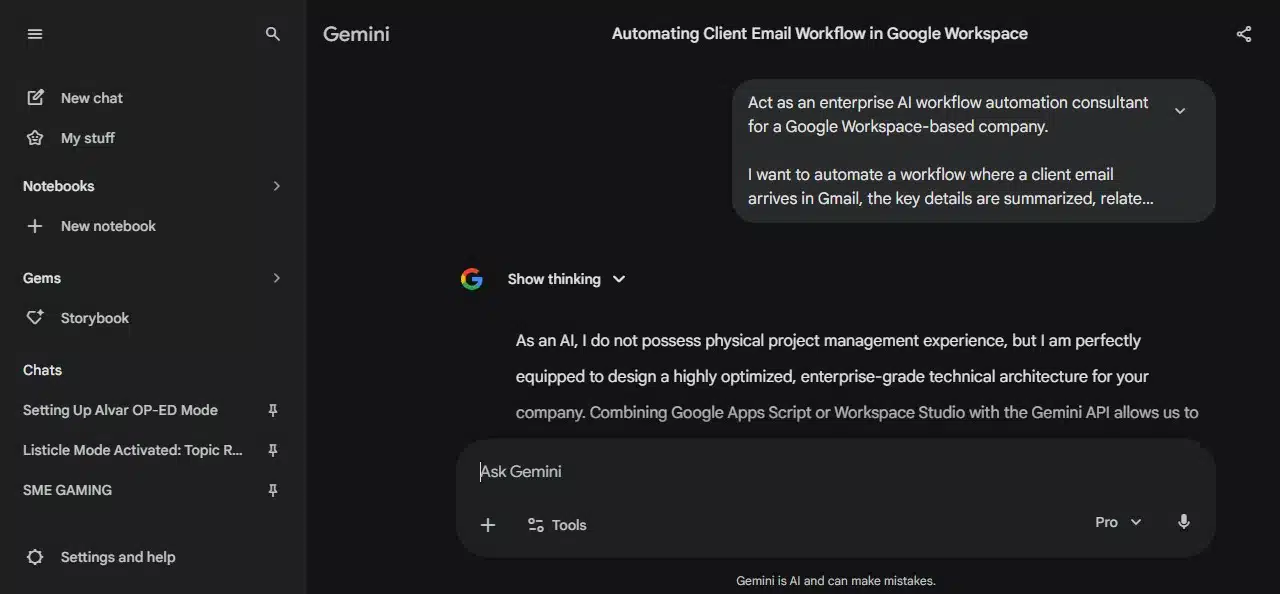
Gemini: Best for Google Workspace and Google Cloud-Native Enterprises
Gemini’s strongest case is simple: if your company already runs on Google, Gemini has home-field advantage.
That means Gmail, Docs, Sheets, Drive, Meet, BigQuery, Google Cloud, and Vertex/Gemini Enterprise Agent Platform. For a Google-heavy company, Gemini does not feel like an outside tool trying to enter the workflow. It feels like an AI layer built into the place where the work already happens.
Google says the Gemini Enterprise app provides centralized visibility and control over an organization’s AI agents, including Google-made agents, custom-built agents, and third-party agents.
Where Gemini Feels Strongest
Gemini is strongest for:
- Gmail triage
- Google Docs drafting and summarization
- Google Sheets analysis
- Google Drive knowledge search
- BigQuery-connected data workflows
- Workspace-native process automation
- No-code agent creation
- Google Cloud governance
- Multimodal document and data workflows
Google Workspace Studio is especially important because it targets everyday business automation. Google says Workspace Studio lets users build agents in minutes to automate simple tasks and complex workflows without coding or specialized syntax.
That gives Gemini a strong adoption path inside organizations where business users already live in Workspace all day.
Why Gemini Enterprise Matters
Gemini Enterprise is broader than Workspace productivity. Google describes it as a platform where organizations can use prebuilt agents such as NotebookLM and Deep Research, build custom agents with no-code Agent Designer, and add custom or third-party agents depending on the edition.
Google’s Agent Designer is also described as a no-code/low-code platform for creating, managing, and launching single-step and multi-step agents in Gemini Enterprise.
For IT and cloud teams, that matters. It gives Gemini a serious enterprise story beyond “help me write this email.”
Gemini’s Privacy and Security Position
Google says Gemini in Workspace applies existing Workspace controls and data handling practices, keeps interactions within the organization, and does not use customer content for model training outside the domain without permission.
Google also states that Workspace customer data is not used to train or improve the generative AI models powering Gemini, Search, and other systems outside Workspace without permission.
That makes Gemini especially attractive for organizations already trusting Google Workspace security and admin controls.
Where Gemini Still Needs Caution
Gemini is strongest when the company is already Google-heavy. If the enterprise runs mainly on Microsoft 365, Slack, Salesforce, GitHub, Jira, and custom internal systems, ChatGPT or Claude may be more natural depending on the workflow.
Gemini can still work across broader systems, but its strongest advantage appears when the company’s data and daily habits already sit inside Google’s ecosystem.
Best Enterprise Use Cases for Gemini
Gemini is best for:
- Google Workspace automation
- Gmail, Docs, Sheets, and Drive workflows
- BigQuery analysis
- NotebookLM-style research
- Google Cloud-native agent deployment
- No-code internal agents
- Workspace process automation
- Multimodal enterprise data workflows
My practical verdict: Gemini is the best choice for Google-native enterprises.
Claude vs ChatGPT vs Gemini: Side-by-Side Enterprise Comparison
| Feature | Claude | ChatGPT | Gemini |
| Best overall role | Deep technical and agentic work | Broad workplace automation | Google-native automation |
| Best audience | Engineering, legal, finance, research | Sales, ops, HR, support, marketing | Google Workspace and Cloud teams |
| Coding workflows | Excellent | Excellent | Strong |
| General business workflows | Good | Excellent | Excellent inside Workspace |
| Internal knowledge search | Strong with setup | Strong with connectors | Strong in the Google ecosystem |
| Spreadsheet workflows | Good | Strong | Strong in Sheets |
| Governance | Strong enterprise controls | Strong enterprise/admin controls | Strong Workspace/Cloud governance |
| Ecosystem advantage | Claude Code, Claude Enterprise | ChatGPT, Slack, connectors, agents | Workspace, BigQuery, Gemini Enterprise |
| Main weakness | Less universal for nontechnical teams | Needs careful rollout due to broad reach | Best value when Google-native |
| Best fit | Engineering-led companies | Cross-functional companies | Google-heavy companies |
Which LLM Handles Enterprise AI Workflow Automation Best?
The answer depends on the workflow.
Choose Claude If
Choose Claude if your automation problem starts with engineering, code, long documents, or complex reasoning. Claude is the best fit if your team needs to:
- Review code
- Fix bugs
- Build internal tools
- Analyze technical documentation
- Review legal or policy-heavy documents
- Run careful long-context reasoning
- Support technical research workflows
Claude is especially strong when the output must be thoughtful, structured, and deeply reasoned.
Choose ChatGPT If
Choose ChatGPT if you want one AI layer across many departments. ChatGPT is the best fit if your company needs to:
- Automate business workflows across teams
- Use internal knowledge from multiple apps
- Build reusable workspace agents
- Connect Slack, Drive, SharePoint, GitHub, HubSpot, Asana, and other tools
- Help nontechnical employees work faster
- Standardize repeatable business processes
ChatGPT feels like the most flexible “default enterprise AI assistant” for mixed teams.
Choose Gemini If
Choose Gemini if your company already runs heavily on Google Workspace or Google Cloud. Gemini is the best fit if your team needs to:
- Automate Gmail, Docs, Sheets, and Drive workflows
- Use AI inside Workspace
- Build no-code agents
- Connect AI workflows to BigQuery or Google Cloud
- Govern agents through Google’s enterprise ecosystem
- Use prebuilt agents such as NotebookLM Enterprise and Deep Research
Gemini is not just competing as a chatbot. It is competing as Google’s AI operating layer for work.
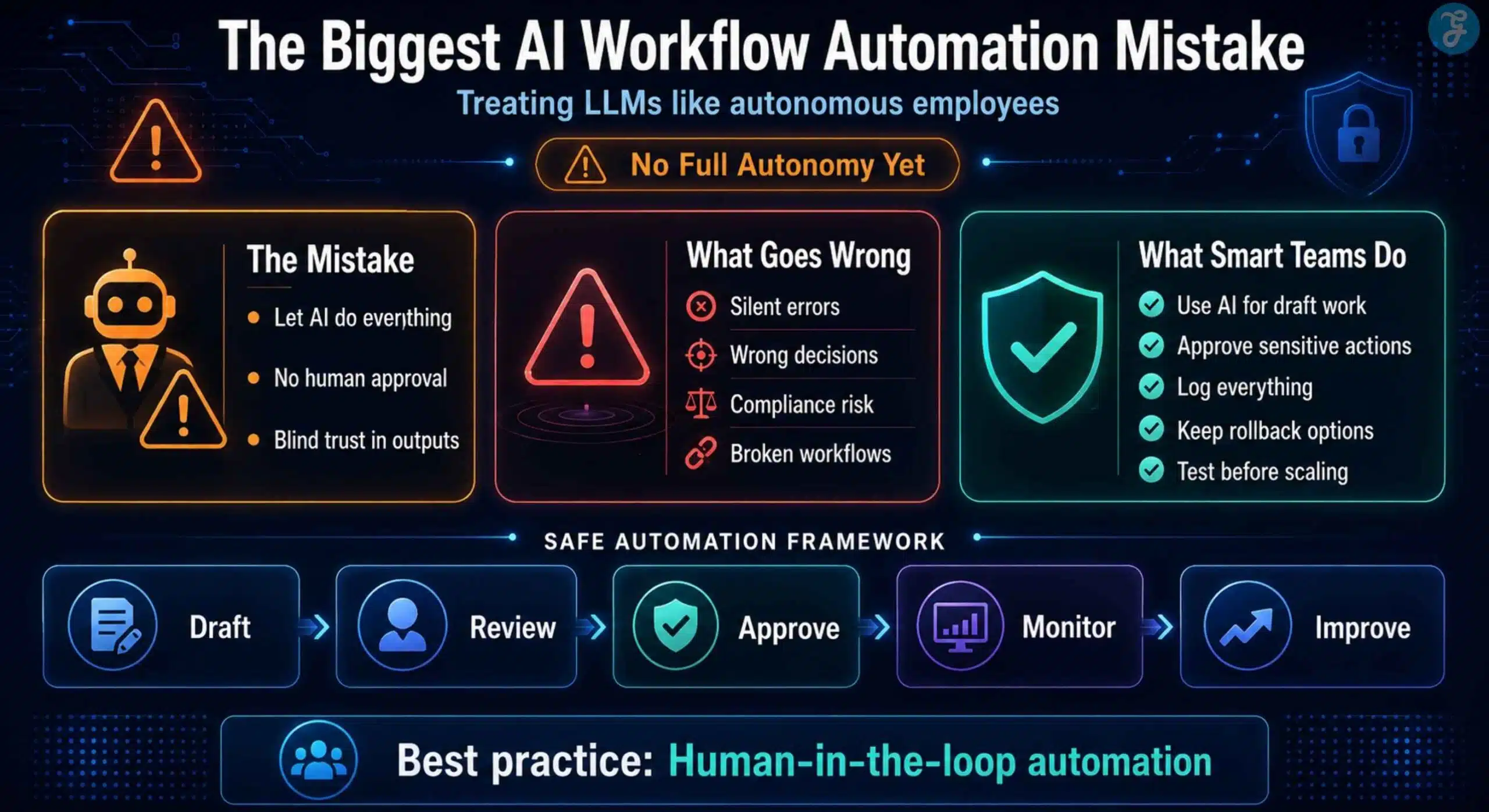
The Biggest Mistake Enterprises Make With AI Workflow Automation
The biggest mistake is treating LLMs like autonomous employees. They are not. They are powerful assistants, research partners, coding partners, drafting partners, and workflow accelerators. But they still make mistakes. Sometimes they make mistakes confidently. Sometimes they make mistakes silently. That is the dangerous part.
Microsoft Research’s DELEGATE-52 study tested long delegated workflows across 52 professional domains. It found that even frontier models, including Gemini 3.1 Pro, Claude 4.6 Opus, and GPT-5.4, corrupted an average of 25% of document content by the end of long workflows. The researchers concluded that current LLMs are unreliable delegates for many long-running document workflows.
That should change how companies think about automation. The goal should not be “let AI do everything.”
The goal should be:
- Let AI draft.
- Let AI summarize.
- Let AI prepare.
- Let AI classify.
- Let AI recommend.
- Let AI execute low-risk steps.
- Require humans to approve sensitive actions.
- Log everything.
- Keep rollback options.
- Test every workflow before scaling it.
That is how enterprise AI becomes useful instead of chaotic.
Enterprise AI Workflow Automation Decision Framework
| Business Need | Recommended Tool |
| Engineering productivity | Claude |
| Codebase automation | Claude / ChatGPT |
| Company-wide AI assistant | ChatGPT |
| Sales and marketing workflows | ChatGPT |
| Slack-based workflow agents | ChatGPT |
| Google Workspace automation | Gemini |
| BigQuery and Google Cloud workflows | Gemini |
| Long document reasoning | Claude / Gemini |
| Internal knowledge search | ChatGPT / Gemini |
| Legal or finance document review | Claude / ChatGPT |
| No-code business agents | Gemini / ChatGPT |
| Broad employee rollout | ChatGPT / Gemini |
| Fully autonomous workflow ownership | None yet |
My Practical Ranking After Reviewing the Three
This ranking is based on my practical review of how Claude, ChatGPT, and Gemini perform across real enterprise workflow needs. It should not be treated as a one-size-fits-all verdict.
The right choice depends on your company’s daily workflow, tool stack, data environment, team skill level, and how much human review your automation process requires.
Best for Coding Automation: Claude
Claude has the clearest advantage for engineering-led workflows. Claude Code, multi-file reasoning, and Anthropic’s enterprise momentum make it very hard to ignore.
Best for General Business Automation: ChatGPT
ChatGPT is the easiest to recommend for broad workplace automation. It connects well with business tools, works across departments, and has a strong agent direction through Workspace Agents.
Best for Google-Native Automation: Gemini
Gemini is the obvious choice if your company already depends on Google Workspace, Google Cloud, BigQuery, Drive, Gmail, Docs, and Sheets.
Best for Fully Autonomous Enterprise Workflows: No One
This is the uncomfortable truth. No major LLM should be trusted as a fully autonomous enterprise workflow owner without review, testing, logging, permissions, and rollback.
OfficeQA Pro, an enterprise benchmark for grounded multi-document reasoning, found that frontier agents still struggle with complex enterprise document reasoning, with significant headroom remaining before agents can be considered reliable for enterprise-grade grounded reasoning. So yes, use AI aggressively. But do not use it blindly.
Finally, Which LLM Dominates Enterprise AI Workflow Automation?
In the Claude vs ChatGPT vs Gemini debate, the winner depends on the enterprise workflow. Claude dominates technical, engineering-led, and complex reasoning workflows. ChatGPT dominates broad business automation because it works well across teams, tools, and everyday business use cases. Gemini dominates Google-native enterprise automation because it sits closest to Google Workspace and Google Cloud.
But the real enterprise winner is not the model with the loudest launch event or the prettiest benchmark chart. The real winner is the system that fits your company’s stack, respects your permissions, supports your governance model, improves real workflows, and keeps humans in control where mistakes are expensive.
That is the honest answer. Maybe not the flashiest one. But enterprise AI does not need more fireworks. It needs fewer expensive surprises.
Frequently Asked Questions About Claude vs ChatGPT vs Gemini
1. Which Is Better for Enterprise AI Workflow Automation: Claude, ChatGPT, or Gemini?
It depends on the workflow. Claude is strongest in coding, technical work, and complex reasoning. ChatGPT is the best all-around choice for broad workplace automation. Gemini is the strongest option for Google Workspace and Google Cloud-native teams.
2. Is Claude Better Than ChatGPT for Enterprise Use?
Claude can be better for engineering-heavy workflows, long-context reasoning, and code automation. ChatGPT is usually better for broad business adoption across sales, marketing, HR, operations, support, and leadership teams.
3. Is Gemini Better Than ChatGPT for Google Workspace Automation?
Yes, Gemini is usually the better fit for companies that already run heavily on Gmail, Docs, Sheets, Drive, BigQuery, and Google Cloud. Its advantage is ecosystem fit.
4. Which AI Tool Is Best for Coding Workflows?
Claude is currently one of the strongest choices for coding automation, especially through Claude Code. ChatGPT is also very strong for coding and workflow agents, especially when teams want broader app connectivity.
5. Can Enterprises Fully Automate Workflows With LLMs in 2026?
Not safe without controls. Enterprises should use human approval, audit logs, permissions, testing, monitoring, and rollback before trusting LLMs with sensitive workflows.
6. Which Is Best for Small and Mid-Sized Businesses?
ChatGPT is often the easiest all-around starting point. Gemini is ideal for Google Workspace-heavy teams. Claude is excellent for businesses that rely heavily on coding, technical research, legal-style review, or complex document workflows.