The internet loves the phrase “4-hour work week” because it sounds like a loophole. Work less. Earn more. Travel whenever. Answer emails from a beach. Somehow stay rich, rested, and permanently unavailable. That version is mostly fantasy. The real version is less magical but much more useful. A 4-hour work week usually does not start as a job listing.
It is built through skill, proof, positioning, systems, and leverage. People who reach that kind of schedule are rarely paid for “being available.” They are paid for solving expensive problems, building repeatable systems, managing high-value outcomes, or owning a specialized process that clients do not want to figure out themselves.
That is why high-paying remote jobs with a 4-hour work week need to be discussed honestly. Some remote roles can become low-hour, high-income careers. But they usually do not begin that way.
The first stage often takes more work, not less. You build the skill. You create proof. You learn how to sell the outcome. You package the service. You automate or delegate the repeatable parts. Then, if the economics work, your weekly hours can shrink.
This list is not about easy remote jobs. It is about remote careers and service models that can realistically move toward a 4-hour work week style when handled well.
Who This List Is For
This list is best for people who want flexible remote careers but are willing to build real value first.
It is especially useful for:
- Skilled professionals who want more control over their schedule
- Freelancers are trying to move away from low hourly rates
- Consultants who want to productize their expertise
- Digital workers who want higher-value remote work
- Career switchers willing to spend months building proof
- Marketers, developers, analysts, writers, designers, and operators
- People who understand that remote freedom usually comes after competence
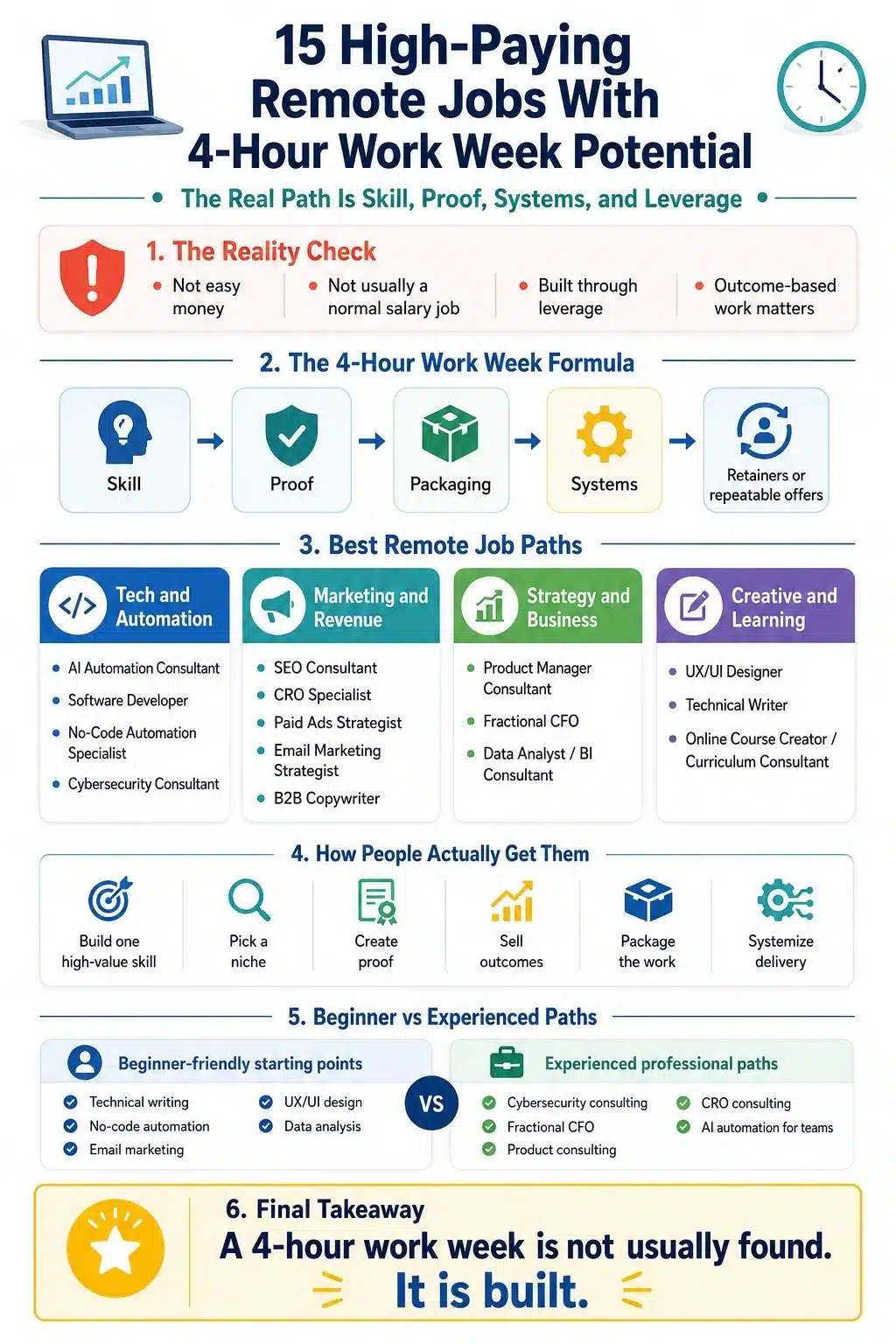
This list is not for people who want instant income without learning, client work, deadlines, sales, or responsibility. A 4-hour work week is not usually found. It is built.
What “4-Hour Work Week” Actually Means
Before getting into the jobs, the phrase needs a reality check.
In most cases, a 4-hour work week means one of these:
| Model | What It Really Means |
| Retainer-based work | A client pays monthly for access to a valuable skill or system |
| Productized service | The work is packaged into a repeatable offer |
| Consulting | The client pays for judgment, not task completion |
| Automation-backed work | Tools and systems reduce manual effort |
| Delegated delivery | The expert sells the outcome and manages support help |
| Asynchronous work | Fewer meetings and more focused output |
| Scalable assets | Templates, courses, frameworks, or reports do some of the work |
The common thread is leverage. If someone is paid only by the hour, cutting the workweek from 40 hours to 4 usually cuts the income too. But if someone is paid for a result, a system, a strategy, a deliverable, or a business outcome, the math changes. That is where the real opportunity sits.
15 High-Paying Remote Jobs With a 4-Hour Work Week Potential
These are not ranked from easiest to hardest. They are ranked by practical fit for high-value remote work, outcome-based earning, and long-term schedule control.
1. AI Automation Consultant
AI automation consultants help businesses reduce repetitive work using tools, workflows, integrations, chatbots, internal assistants, CRM automations, reporting systems, and AI-assisted operations.
This can include automating lead routing, customer support drafts, content workflows, invoice reminders, internal knowledge bases, or data entry tasks.
The reason this can become low-hour is simple: once the consultant builds repeatable systems, the delivery becomes faster. A consultant may start by custom-building everything manually, but later turn the work into templates, setup packages, monthly optimization retainers, and documented processes.
How people actually get it:
Most people enter this field by solving one clear business problem first. They might build automation for a local agency, an e-commerce store, a coach, a SaaS company, a clinic, or a service business. The first case study matters more than the job title.
A practical path looks like this:
- Learn tools such as Zapier, Make, Airtable, Notion, HubSpot, Google Workspace, and AI workflow tools
- Build 2-3 demo automations for real business use cases
- Pick one niche, such as agencies, ecommerce, real estate, coaches, or healthcare admin
- Offer a fixed-scope automation audit
- Turn repeated fixes into a setup package
- Move strong clients into monthly maintenance retainers
Income potential: High, especially when the automation saves staff time, reduces errors, or improves lead handling.
Reality check: This is not just “knowing AI prompts.” Clients pay for business process improvement. If the consultant cannot understand operations, the work becomes fragile.
2. SEO Consultant
SEO consulting is one of the more realistic paths toward a flexible remote career because the work can be strategic, audit-based, retainer-friendly, and asynchronous.
An SEO consultant may handle technical audits, content strategy, keyword mapping, competitor analysis, internal linking plans, topical authority planning, content refreshes, or reporting.
The 4-hour work week version usually does not come from writing blog posts all day. It comes from selling strategy, diagnosis, audits, and retainers.
How people actually get it:
Most serious SEO consultants build proof through projects. That proof can come from client work, personal websites, niche sites, agency experience, or documented case studies.
A practical path:
- Learn technical SEO, on-page SEO, keyword research, content strategy, and analytics
- Build or improve a website and document the results
- Create SEO audits for small businesses or publishers
- Publish practical SEO breakdowns on LinkedIn or a personal site
- Offer a paid SEO audit instead of free advice
- Turn audits into strategy retainers or monthly advisory calls
Income potential: Strong for consultants who can connect SEO work to revenue, leads, traffic quality, or publishing efficiency.
Reality check: SEO is slow. Clients may expect fast results. A consultant needs clear communication, realistic timelines, and enough proof to avoid being treated like a keyword tool operator.
3. Conversion Rate Optimization Specialist
A conversion rate optimization specialist helps websites turn more visitors into leads, purchases, signups, trial users, or booked calls.
The work may include landing page audits, user behavior analysis, A/B testing plans, checkout improvement, funnel analysis, analytics review, copy testing, and UX recommendations.
This role can become low-hour because CRO is tied directly to business outcomes. A small improvement on a high-traffic or high-revenue page can be worth far more than the hours spent finding it.
How people actually get it:
CRO specialists usually need proof. Businesses do not pay premium rates for opinions. They pay for tested judgment.
A realistic path:
- Learn analytics, heatmaps, landing page structure, copywriting, and UX basics
- Study ecommerce, SaaS, or lead-generation funnels
- Create teardown-style audits of real landing pages
- Offer fixed-scope conversion audits
- Build case studies around improved conversion rates, clearer messaging, or reduced checkout friction
- Move into monthly testing roadmaps or advisory retainers
Income potential: High when working with e-commerce, SaaS, paid ads teams, or high-ticket service businesses.
Reality check: Not every business has enough traffic to test properly. CRO work is strongest when the client already has traffic and revenue.
4. Paid Ads Strategist
Paid ads strategists manage or advise on advertising across platforms such as Google Ads, Meta Ads, LinkedIn Ads, TikTok Ads, YouTube Ads, and other paid acquisition channels.
This can become a high-paying remote role because businesses spend real money on ads and care about return. If a strategist can improve cost per lead, revenue, conversion quality, or campaign efficiency, the work becomes valuable.
The low-hour version usually comes from strategy, audits, account restructuring, reporting systems, and retainer-based oversight rather than constantly building campaigns from scratch.
How people actually get it:
Most paid ads strategists start by managing small accounts and proving they can avoid wasting money.
A practical route:
- Learn one ad platform deeply before trying to master all of them
- Understand tracking, landing pages, offers, and conversion quality
- Manage small budgets first
- Build case studies around cost reduction, better lead quality, or higher ROAS
- Offer ad account audits
- Package campaign setup and monthly optimization separately
- Move into retainer work after results are proven
Income potential: High for specialists who manage serious budgets or advise revenue-focused teams.
Reality check: Paid ads can be stressful. Clients watch results closely because spending is visible every day. Weak offers and bad landing pages can make even good ad work look poor.
5. Email Marketing Strategist
Email marketing strategists help businesses turn subscribers, leads, and customers into revenue through welcome sequences, newsletters, sales campaigns, lifecycle emails, abandoned cart flows, reactivation campaigns, and retention systems.
This job fits the 4-hour work week idea because email systems can be built once and improved over time. The strategist can create automated flows, templates, segmentation rules, and campaign calendars that keep working after the initial setup.
How people actually get it:
The easiest path is to focus on one business type.
For example:
- Ecommerce email flows
- SaaS onboarding emails
- Course creator launch emails
- Newsletter monetization
- B2B nurture sequences
- Local service lead follow-up
A realistic path:
- Learn platforms such as Klaviyo, ConvertKit, Mailchimp, HubSpot, ActiveCampaign, or Customer.io
- Build sample email sequences
- Rewrite weak welcome flows as portfolio samples
- Offer an email revenue audit
- Package setup work into fixed offers
- Add monthly campaign support or reporting retainers
Income potential: Strong when email directly affects sales, retention, or lead conversion.
Reality check: Email is not just about writing subject lines. Strong email strategists understand offers, audience segments, timing, analytics, and customer behavior.
6. Software Developer
Software development remains one of the strongest, high-paying remote career paths. Developers build applications, internal tools, websites, platforms, APIs, integrations, and technical systems.
Official wage data support software development as a high-paying occupation, but not every developer gets a flexible schedule. The 4-hour work week version usually appears in contract work, specialized consulting, maintenance retainers, or owning a small software product.
How people actually get it:
Most developers need proof of ability. That may come from a computer science degree, bootcamp, open-source contributions, freelance projects, work experience, or a strong portfolio.
A practical path:
- Learn one stack well
- Build projects that solve real problems
- Contribute to open-source or create public demos
- Apply for remote developer roles
- Take contract projects after gaining experience
- Specialize in a profitable niche such as SaaS integrations, backend systems, Shopify apps, AI tools, or internal automation
- Later move toward retainers, productized fixes, or a micro-SaaS
Income potential: High, especially for experienced developers in specialized areas.
Reality check: Entry-level remote developer jobs can be competitive. The low-hour version usually requires years of skill, trust, and systems.
7. Cybersecurity Consultant
Cybersecurity consultants help organizations reduce security risks. They may handle security audits, compliance readiness, vulnerability assessments, employee security training, incident response planning, cloud security reviews, or risk documentation.
This field pays well because the risk is expensive. A breach, compliance failure, or weak security process can cost far more than the consultant’s fee.
The 4-hour work week potential comes from audits, retainers, templates, repeatable assessments, and advisory work.
How people actually get it:
Cybersecurity is not a shortcut field. Trust matters.
A realistic path:
- Build a foundation in networking, systems, cloud, and security basics
- Earn certifications where useful, such as Security+, CISSP, CISA, or cloud security credentials
- Work in IT, security operations, compliance, or risk roles
- Document security projects and outcomes
- Pick a niche such as SaaS security, small business security, healthcare compliance, cloud security, or incident readiness
- Offer fixed-scope security assessments
- Move into advisory retainers
Income potential: High, especially with experience, credentials, and industry specialization.
Reality check: This is not beginner-friendly. Mistakes can be serious, and credibility takes time.
8. Data Analyst or BI Consultant
Data analysts and BI consultants help companies turn messy data into useful dashboards, reports, forecasts, and decisions. They may work with tools such as Excel, SQL, Power BI, Tableau, Looker Studio, Python, Google Analytics, CRMs, and data warehouses.
The 4-hour work week version often comes from building dashboards, automated reports, and recurring insight systems. Once the reporting system is built, the consultant may be paid monthly to maintain, interpret, and improve it.
How people actually get it:
A good starting path:
- Learn Excel or Google Sheets deeply
- Add SQL and one dashboard tool
- Build public sample dashboards
- Focus on one business area such as sales, marketing, finance, operations, or e-commerce
- Offer a reporting cleanup project
- Build dashboards that replace manual reporting
- Package monthly reporting reviews as a retainer
Income potential: Strong, especially in companies with messy reporting, ad spend, sales teams, or recurring performance reviews.
Reality check: Data work is not just making charts. The real value is knowing what the numbers mean and what decision they support.
9. Product Manager Consultant
Product manager consultants help companies decide what to build, what to improve, what to stop building, and how to align product work with user needs and business goals.
They may work on product strategy, roadmap planning, user research, feature prioritization, launch planning, stakeholder alignment, and product audits.
This can become a high-paying remote path because product mistakes are expensive. Building the wrong feature wastes engineering time, money, and market opportunity.
How people actually get it:
Most product consultants start with real product experience. It is hard to advise teams without having worked through product decisions before.
A realistic path:
- Work in product, UX, engineering, marketing, customer success, or operations
- Build experience shipping products or features
- Learn user research, prioritization, product analytics, and roadmap planning
- Create case studies showing product decisions and outcomes
- Offer product audits or roadmap workshops
- Move into fractional product leadership or advisory retainers
Income potential: High for consultants who can help teams reduce waste and make better product decisions.
Reality check: Product consulting requires judgment. It is not just about making roadmaps look organized.
10. UX/UI Designer
UX/UI designers improve how digital products look, feel, and function. They may design websites, apps, dashboards, onboarding flows, landing pages, checkout screens, SaaS interfaces, or mobile experiences.
This role can become flexible because design work can be project-based, packaged, and portfolio-driven. A skilled designer can charge for a landing page redesign, app screen package, design audit, or product design sprint.
How people actually get it:
A realistic path:
- Learn design fundamentals, UX principles, accessibility, and Figma
- Redesign weak interfaces as practice projects
- Build a portfolio with before-and-after thinking
- Explain design decisions, not just visuals
- Pick a niche such as SaaS, ecommerce, mobile apps, healthtech, fintech, or creator brands
- Offer design audits or fixed-scope redesigns
- Build relationships with developers, agencies, and founders
Income potential: Strong for designers who can connect design decisions to usability, conversion, retention, or product clarity.
Reality check: Pretty screens are not enough. Clients pay more for a design that solves business and user problems.
11. Technical Writer
Technical writers create documentation, manuals, API docs, onboarding guides, knowledge bases, help-center articles, software instructions, internal SOPs, and complex explainers.
This is one of the more underrated high-paying remote careers. It works especially well in SaaS, cybersecurity, developer tools, fintech, healthcare technology, AI tools, and enterprise software.
The low-hour version comes from specialization, templates, recurring documentation retainers, and deep knowledge of a technical niche.
How people actually get it:
A practical path:
- Learn how to explain complex topics clearly
- Build writing samples around APIs, software tools, cybersecurity, cloud systems, or technical workflows
- Learn Markdown, Git basics, documentation platforms, and product terminology
- Offer documentation audits
- Rewrite confusing help docs as portfolio samples
- Work with SaaS companies, developer tools, or agencies
- Build retainer packages for documentation updates
Income potential: Good to high, especially in technical industries where clear documentation reduces support tickets and improves user adoption.
Reality check: Technical writing requires accuracy. It is not generic blog writing with a technical title.
12. Fractional CFO or Finance Consultant
Fractional CFOs and finance consultants help businesses understand cash flow, forecasting, pricing, profitability, budgets, financial reporting, and strategic finance.
This role can be very high-paying because financial clarity affects survival and growth. A business owner may not need a full-time CFO, but they may need a senior finance expert a few hours per month.
That is exactly why the fractional model can work.
How people actually get it:
Most fractional CFOs do not start from zero. They usually have accounting, finance, banking, operations, startup, or corporate finance experience.
A realistic path:
- Build strong financial fundamentals
- Gain experience in accounting, FP&A, bookkeeping, startup finance, or business operations
- Learn forecasting, cash flow, margins, and reporting
- Create dashboard and reporting templates
- Serve small businesses or startups first
- Offer monthly finance reviews
- Move into fractional advisory retainers
Income potential: High for experienced finance professionals, especially with business owners who need decision support.
Reality check: This is a trust-heavy role. Clients are sharing sensitive financial information, so credibility and professionalism matter.
13. Online Course Creator or Curriculum Consultant
Online course creators and curriculum consultants design structured learning experiences. They may build courses, employee training, onboarding programs, workshops, educational content, or learning paths for companies and creators.
This role can become low-hour when the creator owns reusable assets or sells a curriculum strategy rather than custom-building every lesson from scratch.
How people actually get it:
A practical route:
- Choose a subject with real demand
- Build expertise or use existing professional experience
- Create a small workshop before building a full course
- Test the offer with a real audience
- Turn repeated teaching into modules, templates, and worksheets
- Help businesses, creators, coaches, or education companies structure their learning materials
- Sell curriculum audits, course outlines, and lesson design packages
Income potential: Strong when paired with a valuable niche, proven audience, or business training need.
Reality check: Course creation is not passive at the beginning. Marketing, trust, audience building, and support take work.
14. No-Code Automation Specialist
No-code automation specialists build business systems without traditional software development. They may use tools such as Airtable, Notion, Webflow, Softr, Bubble, Zapier, Make, Glide, Tally, Typeform, and other no-code platforms.
They help businesses build portals, dashboards, lead systems, internal tools, onboarding systems, lightweight CRMs, and workflow automations.
This can become a 4-hour work week-style role because many no-code projects repeat across clients. Once the specialist has templates and processes, delivery becomes faster.
How people actually get it:
A practical path:
- Learn 2-3 no-code tools deeply
- Build demo systems for real business cases
- Pick a niche such as agencies, coaches, real estate, recruiting, education, or operations
- Offer fixed-scope builds
- Create templates
- Add setup videos and documentation
- Move clients into support retainers
Income potential: Strong when the tool saves operational time or replaces messy manual workflows.
Reality check: No-code does mean no thinking. Bad systems can break, confuse teams, or create data problems.
15. B2B Copywriter or Sales Page Strategist
B2B copywriters and sales page strategists write content designed to support revenue. This can include landing pages, sales pages, email sequences, case studies, product messaging, ads, website copy, and lead-generation assets.
The high-paying version is not generic content writing. It is revenue-focused messaging for businesses that sell valuable products or services.
This can become low-hour when the writer sells fixed-scope assets, strategy packages, audits, templates, or retainers rather than low-paid hourly writing.
How people actually get it:
A realistic path:
- Learn direct response, positioning, customer research, and offer strategy
- Study real landing pages and sales pages
- Rewrite weak pages as portfolio samples
- Pick a niche such as SaaS, fintech, cybersecurity, healthtech, agencies, or B2B services
- Offer messaging audits
- Build case studies around conversion, clarity, or lead quality
- Move into retainers for launches, email campaigns, and sales assets
Income potential: High for writers who understand business strategy, not just grammar.
Reality check: AI has made generic writing less valuable. Strategic copywriting, research, positioning, and offer thinking still matter.

An Overview of High-Paying Remote Jobs With a 4-Hour Work Week Potential
The clearest pattern is that low-hour remote work usually favors roles where the output is valuable, specialized, and easy to package. A remote job with constant meetings, live support, or hourly task work is harder to compress. A consulting role, audit, system setup, or retainer is easier to shape around fewer hours.
Overview Comparison Table
| Job | Best Path to Low-Hour Work | Better For |
| AI Automation Consultant | Templates, retainers, workflow packages | Operators, builders, consultants |
| SEO Consultant | Audits, strategy retainers, advisory calls | Marketers, publishers, analysts |
| CRO Specialist | Revenue audits and testing roadmaps | Marketers, UX thinkers |
| Paid Ads Strategist | Account audits and optimization retainers | Performance marketers |
| Email Marketing Strategist | Automated flows and campaigns | Writers, marketers |
| Software Developer | Contract projects, retainers, products | Technical workers |
| Cybersecurity Consultant | Security audits and advisory retainers | Experienced IT/security pros |
| Data Analyst / BI Consultant | Dashboards and reporting systems | Analysts, spreadsheet experts |
| Product Manager Consultant | Roadmaps, workshops, advisory | Product and startup pros |
| UX/UI Designer | Design audits and fixed-scope redesigns | Designers |
| Technical Writer | Documentation systems and retainers | Writers with technical interest |
| Fractional CFO | Monthly finance advisory | Finance professionals |
| Course Creator / Curriculum Consultant | Reusable learning assets | Educators, experts |
| No-Code Automation Specialist | Repeatable business systems | Builders, ops people |
| B2B Copywriter / Sales Page Strategist | Fixed assets and messaging retainers | Writers, marketers |
Best Jobs for Beginners vs Experienced Professionals
Some of these paths are easier to start than others. That does not mean they are easy. It means the entry point is more realistic without years of senior-level experience.
| Better for Beginners | Better for Experienced Professionals |
| Technical Writer | Cybersecurity Consultant |
| No-Code Automation Specialist | Fractional CFO |
| Email Marketing Strategist | Product Manager Consultant |
| UX/UI Designer | AI Automation Consultant for complex teams |
| B2B Copywriter | CRO Specialist for high-revenue sites |
| Data Analyst | Senior Software Developer |
Beginners should focus on portfolio-friendly roles. Experienced professionals should look for advisory, consulting, and fractional models. The mistake is trying to copy someone else’s path without matching their skill base.
What “How People Actually Get Them” Looks Like
Most people do not get these opportunities by applying to one dream remote job and waiting. The path is usually more active.
Here is the practical version:
- Pick one skill with real business value.
- Choose a niche that has money and urgency.
- Build proof before asking for premium pay.
- Create 2-3 public samples or case studies.
- Offer a small paid audit or fixed-scope project.
- Turn repeated problems into a productized service.
- Use LinkedIn, referrals, communities, and targeted outreach.
- Avoid competing only on hourly rates.
- Learn to sell the business outcome.
- Build systems before trying to reduce hours.
The first client is often the hardest. The second is easier if the first becomes proof. The 4-hour work week starts becoming possible when the work stops being custom chaos every time.
The Real Shortcut Is Leverage, Not Laziness
The phrase “4-hour work week” attracts people because it sounds like escape. But the people who get closest to it usually do not escape work. They redesigned it.
They stop selling raw hours. They build rare skills. They create proof. They choose better clients. They package outcomes. They document their process. They automate repetitive work. Sometimes they delegate. Sometimes they build assets. Sometimes they simply become good enough that clients pay for judgment instead of time.
That is the honest path behind high-paying remote jobs with a 4-hour work week.
It is not easy money. It is not a trick. It is not a salary where someone pays full-time income for four casual hours of effort. It is a work design built around leverage.
The best move is not to chase all 15 jobs. Pick one. Study the market. Build a useful skill. Create proof. Sell a small result. Improve the offer. Then systemize what repeats. A 4-hour work week is rarely the starting point.
It is what becomes possible after the work becomes valuable enough to stop being measured only by time.
Frequently Asked Questions About High-Paying Remote Jobs With a 4-Hour Work Week
1. Are 4-Hour Work Week Jobs Real?
They are real in some cases, but they are rarely traditional jobs. Most 4-hour work week setups come from consulting, freelancing, retainers, automation, productized services, or business ownership.
2. What Remote Jobs Pay the Most in 2026?
High-paying remote jobs often include software development, cybersecurity, data science, marketing strategy, finance consulting, product management, paid ads, CRO, and specialized technical writing. Pay varies by experience, niche, location, and proof.
3. Can Beginners Get High-Paying Remote Jobs?
Beginners can start building toward them, but they usually will not start at the top. Beginner-friendly paths include technical writing, no-code automation, email marketing, UX/UI design, data analysis, and B2B copywriting when paired with a strong portfolio.
4. Which Remote Jobs Are Best for Freelancers?
Good freelance-friendly options include SEO consulting, paid ads strategy, email marketing, CRO, UX/UI design, technical writing, no-code automation, B2B copywriting, and AI automation consulting.
5. How Long Does It Take to Build a 4-Hour Work Week Career?
For most people, it takes months or years, not days. The timeline depends on the skill, existing experience, proof, client quality, pricing, and how well the work can be systemized.
6. Are AI Jobs Good for Remote Work?
Yes, AI-related work can be strong for remote work, especially automation consulting, workflow design, AI-assisted operations, and technical implementation. But businesses pay for problem-solving, not just prompt knowledge.