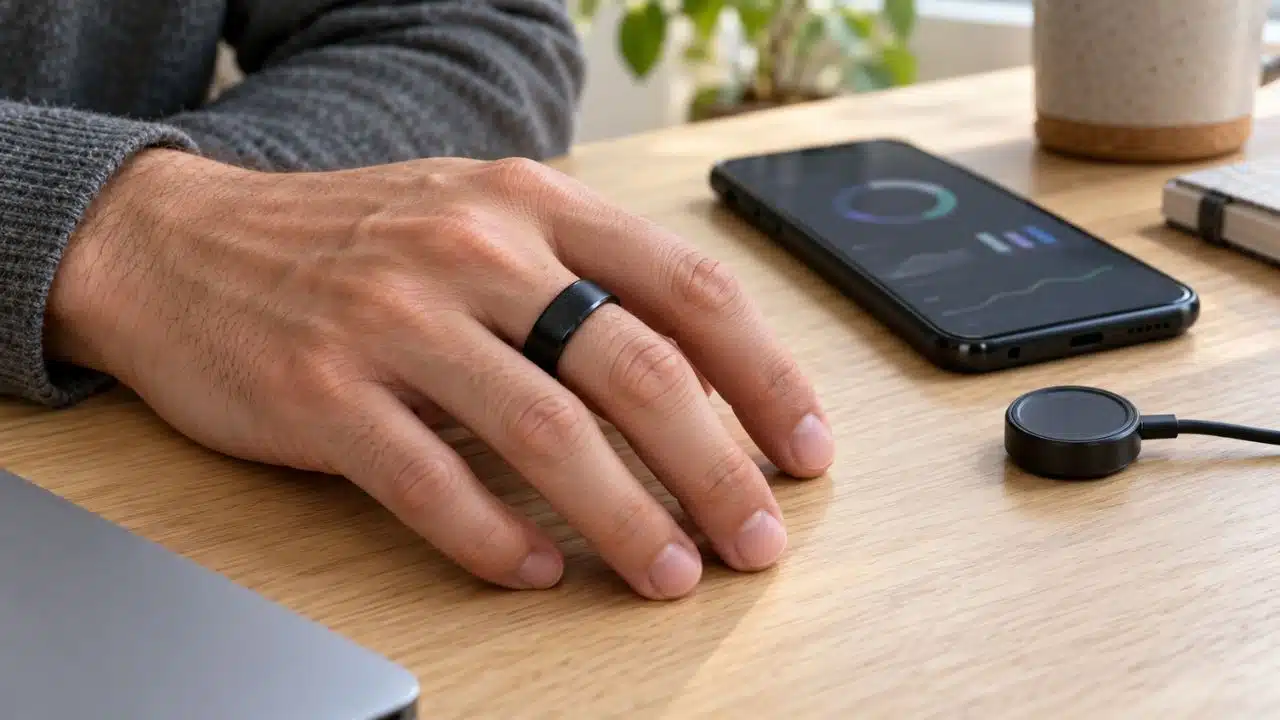
In this Classic Smart Ring review, I am focusing on the parts that affected my experience most after two months of regular use: selecting the right size, setting it up on Android, and wearing it throughout an ordinary day. I bought the black version, confirmed my measurement using the available size chart, and chose to wear it on my middle finger.
At first, I was surprised by how many features had been fitted into such a small device. Through its companion app, the ring can record activity, workouts, sleep, and several wellness-related readings. That makes it sound like a smartwatch reduced to the size of a ring, but the actual experience is different.
It is comfortable, discreet, and easy to incorporate into a daily routine. It also has some major limitations. There is no screen, almost every interaction depends on the phone app, workout tracking is not consistently dependable, and the black finish has developed scratches.
I still like the ring for the range of features it offers. I simply do not treat it as medical equipment or expect it to replace every function of a smartwatch.
Disclosure: I purchased this ring myself and used it regularly for two months.
Classic Smart Ring Review at a Glance
The Classic Smart Ring works best as a discreet entry-level wearable. Its comfort and broad feature set are appealing, but buyers should understand that it remains heavily dependent on a basic companion app.
| Review detail | My experience |
| Testing period | Two months of regular use |
| Color | Black |
| Finger used | Middle finger |
| Phone platform | Android |
| Companion app | QRing |
| Features used | Activity, workouts, sleep, and wellness tracking |
| Everyday comfort | Comfortable |
| Water exposure | No problems during my normal use |
| Visible wear | The black finish developed scratches |
| Best quality | Broad tracking features in a discreet design |
| Main drawback | No screen and complete dependence on the phone app |
| Overall verdict | Useful for general trends, but not for medical or serious athletic tracking |
Confirming My Size Before Ordering Made a Difference
Sizing is one of the easiest ways to get a smart-ring purchase wrong. Unlike an adjustable watch strap, a ring gives me little room to correct a poor fit after it arrives.
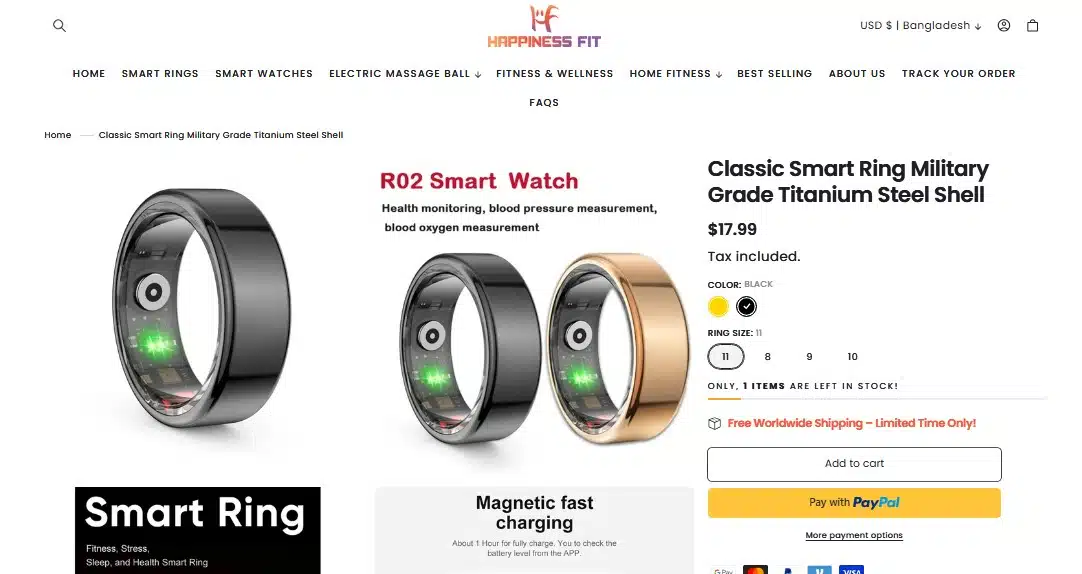
The seller provides a size chart, so I confirmed my measurement before ordering. I selected a size for my middle finger, and the fit has been comfortable during regular wear.
I would not order this ring solely from the size of a narrow jewellery band. The Classic Smart Ring is relatively wide, and wider rings can feel different even when the internal measurement appears familiar. The band may also press against the neighboring fingers more than a conventional ring.
Finger size can change slightly during the day. Warm weather, exercise and natural swelling can make a ring feel tighter in the evening than it did in the morning. For that reason, it is sensible to measure the intended finger more than once.
A suitable fit should remain secure without pinching. The ring should not spin constantly, but it should still come off without a struggle. Fit also matters because the internal sensors need stable contact with the finger.
My size worked because I checked before ordering. I would consider that step essential rather than optional.
Setting Up the Ring on Android
My unit identifies as an R02 and uses the QRing companion app. On Android, the basic setup involves charging the ring, enabling Bluetooth, and adding the device through the app.
The process follows the same general pattern as many Bluetooth wearables. Once connected, QRing becomes the control center for the product. That is where I can check recorded information, open workout modes, and review previous activity or sleep data.
The ring itself provides almost no direct feedback. It collects information, but the phone is where that information becomes visible.
This creates a clear tradeoff. The design remains simple and unobtrusive because there is no display, but the ring is not particularly useful without QRing. If the app is closed, disconnected, or fails to synchronize properly, there is no alternative way to examine the recorded information directly on the device.
I would also review the app permissions instead of accepting every request automatically. Bluetooth access is necessary for connecting the ring, while other permissions may relate to optional features such as remote camera control or phone integration. I prefer granting only what I intend to use.
The Lack of a Screen Is More Important Than It Sounds
The screen-free design initially appealed to me. I already spend enough time looking at displays, and I did not necessarily want another device competing for my attention.
That simplicity makes the ring discreet. It resembles an ordinary black ring more than a miniature smartwatch, and it does not light up every few minutes with another card or message.
The disadvantage becomes obvious when I want information quickly. I cannot check the time, view my current heart rate, read a message, or look at a workout result directly on the ring. I have to open the QRing app on my phone.
The product page mentions smart notifications, but buyers should not interpret that as a readable notification experience. The ring has no display on which to show calls or messages.
For me, this is one of the biggest compromises. The Classic Smart Ring is better understood as a discreet sensor that sends information to a phone, not as a smartwatch replacement wrapped around a finger.
Daily Wear Has Been Comfortable
Comfort is one of the strongest parts of my experience. After two months, I have had no difficulty wearing the ring regularly on my middle finger.
There is no strap around my wrist, and the ring does not feel as bulky as a watch during sleep. Once I became accustomed to the width, it fitted naturally into my routine.
Its shape does become more noticeable when I grip something tightly. Any metal ring can press against a mug, tool, handle, or piece of gym equipment. That is especially relevant during weightlifting, where the ring may sit directly between the hand and a dumbbell or barbell.
I would remove it before heavy lifting. This protects both my finger and the ring’s finish, and it also avoids placing additional pressure around the sensors.
For desk work, walking, and ordinary daily activities, I have found it comfortable. That may sound like a simple quality, but comfort is what determines whether a wearable continues collecting information or ends up forgotten in a drawer.
The Black Finish Has Not Remained Perfect
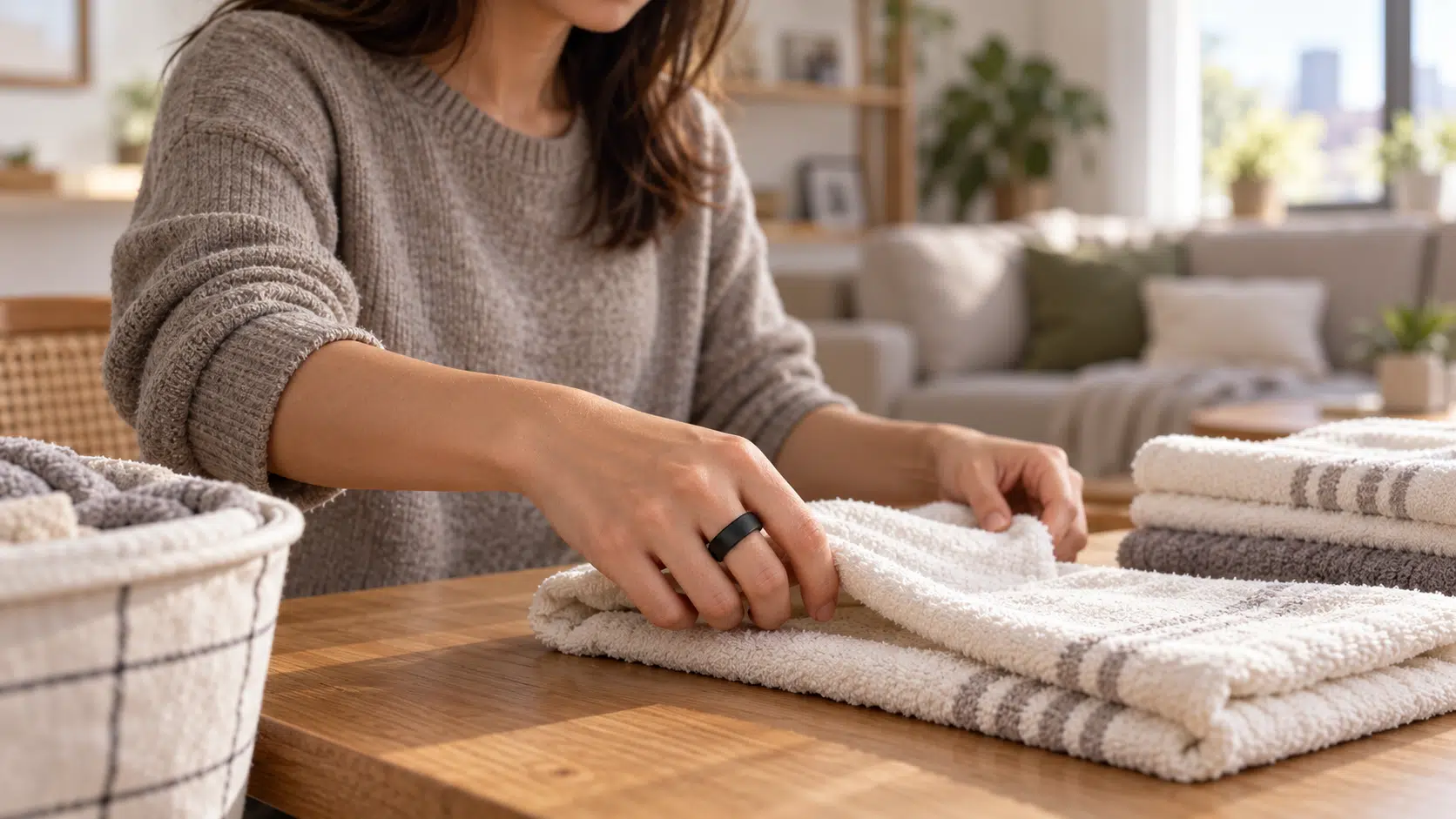
The product description uses strong durability language, but my black ring has developed scratches during regular use.
That does not mean the ring is falling apart. The damage is mainly a cosmetic drawback. However, it does show why “scratch resistant” should never be interpreted as “scratch-proof.”
A ring is worn on one of the busiest parts of the body. It regularly comes into contact with desks, door handles, cups, cookware, and exercise equipment. A dark outer finish can make lighter marks easier to notice.
The scratches have not stopped the ring from functioning, but buyers who care about keeping it pristine should be realistic. Removing it during manual work, weightlifting, and contact with rough metal should help reduce visible wear.
I Used the Full Tracking Feature Set
The QRing app includes sections for steps, distance, estimated calories, exercise, sleep, heart rate, blood oxygen, and stress-related information. I tried the available features rather than judging the ring from its product description alone.
Not all these measurements deserve the same level of confidence.
The activity section is useful for showing whether I had a relatively active or inactive day. That is how I prefer to use it. I look for patterns rather than assuming every step or calorie estimate is exact.
A phone, watch, and ring can all produce different results from the same day. They use different sensors, positions, and calculations. For me, consistency over time matters more than making every device display an identical number.
The ring becomes less convincing when its readings are treated as precise evidence. It works better as a general record of my routine.
Sleep Tracking Is Useful Only With Realistic Expectations
A ring is naturally more comfortable to wear overnight than many larger wrist-based devices. That makes sleep tracking one of its more appealing functions.
QRing presents a sleep timeline and divides the night into different stages. I use that information as a broad overview. It can help me notice whether I went to bed later, slept for a shorter period, or changed my routine.
I do not treat every stage or sleep score as an exact description of what happened.
Smart rings estimate sleep from movement and sensor patterns; they do not directly observe the brain activity used in a clinical sleep study. Budget hardware and basic software add further uncertainty.
Other R02 users have reported mixed results, including acceptable overall duration, missed sleep, delayed starting times, and naps that were not recorded. That variation is another reason I avoid taking one night’s graph too seriously.
The feature can support awareness. It cannot tell me, with medical certainty, whether my sleep was healthy or diagnose why I felt tired.
Workout Tracking Is One of the Weaker Features
The gap between general activity tracking and workout tracking became important during use.
The ring can record exercise sessions, but finger-based optical sensors face difficult conditions during intense movement. Tight gripping, rapidly changing effort, and movement between the sensor and skin can interfere with the signal.
This makes the ring less dependable during weightlifting and other activities that require holding equipment firmly. Readings can lag behind rapid changes or fail to reflect the full intensity of a session.
I therefore see its workout information as a rough record rather than serious performance data. It can remind me that I exercised and provide a general summary, but I would not use it to control training intensity.
Someone who needs dependable exercise heart-rate information would be better served by an appropriate sports watch or chest strap. This ring is more convincing during ordinary daily activity than during demanding workouts.
I Treat the Wellness Readings as Estimates
Heart rate, blood oxygen, and stress figures can look authoritative because they use familiar health terminology. That does not make them medical results.
I use these numbers only to observe general patterns. I do not use them to confirm that I am healthy, rule out a problem, or decide whether I need treatment.
The Classic Smart Ring should not be used to:
- Diagnose an illness
- Change medication
- Dismiss worrying symptoms
- Replace a medical pulse oximeter
- Replace an ECG or blood-pressure monitor
- Decide whether professional care is necessary
If I needed a dependable medical measurement, I would use equipment designed and validated for that purpose.
Keeping that boundary clear does not make the ring useless. It simply places the product in the correct category: a consumer wellness wearable rather than a medical device.
Battery and Charging Depend Heavily on the App
The ring uses a small rechargeable battery and connects to a proprietary magnetic charging cable. The remaining battery level is checked through QRing.
Because there is no screen, it is possible to keep wearing the ring without immediately noticing that its battery is low. I found that checking the app regularly is more sensible than waiting for the device to stop recording.
Battery duration can change according to measurement frequency, workouts, manual readings, Bluetooth behavior, and the condition of the individual unit. This is why I would not promise every buyer an exact number of days from one charge.
The magnetic charger is compact and straightforward, but it is not a standard cable. Losing it would be more inconvenient than replacing an ordinary USB cable.
Once again, the app dependence is the bigger issue. QRing is required not only for viewing measurements but also for checking whether the ring has enough power to keep collecting them.
Normal Water Exposure Has Not Caused a Problem
I have exposed the ring to water during ordinary use and have not encountered a problem over my two-month testing period.
The R02 is promoted with IP68 and 5ATM water-resistance ratings. Those ratings are reassuring for everyday situations, but I still would not describe any wearable as universally waterproof.
Hot water, soaps, cleaning chemicals, impacts, and aging can create conditions different from a controlled resistance test. A damaged unit may also behave differently from a new one.
My experience has been positive around normal water exposure. I would still be cautious with prolonged hot-water use, harsh chemicals, and any activity where the ring could be damaged or lost.
Benefits and Drawbacks After Two Months
The Classic Smart Ring has enough strengths to remain useful, but its weaknesses are substantial enough that buyers should understand them before ordering.
| Benefits I experienced | Drawbacks I experienced |
| Comfortable for regular daily wear | No screen for time, metrics or messages |
| Discreet alternative to a smartwatch | Almost every function depends on QRing |
| Size chart helped me choose a comfortable fit | Fit requires more care than ordering an ordinary ring |
| Tracks multiple activity and wellness categories | Workout tracking is not consistently dependable |
| Comfortable enough for overnight wear | Sleep information should be treated as approximate |
| Normal water exposure caused no problem | Water resistance still has practical limits |
| Simple, unobtrusive appearance | Black finish developed visible scratches |
| Useful for observing general routine patterns | Not suitable for medical decisions |
The broad feature set remains what I like most. The ring manages to collect several types of information without placing another display on my wrist.
Its biggest weakness is that the same screen-free design makes it entirely dependent on a basic app. The ring and QRing have to work as a pair; neither feels complete on its own.
My Thoughts: Useful, but Only Within Its Limits
After two months, my opinion of the Classic Smart Ring is positive but measured.
I like its comfort, understated appearance, and surprisingly broad selection of tracking features. Checking the size chart before ordering helped me get a suitable fit, and normal water exposure has not caused trouble.
The compromises are equally noticeable. I cannot view anything without my phone, workout tracking is not its strongest area, the black finish scratches, and the QRing app remains central to almost every function.
I would recommend it to someone who wants an entry-level smart ring for broad activity and sleep trends. I would not recommend it as medical equipment, a serious sports monitor, or a complete smartwatch replacement.
The ring is at its best when I let it remain a quiet companion. It becomes far less convincing when I expect it to explain my health or measure every workout precisely.
Frequently Asked Questions on Classic Smart Ring
1. What app does the Classic Smart Ring use?
My R02 unit uses the QRing app. On Android, QRing connects to the ring through Bluetooth and displays activity, sleep, workout, and wellness-related information.
2. How should I choose the correct Classic Smart Ring size?
Measure the exact finger on which you plan to wear it and follow the seller’s size chart. I confirmed my size before ordering and wear mine comfortably on my middle finger. Remember that its wide band may feel different from a narrow jewellery ring.
3. Can the Classic Smart Ring display calls and messages?
It has no screen, so it cannot show readable calls, messages, time or live metrics directly on the ring. Most useful information has to be viewed through the QRing app.
4. Can I wear the Classic Smart Ring around water?
Normal water exposure has not caused a problem during my two months of use. Even with advertised IP68 and 5ATM resistance, I would remain careful around prolonged hot water, harsh chemicals, and situations that could damage the ring.
5. Are the Classic Smart Ring’s health readings medically accurate?
I cannot confirm clinical accuracy, and I do not use its readings for medical decisions. I treat heart rate, blood oxygen, stress, and sleep information as general wellness estimates. Medical concerns require suitable validated equipment and professional advice.