

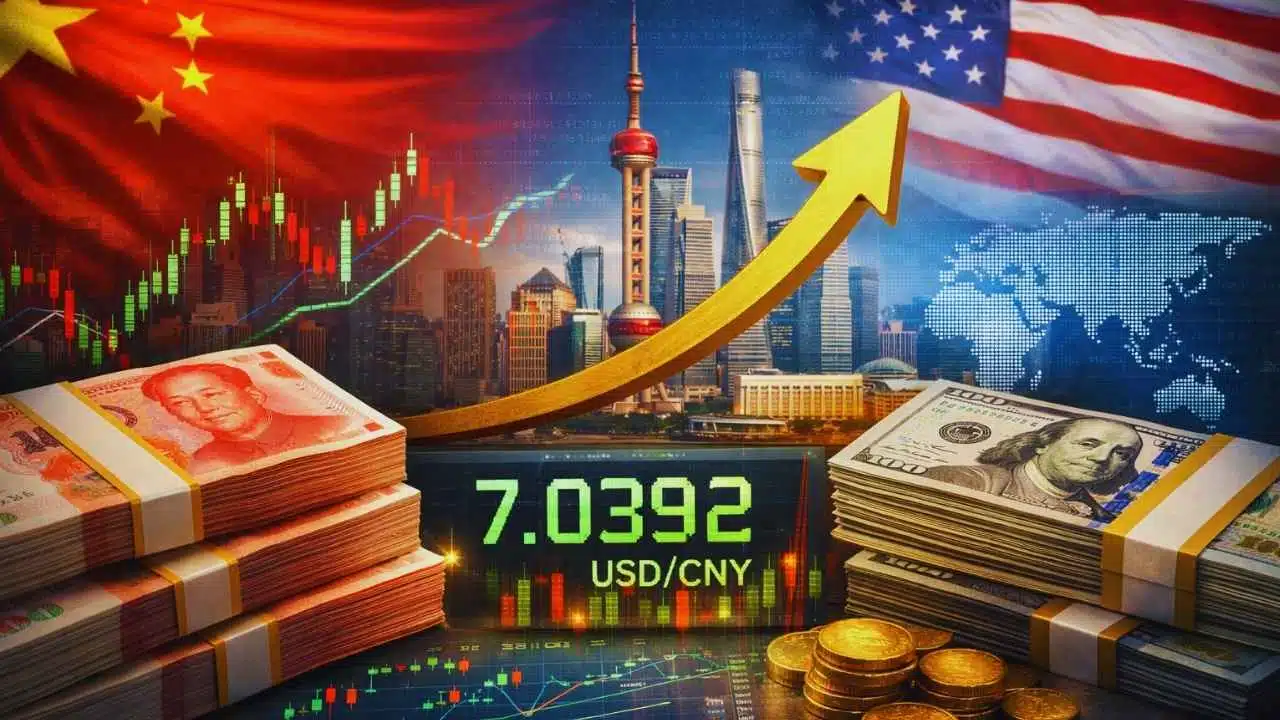
China’s Chinese yuan exchange rate strengthened on Dec. 25, 2025, after the official midpoint was set firmer at 7.0392 per U.S. dollar, pushing onshore and offshore trading toward their strongest levels since Sept. 2024 amid a softer dollar mood.
Chinese yuan exchange rate: what happened and why it matters now?
China’s currency market opened on Thursday, Dec. 25, with a clear signal from the official daily fixing: the onshore midpoint for USD/CNY was set at 7.0392, stronger than 7.0471 the prior session. The difference is 79 pips, a small move on paper but meaningful in a tightly watched market where daily signals can shape expectations.
The Chinese yuan exchange rate move quickly drew attention because the yuan’s spot trading levels (both onshore CNY and offshore CNH) were reported near their strongest marks since September 2024. That “since Sept. 2024” reference matters for two reasons. First, it highlights that the yuan is not merely bouncing day to day—it is returning to a level last seen more than a year earlier. Second, it shows the move is occurring during a period when global investors are reassessing U.S. rate trends and the broader strength of the U.S. dollar.
For readers who follow trade and prices, the Chinese yuan exchange rate affects far more than financial headlines. A stronger yuan can reduce the local-currency cost of imports, including energy and industrial materials priced in dollars. It can also reshape margins for exporters and manufacturers that invoice globally. And because China is central to so many supply chains, even modest currency shifts can ripple through pricing decisions well beyond China’s borders.
At the same time, China’s currency is not a free float. The onshore market is guided by a daily midpoint (the fixing) that serves as an anchor. So when the midpoint moves stronger, markets tend to interpret it as a combination of fundamentals and policy preference: a reflection of where the market is heading and where authorities are comfortable letting it go.
Key snapshot: official midpoint signals on Dec. 25
| Item | Dec. 24, 2025 | Dec. 25, 2025 | What changed |
| USD/CNY midpoint | 7.0471 | 7.0392 | Yuan stronger by 79 pips |
| Market impact | — | Spot rates firmer | Onshore/offshore moved toward 2024 highs |
| Headline reference point | — | “Since Sept. 2024” | Strongest levels in ~15 months |
This is why the day’s move attracted attention: it combined a stronger official anchor with a market move that reinforced the signal.
The data behind the move: midpoint changes and where the yuan sits versus other currencies
The Chinese yuan exchange rate story is not only about the dollar pair. China publishes a daily set of midpoint rates against multiple currencies, and those figures provide a broader picture of how the yuan is being guided across major trading partners’ currencies.
On Dec. 25, several midpoint rates shifted in ways that fit a “firmer yuan” theme against the U.S. dollar and parts of Europe, while showing mixed changes elsewhere. The details matter because they show whether a move is driven mainly by the dollar or reflects a wider “basket” move.
Official midpoints: major pairs on Dec. 25 vs. Dec. 24
| Pair (midpoint) | Dec. 24, 2025 | Dec. 25, 2025 | Direction |
| USD/CNY | 7.0471 | 7.0392 | Yuan stronger |
| EUR/CNY | 8.2969 | 8.2825 | Yuan stronger |
| 100 JPY/CNY | 4.5017 | 4.5047 | Yuan slightly weaker vs JPY |
| HKD/CNY | 0.90623 | 0.90526 | Yuan stronger |
| GBP/CNY | 9.5009 | 9.4877 | Yuan stronger |
| AUD/CNY | 4.7108 | 4.7121 | Yuan slightly weaker vs AUD |
| NZD/CNY | 4.1038 | 4.1006 | Yuan stronger |
| SGD/CNY | 5.4762 | 5.4740 | Yuan stronger |
This mix suggests the day was not a one-note “yuan up against everything” event. Instead, it looked like a combination of a firmer stance against the U.S. dollar and several major peers, with smaller offsets versus the yen and Australian dollar.
A simple timeline: how the official anchor has shifted through 2025?
A longer view helps explain why “since Sept. 2024” landed as a headline phrase. Earlier in 2025, the midpoint sat notably weaker than late-December levels.
| Date | USD/CNY midpoint | Context |
| June 30, 2025 | 7.1586 | Midyear levels were weaker for yuan |
| Dec. 24, 2025 | 7.0471 | The day before the reported jump |
| Dec. 25, 2025 | 7.0392 | Strongest zone since Sept. 2024 |
The central point is not that the yuan strengthened in a straight line all year. Currency paths are rarely smooth. The point is that late-December pricing and the official anchor moved into a range that market participants associate with a stronger phase of the yuan cycle.
What’s driving the Chinese yuan exchange rate: rates, the dollar, and China’s FX flows?
Currency moves usually have more than one engine. In this case, several forces aligned in the same direction, making it easier for the yuan to strengthen without a fight.
One major factor is the direction of U.S. interest rates. The U.S. Federal Reserve cut rates by 25 basis points in mid-December, setting the target range at 3.50%–3.75%. When U.S. rates move lower, holding dollars can become less rewarding relative to other currencies. That does not automatically weaken the dollar every day, but it can change the balance of incentives that drive global capital flows.
Another factor is the broader tone of the U.S. dollar. When the dollar’s momentum cools, Asian currencies often find breathing room. A softer dollar environment can reduce the need for local markets to defend their currencies through higher interest rates or heavier intervention. That context matters for China because the yuan is managed within a policy framework designed to avoid sharp swings while allowing the market to play a role.
A third factor is domestic and cross-border behavior. China’s State Administration of Foreign Exchange (SAFE) has consistently emphasized that cross-border flows and FX supply-demand conditions have remained generally stable, even during periods of higher global volatility. When companies and households are not rushing to buy dollars, it becomes easier for the yuan to strengthen on days when the dollar is soft and the official fixing leans in the same direction.
A fourth factor is the role of expectations. Currency markets are often driven by what participants think will happen next. When traders believe authorities prefer stability—or prefer avoiding a one-way bet—pricing can adjust quickly. A firmer fixing can signal comfort with a stronger yuan and can discourage speculative positioning against the currency.
Finally, there is the “basket” dimension. China often stresses that the yuan should be stable not only against the U.S. dollar but also against a basket of currencies. The CFETS RMB Index, which tracks the yuan versus a basket, offers one lens into this approach. When the basket measure stays steady, a move in USD/CNY may reflect shifts in the dollar itself rather than a broad revaluation of the yuan against everything.
Key macro indicators markets watch alongside the yuan
| Indicator | Latest available value | Why it matters for yuan |
| Fed funds target range (upper bound) | 3.75% | Influences dollar yield advantage and “carry” trades |
| China FX reserves (end-Nov. 2025) | $3.3464 trillion | Signals external buffer and valuation shifts |
| CFETS RMB Index (latest published) | 97.71 | Tracks yuan vs a currency basket, not just USD |
| Broad U.S. dollar index (latest published) | 120.5571 | Measures overall dollar strength across trading partners |
None of these indicators alone explains a daily move. But together, they form the environment in which the Chinese yuan exchange rate can strengthen, sometimes quickly, when the official anchor and market forces line up.
How China’s fixing system works and why “onshore vs offshore” can tell two different stories?
To understand why a single day’s fixing can matter, it helps to know the structure of China’s FX market.
China operates a managed floating exchange rate system in which the onshore yuan (CNY) trades with reference to a daily midpoint. Each trading day begins with an official midpoint for USD/CNY, and onshore spot trading is allowed to move within a set band around that midpoint. The fixing is produced using quotes from market makers, with a methodology designed to reflect the previous day’s close, market demand and supply, and moves in major currencies.
This is why the fixing is watched as a signal. If the midpoint is consistently set stronger than the market expects, traders may interpret that as a preference for currency strength or stability. If it is set weaker, they may interpret it as tolerance for depreciation. In practice, the midpoint often reflects a blend: some reaction to market forces and some guidance to prevent disruptive moves.
Another critical feature is the existence of two trading venues: onshore CNY and offshore CNH.
Onshore CNY is traded within mainland China under domestic rules and is more directly shaped by the daily fixing, local liquidity conditions, and regulatory frameworks. Offshore CNH is traded outside the mainland, with major activity historically centered in financial hubs like Hong Kong. Offshore pricing can react faster to global risk sentiment, U.S. data surprises, and shifts in investor positioning, because it is less constrained by the onshore framework.
This creates moments when the two rates diverge. A CNH move can lead headlines because it reflects real-time sentiment and global positioning. Meanwhile, the onshore market may follow more gradually, especially if the fixing signals a preferred direction.
In the Dec. 25 move, the headline claim that the yuan reached the strongest levels since Sept. 2024 fits with a pattern where offshore and onshore markets respond to a favorable global backdrop and a supportive official anchor. When both markets strengthen together, it tends to reinforce the idea that the move is not just speculative noise.
The practical takeaway for readers is simple: when you see “Chinese yuan exchange rate hits X,” it is worth checking whether the figure refers to onshore CNY, offshore CNH, or the daily midpoint. They are connected, but they can tell slightly different stories about timing and intensity.
What a stronger yuan means next for trade, prices, and policy, and what to watch in early 2026?
A stronger Chinese yuan exchange rate can produce winners and losers. The biggest impact often shows up in trade, inflation pressures, and corporate planning.
For importers in China, a stronger yuan can reduce the local-currency cost of goods priced in dollars, from energy products to industrial metals to certain high-value components. This can ease cost pressures for manufacturers that rely on imported inputs, potentially improving margins or allowing stable pricing for finished goods.
For exporters, the story is more complicated. A stronger yuan can reduce the value of foreign-currency revenue when converted back into yuan. If the move is modest and orderly, firms can manage it through hedging strategies, pricing adjustments, or operational efficiencies. If appreciation becomes rapid or sustained, it can squeeze margins, especially in industries where competition limits the ability to raise export prices.
For global buyers and supply chains, the yuan’s direction can influence negotiation dynamics. When the yuan strengthens, foreign buyers may push for price stability, while Chinese suppliers may face pressure to hold pricing steady even as their currency rises. In some sectors, this can lead to adjustments in contract terms, payment timing, or the use of invoicing currencies other than the dollar.
For policymakers, the main objective is usually stability. China has repeatedly signaled that it aims to keep the currency basically stable at an adaptive and equilibrium level while allowing two-way movement. That typically means leaning against disorderly moves in either direction, rather than targeting a specific “strong” or “weak” level.
What comes next depends on several moving parts:
U.S. monetary policy remains a key driver. If markets expect additional U.S. cuts or slower growth, the dollar could remain under pressure, which may support a stronger yuan. If U.S. inflation re-accelerates or growth surprises on the upside, the dollar could rebound, which could cap yuan strength.
China’s domestic economic signals also matter. If domestic demand and business activity strengthen, confidence can support the yuan through improved sentiment and steadier capital flows. If growth concerns rise, the market may test the currency’s downside, especially if global risk appetite weakens.
Corporate behavior around year-end and early-year settlement cycles can also cause short-term swings. Companies often adjust hedges, settle invoices, and manage balance sheets around reporting periods. These flows can temporarily amplify currency moves even when the big-picture trend is steady.
Finally, watch how the fixing behaves in the days after a headline move. A single stronger fix can be a one-off. A series of firmer fixings can shape expectations for a longer period. If the midpoint continues to guide the market toward a stable, stronger range, it can reinforce the message that authorities are comfortable with the yuan near those levels. If the fix turns weaker, it can signal caution about too much appreciation too quickly.
Practical “watch list” for readers tracking the yuan
| What to watch | Why it matters | What it could signal |
| Daily USD/CNY midpoint trend | Official anchor guides onshore market | Comfort with strength or preference for stability |
| Onshore CNY vs offshore CNH gap | Shows real-time sentiment vs domestic conditions | Global risk appetite, positioning, liquidity shifts |
| U.S. rate expectations | Drives dollar demand and yield advantage | More room for yuan strength if rates fall |
| China’s FX reserves and flow commentary | Reflects external buffers and policy tone | Market confidence in stability and buffers |
| CFETS basket performance | Tracks yuan versus a basket, not just USD | Whether move is “dollar-driven” or broader |
In short, the Dec. 25 move places the Chinese yuan exchange rate back in a stronger zone that markets associate with late-2024 levels. Whether it holds will depend on the dollar’s direction, rate expectations, and the balance between market forces and policy preference for stability.





















