

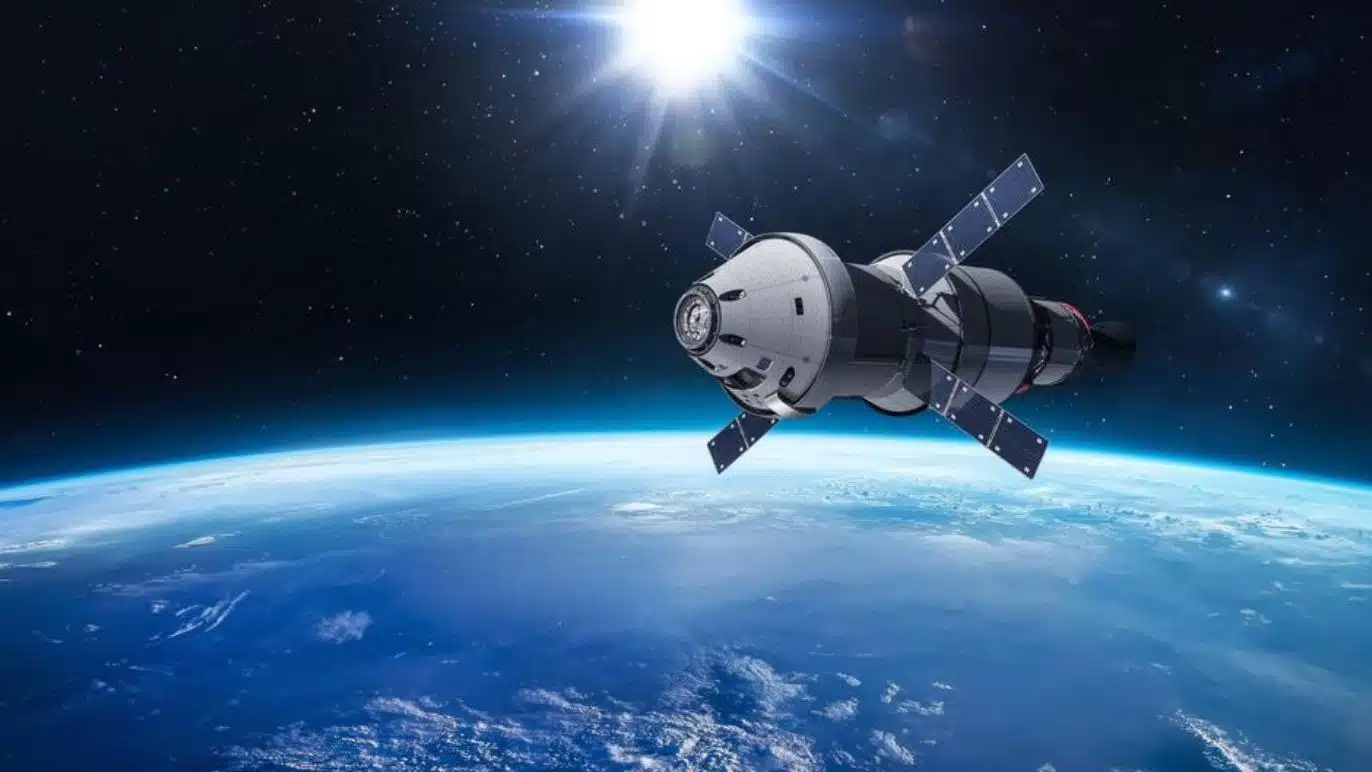
China has outlined one of its most ambitious annual roadmaps yet, revealing five major space missions planned for 2026 that will push its capabilities from the Moon and asteroids to deep-space astronomy and long-duration human spaceflight. Together, these missions highlight Beijing’s drive to cement its status as a leading space power and to lay the groundwork for future crewed lunar landings and an international research base on the Moon.
China’s 2026 Space Roadmap at a Glance
China’s National Space Administration (CNSA) and the China Manned Space Agency (CMSA) have sketched a packed 2026 calendar that blends robotic exploration, human spaceflight, technology tests, and cutting-edge astronomy. The five headline missions are:
-
Chang’e‑7 lunar south pole mission
-
Tianwen‑2 asteroid sample return mission
-
Shenzhou‑23 and Shenzhou‑24 crewed flights to the Tiangong space station
-
Mengzhou‑1 uncrewed test flight, China’s next‑generation crewed spacecraft
-
Xuntian (CSST) space telescope, a Hubble‑class survey observatory operating near Tiangong
Taken together, this portfolio shows how China is moving in parallel on three tracks: sustainable lunar exploration, planetary defense and resource prospecting, and a long‑term human presence in low Earth orbit that supports future missions beyond Earth orbit.
Chang’e‑7: China’s Big Push to the Lunar South Pole
Chang’e‑7 is the centerpiece of China’s 2026 plans and a cornerstone of its broader lunar strategy. Scheduled for around August 2026, the mission will target the Moon’s south pole, a region that has become the main focus of global lunar competition due to its potential water ice reserves.
Mission Architecture and Hardware
Chang’e‑7 is significantly more complex than earlier Chinese lunar landers and orbiters. It is designed as a multi‑element mission that includes:
-
An orbiter to conduct high‑resolution mapping and remote sensing of the south polar region
-
A lander to touch down near permanently shadowed craters suspected to harbor water ice
-
A rover for surface exploration over several kilometers
-
A small hopping probe capable of leaping into shadowed craters that are difficult for wheeled rovers to access
The mission will launch on a Long March 5 rocket from the Wenchang Space Launch Site, continuing use of China’s heavy‑lift workhorse for large deep‑space payloads.
Hunt for Lunar Water and resources
The central scientific goal of Chang’e‑7 is to search for definitive evidence of water in the form of ice trapped in permanently shadowed regions. To do this, the hopping probe will carry a water molecule analyzer and other instruments to directly sample the environment inside these dark, ultra‑cold craters.
Key science and strategic objectives include:
-
Mapping the distribution and concentration of water ice in and around the south pole
-
Studying the thermal, geological, and chemical environment in polar shadowed regions
-
Assessing whether local resources – such as water and regolith – can support future human activities and in‑situ resource utilization (ISRU)
The data will directly feed into plans for the International Lunar Research Station (ILRS), a long‑term robotic and eventually crewed base China aims to build in the 2030s with international partners.
Role in International Lunar Research Station (ILRS)
Chang’e‑7 is not a standalone mission; it is part of a sequence that includes Chang’e‑8 later this decade, which will test ISRU technologies and potentially 3D‑printing techniques on the Moon. Together, these missions are intended to:
-
Select candidate sites for the ILRS
-
Characterize local resources and hazards
-
Demonstrate key technologies required for long‑duration stays, such as power systems, communications, and surface mobility
In geopolitical terms, the mission underlines how Beijing is positioning itself as a central hub for countries seeking alternatives or complements to U.S.‑led Artemis lunar efforts.
Tianwen‑2: Asteroid Sample Return and Planetary Defense
While Chang’e‑7 focuses on the Moon, Tianwen‑2 will push deeper into the inner solar system to study a near‑Earth asteroid and return samples to Earth. The mission builds on the success of Tianwen‑1, China’s Mars orbiter and rover, and marks the country’s entry into the elite club of asteroid sample‑return powers.
Target Asteroid and Mission Profile
Public planning documents and recent reports describe Tianwen‑2 as a mission to a small near‑Earth asteroid, often identified as 2016 HO3 (also known as Kamoʻoalewa), which co‑orbits with Earth. The baseline profile includes:
-
Launch in 2026 on a Long March rocket
-
A cruise phase to rendezvous with the target asteroid
-
Prolonged proximity operations for mapping and reconnaissance
-
Touch‑and‑go or surface sampling operations to collect material
-
Return of samples to Earth in a re‑entry capsule after several years
Some mission concepts also include a secondary encounter with a comet after leaving the asteroid, designed to maximize scientific return and test deep‑space navigation capabilities.
Scientific and Strategic Aims
Tianwen‑2 has dual scientific and strategic aims.
On the scientific side, the mission will:
-
Study the composition and structure of a near‑Earth asteroid, which preserves primitive material from the early solar system
-
Analyze organics and volatiles that may have contributed to delivering building blocks of life to early Earth
-
Compare Chinese measurements and samples with those returned by missions such as Japan’s Hayabusa series and NASA’s OSIRIS‑REx
Strategically, Tianwen‑2 supports:
-
Planetary defense research by improving models of asteroid dynamics, surface properties, and impact risks
-
Technology development in autonomous navigation, sampling mechanisms, and long‑distance communications
-
Industrial and resource‑use studies, since some near‑Earth asteroids are rich in metals and volatiles that could one day be mined
The mission also demonstrates that China is no longer only “catching up” in deep‑space exploration but actively contributing unique datasets and mission architectures to planetary science.
Shenzhou‑23 and Shenzhou‑24: Keeping Tiangong Fully Occupied
Alongside its robotic missions, China plans to maintain continuous human presence in orbit with at least two major crewed flights to the Tiangong space station in 2026. These missions, Shenzhou‑23 and Shenzhou‑24, will ensure that the station remains a centerpiece of China’s human spaceflight program and a platform for experiments that prepare for future missions beyond low Earth orbit.
Long‑Duration Crewed Rotations
Reports indicate that Shenzhou‑23 and Shenzhou‑24 will operate as standard long‑duration rotation missions, each carrying three astronauts to Tiangong for several months. Their tasks will include:
-
Conducting life and material science experiments in microgravity
-
Testing closed‑loop life support and regenerative systems that reduce resupply needs
-
Performing maintenance, upgrades, and external spacewalks to keep Tiangong fully operational
Previously, CMSA has disclosed that some crew members will test ultra‑long‑duration stays in orbit, with at least one taikonaut planned to remain in space for more than a year across overlapping missions, demonstrating China’s growing experience with long‑term human habitation in space.
Science, Technology, and International Cooperation
The Tiangong station is equipped with multiple experiment racks spanning areas such as:
-
Space medicine and human physiology
-
Fluid physics and combustion in microgravity
-
Materials science and crystal growth
-
Earth observation and space environment monitoring
Shenzhou crews are expected to continue running a diverse portfolio of experiments, many of which are designed with international partners and institutions. Although China remains excluded from the International Space Station’s partnership framework, Tiangong is increasingly framed as an open platform, with several countries already flying or preparing experiments on board.
This model allows Beijing to deepen space ties with emerging space nations in Asia, Africa, and Latin America, aligning with its broader diplomatic and economic outreach.
Mengzhou‑1: Testing China’s Next‑Generation Crewed Spacecraft
If Tiangong is China’s orbital outpost, Mengzhou‑1 represents the next vehicle designed to eventually take Chinese astronauts beyond low Earth orbit toward the Moon. The uncrewed Mengzhou‑1 test flight, planned around mid‑2026, is one of the most consequential technology demonstrations in the lineup.
A New Capsule for the Lunar Era
Mengzhou is often described as a “new‑generation crewed spacecraft” intended to replace or complement the older Shenzhou design. Key features highlighted in official and expert commentary include:
-
A modular architecture with a re‑entry capsule and a service module
-
Higher payload capacity and more internal volume than Shenzhou
-
The ability to support deep‑space missions, including lunar orbit and potential lunar landing profiles
-
Improved safety systems, including a modern launch escape system and upgraded avionics
In June 2025, China conducted a zero‑altitude escape test for the Mengzhou spacecraft, validating its emergency abort capability during ground‑level or early‑ascent contingencies. The 2026 flight will be the first full orbital test.
2026 Test Flight Objectives
The Mengzhou‑1 uncrewed mission, expected around June–July 2026, will aim to:
-
Test the spacecraft’s performance in orbit, including power, thermal control, and navigation systems
-
Validate rendezvous and docking procedures in low Earth orbit, possibly near or at Tiangong
-
Demonstrate re‑entry, atmospheric deceleration, and landing, including heat shield and parachute systems
-
Evaluate communications, telemetry, and control systems under operational conditions
The mission’s success will be critical for China’s short‑term goal of sending astronauts around the Moon and its longer‑term objective of landing crews on the lunar surface later in the decade. It will also help verify China’s new heavy‑lift launcher family, which will be paired with Mengzhou for future crewed lunar flights.
Xuntian Space Telescope: A Chinese “Hubble” in Orbit
While lunar and planetary missions grab headlines, the Xuntian space telescope—also known as the China Space Station Telescope (CSST)—is arguably the most significant pure science mission in the 2026 lineup. Planned for launch around late 2026, Xuntian will operate in an orbit similar to Tiangong’s and will be serviceable by astronauts from the station.
Design and Capabilities
Xuntian features a 2‑meter primary mirror, putting it in the same general class as the iconic Hubble Space Telescope in terms of aperture size. However, its design emphasizes an extremely wide field of view, reportedly hundreds of times larger than Hubble’s, allowing it to survey large swaths of the sky quickly and in great detail.
Key capabilities include:
-
Wide‑field imaging for cosmology and galaxy evolution studies
-
Spectroscopic instruments to analyze the composition and motion of stars and galaxies
-
The ability to search for and characterize exoplanets indirectly through microlensing and other techniques
-
Revisitability and long‑term surveys that build deep statistical datasets
The telescope will fly independently but in a similar orbit to Tiangong, enabling docking or close‑approach operations for maintenance, instrument upgrades, and repairs—a capability reminiscent of NASA’s crew‑serviced Hubble missions, but using China’s own space station as the servicing hub.
Scientific Goals and Global Impact
Xuntian is designed to tackle some of the most pressing questions in modern astrophysics and cosmology. Its science program will target:
-
The large‑scale structure of the universe and the distribution of dark matter
-
The expansion history of the cosmos and constraints on dark energy
-
The formation and evolution of galaxies over cosmic time
-
Stellar populations, star formation, and nearby exoplanet systems
By combining a large aperture with a wide field of view and long mission life, Xuntian is expected to generate huge volumes of data, positioning China as a major contributor to global astronomical research. The mission could also anchor new data‑sharing collaborations, especially with institutions that already partner with China on Tiangong or other space science projects.
How the Five Missions Fit China’s Long‑Term Strategy
China’s 2026 space plans are not a collection of isolated projects; they are interlocking pieces of a long‑term strategy that stretches from low Earth orbit to the Moon, asteroids, Mars, and beyond.
Building Infrastructure and Know‑How
Each of the five major missions develops crucial infrastructure or expertise:
-
Chang’e‑7: polar landing, resource prospecting, precision navigation in difficult terrain, and long‑lived lunar assets.
-
Tianwen‑2: deep‑space navigation, autonomous operations near small bodies, and sample‑return technologies.
-
Shenzhou‑23/24: long‑duration human spaceflight, life support, and station operations.
-
Mengzhou‑1: next‑generation crew vehicle for deep‑space missions and future lunar flights.
-
Xuntian: large‑scale space observatory design, servicing operations from a space station, and big‑data astrophysics.
These missions are milestones toward broader goals in the 15th Five‑Year Plan period (2026–2030), which include multiple lunar missions, further planetary exploration, and eventual Mars sample return.
Positioning in Global Space Competition
The 2026 lineup underscores several trends in the evolving geopolitics of space:
-
China is creating a parallel ecosystem of space infrastructure—Tiangong, Xuntian, Chang’e lunar missions, Tianwen planetary missions—that runs alongside, but separate from, U.S.‑ and European‑led architectures.
-
By offering access to Tiangong and ILRS‑related projects, Beijing can deepen ties with countries that lack independent human spaceflight capabilities but want a presence in orbit or on the Moon.
-
Success in missions like Tianwen‑2 and Mengzhou‑1 could accelerate timelines for crewed lunar flyby or landing attempts, potentially intensifying the 21st‑century “Moon race.”
For the global scientific community, these missions also represent additional sources of data and opportunities, while raising questions about standards, data sharing, and interoperability across different national space systems.
What to Watch in 2026
For observers, several markers will show how far China’s 2026 program advances.
-
The Chang’e‑7 landing site choice and the performance of its hopping probe will reveal how close China is to operational use of lunar resources.
-
Tianwen‑2’s timeline and early operations will indicate how robust China’s deep‑space infrastructure has become beyond Mars.
-
Any ultra‑long‑duration stays on Tiangong during Shenzhou‑23/24 will illustrate how aggressively China is preparing its astronauts for future deep‑space missions.
-
The Mengzhou‑1 test flight will be scrutinized for how smoothly its re‑entry and recovery proceed, given its role as a future crew carrier.
-
Xuntian’s launch and commissioning will mark China’s arrival as a builder of flagship space telescopes, with direct implications for future international astronomy projects.
If these five missions proceed largely on schedule and achieve their main objectives, 2026 could stand as a turning point year in which China firmly consolidates its status not only as a major spacefaring nation, but as one of the principal architects of humanity’s long‑term expansion into the solar system.





















