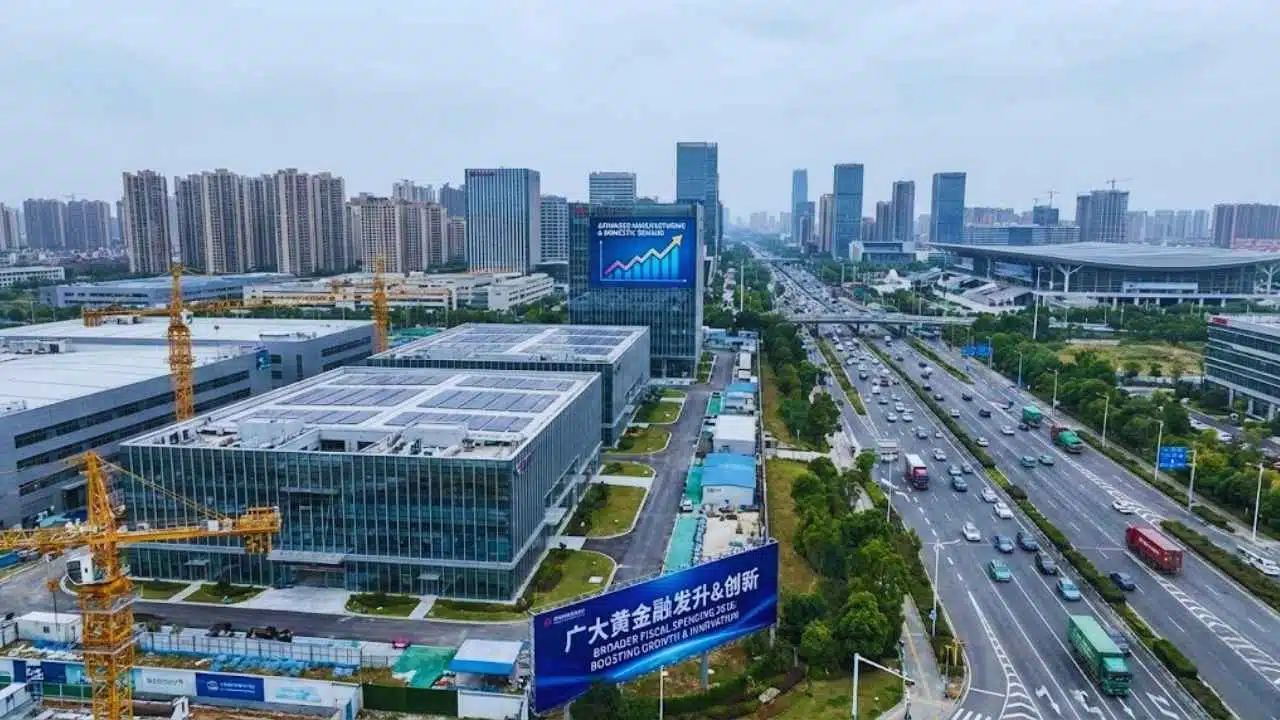
China’s Ministry of Finance said Sunday, Dec. 28, it will broaden the fiscal spending base in 2026, steering more funding toward advanced manufacturing, technological innovation and human-capital development as Beijing tries to shore up growth amid external pressures.
What China announced — and why it matters
China’s year-end national fiscal work conference (held Saturday–Sunday) set out a more proactive fiscal stance for 2026, with Finance Minister Lan Fo’an calling for an expanded scale of fiscal expenditure to ensure “adequate funding” for necessary spending.
In practical terms, the finance ministry’s messaging points to bigger and broader government outlays aimed at stabilizing growth drivers that have softened over the past two years—especially household consumption and private-sector confidence—while continuing industrial upgrading in areas seen as strategic.
The announcement also feeds directly into preparations for the 15th Five-Year Plan (2026–2030), where policymakers are expected to place heavier emphasis on “high-quality” growth, productivity gains and resilience against external shocks.
Where the money is expected to go
Officials highlighted a wider spending base and more targeted investment into priority areas. Based on the finance ministry’s statement and recent policy direction, the spending focus clusters into three broad pillars:
1. Upgrading industry and building “new growth engines”
Beijing signaled support for:
- Advanced manufacturing and industrial modernization
- Technological innovation, including applied R&D and commercialization
- Human capital, including education and skills development
This aligns with China’s broader push to improve productivity, move up value chains, and reduce reliance on externally constrained technologies.
2. Supporting domestic demand and household consumption
The finance ministry emphasized domestic demand as a central growth engine and referenced programs that typically include:
- Consumer trade-in subsidies (vehicles, appliances, digital products)
- Measures tied to jobs, income growth, and consumption capacity
- Continued attention to education and healthcare services
China has already leaned on trade-in subsidies as a near-term consumption lever. In 2025, authorities earmarked 81 billion yuan for consumer goods trade-ins, according to China’s State Council portal.
3. Stabilizing local finances and improving policy transmission
Beijing also reiterated themes that matter for execution:
- Refining the expenditure structure
- Improving transfer payments to local governments
- Stronger coordination between fiscal and financial policy
That emphasis reflects a constraint policymakers have wrestled with: local governments carry heavy spending responsibilities, but revenue—especially property-linked income—has been under pressure.
Market reaction: commodities end the year stronger
The policy signal helped lift risk appetite around China-linked demand expectations. Benchmark oil prices traded higher around the start of the week, with Brent near the low $60s per barrel and U.S. WTI in the high $50s—moves traders often interpret as a bet that stronger Chinese demand could support global consumption of energy and raw materials.
That said, commodity prices remain influenced by multiple forces at once—geopolitics, supply decisions, and broader macro conditions—so fiscal headlines are only one part of the story.
How Beijing could fund a bigger 2026 push
China has several established fiscal channels it can scale up without describing a single “headline stimulus” package:
- Central government deficit spending
- Central government bond issuance
- Local government special-purpose bonds for investment projects
- Targeted subsidies and consumption vouchers/programs
- Transfers to ensure local governments can fund social and public services
For context, China set its official 2025 fiscal deficit target at 4% of GDP, a record-high level by its recent standards.
It also planned 4.4 trillion yuan of local government special-purpose bond issuance for 2025, according to the government work report released via the State Council portal.
While 2026 targets will not be confirmed until the annual legislative meetings (typically in March), the current messaging suggests policymakers want enough fiscal “headroom” to keep demand supported while continuing structural upgrading.
The economic backdrop: property slump, soft demand, and external uncertainty
China’s fiscal pivot comes as policymakers confront three overlapping headwinds:
Prolonged property-sector adjustment
The property downturn has weighed on household confidence, local government revenue, and construction-linked activity. That has made it harder for consumption to accelerate in a sustained way without policy support.
Weak private demand and deflationary pressure
A soft labor market and cautious consumers have been recurring themes in recent assessments by multilateral institutions.
External pressures and trade uncertainty
China’s leadership has repeatedly emphasized resilience amid a more fragmented global trade and technology environment, which increases the incentive to rely more on domestic demand and productivity-led growth.
Key numbers at a glance
Policy priorities signaled for 2026 (what’s in focus)
| Priority area | What it typically includes | Why it’s emphasized now |
| Advanced manufacturing | Industrial upgrading, high-end equipment, strategic supply chains | Boost productivity and competitiveness |
| Tech innovation | R&D support, commercialization, strategic tech capacity | Build new growth engines |
| Human capital | Education investment, training, healthcare capacity | Support long-run growth and resilience |
| Domestic demand | Trade-in subsidies, jobs/income support, consumption measures | Offset property drag and weak confidence |
| Local government support | Transfer payments, financing coordination, debt-risk management | Improve execution and service delivery |
China growth outlook from major institutions
| Forecaster | 2025 growth | 2026 growth | Notes |
| World Bank | 4.9% | 4.4% | Points to cautious households and property adjustment |
What to watch next (and what “success” would look like)
Investors and businesses will likely focus on four signals in early 2026:
- The size of the official deficit and bond quotas announced at the annual legislative session.
- Whether consumption support expands beyond goods trade-ins toward services (childcare, healthcare, eldercare) that directly reduce household precautionary saving.
- How transfer payments change, especially for localities under revenue strain.
- Evidence of improved private demand, such as steadier retail sales and more stable housing-market expectations.
China fiscal policy 2026 is shaping up as a more proactive, investment-and-demand balancing act: sustaining near-term growth through broader fiscal support while channeling funding into strategic sectors meant to raise productivity over the 15th Five-Year Plan period. The next concrete test will come with March’s budget details—how large the fiscal envelope is, where it is directed, and whether it meaningfully lifts household confidence without worsening financial risks.