

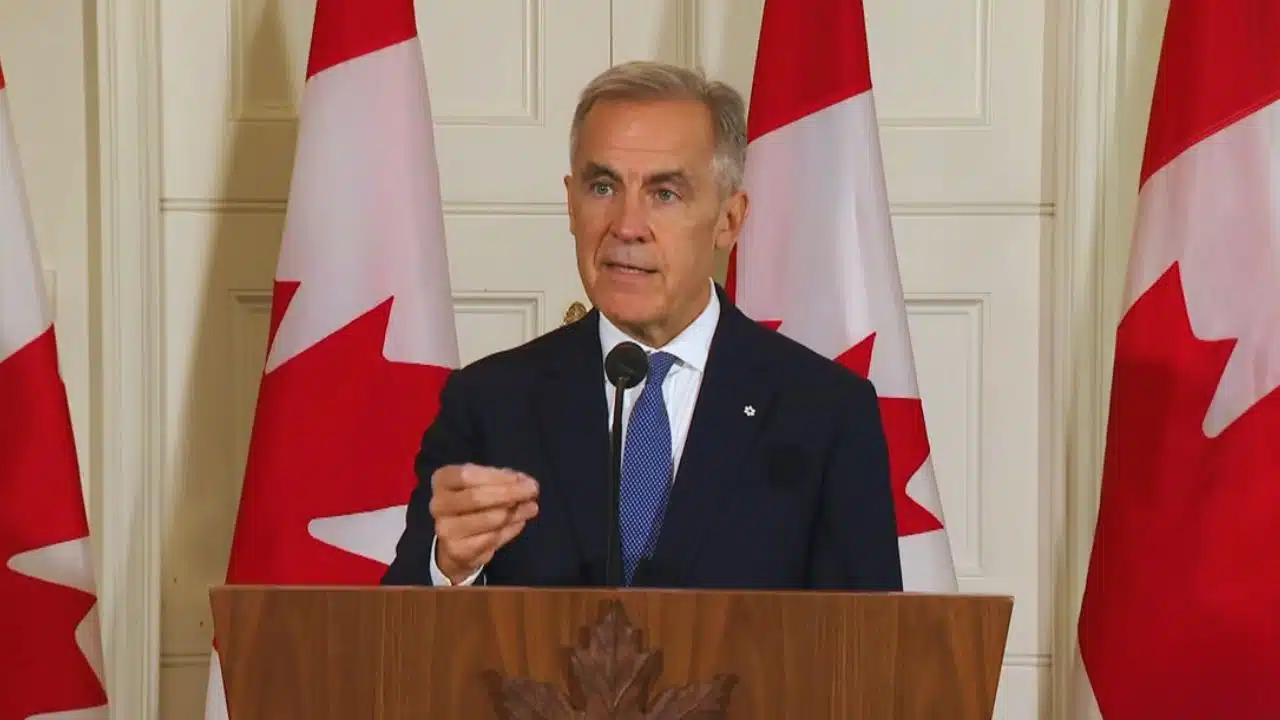
In a direct response to the Trump administration’s seismic fee hike on H-1B visas, Canada is preparing a formal proposal to attract high-skilled professionals, particularly from the technology sector, who now face a daunting barrier to working in the United States. Statements from former Bank of England and Bank of Canada governor Mark Carney, who has been cited in multiple international reports in the context of the Canadian government’s response, suggest a strategic move to capitalize on the major US policy shift.
The development follows a recent executive order by the Trump administration imposing a staggering $100,000 fee for new H-1B visa applications. This move has sent shockwaves through the global tech industry, which heavily relies on the program to hire international talent in critical fields like engineering, IT, and research.
“Not as many H-1B visa holders will get visas in the US. These people are skilled, and this is an opportunity for Canada,” Carney was quoted as saying in a statement that circulated widely over the weekend. “We will soon bring a proposal on this.”
The initiative signals a clear intention by Ottawa to position itself as a more stable and welcoming destination for the world’s brightest minds, many of whom are now re-evaluating their American dream. The Justin Trudeau government has historically championed skilled immigration, but this marks a direct and opportunistic pivot in reaction to US policy.
Key Facts & Quick Takes
- US Policy Shift: The Trump administration has mandated a new fee of $100,000 for new H-1B visa applications, a program heavily used by tech companies to hire foreign professionals.
- Canada’s Response: Canada is preparing a “clear offering” to attract skilled workers, viewing the US fee hike as a strategic “opportunity” to address its own tech talent shortages.
- Target Demographic: The focus is on tech professionals, with Indian and Chinese nationals, who are the largest recipients of H-1B visas, being the most affected demographic.
- Existing Trends: Canada has already seen a significant influx of tech talent. Between April 2022 and March 2023, nearly half of the 32,000 tech workers who relocated to Canada were from India.
- Global Competition: Canada is not alone; Germany and the United Kingdom are also actively courting skilled workers impacted by the new US restrictions.
The Context: A Global Scramble for Talent

The American H-1B program has long been a global magnet for talent. However, the new six-figure fee represents a fundamental shift, making it prohibitively expensive for many companies, especially startups and smaller enterprises, to hire foreign workers. This has created a sudden and significant pool of mobile, highly skilled professionals looking for alternatives.
Experts say this presents a golden opportunity for countries like Canada. “This is almost a gift because every time the U.S. closes the door on global talent, Canada gains,” said one immigration lawyer.
Canada has already laid the groundwork with programs designed to attract the very workers now in limbo. The Global Skills Strategy, for instance, offers two-week processing for work permits for eligible high-skilled roles. Furthermore, a 2023 pilot program offering open work permits to 10,000 US H-1B visa holders saw its cap reached in just 24 hours, demonstrating the immense pent-up demand.
Latest Data & Statistics
The trend of skilled workers, particularly from India, choosing Canada is already well-established. Recent data paints a clear picture:
- Record Immigration from India: In 2022, approximately 118,095 Indian citizens became permanent residents of Canada, accounting for nearly 30% of all new permanent residents.
- New Canadian Citizens: In 2024, an estimated 87,000 Indians acquired Canadian citizenship, making them the largest single group of new citizens.
- Tech Sector Inflow: Between April 2022 and March 2023, Canada welcomed 32,000 tech workers. Of these, nearly 15,000 were from India, highlighting the strong existing pipeline of talent.
Official Responses & Expert Analysis
While details of the new Canadian proposal remain under wraps, the official sentiment is proactive. Mark Carney emphasized that the affected workers are enterprising and mobile, making them ideal candidates for Canada’s growing economy.
“What is clear is that the opportunity to attract people who previously would have got so-called H-1B visas… One of the big cohorts is in the tech sector,” Carney was quoted in London.
Immigration experts and business groups are urging the Canadian government to act swiftly. Build Canada, a non-profit focused on national productivity, released a memo arguing that Canada is the “natural destination” for the “hundreds of thousands of highly skilled and highly paid H-1B professionals” now seeking a new home.
However, some analysts caution that Canada’s own immigration system faces challenges, including processing backlogs and uncertainty regarding the path to permanent residency for temporary workers. Economist Mikal Skuterud of the University of Waterloo has noted that Canada has scaled back some immigration streams, and that lower average wages compared to the US could be a deterrent.
Impact on People and Businesses
For thousands of international graduates and seasoned professionals, the US policy change has thrown careers into chaos. Many who had built lives in the US are now facing an uncertain future, prompting a surge in inquiries to Canadian immigration lawyers.
For US businesses, particularly in Silicon Valley, the fee hike is a major blow. They risk losing top talent not only to competitors abroad but also to their own international offices. Research from the National Bureau of Economic Research has shown that US firms often respond to H-1B restrictions by hiring the same skilled workers at their Canadian subsidiaries. The new fee is expected to accelerate this trend dramatically.
What to Watch Next
The global tech community is now keenly awaiting the details of Canada’s forthcoming proposal. Key questions remain:
- Will Canada create a new, dedicated visa stream for displaced H-1B applicants?
- How quickly can the government implement the new measures to seize the current opportunity?
- Will the proposal include clearer pathways to permanent residency to provide long-term stability?
The coming weeks will be crucial in determining whether Canada can effectively translate this strategic opening into a lasting “brain gain,” reshaping the landscape of the North American tech industry for years to come.
The Information is Collected from Indian Express and CBC News.
























