


The cryptocurrency industry continues to redefine the boundaries of finance, technology, and society. Over the past decade, we’ve witnessed incredible transformations—from Bitcoin’s rise as digital gold to Ethereum’s smart contract revolution.
Today, the evolution is faster and more groundbreaking than ever. In this article, we’ll dive into five breakthrough innovations in crypto you should know that are shaping the future of blockchain and cryptocurrency.
Let’s explore how these innovations are addressing existing challenges, unlocking new possibilities, and revolutionizing industries worldwide.
Why Crypto Innovations Are Shaping the Future?
The crypto landscape has become a hotbed of innovation, driven by the need for scalability, accessibility, and efficiency. Breakthrough innovations in crypto are solving problems such as high transaction fees, slow processing times, and limited use cases.
Blockchain technology’s potential to transform industries—from finance and healthcare to supply chain and entertainment—is a key reason why crypto is a focal point for innovators worldwide.
By addressing these challenges and creating opportunities for global inclusion, crypto innovations are more than technological upgrades—they’re the foundation of a decentralized future. These innovations pave the way for improved adoption rates and create pathways for industries to transition into a blockchain-powered ecosystem.
Recent studies indicate that the global blockchain market size is expected to grow at a compound annual growth rate (CAGR) of 67.3% from 2023 to 2030, showcasing the vast potential of breakthrough innovations in crypto.
Breakthrough #1: Layer 2 Scaling Solutions
Layer 2 solutions are protocols built on top of existing blockchain networks to enhance their scalability and efficiency. These solutions aim to address the congestion and high transaction fees often associated with popular blockchains like Ethereum.
By processing transactions off-chain while maintaining the security of the underlying Layer 1 blockchain, Layer 2 solutions have become a critical component of blockchain infrastructure.
Examples of Layer 2 solutions include:
- Optimistic Rollups: Process transactions off-chain and publish proof back to the main chain.
- Zero-Knowledge Rollups (ZK-Rollups): Use cryptographic proofs to validate transactions without revealing sensitive data.
- State Channels: Allow parties to transact directly without broadcasting every transaction to the blockchain.
Why It’s Important in 2025
As blockchain adoption grows, the demand for scalability is at an all-time high. Layer 2 scaling solutions reduce transaction costs, improve speed, and unlock new use cases, such as decentralized finance (DeFi) applications and NFT marketplaces.
For instance, Ethereum’s Layer 2 ecosystem has seen massive growth, with rollup solutions handling billions of dollars in transaction volume monthly.
Actionable Tips:
- For developers, exploring tools like zkSync SDKs can simplify integration into existing applications.
- Businesses can reduce transaction costs by adopting Layer 2 solutions for payment systems.
Key Benefits:
- Faster transaction processing.
- Lower gas fees.
- Increased accessibility for users worldwide.
Real-World Example:
Ethereum’s rollup technologies, like Arbitrum and Optimism, have demonstrated how Layer 2 solutions can scale blockchain networks effectively. For instance, Arbitrum handled over $2 billion in total value locked (TVL) in 2024, showing its impact on scalability.
Layer 2 Solutions Overview
| Type | Key Features | Examples |
| Optimistic Rollups | Off-chain processing with fraud-proof systems | Arbitrum, Optimism |
| ZK-Rollups | Cryptographic proofs for high-security transactions | zkSync, StarkNet |
| State Channels | Direct transactions between parties | Lightning Network |
Breakthrough #2: Decentralized Finance (DeFi) 2.0
DeFi 2.0 represents the next stage of decentralized finance, focusing on sustainability, scalability, and improved user experience. While DeFi introduced financial services like lending, borrowing, and trading without intermediaries, DeFi 2.0 enhances these systems by addressing challenges like liquidity fragmentation and impermanent loss.
Key features of DeFi 2.0 include:
- Protocol-Owned Liquidity (POL): Reducing reliance on external liquidity providers by enabling protocols to own their liquidity.
- Yield Optimization: Automating strategies to maximize returns for users.
- Insurance Mechanisms: Providing coverage for risks such as smart contract failures.
Key Projects to Watch
- OlympusDAO: Pioneered the concept of protocol-owned liquidity, creating more sustainable DeFi ecosystems.
- Aave V3: Introduced advanced risk management and cross-chain functionality.
- Curve Finance: Enhanced stablecoin liquidity with its innovative pool designs.
Benefits of DeFi 2.0
- Greater financial inclusivity.
- Enhanced security and transparency.
- Improved user incentives and tokenomics.
Practical Applications:
- Users can leverage platforms like Aave for decentralized lending and borrowing with minimal risk.
- Protocol developers can implement POL strategies to enhance liquidity stability.
DeFi 2.0 Innovations
| Innovation | Description | Notable Project |
| Protocol-Owned Liquidity | Ensures sustainability by owning liquidity | OlympusDAO |
| Yield Optimization | Automates strategies for maximizing returns | Yearn Finance |
| Advanced Risk Management | Enhances security for users | Aave V3 |
Breakthrough #3: Non-Fungible Tokens (NFTs) in Real-World Use Cases

Initially popularized by digital art and collectibles, NFTs have evolved into powerful tools with applications in various industries. By tokenizing assets and enabling verifiable ownership, NFTs are driving innovation in gaming, real estate, identity verification, and more. Recent trends show a shift toward NFTs being used in decentralized identity systems, where users control their personal data.
Key Real-World Use Cases:
| Industry | Example of NFT Application |
| Gaming | In-game assets and rewards (e.g., Axie Infinity). |
| Real Estate | Tokenized property deeds for fractional ownership. |
| Identity Verification | Blockchain-based digital identities for secure access. |
Why It Matters
NFTs are enabling creators and businesses to explore new revenue streams while ensuring transparency and traceability. This breakthrough innovation in crypto is not just about digital ownership; it’s about bridging the gap between the physical and digital worlds.
Case Study: Tokenized Real Estate
In 2024, a luxury apartment in New York was tokenized and sold as NFTs, enabling fractional ownership and liquidity in the real estate market. This highlights how NFTs are breaking barriers in traditional industries.
Actionable Insights:
- Artists and creators can tokenize their work to reach global audiences without intermediaries.
- Real estate developers can explore tokenization to attract smaller investors.
Breakthrough #4: Central Bank Digital Currencies (CBDCs)
CBDCs are digital versions of national currencies issued by central banks. Unlike cryptocurrencies, CBDCs are regulated and aim to enhance the efficiency of monetary systems. Countries worldwide are exploring or piloting CBDCs to modernize their financial infrastructure.
Key Features:
- Backed by central authorities, ensuring trust and stability.
- Facilitate instant cross-border payments.
Opportunities and Challenges
Opportunities:
- Increased financial inclusion in underbanked regions.
- Enhanced transparency and reduced fraud.
Challenges:
- Privacy concerns over centralized control.
- Technical and regulatory hurdles.
Real-World Examples
China’s Digital Yuan and the European Union’s exploration of a digital euro highlight the growing interest in CBDCs as a breakthrough innovation in crypto. By 2025, over 100 countries are expected to pilot or deploy CBDCs, reflecting their global significance.
CBDC Insights
| Region | CBDC Name | Current Status |
| China | Digital Yuan | In advanced pilot phase |
| European Union | Digital Euro | Under development |
| United States | Digital Dollar | Research and testing stage |
Actionable Tip:
- Financial institutions should prepare for CBDC adoption by upgrading their digital infrastructure.
Breakthrough #5: Blockchain Interoperability Solutions
Blockchain interoperability refers to the ability of different blockchain networks to communicate and share data seamlessly. As the number of blockchains grows, interoperability is essential for creating a unified and efficient crypto ecosystem.
Benefits of Interoperability:
- Enhanced user experience through seamless data exchange.
- Improved efficiency for cross-chain transactions and smart contracts.
Leading Interoperability Projects
- Polkadot: Enables multiple blockchains to transfer data and assets.
- Cosmos: Focuses on creating an “Internet of Blockchains.”
- Chainlink: Provides off-chain data for smart contracts across networks.
Real-World Example
Polkadot’s parachain model has allowed projects like Moonbeam to seamlessly integrate decentralized applications (dApps) across multiple blockchains. This level of interoperability is unlocking new possibilities in DeFi and beyond.
Interoperability Highlights
| Project | Focus | Notable Feature |
| Polkadot | Cross-chain communication | Parachain technology |
| Cosmos | Internet of Blockchains | Inter-Blockchain Communication |
| Chainlink | Off-chain data integration | Oracle technology |
Actionable Advice:
- Developers should consider cross-chain compatibility to future-proof their dApps.
- Investors can evaluate interoperability projects for long-term growth opportunities.
The Future of Crypto Innovations
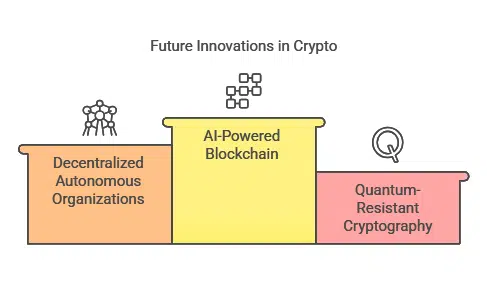
As we look to the future, emerging trends like AI-powered blockchain networks, decentralized autonomous organizations (DAOs), and quantum-resistant cryptography could redefine the crypto landscape.
These trends build upon the foundation of today’s breakthrough innovations in crypto, ensuring that the industry remains at the forefront of technological progress.
How to Stay Informed About Innovations
- Follow trusted crypto blogs and news sources.
- Engage with communities on platforms like Twitter and Reddit.
- Attend blockchain conferences and webinars to stay updated.
Takeaways
These five breakthrough innovations in crypto you should know—Layer 2 scaling solutions, DeFi 2.0, NFTs in real-world use cases, CBDCs, and blockchain interoperability—are transforming the blockchain ecosystem.
Each innovation addresses critical challenges while unlocking new possibilities for businesses, governments, and individuals alike.
As the crypto industry continues to evolve, staying informed about these innovations is crucial. They are not just reshaping blockchain technology but also redefining how we interact with the digital world.
Explore these breakthrough innovations in crypto and discover how they can benefit you in this ever-changing landscape.
























