

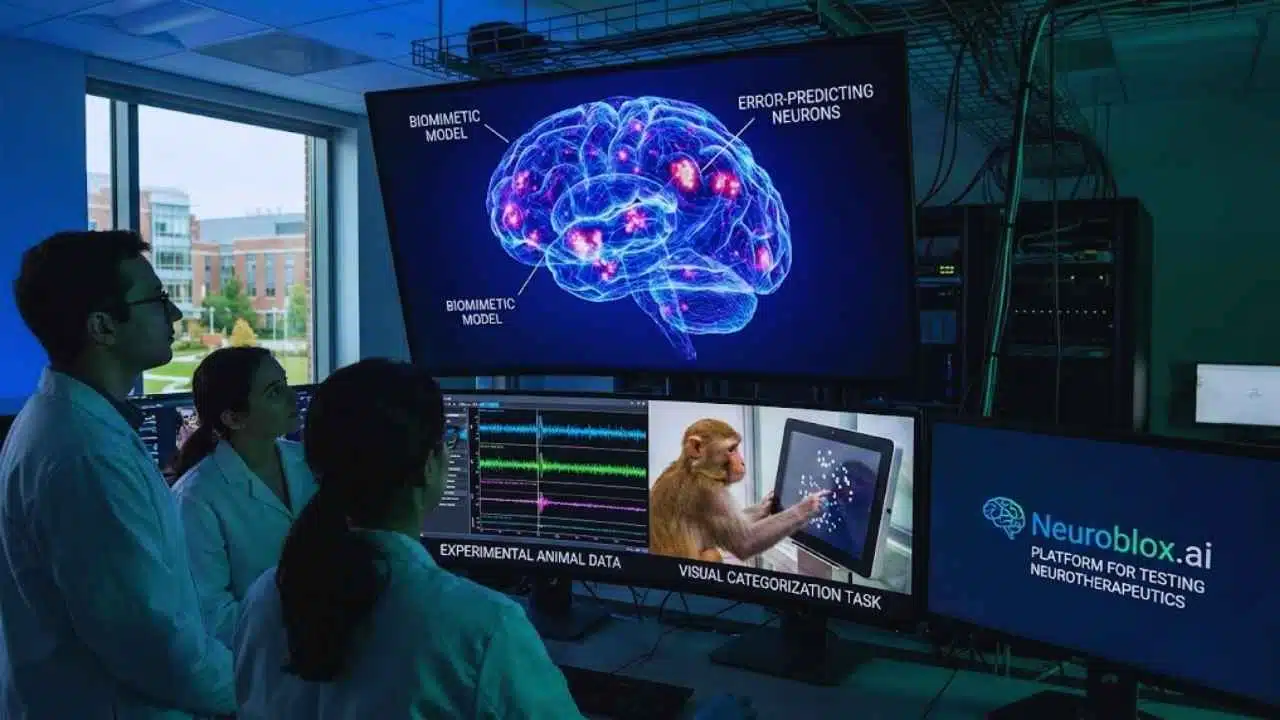
A biology-first brain simulation built without animal training data closely matched macaque learning behavior—and helped researchers notice a subset of neurons whose activity rises before wrong choices, a potential new signal for studying decision errors and testing neurotherapies.
What Happened And Why It Matters
A research team spanning Dartmouth College, MIT, and Stony Brook University has built a biomimetic computational model designed to mimic how real brain circuits are wired and how signals flow between regions involved in learning and decisions. In tests modeled on a well-known macaque visual categorization task, the simulation produced learning curves and neural-style activity patterns that closely resembled what has been recorded in animals—despite the model not being trained on animal datasets in the way many modern AI systems are.
The most notable claim is that the model highlighted a previously under-appreciated pattern in existing experimental recordings: a minority population of neurons (described in the team’s work as “incongruous” signals tied to upcoming errors) whose elevated activity reliably appears before incorrect choices. If this holds up broadly, it could add a practical new handle for neuroscience—flagging when the brain is drifting toward a mistake—and for drug development, where researchers want measurable circuit-level markers that change with treatment.
Who Did The Work
The work is associated with researchers including Anand Pathak, Earl K. Miller, Richard Granger, and Lilianne R. Mujica-Parodi, among others, across the participating institutions. The Miller Lab’s publication listing describes the effort as a “biomimetic model of corticostriatal micro-assemblies” aimed at connecting circuit-level activity to learning and categorization behavior.
How The Model Works In Plain Terms
Instead of starting with a generic machine-learning architecture and fitting it to animal data, the team’s approach emphasizes “biology-first” design:
- Circuit building blocks are created to reflect known anatomical and physiological properties (how neurons connect locally and how they communicate).
- Those blocks are then assembled into a multi-region system representing major parts of the learning/decision pathway—especially circuits spanning cortex and striatum (a core pathway for learning from outcomes and forming action habits).
- The model produces multiple kinds of outputs that neuroscientists measure in animals—such as spiking-like activity and coordination between regions—so comparisons aren’t limited to behavior alone.
This matters because many AI models can match behavior while still failing to match internal neural dynamics. A model that aligns on both behavior and neural signatures can become more than a predictor—it can become a tool to generate testable hypotheses about real brain signals.
The “Error-Predicting” Neurons: What The Team Claims To Have Found
According to the team’s preprint, the simulation revealed a neural code that predicted upcoming erroneous (“incongruous”) behaviors, and the authors report that the signal was later checked against empirical recordings.
In accessible terms, the hypothesis is:
- Most neurons track evidence for the correct category as learning progresses.
- A smaller subgroup shows a counter-pattern—activity that ramps in a way that correlates with mistakes.
- That subgroup may reflect the brain maintaining flexibility (for example, keeping alternative rules “alive” so it can adapt if the task changes), rather than simply “noise.”
It’s important to underline what is and isn’t proven here. The core claim is pattern discovery and alignment—not that these neurons cause errors. Establishing causality would require interventions (stimulation/inactivation) targeted to the identified population.
A Quick Look At Error Monitoring In The Brain
Neuroscientists have long studied how the brain detects and responds to mistakes (often called performance monitoring). Evidence points to specialized signals in frontal brain regions that track conflict, surprise, and errors, helping guide learning and behavioral adjustment.
What’s potentially new in this line of work is the idea that, within the circuits used for categorization decisions, there may be a distinct, reliable pre-error signature embedded in ongoing activity—one that can be surfaced more clearly by a model built to reproduce biological constraints.
Key Elements At A Glance
| Component | What It Does | Why It’s Relevant |
| Biomimetic circuit design | Builds networks meant to resemble real neuronal wiring and dynamics | Better chance of matching neural recordings, not just behavior |
| Corticostriatal focus | Emphasizes cortex–striatum loops central to learning and decisions | A major pathway implicated in reinforcement learning and action selection |
| “Incongruous” / error-linked signals | Subpopulation activity rises before incorrect choices | Possible pre-error marker for studying mistakes and testing interventions |
Why This Could Matter For Drug Development
One reason brain and psychiatric drug development is hard is that clinical symptoms are far downstream from cellular and circuit changes. A platform that simulates circuits and produces measurable “biomarkers” of learning, coordination, or error states could help researchers:
- test how changing neurotransmitter parameters might shift circuit dynamics,
- predict whether a drug candidate is likely to move a system toward healthier patterns,
- reduce reliance on trial-and-error in expensive late-stage trials.
The team’s paper includes a declared competing interest noting that several authors are connected to a company, Neuroblox Inc., aimed at translating this modeling approach into a broader software platform for neuroscience and psychiatry applications.
On the software side, Neuroblox’s open-source ecosystem (for example, Neuroblox.jl) describes tools for brain circuit simulations and related computational psychiatry workflows.
What Comes Next: The Most Important Open Questions
For readers watching this space, the next phase is less about headlines and more about validation:
- Generalization: Do these pre-error neuron patterns appear across different tasks, labs, and species—or only in specific setups?
- Causality: If researchers perturb these neurons, do error rates change? Or are they merely correlated “warning lights”?
- Clinical relevance: Can similar signals be observed non-invasively in humans (for example, via EEG/MEG proxies), or do they require invasive recordings?
- Therapeutic sensitivity: Do medications or neuromodulation reliably alter these signals in ways that predict improved outcomes?
If the answers trend positive, “error-predicting” circuit markers could become a practical readout for testing therapies in silico before moving into animals or humans.
Biology-first brain simulation is not a replacement for animal or human experiments, but it can serve as a strong partner—especially when it generates hypotheses that can be checked in existing recordings. If the reported pre-error neuron signature proves robust, it could sharpen how researchers measure decision instability, design behavioral experiments, and evaluate how candidate treatments change brain circuit function.

























