
Node.js has become a dominant force in modern web development, enabling developers to build high-performance, scalable applications. However, to fully leverage the power of Node.js, choosing the right hosting provider is crucial.
The best Node.js hosting providers for scalable applications offer fast servers, robust security, seamless scalability, and developer-friendly features.
In this guide, we’ll explore the top hosting providers that can help you deploy and manage your Node.js applications efficiently.
What to Look for in a Node.js Hosting Provider?
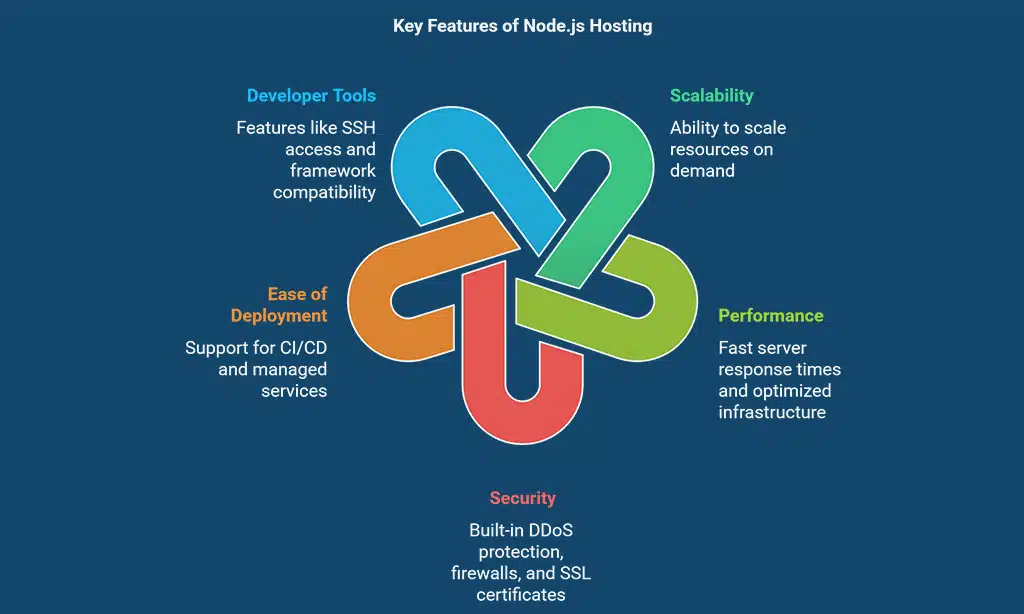
Before diving into the best Node.js hosting providers for scalable applications, it’s essential to understand the key features that define a quality host. Here’s what you should look for:
- Scalability: The ability to scale resources on demand is critical for handling traffic spikes.
- Performance: Fast server response times and optimized infrastructure enhance application performance.
- Security: Built-in DDoS protection, firewalls, and SSL certificates safeguard your app.
- Ease of Deployment: Support for continuous integration (CI/CD), one-click installs, and managed services simplifies deployment.
- Developer Tools: Features like SSH access, root access, and compatibility with popular frameworks improve the development experience.
- Pricing: Understanding pricing models (pay-as-you-go, subscription-based, or fixed) is key to budget planning.
Top 5 Node.js Hosting Providers for Scalable Applications
Choosing the best Node.js hosting provider for scalable applications can make a significant impact on your web app’s performance, security, and scalability. Whether you’re a startup looking for affordable hosting or an enterprise needing advanced cloud infrastructure, selecting the right hosting service is crucial.
Below, we explore the top options available today.
1. AWS (Amazon Web Services)
AWS is one of the most powerful cloud computing platforms, offering flexible and scalable solutions for hosting Node.js applications. With its global network of data centers, AWS ensures low latency and high availability, making it a preferred choice for businesses of all sizes.
The platform provides a vast array of services, from managed databases to AI-driven analytics, enabling developers to build, deploy, and manage applications with ease. Additionally, AWS’s extensive security features, including encryption, DDoS protection, and compliance certifications, ensure that applications remain secure and resilient against cyber threats.
Features:
- Auto-scaling: Dynamically scales resources based on demand.
- Global Infrastructure: Multiple data centers worldwide ensure low latency.
- Elastic Beanstalk: Simplifies deployment with automated scaling and load balancing.
- Pay-as-you-go pricing: Cost-effective for startups and enterprises alike.
- Security & Compliance: Advanced security measures and compliance certifications.
Key Details:
| Feature | AWS Details |
| Pricing | Pay-as-you-go model with flexible plans |
| Best for | Enterprises, high-traffic applications |
| Key Benefit | High availability and auto-scaling |
| Support | 24/7 customer support and documentation |
2. DigitalOcean App Platform
DigitalOcean provides a developer-friendly environment with straightforward pricing, making it an excellent choice for startups and mid-sized businesses. It simplifies the deployment of Node.js applications through an intuitive control panel and integration with GitHub and GitLab. The platform also offers a managed Kubernetes service, which is beneficial for deploying containerized applications with automated scaling.
Additionally, DigitalOcean provides high-performance SSD-based cloud computing instances, ensuring fast load times and reliable application performance. With built-in monitoring tools and API support, developers can efficiently manage resources and optimize application workflows.
Features:
- Simplified deployment: Supports GitHub and GitLab integrations.
- Auto-scaling: Easily scales with traffic surges.
- Kubernetes Support: Enables containerized deployment.
- Affordable Pricing: Suitable for small and mid-sized businesses.
Key Details:
| Feature | DigitalOcean Details |
| Pricing | Fixed monthly or hourly pricing |
| Best for | Startups, developers |
| Key Benefit | Simple interface and cost-effective scaling |
| Support | Community support & ticket-based assistance |
3. Google Cloud Platform (GCP)

GCP offers a strong suite of cloud computing tools, making it a preferred choice for enterprises that demand high-performance hosting with AI/ML capabilities. It provides flexible pricing and seamless integration with Google’s services. GCP’s infrastructure is designed to handle massive workloads, making it an excellent option for businesses with high computational needs.
Additionally, it offers industry-leading networking capabilities, ensuring low-latency access to applications worldwide. Its serverless computing options, such as Cloud Functions and App Engine, help developers build scalable applications with minimal management overhead.
Features:
- App Engine & Compute Engine: Allows flexible deployment options.
- Auto-scaling: Ensures high availability during traffic spikes.
- Integrated AI & ML tools: Advanced analytics for smart applications.
- Global CDN: Reduces latency and improves speed.
Key Details:
| Feature | GCP Details |
| Pricing | Pay-as-you-go with free-tier options |
| Best for | AI/ML applications, enterprises |
| Key Benefit | Advanced analytics and performance monitoring |
| Support | 24/7 technical support |
4. Vultr
Vultr is known for its high-performance cloud hosting at competitive prices. It offers one-click Node.js deployment, making it an attractive option for developers and cost-conscious users who need efficient hosting solutions. With a strong focus on performance, Vultr provides high-frequency compute instances powered by the latest Intel and AMD processors, ensuring optimized speed and reliability.
Additionally, its automated backups, DDoS protection, and API-driven control panel make it a flexible solution for businesses seeking a balance between cost-efficiency and performance. Developers can also take advantage of its customizable server configurations, allowing for seamless scalability based on project demands.
Features:
- High-performance SSD storage: Ensures faster data retrieval.
- Flexible pricing: Pay for what you use.
- One-click Node.js deployment: Simplifies server setup.
- Multiple data centers: Ensures lower latency.
Key Details:
| Feature | Vultr Details |
| Pricing | Hourly and monthly plans |
| Best for | Budget-conscious developers |
| Key Benefit | High-speed SSD storage |
| Support | Standard support & documentation |
5. Heroku
Heroku is a Platform-as-a-Service (PaaS) that simplifies the deployment of Node.js applications. It is well-suited for developers who want a hassle-free environment with minimal server management. Heroku provides a streamlined workflow, allowing developers to deploy applications quickly using Git-based version control.
Additionally, it offers automatic scaling, ensuring applications remain responsive under varying loads. With its extensive add-ons marketplace, developers can integrate third-party services such as databases, logging, and monitoring tools with ease. This makes Heroku an ideal choice for startups, small businesses, and development teams looking to focus on coding rather than infrastructure management.
Features:
- Easy deployment: Supports Git-based deployments.
- Built-in monitoring tools: Real-time performance insights.
- Seamless scalability: Auto-scales based on traffic.
- Add-ons marketplace: Expands functionality with third-party integrations.
Key Details:
| Feature | Heroku Details |
| Pricing | Free tier available, premium plans |
| Best for | Developers, small businesses |
| Key Benefit | Seamless integration and ease of use |
| Support | Limited free support, premium support available |
How to Choose the Best Node.js Hosting Provider for Your Needs?
- For Startups: DigitalOcean or Heroku provides affordable and user-friendly solutions.
- For Enterprises: AWS or GCP offers enterprise-grade scalability and security.
- For Developers: Vultr provides cost-effective yet powerful hosting solutions.
Takeaways
Choosing the right Node.js hosting provider is essential for ensuring high performance and scalability. Whether you need enterprise-grade infrastructure or a budget-friendly solution, the best Node.js hosting providers for scalable applications include AWS, DigitalOcean, GCP, Vultr, and Heroku.
Assess your specific needs and select a provider that aligns with your business goals to optimize your application’s performance.