

The creative industry in 2026 has witnessed a massive transformation in how audio content is produced and consumed. Synthetic speech has moved beyond simple text-to-speech toward high-fidelity emotional performances that are often indistinguishable from human recordings. This shift allows creators to maintain consistent vocal branding across global platforms without the logistical friction of traditional studio sessions.
Finding the best AI voice generators 2026 requires looking at tools that offer more than just clarity. Modern platforms now prioritize prosody and emotional nuance and real-time controllability to help content stay engaging for long-form listening. Whether you are producing a daily news podcast or a faceless YouTube channel, these tools provide the technical foundation for professional audio storytelling.
How We Chose Our Top 10 List ?
Our selection process for the current year involved analyzing voice naturalness and the robustness of cloning technology. We prioritized platforms that offer commercial rights and seamless integration into existing video and audio editing workflows.
We applied the following weightings to our research and comparison:
| Criteria | Weighting | Focus Area |
| Vocal Realism | 40% | Emotional depth and human-like intonation |
| Cloning Quality | 30% | Accuracy of voice replication from short samples |
| Language Support | 30% | Availability of diverse accents and global dialects |
Comprehensive Review of the 10 Best AI Voice Generators 2026 for Content Creation
The following ten platforms represent the peak of synthetic speech technology in the current market. Each has been selected for its unique ability to solve production challenges for modern digital creators.
1. ElevenLabs
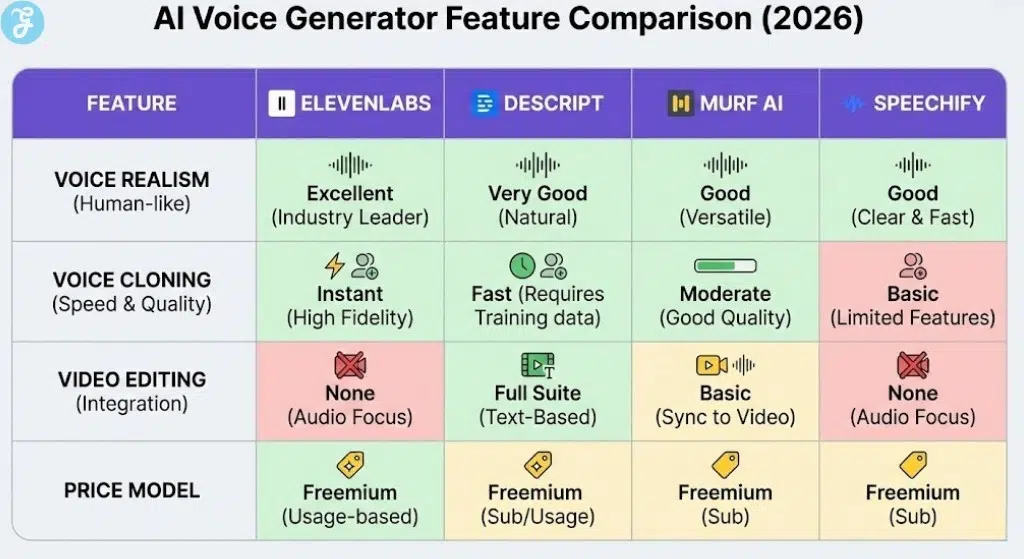
ElevenLabs remains the industry leader for creators who demand the highest level of realism in their audio. Their proprietary models excel at grasping the logic and emotions behind words rather than just reading them. This results in narration that includes natural pauses and intonations that keep listeners engaged for 10 minutes or more.
Special Features:
-
Advanced performance notes that allow you to tweak emotion using text prompts.
-
Instant voice cloning that requires less than a minute of clean audio.
-
Integrated sound effects generator to build fully immersive audio scenes.
Things to Consider:
-
The cost can scale quickly if you generate thousands of characters daily.
-
Fine-tuning specific pronunciations for technical jargon can be time consuming.
-
Does not include a full video editor for a complete production workflow.
Best for: Podcasters and narrators who need the most human-sounding voice available.
2. Fish Audio
Fish Audio has quickly become a favorite for creators who need high emotional range and “living” voices. It avoids the flat delivery often found in older AI models by focusing on expressive and natural sounding output. This is particularly effective for character voices in gaming or highly stylized YouTube video essays.
Special Features:
-
Superior “Story Studio” designed specifically for multi-speaker narrations.
-
High-speed API and SDKs for developers building interactive AI agents.
-
Deep emotional control that allows for whispering or shouting in a single script.
Things to Consider:
-
The interface is more technical than consumer-facing tools like Murf.
-
It is a newer player in the market with a smaller community of users.
-
Some voices can feel overly dramatic if the prompt is not carefully worded.
Best for: Storytellers and creators who need voices that feel alive and reactive.
3. Murf AI
Murf AI positions itself as a complete production studio that combines voice generation with video timing. It features a timeline-based editor where you can sync your voiceover with images and music directly in the browser. The platform is designed for professional teams who need a consistent and brand-safe voice across multiple projects.
Special Features:
-
Integrated media library with high-quality stock music and background tracks.
-
Direct integration with Canva to add professional audio to your designs.
-
Collaborative workspaces that allow teams to share scripts and voices.
Things to Consider:
-
The higher-tier pricing is steep for individual content creators.
-
Some of the most realistic voices are locked behind the pro subscription.
-
Cloning features are primarily aimed at enterprise and corporate accounts.
Best for: Marketing teams and educators who need a structured studio environment.
4. WellSaid Labs
WellSaid focuses on professional and corporate narration where clarity and brand consistency are the top priorities. Their voices are sourced from licensed professional talent to ensure a polished and predictable output every time. It integrates natively with Adobe Premiere Pro to make it part of a standard video editing routine.
Special Features:
-
Shared pronunciation libraries to ensure technical terms are always correct.
-
Native integrations with major creative software like Adobe Express.
-
High-security standards including SOC 2 compliance for enterprise users.
Things to Consider:
-
It has a narrower creative range than tools like ElevenLabs or Hume.
-
The starting price is one of the highest in the current market.
-
Focuses almost exclusively on English and a few major global languages.
Best for: Corporate L&D teams and organizations producing high-volume training content.
5. Lovo (Genny)
Lovo has expanded its Genny platform to support over 500 voices across 100 different languages. It is a massive toolkit that includes an AI writer and an image generator alongside its text-to-speech features. This makes it an ideal choice for creators who want to manage their entire script-to-video process in one place.
Special Features:
-
Support for hyper-local dialects and rare languages for global reach.
-
Built-in AI art generator to create visuals for your narrated clips.
-
Real-time emotional tagging to change the tone of specific sentences.
Things to Consider:
-
The sheer number of voices can make it difficult to find the perfect one.
-
Some of the secondary AI tools are not as polished as dedicated apps.
-
The credit system for generation can be confusing for new users.
Best for: Social media creators and agencies targeting a global international audience.
6. Descript Overdub
Descript changed the industry by allowing you to edit audio by simply editing a text transcript. Their Overdub feature lets you clone your own voice to fix mistakes in your recording without ever turning on a mic. It is the fastest way for podcasters to do “pickups” or add a new sentence to an old episode.
Special Features:
-
“Studio Sound” feature that cleans up background noise instantly.
-
High-speed voice cloning that integrates directly into the editor timeline.
-
Automatic filler word removal that deletes “um” and “ah” from your tracks.
Things to Consider:
-
It is a full editing platform so it has a higher learning curve.
-
The AI voices are best used for short fixes rather than full narration.
-
Requires a desktop installation for the most powerful features.
Best for: Podcasters who want to edit their shows with the speed of a word processor.
7. Respeecher
Respeecher is the choice for high-end film and TV production where “Speech-to-Speech” conversion is required. It allows you to record your own performance and then wrap another voice around it to maintain all your human emotion and timing. This technology has been used to recreate voices for major film franchises with incredible accuracy.
Special Features:
-
Incredible accuracy in maintaining the original speaker’s emotional intent.
-
High-fidelity results suitable for cinematic and theatrical release.
-
Support for a wide range of voices including historical and celebrity styles.
Things to Consider:
-
It is a professional tool with a price point that reflects its power.
-
The workflow is much more complex than a simple text-to-speech app.
-
Requires high-quality source audio to achieve the best conversion results.
Best for: Filmmakers and creators who need absolute control over emotional delivery.
8. Hume AI
Hume AI is built on research into human emotional expression and focuses on “Empathetic AI” interactions. It provides granular control over the emotional tone of a voice which is perfect for immersive storytelling. The platform is designed to understand and replicate over 50 distinct emotional nuances in speech.
Special Features:
-
Emotionally-aware voice agents for interactive and dynamic content.
-
Ability to prompt a voice to sound happy or sad or even nostalgic.
-
High privacy standards with options for zero-data retention.
Things to Consider:
-
It currently has limited multi-language support compared to its peers.
-
The model can occasionally produce audio hallucinations in long scripts.
-
Focuses more on emotional research than standard marketing narration.
Best for: Creators building interactive experiences or mood-driven stories.
9. Speechify
Speechify began as an accessibility tool for reading text and has evolved into a powerful creator platform. It features some of the most recognizable voices in the world including famous celebrities and athletes. It is a great choice if you want to turn written blog posts into podcast episodes with one click.
Special Features:
-
High-speed reading modes for listening to scripts and documents.
-
Celebrity voice partnerships that add a unique flair to your projects.
-
Mobile app and browser extension for generating audio on the go.
Things to Consider:
-
The creative controls for tone and emphasis are relatively basic.
-
High-quality voices are often behind a more expensive monthly plan.
-
Its roots in text-to-speech mean it lacks some production studio features.
Best for: Busy creators who want to listen to their work or narrate short scripts.
10. PlayHT
PlayHT offers an incredibly large library of voices and specializes in creating high-fidelity audio for the web. It uses a hybrid of several different AI models to ensure that you always have the best voice for a specific niche. Their new v3 models have significantly improved the naturalness of their long-form narration.
Special Features:
-
Global CDN hosting for audio widgets on websites and blogs.
-
Massive selection of accents and styles for every conceivable brand tone.
-
Simple and effective voice cloning that produces clear results.
Things to Consider:
-
The interface can feel a bit cluttered compared to minimalist tools.
-
Voice consistency can vary depending on which model you choose.
-
Pricing is competitive but the top tiers are aimed at power users.
Best for: Agencies and businesses that need a wide variety of voices for the web.
AI Voice Generation Market Overview 2026
The market is currently split between hyper-realistic narration tools and all-in-one content creation suites. Many developers are focusing on “Speech-to-Speech” technology which allows creators to use their own performance to guide the AI output.
| Platform Name | Primary Strength | Starting Price | Best For |
| ElevenLabs | Ultra-realism | $5/month | Narrators |
| Murf AI | Studio workflow | $19/month | Corporate |
| Fish Audio | Expressive tone | Free / Paid | Storytellers |
| WellSaid Labs | Clean clarity | $49/month | L&D Teams |
| Lovo (Genny) | Multi-language | $24/month | Social Media |
How Should You Choose The Best Option For You
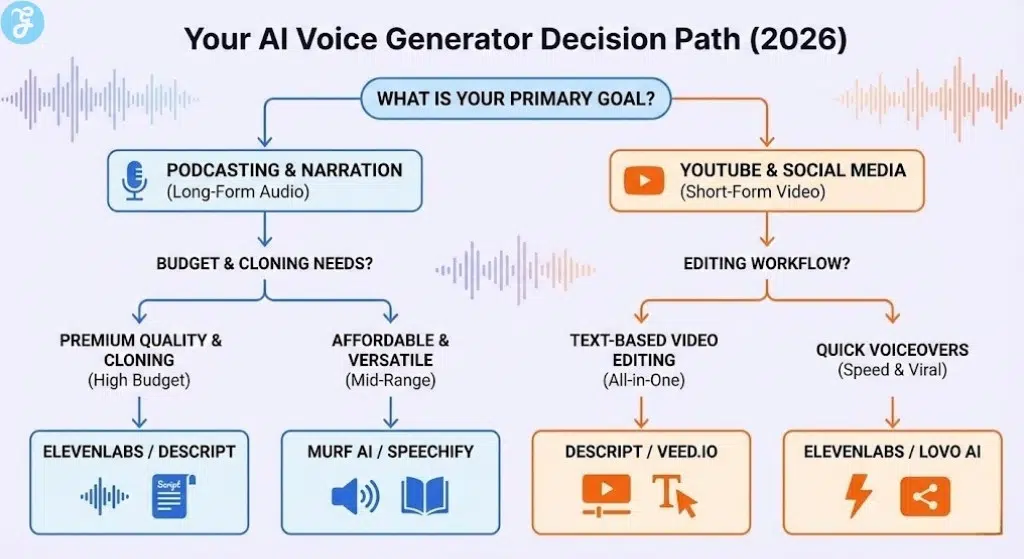
Your choice for the best AI voice generators 2026 should be determined by the length and tone of your content. If you are producing long-form podcasts or audiobooks then the “zoomed-out” perspective of ElevenLabs is almost mandatory for naturalness. This ensures that the AI understands the context of the entire paragraph rather than just reading one sentence at a time.
For creators focused on short-form social media like TikTok or Reels a tool like Lovo or the integrated features in CapCut might be more efficient. These allow for faster iteration and include extra visual tools that standalone voice generators lack. Always check the licensing agreements for each platform to ensure you have the full commercial rights needed for monetizing your YouTube or Spotify content.
To recap:
| Category | Top Pick | Primary Reason |
| Best for Realism | ElevenLabs | The industry standard for natural and human-like intonation. |
| Best for Storytelling | Fish Audio | Unmatched emotional range and expressive character voices. |
| Best for Teams | Murf AI | Professional studio environment with strong collaboration tools. |
| Best for Editing | Descript | The unique ability to fix audio by simply editing a text transcript. |
Wrap-Up
The market for the best AI voice generators 2026 has officially bridged the gap between synthetic and human sound. Technology has advanced to a point where creators can focus entirely on their scripts while leaving the vocal performance to highly capable AI models. By identifying whether you need raw realism or high-speed production you can find a tool that scales with your creative ambitions. Investing in a high-quality voice today is the fastest way to improve the professionalism and global reach of your digital content.





















