
We compared the AI trip planner apps people are actually using in 2026. Our method was simple: official product pages, current pricing pages, app store data, and privacy notes.
The enthusiasm is real. Among travelers who have used generative AI for travel, McKinsey found 84% said it improved their experience. YouGov asked a much wider group and found only 30% of US travelers were comfortable using AI travel tools at all in 2025, down from 32% a year earlier. Both numbers are real. Here are the 12 best AI trip planner apps in 2026, ranked on what each vendor currently publishes rather than on demo videos, because features and pricing shift fast.
How We Compared The Best AI Trip Planner Apps
We scored each planner on capability that a vendor or published review states plainly, not on demo videos. Our sources were official product pages, current pricing pages, app store data, and privacy notes.
That means nothing here came from a test trip; we built this list from what tools publish and what reviewers report. So before you install anything, open the vendor’s own pricing and privacy pages and check the date at the top.
The Categories Every AI Trip Planner Falls Into
Most “best of” lists mix planners that do different jobs. Some are all-in-one, some only organize what you’ve already booked, and some just generate ideas. The feature gap between those categories is wide, and they are not competing for the same job.
A generator turns a rough idea into a day-by-day plan. An organizer takes what you already booked and makes it readable. An all-in-one tries to do both, plus budgets and maps. None does every job well.
The Gap Between the Demo and the Departure Date
Generic AI makes planning sound easy until the output becomes a pretty list you cannot use—attractions too far apart, restaurant times that miss your route, the wrong hotel area. The plan looks finished before it is usable.
Our rule for this list: a planner earns a spot for the stage of the trip it actually handles. Brainstorming, booking, organizing, and checking the plan are four different jobs. Most tools stop short of the last one.
1. Layla: Documented Booking and Discovery Coverage
If you want to talk through a trip and watch live prices update in the same window, Layla is built for that. It plans conversationally while pulling real-time prices from broad travel inventory, which is why it shows up in nearly every comparison we read.
Reviewers at Stippl called it the most visually engaging AI planner in 2026. Pricing is where things get messy. One writer lists Layla at roughly $49 a year for the full plan, another puts the premium at about $50 a year, and a third lists it as free or $9.99 a month. Those numbers don’t agree, so check the vendor’s page yourself.
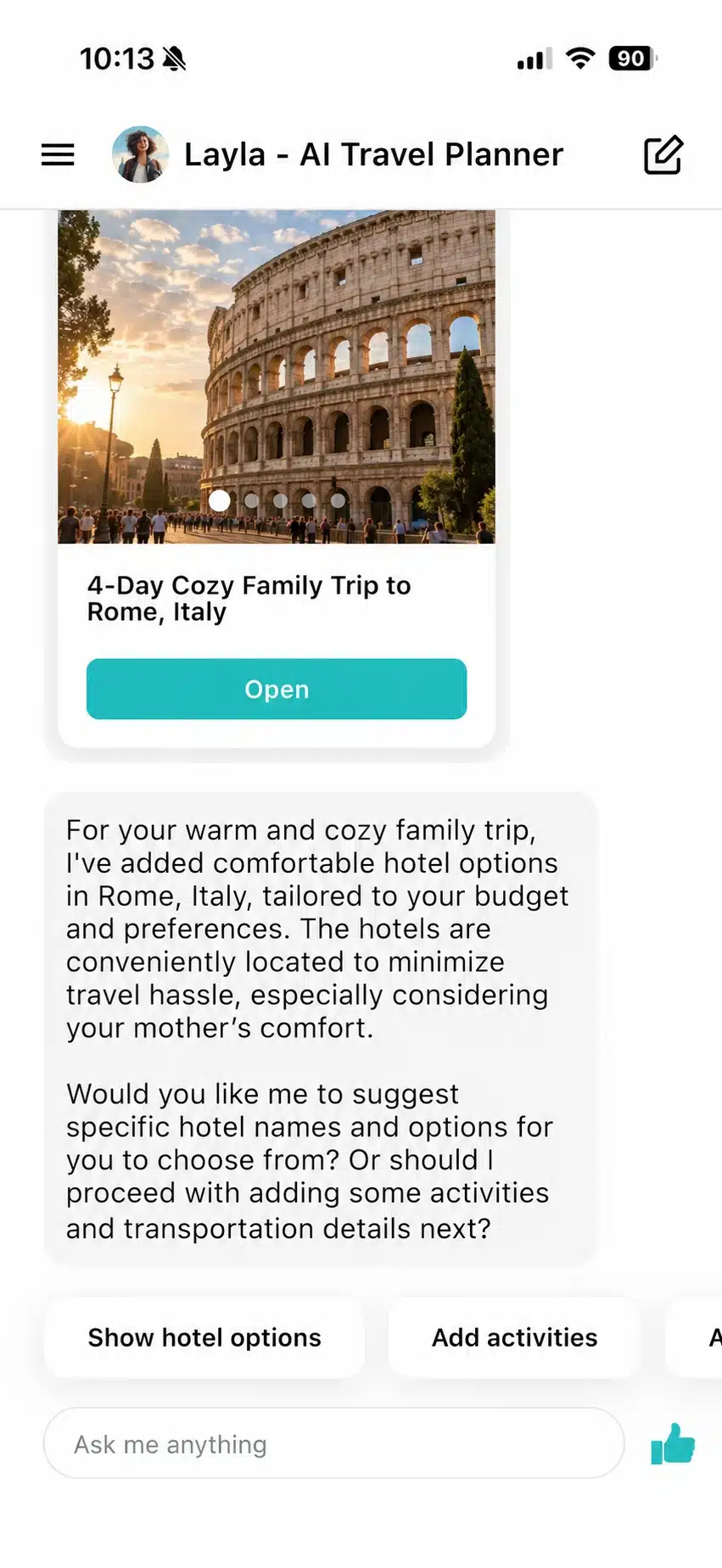
One source describes a feature as “not fully” available as of August 2026. The excerpt doesn’t say which feature, so treat that flag as a reason to verify rather than a verdict.
2. Mindtrip: Visual Planning, Collaboration, and Stated Privacy Practices
Mindtrip’s free tier isn’t free in the usual sense. The core plan costs nothing, and the company makes money through in-app bookings.
Reviewers at Toolworthy rate it best for visual trip planning, with strong collaboration and privacy notes to match. It turns up on every comparison list we checked, which is a consistency signal rather than proof of quality.
A shared link is not group planning. Group planning needs two things beyond that. Everyone has to be able to comment or vote, and someone has to be able to lock decisions so the plan stops changing. Planners that only share a read-only link cover the first and fail the other.
Mindtrip is the tool reviewers most often name for group collaboration. If your group has a strong opinion-holder problem, check that feature before you check the price.
3. iPlan AI: Free Access and Documented Roaming
iPlan.ai keeps its free access on the record, which matters if budget is your first filter. It also appears on a ranked tool list alongside Kayak AI, Layla, Google Gemini, ChatGPT, Wonderplan, and Curiosio.
That ranking groups tools by job, not by hype, and iPlan.ai sits in the free-option column—where most readers start.
Free tiers rarely include everything. Expect limits on trip length, exports, or how many plans you can save. Read the current terms.
The 2026 field is crowded, and most apps in it are generic list generators with an AI label on the box. iPlan.ai’s free access sets it apart from that pile for a first-time user. Check the current site before you commit. Features and pricing move quickly.
4. Wonderplan: Scope, Limits, and Who It Suits
Wonderplan builds complete itineraries for free, according to a current pricing roundup, and that same roundup puts GuideGeek and Mindtrip in the same no-cost group.
It also names Mindtrip the best AI travel planner for most trips in 2026, so free alone does not make Wonderplan the winner. Its case rests on scope. It shows up repeatedly on comparison lists as a solid free generator for standard trips.
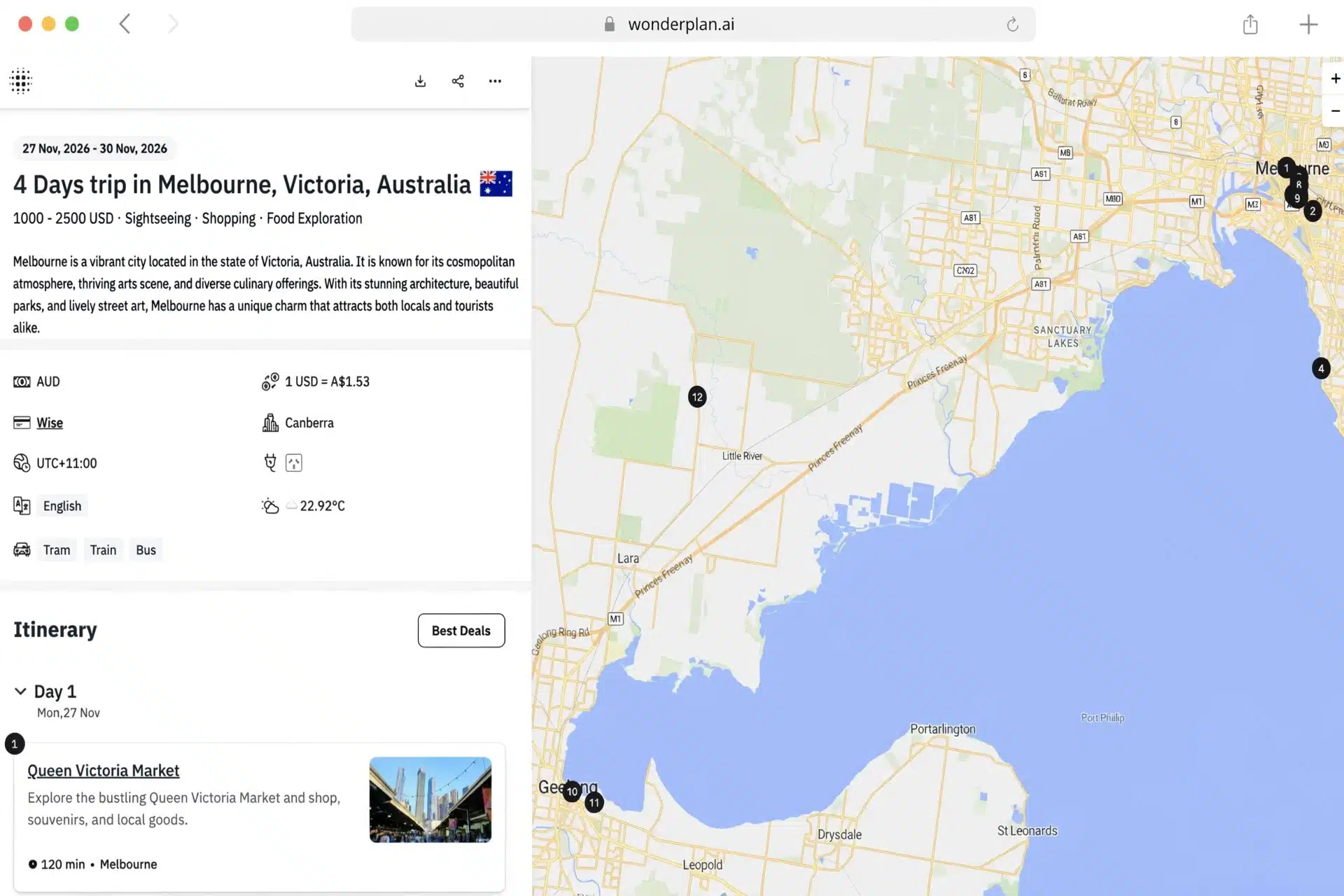
The open question is what happens when your trip is not standard. Free generators tend to flatten unusual routes into common ones. If you are doing three cities in eight days or traveling with a strict food budget, a free plan may be a starting draft rather than a finished itinerary.
5. ChatGPT: Capability and Its Documented Accuracy Ceiling
Your itinerary is only as good as what the model happens to know, and no chatbot will warn you when that knowledge runs thin. Ask ChatGPT for a day in a city it has never seen discussed online and you will get confident, plausible, and possibly wrong directions.
Reviewers treat ChatGPT as a brainstorming and flexible-planning tool rather than a finished planner. ChatGPT Plus runs for $20 a month, or free if you skip the paid tier. The $20 figure appears in the Layla tier list as well. Before you trust any specific claim, check it against a booking site.
Why Confidence and Adoption Numbers Diverge
McKinsey’s 84% and YouGov’s 30% look like a fight until you check who answered. The 84% who said AI improved their experience were people who had already used it; they chose the tool, so they were inclined to like it. YouGov’s 30% comfort figure came from a much broader population, and it fell from 32% the year before, while the 40% who were uncomfortable held steady. The two surveys measure different things: satisfaction after use and willingness to try at all.
6. Stardrift: Best for Business and Remote-Work Travel
Stardrift syncs with your calendar to catch meeting conflicts and can filter flights by Starlink Wi-Fi. Stardrift has a free plan available. However, the Pro plan is $9.99/month or $99.99/year with added features and benefits.
7. Stippl: Best for Managing the Whole Trip
Stippl promises five jobs in one app, and something always gives. It is listed for travelers who want planning, routes, budgets, packing, and bookings together. Breadth is easy to advertise and hard to deliver.
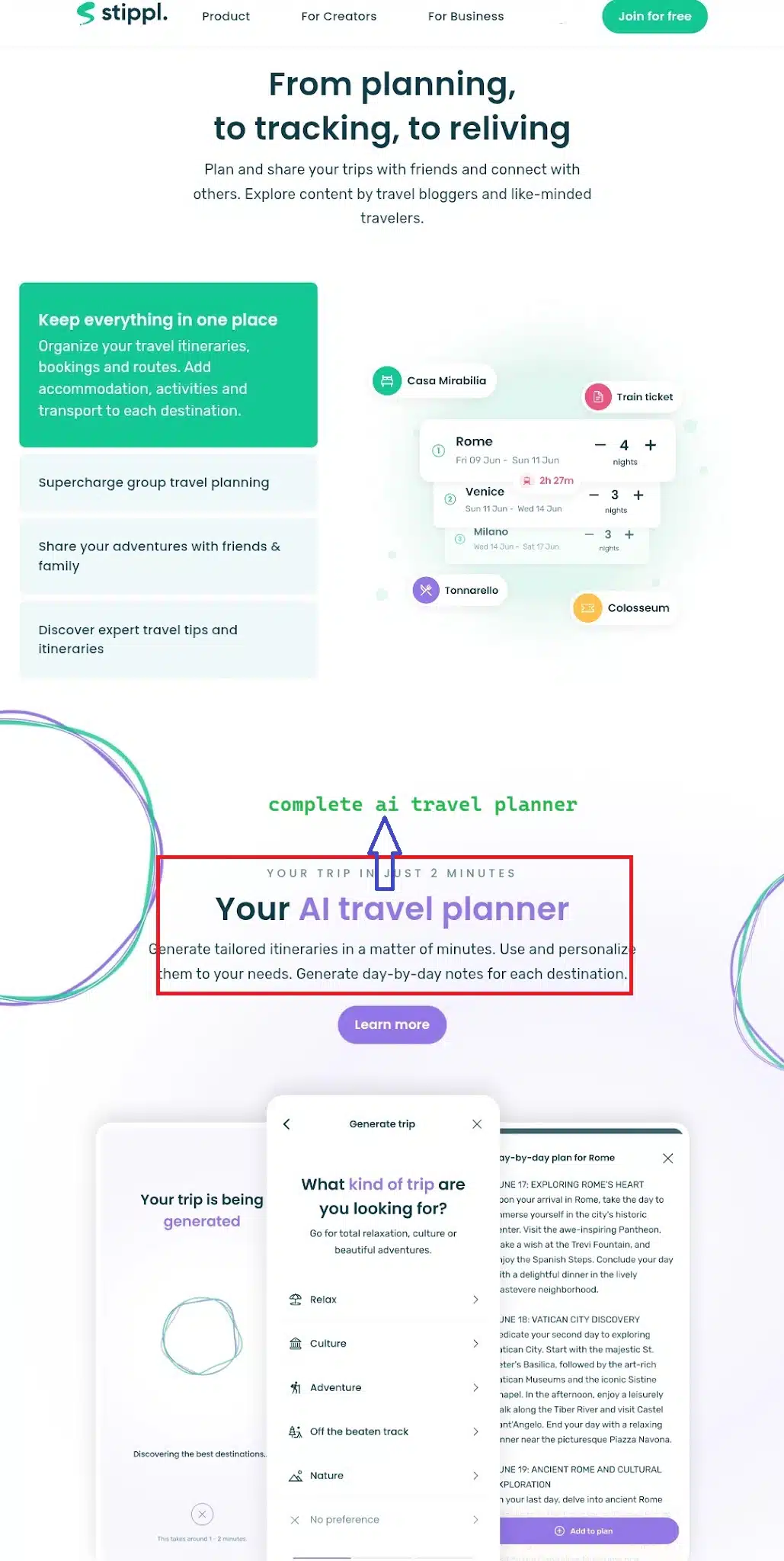
It covers group expense splitting, automated packing lists, and shareable timelines for people at home. The full AI itinerary generator requires the PRO tier.
If your trip is simple, an all-in-one saves you app-switching. If your trip is complicated, you will likely end up with a specialist for the part that breaks—usually routes or group decisions.
8. Tineo: For the Post-Booking Half of a Trip
You have already booked, and the question now is who turns scattered confirmations into one timeline you can read at the airport.
Tineo is listed for exactly that job. The post-booking half of a trip is the half most planners ignore entirely. A dedicated organizer beats a generator here because it starts from real data, not ideas.
Wanderlog and Stippl both carry organizer features too. The difference is focus. An organizer app does one thing, so it tends to do it better.
9. Ribbit: Best Mobile-first Itinerary Builder
Budgets sit inside the big planning apps, but almost nobody builds a true expense tracker for travel. Stippl folds budgets in with routes and packing, and Wanderlog includes budgets with maps and bookings. Those are features, not full accounting tools.
Ribbit works differently. Its assistant, Lily, builds a day-by-day plan from chat, and recommended activities are real Viator listings you can book in one tap. Free; Ribbit Plus is $4.99/month or $39.99/year.
The category with the clearest user need has the least AI behind it. If someone builds a good one, that is the gap to watch.
10. MonkeyTravel: Best for Group Trips
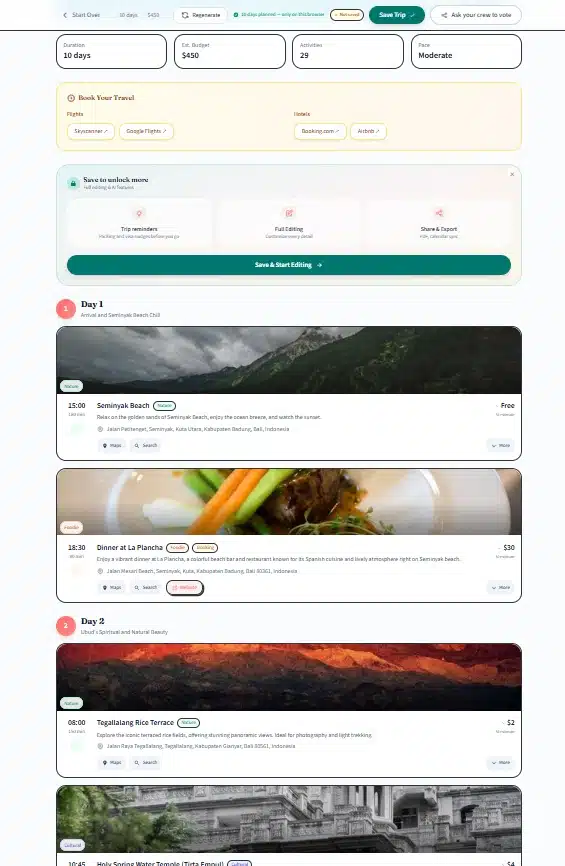
MonkeyTravel is best for group trips worldwide. Each activity can be voted on, with a live consensus score, and only the organizer needs an account. MonkeyTravel is free, but browser-only for now, with no iOS or Android app. MonkeyTravel offers free web planning with group voting and PDF exports.
11. Google Gemini: Pulls Every Information Using AI
Google Gemini is probably the best if you live in the Google ecosystem. It can pull existing flight and hotel bookings from Gmail and uses live pricing from Google Flights and Google Hotels. Free with a Google account.
12. GuideGeek: Get Answers Through Web and Chat
GuideGeek works as a message-based travel answer through web and chat apps, and it appears among the free full-itinerary options. GuideGeek is best if you don’t want another app. Built by Matador Network, it runs inside WhatsApp, Instagram, and Messenger and includes live flight search and support for 50+ languages. GuideGeek is completely free.
Frequently Asked Questions (FAQs) on AI Trip Planner Apps
These four come up every time we discuss this list. Here are the short answers.
Are AI trip planners free?
Some are. Mindtrip, GuideGeek, and Wonderplan build full itineraries at no cost. Layla adds a paid premium tier, while ChatGPT or Gemini fold planning into a subscription many people already pay for. iPlan.ai also offers free access. The free versions usually limit how long a trip can run, or how many saved plans and exports you get, so check the current terms before you rely on one.
Are AI-generated itineraries accurate?
Often not accurate enough to book from directly. Generic output turns into a pretty list you cannot use: attractions too far apart, restaurant times that miss your route, the wrong hotel area. Treat the first draft as a starting point and verify the details on a real booking site before you commit.
Which AI trip planner is best for groups?
Mindtrip is the tool reviewers most often name for group collaboration, based on our reading of the toolworthy comparison. Real group support means shared editing and voting, not just a shareable link. MonkeyTravel also lists group voting as a feature, so it is worth a look if Mindtrip’s booking model does not fit.
How was this list put together?
We compared these planners using official product pages, current pricing pages, app store data, privacy notes, and published product announcements. We did not run test trips. A tool earned its place for capability at a specific stage of planning, not on the strength of a demo.
Final Words
Start with the job, not the brand. For free full itineraries, look at Mindtrip and GuideGeek. If you want live booking prices while you chat, Layla is the pick. If you already pay for ChatGPT or Gemini, planning inside that subscription is the cheapest route. Open two pricing pages, check the date, evaluate every options and pick the one that suits you the most.