The idea of sustainable living is often discussed in abstract terms, but its real impact becomes clear when it is practiced at the community level. Eco-friendly communities are designed around shared values such as environmental responsibility, efficient resource use, and long-term well-being. They are not just about green buildings or renewable energy. They are about creating healthier, more resilient ways of living together.
The benefits of living in an Eco-Friendly Community go far beyond environmental protection. People who live in these communities often experience lower living costs, stronger social connections, improved health, and a greater sense of purpose. This article explains how eco-friendly communities improve daily life and why they are becoming an attractive choice for individuals, families, and retirees alike.
How Eco-Friendly Communities Improve Quality of Life Over Time?
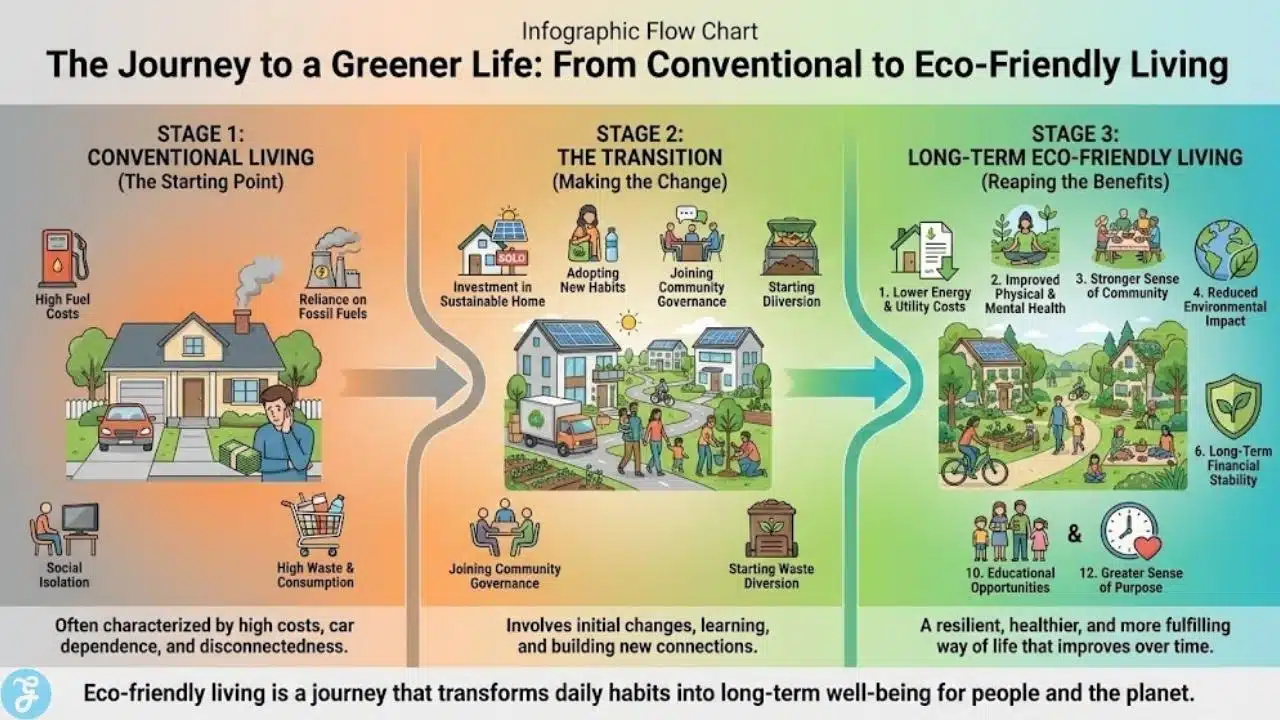
The advantages of eco-friendly communities become clearer with time. Residents often experience better health, stronger social ties, and more stable living costs as the years pass. These benefits tend to accumulate rather than fade.
Cleaner air, quieter streets, and regular access to green spaces support long-term physical and mental well-being. Walkable neighborhoods reduce isolation, while shared spaces encourage interaction and trust among neighbors.
From a financial perspective, residents benefit from lower exposure to rising energy costs and reduced dependence on private transport. Emotionally, living in an environment aligned with long-term values creates a sense of purpose and belonging. Over time, these factors turn sustainability into a lived experience rather than an abstract goal.
How to Tell If a Community Is Truly Eco-Friendly?
Not every community marketed as “eco-friendly” performs well in real life. Some places use a few visible features—like solar panels or a “green” label—while staying highly car-dependent and waste-heavy. Before choosing a community, it helps to evaluate it like a system.
A simple verification checklist (fast but revealing)
Ask about measurable performance (not vibes):
-
Are homes built to a recognized efficiency standard, or is it vague?
-
Are there targets for waste diversion, water use, or energy performance?
-
How is stormwater handled—does the design reduce runoff and flooding?
Ask about transportation reality:
-
How far are essentials (groceries, schools, clinics, transit stops)?
-
Are sidewalks continuous, shaded, and safe at night?
-
Do people actually walk/bike, or is driving still the default?
Ask about long-term upkeep and governance:
-
Who maintains shared systems like gardens, water features, or energy equipment?
-
Is there a budget plan for maintenance, not just installation?
-
How are conflicts handled, and are rules transparent?
A truly eco-friendly community isn’t defined by one feature. It’s defined by whether sustainable living is easier, cheaper over time, and more stable than conventional alternatives.
12 Benefits of Living in an Eco-Friendly Community
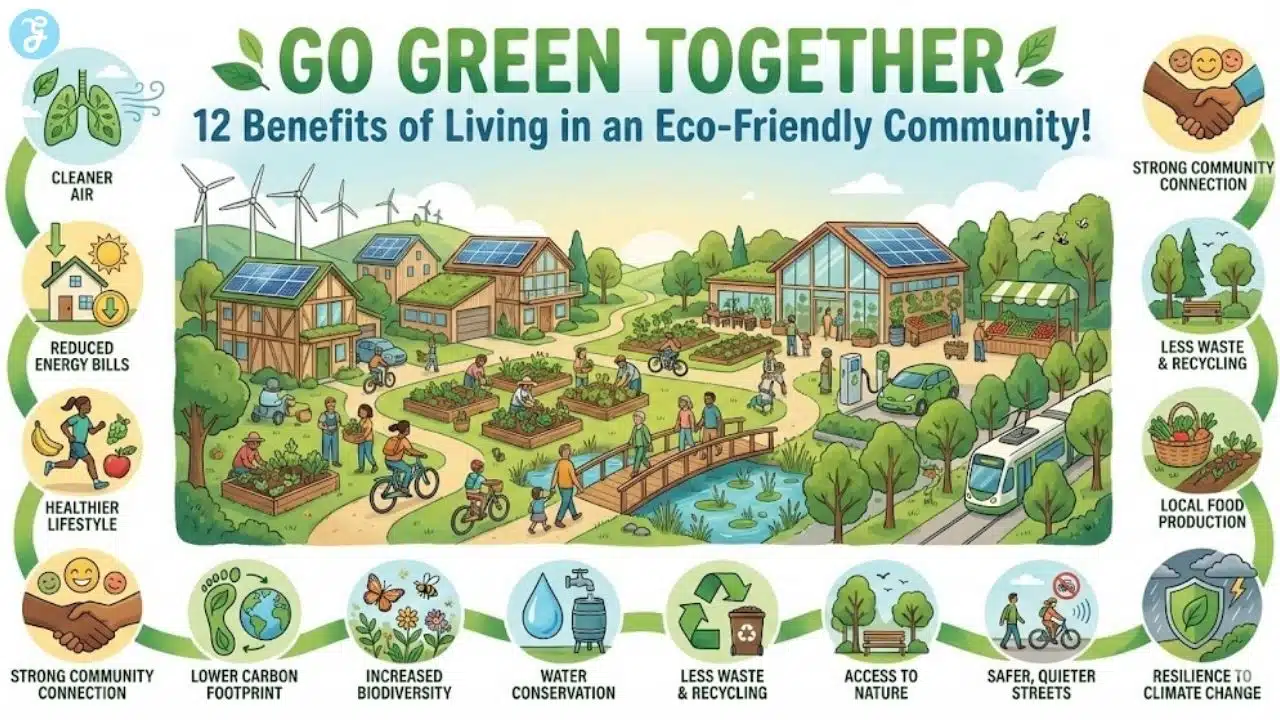
Eco-friendly communities combine environmental awareness with practical lifestyle advantages. Below are twelve key benefits that explain why this way of living continues to grow in popularity.
1. Lower Energy and Utility Costs
One of the most immediate benefits residents notice is reduced monthly expenses. Eco-friendly communities often prioritize energy-efficient buildings, shared infrastructure, and renewable energy sources.
Homes may include:
-
Better insulation and passive design
-
Solar panels or shared renewable systems
-
Energy-efficient appliances and lighting
-
Smart energy management systems
These features reduce electricity and heating costs over time. When combined with shared resources, residents often spend less on utilities compared to conventional neighborhoods.
2. Improved Physical and Mental Health
Living in an eco-friendly community often means greater access to green spaces, cleaner air, and more walkable environments. These factors contribute directly to physical and mental well-being.
Residents benefit from:
-
More opportunities for walking and cycling
-
Reduced exposure to pollution
-
Access to parks, gardens, and natural surroundings
-
Lower stress levels linked to quieter, greener environments
The design of these communities encourages movement and outdoor activity, which supports healthier lifestyles without requiring extra effort.
3. Stronger Sense of Community and Belonging
Eco-friendly communities often emphasize shared responsibility and collaboration. This creates stronger social bonds than those found in many traditional neighborhoods.
Community-oriented features may include:
-
Shared gardens or green spaces
-
Community centers or gathering areas
-
Cooperative decision-making structures
-
Local events and sustainability initiatives
These shared experiences help residents feel connected, supported, and invested in their surroundings.
4. Reduced Environmental Impact
A core advantage of eco-friendly communities is their lower environmental footprint. These neighborhoods are designed to reduce waste, conserve water, and minimize emissions at a collective level.
Common practices include:
-
Recycling and composting systems
-
Rainwater harvesting
-
Efficient waste management
-
Reduced reliance on fossil fuels
By living in a system built around sustainability, individuals reduce their impact without needing to manage everything on their own.
5. Access to Green and Open Spaces
Eco-friendly communities prioritize nature as an essential part of daily life rather than an afterthought. Green spaces are often integrated into residential design.
These spaces provide:
-
Areas for relaxation and recreation
-
Safe play environments for children
-
Natural cooling that improves comfort
-
A stronger connection to nature
Regular exposure to green environments has been linked to improved mood, concentration, and overall life satisfaction.
6. Long-Term Financial Stability
While some eco-friendly homes may have higher upfront costs, long-term savings often outweigh the initial investment. Reduced energy use, lower maintenance needs, and durable construction contribute to financial stability.
Residents may experience:
-
Lower repair and replacement costs
-
Reduced exposure to rising energy prices
-
Increased property value over time
-
Better resale appeal as sustainability demand grows
These factors make eco-friendly communities a practical long-term financial choice.
7. Better Air and Water Quality
Environmental design choices directly affect the quality of air and water in a community. Eco-friendly neighborhoods often use non-toxic materials and pollution-reducing practices.
This results in:
-
Fewer indoor air pollutants
-
Cleaner outdoor air
-
Safer water management systems
-
Reduced chemical exposure
For families, children, and older adults, these improvements can have meaningful health benefits.
8. Encouragement of Sustainable Daily Habits
Living in an eco-friendly community naturally encourages residents to adopt more sustainable habits. The environment itself supports better choices.
Examples include:
-
Easy access to recycling and composting
-
Infrastructure that supports walking and cycling
-
Shared tools and resources that reduce consumption
-
Community education around sustainability
These habits become routine rather than burdensome, making sustainable living feel normal and achievable.
9. Increased Resilience During Environmental and Economic Changes
Eco-friendly communities are often designed with resilience in mind. This includes preparation for climate-related challenges and economic uncertainty.
Resilience features may include:
-
Local energy generation
-
Water conservation systems
-
Community food initiatives
-
Emergency preparedness planning
These systems help communities adapt to disruptions more effectively than traditional neighborhoods.
10. Educational Opportunities for All Ages
Sustainable communities often serve as living classrooms. Residents learn about environmental responsibility through direct experience rather than abstract concepts.
Learning opportunities include:
-
Workshops on gardening, energy use, or waste reduction
-
Hands-on involvement in sustainability projects
-
Informal knowledge-sharing between neighbors
-
Educational programs for children and adults
This environment supports lifelong learning and environmental awareness.
11. Safer and More Walkable Neighborhoods
Eco-friendly community design often prioritizes pedestrians over cars. Streets are designed to reduce traffic speed and encourage safe movement.
Benefits include:
-
Safer areas for children and older residents
-
Reduced noise pollution
-
Increased physical activity
-
A more relaxed and friendly atmosphere
Walkable neighborhoods also strengthen local connections and reduce dependence on private vehicles.
12. Greater Sense of Purpose and Life Satisfaction
Many residents report that living in an eco-friendly community gives them a stronger sense of purpose. Knowing that daily choices align with personal values can improve overall happiness.
This sense of fulfillment comes from:
-
Contributing to environmental protection
-
Living in alignment with long-term values
-
Feeling part of a collective effort
-
Creating a positive legacy for future generations
This emotional benefit is often cited as one of the most meaningful aspects of sustainable community living.
Is Living Eco-Friendly More Expensive Than Conventional Living?
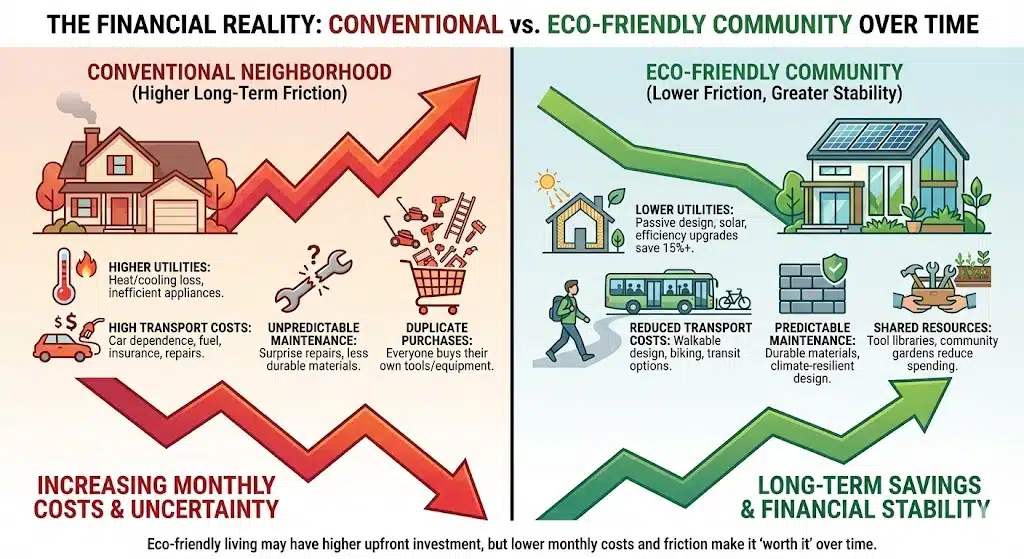
A common assumption is that eco-friendly living comes with higher costs. In reality, community-based sustainability often lowers long-term expenses instead of increasing them. While some sustainable housing options may involve higher upfront investment, ongoing costs are often reduced.
Eco-friendly communities typically lower monthly spending through efficient energy use, reduced transport needs, and shared resources. Lower utility bills, fewer repairs, and more predictable expenses can offset initial costs over time. Many residents find that their overall cost of living becomes easier to manage.
It is also important to separate sustainable living from marketing narratives. Eco-friendly lifestyles do not require constant upgrades or premium purchases. In community settings, savings come from smarter systems and reduced waste, not from buying more.
The Real Cost Math: Where Eco-Friendly Communities Save (and Where They Don’t)
A key reason is energy performance. National energy guidance often points out that energy efficiency upgrades reduce waste and improve comfort, and that an energy evaluation can identify the most effective improvements.
Where savings commonly show up
Utilities: Better insulation, tighter envelopes, efficient systems, and (sometimes) shared renewable energy reduce monthly bills. ENERGY STAR notes that sealing and adding insulation can save an average of about 15% on heating and cooling costs (and around 11% on total energy costs).
Transportation: Walkable design isn’t just “nice.” Driving less often means saving on fuel, repairs, parking, and the quiet cost of time.
Shared resources: Tool libraries, shared gardens, community workspaces, and shared amenities can reduce duplicate spending (everyone doesn’t need to own everything).
Long-term maintenance: Durable materials and better construction practices can reduce repairs—especially when buildings are designed for local climate realities.
Where can costs still be higher?
-
Upfront purchase price in a desirable location
-
Community fees for shared spaces, landscaping, or energy systems
-
Specialized repairs if certain features require specific service providers
-
Higher standards for upgrades (some communities restrict cheap materials or inefficient changes)
These are directional numbers to show where the shift happens (your local costs may differ).
| Monthly category | Conventional neighborhood | Eco-friendly community |
|---|---|---|
| Electricity/heating/cooling | Higher due to leakage + inefficiency | Lower due to efficiency + better design |
| Transportation | Higher (more driving) | Lower (more walking/transit/biking) |
| Maintenance | More surprise repairs | Often steadier if buildings are newer/durable |
| “Duplicate purchases” | Higher (own everything individually) | Lower (shared tools/spaces) |
Bottom line: Eco-friendly living can cost more at the start, but many residents experience lower monthly friction—and that is often what makes it feel “worth it.”
Why Community Design Plays a Bigger Role Than Individual Effort?
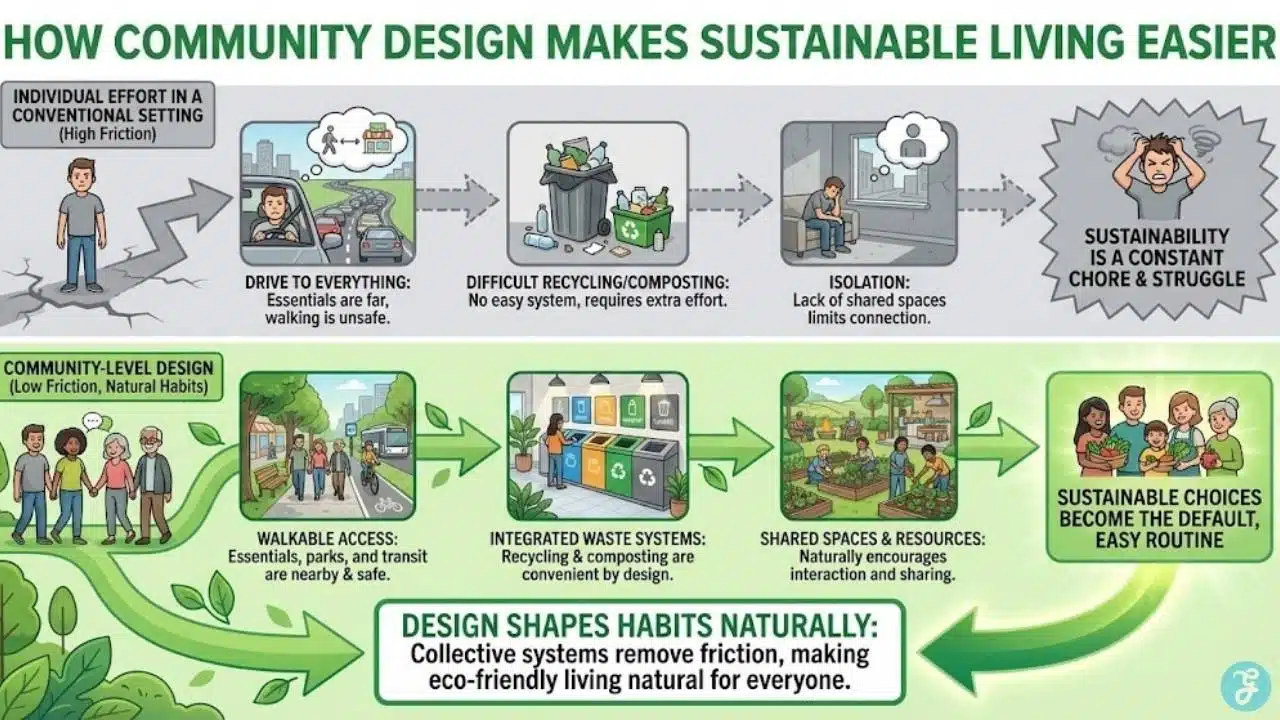
Personal motivation alone is rarely enough to sustain long-term change. The way a community is designed has a much stronger influence on daily behavior. When neighborhoods rely heavily on cars, inefficient housing, and long commutes, even well-intentioned residents struggle to live sustainably.
Eco-friendly communities change this dynamic. Walkable layouts, accessible services, shared green spaces, and efficient infrastructure make responsible choices easier. People walk more, consume less, and waste less without having to constantly think about it.
This is why community-level sustainability is often more effective than individual effort. Well-designed systems shape habits naturally, benefiting residents regardless of income level or lifestyle preferences.
Why Adopting an Eco-Friendly Lifestyle Makes Sense Today
Choosing an eco-friendly lifestyle is no longer driven only by environmental awareness. It is increasingly shaped by practical concerns such as rising living costs, health risks, and long-term stability. As energy prices fluctuate and climate-related disruptions become more common, many people are looking for lifestyles that reduce uncertainty rather than add to it.
An eco-friendly lifestyle emphasizes efficiency over excess. It encourages using fewer resources while maintaining comfort and functionality. Over time, this approach can lower dependence on unstable systems like fuel prices, utility costs, and overstretched infrastructure. What starts as a responsible choice often becomes a more reliable way to live.
There is also a mental benefit. When daily habits naturally support sustainability, people experience less stress and fewer trade-off decisions. Living in alignment with long-term values creates a sense of control and consistency that improves overall quality of life.
What Living Eco-Friendly Looks Like at the Community Level
Living eco-friendly within a community goes beyond individual habits such as recycling or saving electricity. It means being part of a neighborhood where sustainability is built into design, infrastructure, and shared expectations.
In eco-friendly communities, responsible living happens by default. Homes are designed to reduce energy use. Streets support walking and cycling. Waste systems make recycling and composting easier. Shared spaces reduce unnecessary consumption. These features remove friction from sustainable choices.
The difference lies in scale. When sustainability is supported collectively, residents do not need to constantly self-regulate. The environment itself encourages better behavior, making eco-friendly living feel natural rather than demanding.
Types of Eco-Friendly Communities and Which One Fits Your Lifestyle
Eco-friendly communities are not all the same. Some are built from scratch with strict sustainability standards, while others are “retrofit neighborhoods” that improve walkability, water use, and energy efficiency over time. Understanding the type matters because it changes your daily experience—how much you drive, how shared resources work, and how decisions get made.
Some people want a light-touch green neighborhood (efficient homes + better transit). Others want a high-commitment shared-living model (cohousing, shared meals, shared governance). Neither is “better.” The right one is the one that matches your routines, privacy needs, and budget.
Common community models (quick guide)
| Community type | What it usually looks like | Best for | Watch-outs |
|---|---|---|---|
| Green subdivision / eco-development | Efficient homes, solar, and better stormwater design | Families, retirees who want comfort with fewer lifestyle changes | It can still be car-dependent if services are far |
| Transit-oriented / walkable district | Shops, schools, transit nearby; less parking | People who want to drive less | Often higher demand in prime locations |
| Cohousing | Private homes + shared common house/resources | People who want strong community ties | More meetings, shared norms, less anonymity |
| Eco-village / intentional community | Deep sustainability + shared values/projects | People who want purpose-driven living | Biggest lifestyle shift; governance can be intense |
| Retrofit “greener neighborhood.” | Existing area improving bike lanes, parks, waste systems | People who want sustainability without moving far | Change can be gradual and uneven |
Why These Benefits Matter More Than Ever
As environmental and social challenges increase, the way people live together matters more than ever. Eco-friendly communities offer practical solutions that address cost of living, health, environmental impact, and social connection at the same time.
Rather than placing responsibility entirely on individuals, these communities create systems that make better choices easier. That collective approach is what turns sustainability into a livable, realistic lifestyle rather than an idealistic goal.
Ending Thoughts
Choosing this type of community is not only about protecting the planet. It is about improving the quality of life in ways that are tangible and lasting. Benefits of living in an Eco-Friendly Community include healthier environments, lower long-term costs, stronger social bonds, and greater resilience in a changing world. For many people, this combination makes eco-friendly communities not just a responsible choice, but a deeply rewarding one.