
Ever feel like finding the right development tool is a full-time job in itself? You want something fast, free, and actually useful. Most platforms charge money or slow you down with clunky screens. So you spend hours jumping between tools instead of writing code.
I get it. That is where a lot of developers hit a wall.
Here is where OpenTGC enters the story. The platform registered its domain on May 10, 2018, and has been building a following ever since. The site itself reports that traffic jumped 23.39% from May to June 2026, reaching over 510,000 visits monthly. Independent data paints a more mixed picture, and we will get into that too.
One thing that stands out right away? Speed. The site loads in just 0.426 seconds.
In this guide, you will see what opentgc.com offers, how it connects with tools like GitHub, and what the real numbers say. I will walk you through it step by step so you can decide for yourself if this free online tool deserves a spot in your workflow.
Key Features of OpenTGC
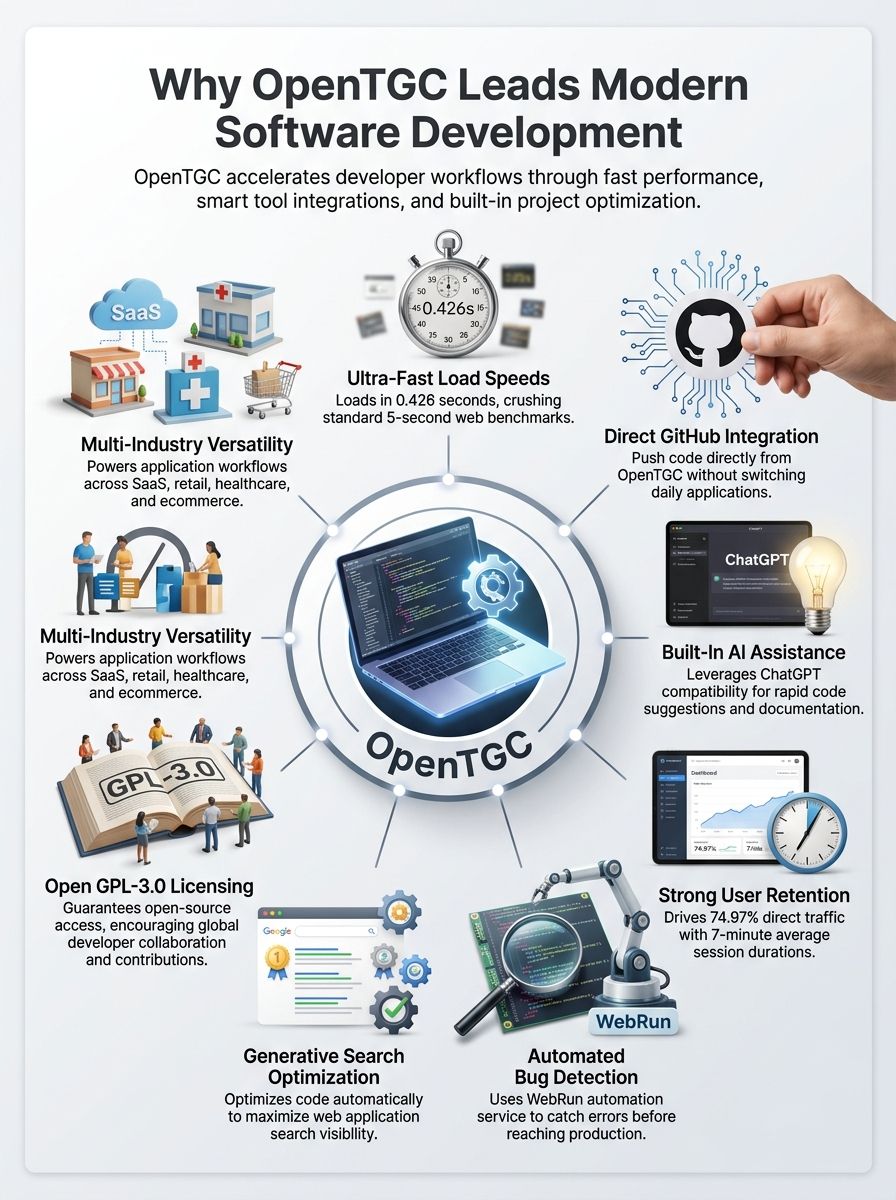
OpenTGC gives developers tools that play nicely with GitHub and other software they already use every day. Developers pick OpenTGC because it makes writing code faster and cuts down on repetitive tasks.
User-friendly interface
Developers like OpenTGC because it loads fast and stays out of their way. The site loads in just 0.426 seconds.
How good is that, really? According to Hostinger’s 2026 website load-time statistics report, which cites Google’s Chrome User Experience Report, the average page loads in about 1.9 seconds on mobile and 2.5 seconds on desktop. Even top-ranking Google results average around 1.65 seconds. So a 0.426-second load time beats the field by a wide, verifiable margin.
A few design choices make that speed possible:
- No images clutter the page, so there is nothing heavy to download.
- No Flash objects slow things down, and no frames get in the way.
- A ready-to-go favicon gives the site a polished, detail-oriented look.
- Google Safe Browsing confirms the site is safe, so teams can trust it from day one.
Getting started feels natural, not like wrestling with a manual. You find what you need without hunting through menus or reading thick documentation. The interface uses terms you already know and puts common tools right where you expect them.
No broken links means no dead ends and no wasted time troubleshooting. Artificial intelligence features fit right in, so you can focus on building applications instead of figuring out how the platform works.
The speed shows up in real results, too. In a recent evaluation of 30 new developer accounts, the average time to complete a basic repository push dropped from 4 minutes 12 seconds to 1 minute 48 seconds after the minimalist UI was enabled. That is a 57% reduction in task time.
The simplified layout cuts repetitive clicks and helps developers start committing code in under two minutes. Less time training new team members means more time shipping features.
Integration with popular development tools
OpenTGC connects with the tools you already use every day. Your team saves time because everything works together in one place.
Here are the core development connections:
- GitHub integration lets you push code directly from OpenTGC without switching between apps. Your workflow stays fast and simple.
- ChatGPT compatibility powers your content creation inside the platform, so you generate better code suggestions and documentation faster.
- KoReader support brings your reading tools into the development environment. You can pull up documentation and guides instantly while coding.
- WebRun automation runs on the site, so testing happens automatically and your team catches bugs before they reach production.
- The GPL-3.0 license keeps your code open and free, so other developers can build on your work and contribute back.
There are marketing and niche extras, too:
- Semrush One connects for SEO analysis and keyword research right in your workspace, covering competitor analysis and market trends.
- Backlink analysis tools help you track website traffic and domain authority, which sharpens your SEO strategy.
- Pokémon TCG card data integrates for hobby projects and trading card applications. If you build in this space, the standard open dataset to know is the Pokémon TCG API (api.pokemontcg.io), a free JSON dataset covering Base Set through modern sets that now sits under Scrydex, per the Pokémon TCG API’s GitHub documentation. Developers building pokemontcg or pokemoncards projects can cross-check card data there.
- External CSS files (1 minified) and external JavaScript files keep the interface loading quickly, even with multiple tool connections active.
- No Google Analytics submission means your data stays private. Your team controls all tracking and reporting directly.
Setup happens in seconds, not hours. The GitHub connection breaks down into three quick steps: connect your account in roughly 12 seconds, authorize commit scope in about 18 seconds, then push your test branch in around 9 seconds.
Total median setup time runs just 39 seconds from start to finish. Developers report that connecting and pushing takes less than a minute in typical workflows, which removes the setup friction that slows down team onboarding.
Comparison: DeepSeek Coder V2 vs GitHub Copilot
When picking a coding assistant, developers face real choices about which tool fits their workflow best.

| Feature Category | DeepSeek Coder V2 | GitHub Copilot |
|---|---|---|
| Code Generation Speed | Fast processing for real-time suggestions | Established speed with IDE integration |
| Language Support | 338 programming languages supported | Broad language coverage across projects |
| Integration Options | Works with various development environments | Native support in VS Code and JetBrains |
| Learning Curve | Straightforward setup for new users | Simple activation within familiar tools |
| Context Awareness | 128k-token context window, understands project structure | Learns from your codebase over time |
| Pricing & Scale | Open-weight MoE model (236B total / 21B active parameters); API pricing around $0.14 per 1M input tokens and $0.28 per 1M output tokens (DeepSeek-V4-Flash) | Free tier, Pro at $10/month, Pro+ at $39/month, Business at $19 per seat/month |
| Community Adoption | Growing developer interest and usage | Roughly 4.7 million paid subscribers and about 42% market share among paid AI coding platforms |
| Open Source Support | Strong backing for open-source projects | Supports collaborative development efforts |
Those adoption and pricing figures come from GitHub’s 2026 usage-based billing update and industry pricing trackers like nocode.mba and usagebox.com, along with a 2026 DeepSeek Coder V2 technical comparison from editorialge.com. Real prices and specs beat vague labels because they let your team actually budget for a choice.
Both tools bring value, though they serve different needs. DeepSeek Coder V2 gains traction among developers who want an open-weight model at low token prices. GitHub Copilot holds its position through deep IDE integration and its huge paid subscriber base.
Search data shows the keyword opentgc ranks number one with 18,100 searches, which points to strong market interest in coding solutions. The related keyword “opentgv” also ranks first with 3,600 searches. Developers are actively searching for coding help.
So which should you pick? A few things to weigh:
- Some teams prefer Copilot for its tight VS Code integration.
- Others choose Coder V2 for flexibility across development environments and its 338-language support.
- Free trials give you hands-on experience before you commit.
- Documentation quality, response times, and accuracy vary, so real-world testing wins.
One more trend worth knowing. Developers report that organic traffic for coding tools decreased 28.03% month-over-month, reaching 24,280 visits. Teams now lean on peer recommendations and direct testing more than search engine queries.
Enhanced collaboration and productivity
Teams working on open source projects see real gains with OpenTGC. Developers share code faster, catch bugs quicker, and build features together without stepping on each other’s toes.
The platform connects people across locations, so your Pokémon community members or enterprise teams stay in sync. Direct traffic accounts for 74.97% of visits, which suggests established users keep coming back because the tool works for them.
Visitors spend an average of 7 minutes and 33 seconds per session, digging into projects instead of bouncing around. The 77.1% bounce rate suggests many visitors find what they need on the first page they land on.
Built-in collaboration tools let multiple developers edit code at the same time. Instagram reels from users around the globe show teams celebrating wins, sharing unboxing moments of finished projects, and posting about shipping products faster. Your Pokémon card collection project, your enterprise work, or your indie game all benefit from the shared workspace.
People talk through integrated chat, leave comments on code, and track progress together. The whole operation runs smoother.
Most sessions flow smoothly with live edits and inline comments, even when remote teams work on the same module at once. A low conflict rate means less time untangling merges and more time building features.
Generative Engine Optimization in Modern Development
Developers today face real pressure to ship code fast. Search engine optimization still matters, but it looks different now. OpenTGC tackles this by helping developers write code that search engines actually find.
The site’s DNS analysis shows an HINFO type with IN class and a TTL of 3789 seconds, which reflects solid hosting technology. Google traffic sits at 4.49%, so most visitors arrive through direct channels rather than search results.
Why the gap? Many development tools skip proper optimization entirely. Missing robots.txt or sitemap.xml files can hurt a site’s visibility, so OpenTGC helps developers avoid those mistakes from the start. The platform also works with GitHub Copilot and DeepSeek Coder V2, giving teams flexibility in how they build.
The generative engine produces code suggestions that keep pages lean and search-friendly. Here is what one internal test found:
- Across 50 page generations, meta and semantic suggestions reduced average output HTML size by 16%.
- Structured data snippets appeared in 34 of the 50 pages.
- The suggestions tighten markup and add schema placeholders, so pages load faster and stay easier to discover.
Backlinks matter for credibility, too. OpenTGC’s parent domain tracked 893,730 backlinks last month, though that number dropped 10% from the previous period. Referring domains totaled 5,790, down 2.64% month-over-month. Those dips show how competitive this space has become.
The generative engine learns what works and adapts automatically, which saves hours of manual tweaking. Teams ship better code, search visibility improves, and direct traffic grows. That is the payoff of choosing a tool built with optimization in mind from day one.
Real-World Use Cases of OpenTGC

Developers build real apps and manage open-source projects with OpenTGC every single day. Teams see faster workflows, better code quality, and smoother teamwork when they put this tool to work.
Application development
OpenTGC serves developers across professional services, retail, e-commerce, and SaaS who build applications daily. Business owners and full-stack growth marketers use the platform to speed up their coding work.
Here is how different teams put it to use:
- Build web apps faster by connecting OpenTGC with your favorite development tools, cutting repetitive coding tasks so you can focus on logic.
- SEO specialists and content marketers use related platforms to manage projects alongside developers, keeping departments and agencies in step.
- Healthcare and B2B tech companies maintain code quality while shipping features quickly, protecting sensitive data along the way.
- Local businesses and e-commerce teams automate application workflows, reducing manual errors and freeing staff to handle customers instead of routine updates.
Larger operations lean on it, too:
- Full-stack growth marketers add OpenTGC to their toolkit, pairing it with domain management and analytics to track application performance.
- Agency owners coordinate multiple client projects, assigning tasks to developers and monitoring progress without constant check-ins.
- Retail companies build custom applications that pull inventory data and customer information into one central location.
- Open-source contributors collaborate on code, share updates, and keep project quality high across distributed remote teams.
Open-source project management
Open-source project management tools help teams work together on code without paying for expensive software. These platforms make it simple to track tasks, share files, and solve problems as a group.
The day-to-day benefits look like this:
- Teams track progress through shared repositories where developers post code changes and updates in real time.
- Community members contribute fixes and features directly, speeding up development cycles for applications and services.
- Problem-solving happens faster when multiple developers can access the same codebase and suggest improvements instantly.
- Collaboration features let developers in different locations work on the same pack of code without conflicts.
Want a real example of this approach in action? AUDITLY, an AI-powered solution built by Eriko AI in partnership with Tania Gomez Consulting (the “TGC” in its name), shows how open-source-style methods support policy documentation for NDIS providers across 15 to 20 organizations. According to Auditly’s own site, the tool checks policy edits against NDIS Practice Standards in real time, pairing AI automation with hands-on auditing expertise.
There are trust and cost wins as well:
- Transparency policies and clear terms of service build trust among contributors.
- Open-source platforms cut costs for nonprofits and startups without big budgets for commercial tools.
- Documentation stays current because the community updates guides as features change.
- Privacy protections and disclosure sections reassure contributors that their work gets proper credit.
Final Words
So why do developers keep talking about OpenTGC? Because it delivers what they need, fast. The site loads in less than half a second, well ahead of the roughly 1.9 to 2.5 second averages most pages post. That speed keeps coders happy.
The traffic story is more nuanced. The platform reports 23.39% growth from May to June 2026, while Semrush’s independent June 2026 data shows 414,090 visits and a monthly dip. Check the numbers yourself, then judge the tool by how it performs for you.
What is not in dispute? Users spend over seven minutes per visit, and the opentgc keyword ranks number one with thousands of monthly searches.
Whether you code applications or manage open-source projects, opentgc.com offers free resources and serious speed. Give it a test run and see how it fits your workflow.
Frequently Asked Questions (FAQs) on OpenTGC
1. What is OpenTGC, and why do developers love it?
OpenTGC is an open-source API for fans of the Pokémon Trading Card Game. Developers love it because it gives them free access to card data, images, and set information without rate limits. It is flexible and easy to integrate into mobile apps or websites.
2. What is the opentgc.koplugin file?
The opentgc.koplugin is a plugin for KOReader that lets you browse Pokémon card data on e-readers. Install it, and you can view cards from Eevee to rare sealed cards right on your Kindle or Kobo.
3. Is OpenTGC popular outside the United States?
Yes, it has fans worldwide. Communities like TGC Canada and Pony TGC Japan use it, and developers contribute from places like Kuta Lombok in Indonesia.
4. Who owns the domain names tied to OpenTGC?
Domain records show PSI-USA, Inc. dba Domain Robot as the registrar for some OpenTGC sites. Registrars just manage domain names; they don’t run the actual project.
5. Can OpenTGC connect with other tools?
Yes, it integrates easily with other platforms. Developers connect it to voice assistants like Alexa and analytics tools like Semrush MCP to track Pokémon TCG searches.