
Most SaaS platforms do not fail from a shortage of user features. They stall when operational friction, breaking updates, and database locking slow down development. Building a multi-tenant product using single-user application habits raises the risk of severe performance bottlenecks and costly architectural rewrites.
Structuring a reliable SaaS development process requires designing for failure isolation, infrastructure cost control, and automated deployments from the very beginning.
Step 1: Choose Your Tenant Model Based on Contract Size and Margins
A common mistake is treating multi-tenancy as a simple architectural preference. Isolation models directly impact your unit economics, infrastructure costs, and sales pipeline.
Matching Architecture to Business Constraints
Use a Siloed Model when selling enterprise contracts with strict compliance mandates (such as HIPAA, FedRAMP, or custom SOC 2 requirements). Each customer receives dedicated compute resources and a distinct database. This minimizes compliance friction and guarantees performance isolation, but it is usually expensive to operate and requires complex deployment orchestrations.
Use a Pooled Model when building self-serve software aimed at SMBs or consumer markets where gross margins must stay high. All customers share servers and database clusters, relying on software filters to separate data. This reduces hosting costs, but it increases the risk of noisy neighbor performance spikes.
Use a Hybrid Model when scaling past initial market fit. Standard tiers run in a pooled environment to protect profit margins, while high-value enterprise accounts pay a premium to be migrated to dedicated infrastructure.
Operational Friction: Managing a siloed or hybrid model at scale creates heavy infrastructure overhead. A pool of 500 isolated databases means running 500 simultaneous schema migrations during every release cycle. This can quickly saturate database connection pools and exhaust deployment runner memory if not carefully throttled.
Step 2: Lock Down API Specifications and Versioning Contracts
Ad-hoc API creation often leads to frontend bugs and broken integration channels. Defining clear interface contracts before writing backend logic prevents cross-team blockers.
Managing API Lifecycle and Schema Friction
Draft explicit API specifications using standards like OpenAPI or gRPC protocol buffers. Front-end engineers can construct user interfaces using generated mock servers while back-end developers write business logic against the agreed specification.
Deprecating fields in a multi-tenant environment requires strict rules:
Sunset Windows: Maintain backward compatibility for older API versions for a defined period (such as 90 days) using API gateway routing.
Client SDK Drift: Automatically generated client libraries can fall out of sync with backend services if API changes are pushed without automated client regression tests.
Payload Limits: Enforce request size caps at the API gateway layer to prevent a single high-volume tenant from overloading backend serialization workers.
Step 3: Secure Data Access and Plan for Migration Failures
In a shared database architecture, appending a tenant identification column to every table is necessary, but relying on developers to manually write filtering logic in every application query introduces risk. Human oversight eventually fails.
Enforcing Database Boundaries
Set up context-aware database rules like PostgreSQL Row-Level Security. When a request hits the database, the application connection sets a session variable identifying the current active customer. The database engine then restricts query results to matching rows automatically, without relying on application code filters.
Real-World Migration Friction
Database schema updates on large, pooled tables carry significant risk. Executing an unindexed column alteration on a table with millions of rows can trigger table locks, queuing incoming web traffic and causing service outages.
Background processes like asynchronous workers and reporting tools often execute under high-privilege system service accounts. If these service accounts bypass database row security rules without strict context-scoping logic, background jobs may accidentally expose or cross-contaminate data across tenant boundaries.
Step 4: Build CI/CD Pipelines with Irreversible Migration Safeguards
Manual deployments slow down release cycles and increase error rates. Automated delivery pipelines test and push code safely, but database changes complicate the release flow.
Deployment Model Comparison
| Deployment Strategy | Operational Risk | Cost Impact | Rollback Feasibility |
| Rolling Update | Medium. Old and new code versions run simultaneously alongside active database changes. | Low. Uses existing server capacity. | Complex if database schema modifications have already executed. |
| Blue/Green | Low. Switches traffic instantly to a fully tested, identical parallel environment. | High. Requires doubling infrastructure capacity during releases. | Fast for application code, but complicated if live data was written to the new environment. |
| Canary Release | Lowest. Routes 1% to 5% of active tenant traffic to the new build while monitoring error rates. | Moderate. Requires advanced traffic routing at the API gateway level. | Straightforward for application logic; requires schema expand/contract patterns. |
Database schema migrations are rarely easy to roll back once written to live tables. To prevent broken deployments, adopt the Expand/Contract pattern.
First, expand the database by adding new columns without deleting old ones. Next, deploy application code that writes to both new and old fields. Once the deployment stabilizes, deploy a final script to contract the schema by removing deprecated columns.
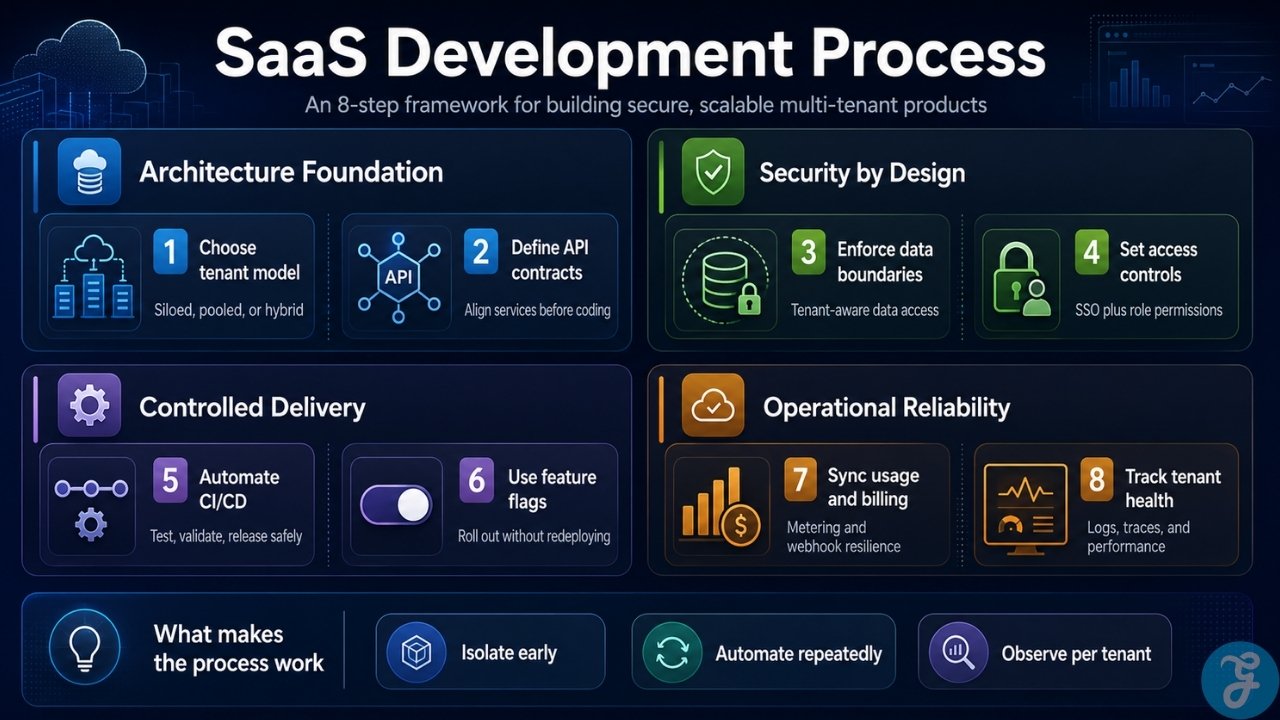
Step 5: Control Releases with Feature Flags and Enforce Cleanup
Deploying code to production should not automatically expose new functionality to all users. Feature flags give engineering teams precise control over feature releases, but unmanaged flags quickly turn into technical debt.
Avoiding Feature Flag Sprawl
Feature toggles allow you to release capabilities to specific tenant groups, execute dark launches, or instantly disable broken tools using emergency kill switches. However, leaving inactive flags in the codebase creates tangled logic branches that are difficult to debug.
Establish operational rules for flag management:
-
Short Lifespans: Treat feature flags as temporary infrastructure. Flags intended for gradual rollouts should have mandatory removal tickets attached to the sprint following full release.
-
Default Fallbacks: Every flag evaluation must include a hardcoded safe fallback value in case the feature flag service times out or becomes unreachable.
-
Decouple Entitlements: Do not use temporary release flags to manage permanent pricing tier access. Use a dedicated billing entitlement service for feature access based on subscription plans.
Step 6: Handle Asynchronous Billing and Webhook Edge Cases
Coupled billing systems increase application complexity. Metering usage (such as compute hours, file storage, or API calls) should happen asynchronously via event brokers like Apache Kafka or RabbitMQ rather than blocking HTTP web requests.
Managing Webhook Friction and Out-of-Order Delivery
Integrating with payment platforms like Stripe or Chargebee introduces network jitter and race conditions. Webhooks can arrive out of chronological order, or fail entirely during temporary network drops.
| Webhook Event Sequence Scenario | Potential Failure | System Safeguard |
subscription.updated arrives before customer.created |
The database fails to match the update to an existing user record, dropping the payment status update. | Queue orphaned events in a retry buffer with exponential backoff until the primary record resolves. |
Duplicate invoice.paid notifications sent within seconds |
The system credits user accounts twice or triggers duplicate receipt emails. | Store processed webhook IDs in a cache and verify incoming event IDs for idempotency before executing logic. |
| Delinquent payment webhook arrives during an active user session | The system instantly revokes user access mid-task, causing data loss and poor user experience. | Implement a grace period state rather than immediate account termination upon first payment failure. |
Step 7: Implement Enterprise Security, SSO, and Service Isolation
SaaS access control spans two distinct areas: verifying user identity (authentication) and enforcing user permissions within a specific organization (authorization).
Single Sign-On and Access Scoping
To close enterprise deals, platforms must support Single Sign-On (SSO) standard protocols such as SAML 2.0 and OpenID Connect. This allows client IT administrators to handle account provisioning and revocation through identity providers like Okta or Azure Active Directory.
Within your application context, control permissions using Role-Based Access Control (RBAC) or Attribute-Based Access Control (ABAC):
-
Role-Based (RBAC): Groups permissions into static system roles like Admin, Member, or Billing Viewer.
-
Attribute-Based (ABAC): Evaluates dynamic variables at runtime, such as user location, IP ranges, device compliance state, and time of day.
Every security token passed across microservices must carry both user and tenant contextual signatures. Services must validate these signatures locally to prevent cross-tenant request forgery.
Step 8: Scale Observability Without Exploding Telemetry Costs
Tracking system performance in a multi-tenant platform requires attaching tenant metadata to logs, traces, and metrics. However, unmonitored metric tagging can lead to massive cloud logging bills.
The Metric Cardinality Problem
Appending a dynamic tenant identification tag to high-frequency system metrics (like CPU usage or HTTP request counters) creates high-cardinality time-series data. If you have 5,000 tenants, a single metric tracked across 10 microservices multiplies your metric storage requirements by 5,000, quickly blowing through observability budgets.
To balance visibility with operational costs:
Use Structured Logs for High-Cardinality Data: Store detailed identifiers like tenant ID, user ID, and trace ID inside structured log payloads and distributed traces where storage costs grow linearly, not exponentially.
Keep Aggregated Metrics Low-Cardinality: Monitor primary time-series infrastructure metrics at the system or service level. Use tenant-level metric tags sparingly, focusing primarily on high-value enterprise accounts or specific rate-limiting counters.
Building the Operational Foundation
Designing a SaaS development process is an exercise in managing trade-offs between speed, security, and hosting costs. Choosing architectural patterns based on real operational realities, such as database migration limits, webhook order failures, and high metric cardinality, prevents costly engineering debt as your application scales.
Focus on establishing firm tenant boundaries and automated deployment checks early. When the underlying delivery pipeline is stable, teams can release new capabilities safely without risking system downtime or data leaks.
Frequently Asked Questions (FAQs) About SaaS Development Process
How do you prevent a high-volume tenant from slowing down other users?
Mitigate noisy neighbor issues by placing strict rate limits on API gateways and using tenant-aware concurrency limits. Separate background workloads into dedicated queues so a heavy burst of jobs from one customer does not block others. This ensures consistent performance across shared infrastructure.
What is the most critical step in the SaaS development process?
Establishing database isolation boundaries during early schema design is the most critical step. Retrofitting row-level security or multi-tenant rules onto an existing live platform usually requires a high-risk code rewrite. Getting this right early protects user data and avoids massive future technical debt.
How do you update a multi-tenant database without causing downtime?
Use an expand and contract database migration pattern. First, expand the database by adding new columns or tables alongside old ones. Next, deploy code that writes to both schemas before contracting the database by removing old structures once stability is confirmed.
Should an early MVP include multi-tenancy from day one?
Yes, your database architecture must track tenant identifiers from the very start. While you can keep initial features minimal, converting a single-tenant application into a multi-tenant model later almost always forces a complete system rewrite. Starting with tenant context avoids this trap.
How do feature flags improve software delivery in SaaS?
Feature flags decouple code deployment from feature releases. Engineering teams can test features silently in production, roll out capabilities gradually to specific customer segments, and disable broken features instantly using kill switches. This reduces deployment risk without needing emergency code rollbacks.