


Evaluating enterprise software used to mean choosing between off-the-shelf subscriptions and custom in-house builds. The rapid commercialization of artificial intelligence has introduced a third path: Model as a Service (MaaS).
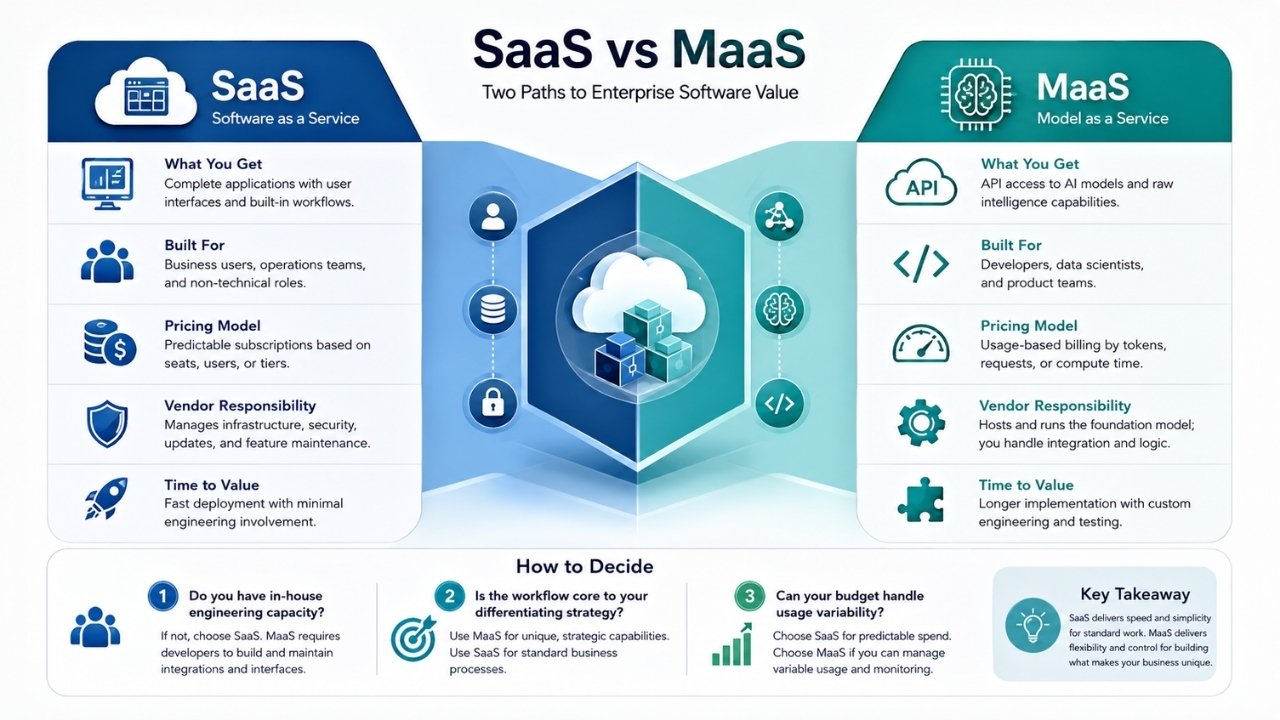
Comparing SaaS vs MaaS comes down to a fundamental operational trade-off: off-the-shelf application workflows versus customizable raw intelligence. While traditional Software as a Service provides complete, user-ready interfaces, Model as a Service provides programmatic access to machine learning capabilities that your engineering team must build around. Choosing the wrong path can lead to surprise infrastructure bills, unexpectedly long implementation timelines, and heavy technical maintenance.
Defining the Two Delivery Models
Understanding where vendor responsibility ends and internal engineering begins is the first step in software evaluation.
What is Software as a Service (SaaS)?
Software as a Service delivers complete applications directly to end-users over the internet. The vendor hosts the entire technical foundation, including databases, business logic, security patches, and frontend interfaces. When you license a SaaS platform like Salesforce or Workday, your team logs in and performs operational tasks immediately without writing code or managing servers.
What is Model as a Service (MaaS)?
Model as a Service exposes cloud-hosted artificial intelligence models through application programming interfaces (APIs). Instead of delivering a finished application interface, MaaS vendors host massive foundational models (such as large language models, speech generators, or vision engines) and charge for raw processing power. Developers connect these intelligence endpoints directly into proprietary enterprise software.
Core Differences Between SaaS and MaaS
Evaluating SaaS vs MaaS requires looking closely at how each model alters technical overhead, financial predictability, and day-to-day user experience.
Cost Structure and Predictability
Moving from SaaS to MaaS changes how finance teams track software expenditure, shifting from predictable monthly line items to fluctuating utility bills.
The Seat-Based Predictability of SaaS
SaaS budgeting relies on straightforward linear scaling. Adding 20 employees to an enterprise software account increases the monthly bill by a fixed, pre-negotiated amount. Financial planning remains steady because sudden spikes in employee usage rarely trigger unexpected infrastructure surcharges.
The Variable Consumption Dynamics of MaaS
MaaS pricing functions like an electric utility. Providers bill based on usage metrics, such as input and output tokens for language models or processing seconds for audio and vision engines.
Low request volumes make initial testing cheap, but live production traffic can introduce sudden budget volatility:
-
Context Window Expansion: Large context inputs and multi-step reasoning agents quickly multiply the number of tokens processed per query.
-
Uncapped Traps: Automated background jobs running without strict API spending limits can incur thousands of dollars in usage within hours.
-
Infrastructure Caching: Keeping operational costs under control requires software developers to build semantic caching systems to stop redundant queries from hitting the paid API.
Engineering Burden and Integration Complexity
Buying a SaaS tool means purchasing a finished business outcome. Buying MaaS means purchasing raw capability that your team must build, test, and maintain.
Turnkey Workflows vs. Custom Pipeline Assembly
SaaS products eliminate setup friction by providing ready-made dashboards, permission settings, and automated email alerts. Operations teams can adjust settings and go live within a few days.
By contrast, raw MaaS endpoints require software developers to write custom code before any employee receives value. Integrating an AI model into your business operations requires building:
-
User Interface Layers: Designing custom software screens so employees can interact with the underlying model.
-
Context Pipelines: Setting up vector databases and retrieval-augmented generation (RAG) frameworks so the model can access internal company records safely.
-
Guardrails and Safety Filters: Adding validation rules to catch incorrect, malformed, or unsafe model responses before they reach users.
-
Provider Redundancy: Configuring backup routes to secondary model providers so business workflows do not stop during primary API outages.
Procurement Friction: A MaaS API contract may look 70 percent cheaper than an off-the-shelf SaaS subscription on paper. However, once you factor in software developer salaries, vector database hosting, and continuous prompt engineering, the total cost of ownership often flips.
Data Governance, Fine-Tuning, and Vendor Lock-In
Data protection protocols differ significantly between structured SaaS databases and raw model inference endpoints.
Data Isolation in SaaS Platforms
Standard SaaS vendors separate tenant data at the database level using logical isolation controls or row-level security policies. Corporate files reside in structured environments audited against security standards like SOC 2 Type II or ISO 27001.
Inference Security and Intellectual Property in MaaS
MaaS contracts demand careful review regarding data retention and training rights:
-
Zero Data Retention Guarantees: Enterprise buyers must confirm that the MaaS vendor explicitly promises not to store API request payloads or use proprietary customer data to train public base models.
-
Fine-Tuning Ownership: When adjusting a base model using internal company records, ensure the agreement explicitly assigns all ownership of the fine-tuned weights to your company.
-
Migration Friction: While changing MaaS providers involves modifying endpoint code, custom prompt structures, context pipelines, and guardrail logic often break when moving between different model architectures.
How to Choose: A Decision Framework for Buyers
Selecting between turnkey SaaS applications and raw MaaS access boils down to three operational questions.
1. Does Your Team Have In-House Software Engineering Capacity?
If your organization lacks dedicated developers to write integration code, manage vector databases, and build user interfaces, select a SaaS solution. MaaS is a developer framework, not an end-user application.
2. Is the Workflow Core to Your Differentiating Strategy?
If the feature you are building represents your company’s core product differentiator, buying raw MaaS access offers total control over customer experience and business logic. For standard administrative tasks like expense reporting or scheduling, turnkey SaaS tools are far more cost-effective.
3. Can Your Finance Department Handle Monthly Cost Fluctuations?
If your organization requires fixed monthly software line items, traditional SaaS subscriptions provide budget safety. If your organization can manage variable usage bills alongside active usage monitoring, MaaS offers flexible pay-as-you-go scalability.
Choosing between SaaS vs MaaS comes down to matching technology architectures with internal engineering capacity and strategic priorities.
Turnkey SaaS platforms remain the fastest, most reliable choice for standard business operations where speed to deployment and predictable subscription pricing matter most. Model as a Service gives technical teams the foundation to build proprietary, deeply customized software directly into company workflows. Evaluating developer overhead, variable usage pricing, and data ownership rules upfront ensures your enterprise picks the right model for long-term growth.
Frequently Asked Questions (FAQs) About SaaS vs MaaS
What is the main difference between SaaS and MaaS?
SaaS provides complete, ready-to-use software applications with built-in user interfaces for non-technical users. MaaS provides raw API access to hosted machine learning models that software developers must build into custom software applications.
Is Model as a Service cheaper than SaaS?
MaaS often has lower initial costs because you pay only for active API token usage or computing time. However, total deployment costs can exceed SaaS once you account for internal engineering salaries, vector storage hosting, and ongoing prompt maintenance.
Can a SaaS platform use MaaS behind the scenes?
Yes, many modern SaaS vendors integrate MaaS APIs into their backend architectures to power built-in artificial intelligence tools. The customer gets a finished SaaS interface while the software vendor manages the underlying MaaS API requests and usage costs.
How does pricing work in a MaaS contract?
MaaS vendors charge based on direct resource consumption, such as input and output tokens, generated images, or GPU processing time. Buyers need to configure API spending limits and prompt caching layers to prevent unexpected billing spikes during high traffic periods.
Which delivery model offers better enterprise data privacy?
Both models can meet strict compliance requirements, but MaaS requires explicit contract terms ensuring zero data retention. Enterprise procurement teams must verify that the provider does not use submitted API prompts to train future public foundation models.





















