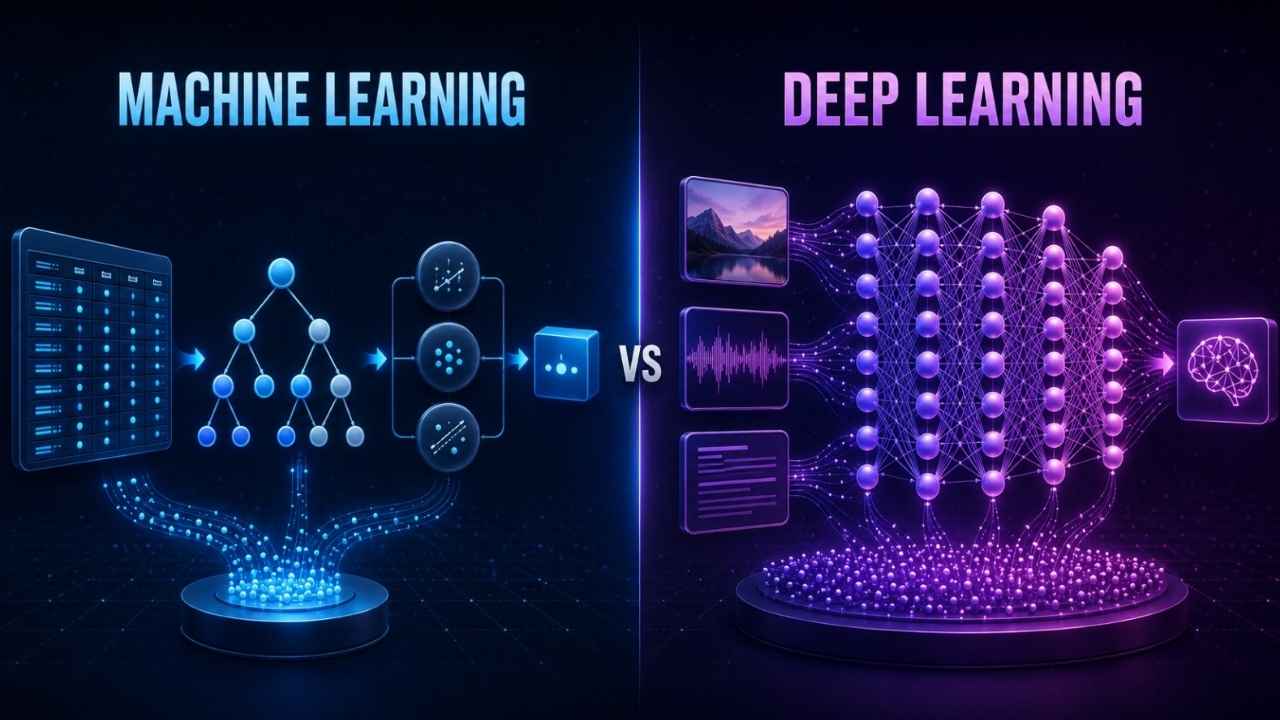
Did you know what exactly differs when we put machine learning vs deep learning? Actually, deep learning is not separate from machine learning. It is one model family within it, built around neural networks with multiple hidden layers.
Traditional machine learning algorithms—like gradient boosting or decision trees—excel on structured tabular data, training faster with lower operating costs and far easier debugging.
Deep learning, by contrast, automatically extracts complex patterns from unstructured inputs like images, speech, and text. Choosing the right approach depends on your data type, infrastructure, response times, and business risk—not which technology sounds more advanced.
Machine Learning vs Deep Learning in Plain English
Machine learning is the broader field. It includes algorithms that learn patterns from data and use those patterns to classify records, predict values, rank results, group similar items, detect anomalies, or support decisions.
Common machine-learning approaches include:
- Linear and logistic regression
- Decision trees
- Random forests
- Gradient-boosted trees
- Support vector machines
- k-nearest neighbours
- Naive Bayes
- Clustering and dimensionality reduction
- Neural networks
Deep learning uses neural networks with several stacked layers. Those layers can learn increasingly useful representations as information moves through the network.
The hierarchy is simple:
Artificial intelligence includes machine learning, and machine learning includes deep learning.
The Main Differences at a Glance: Machine Learning vs Deep Learning
| Area | Traditional machine learning | Deep learning |
| Common inputs | Structured tables and engineered measurements | Images, text, audio, video, graphs, and raw sequences |
| Feature creation | Often depends more on human-designed features | Learns many representations during training |
| Data needs | Often effective on small or medium datasets | Usually benefits from more data or relevant pretraining |
| Computing | Commonly practical on CPUs | Often uses GPUs or other accelerators |
| Training effort | Usually faster to establish and tune | Often requires more experimentation |
| Interpretability | Simple models can be easier to inspect | Internal representations are generally harder to explain |
| Deployment | Often smaller and cheaper to serve | May need optimisation for memory and latency |
| Typical strength | Structured prediction and quick baselines | Complex, high-dimensional, unstructured inputs |
Traditional Machine Learning is Not Obsolete
The label “traditional machine learning” can make established models sound dated. Many remain the most practical choice for business data.
Consider a churn-prediction system with columns for account age, plan type, monthly usage, payment failures, contract status, and support contacts. Much of the useful structure is already present.
A sensible first comparison might include logistic regression, random forest, and gradient boosting. These models train quickly, create a dependable baseline, and often expose poor labels or weak features before a team invests in more complex architecture.
Decision trees learn threshold-based rules. Random forests combine many trees to reduce the instability of one tree. Gradient boosting builds a model in stages, with later components correcting earlier mistakes.
These methods also support fraud detection, forecasting, clustering, recommendations, anomaly detection, and ranking. They are not limited to basic classroom examples.
For many structured datasets, a strong tree-based model remains difficult to beat once training time, inference cost, and maintenance are included.
What Deep Learning Adds
Deep learning’s main advantage is representation learning.
A conventional image system may begin with manually designed measurements for colour, edges, shape, or texture. A deep vision model can learn basic visual patterns in early layers, combine them into more complex structures later, and eventually form representations useful for recognising objects or defects.
The same principle applies across other data types:
- Speech models learn from audio signals.
- Language models learn relationships among tokens and context.
- Deep recommenders combine users, items, sequences, and behaviour.
- Graph neural networks learn from connected entities and relationships.
This does not remove human work.
Teams still define the objective, collect and clean data, create labels, select metrics, prevent leakage, inspect errors, set thresholds, and monitor the deployed system.
Deep learning can reduce manual feature engineering. It does not remove the need for domain expertise or careful data design.
Data Requirements Are More Complicated Than “Small vs Large”
The familiar rule says machine learning works with small datasets, while deep learning needs millions of labeled examples. That is too simple.
Large neural networks trained from scratch can require substantial amounts of data. With too few examples, a high-capacity model may memorize the training set and fail on new inputs.
Transfer learning changes the calculation. A team can begin with a pretrained model and adapt it to a smaller, narrower task. A company with a few thousand labeled product images may achieve useful results without training a vision model from scratch.
Pretraining does not guarantee a good result. A general image model may transfer poorly to pathology scans, infrared factory images, handwritten local-language documents, or unusual industrial sensors.
The more useful questions are the following:
- How much labelled data is available?
- Is a relevant pretrained model available?
- How closely does its original data match the new domain?
- Are the labels consistent?
- Will production data change over time?
Deep learning can reduce the amount of task-specific labeled data needed. It cannot compensate for an evaluation set that does not represent reality.
Deep Learning vs Traditional ML on Tabular Data
For ordinary tables, deep learning should not be assumed to win.
A major benchmark across 45 tabular datasets found that tree-based models remained especially strong on medium-sized data. More recent benchmarks have added nuance: neural approaches can become competitive with larger time budgets, careful tuning, ensembling, and newer tabular foundation models.
That does not make a neural network the best starting point for every business table.
For a customer dataset with 20,000 rows and 30 columns, start with strong linear and tree-based baselines. Test neural or foundation-model approaches when there is a realistic reason to expect additional value.
Deep learning becomes more compelling when structured columns are only part of the input. A fraud system may combine transactions with device graphs and behavioral sequences. A healthcare application may combine patient records with scans or clinical text.
Once the system must learn across several data types, the deep-learning case becomes stronger.
Neural Networks vs Decision Trees
The difference between neural networks vs decision trees is easiest to see in how they form predictions.
A small decision tree may learn a rule such as the following:
- If account age is below six months and failed payments exceed two, follow this branch.
- A shallow tree can be read directly. It may also oversimplify the data or change significantly after a small change in the training sample.
Random forests and boosted trees improve predictive performance by combining many trees. They are usually less transparent than a single small tree, but they remain practical for structured prediction.
A neural network passes inputs through layers of weighted operations and nonlinear activation functions. More layers can represent more complex relationships, but additional capacity usually increases training difficulty, memory use, and serving cost.
Trees are often a strong fit when:
- Inputs are structured columns
- Thresholds and feature interactions matter
- Training speed is important
- The team needs a credible baseline quickly
Neural networks become more attractive when the system must learn representations from raw, complex, or multimodal inputs.
Hybrid systems are common. A deep model may create an image or text embedding, while a linear model, boosted tree, rules engine, or human reviewer handles the final decision.
When to Use Deep Learning
Deep learning usually earns its extra complexity when useful features are difficult to express as a manageable table.
Images and Video
Convolutional networks and vision Transformers are widely used for image classification, object detection, document analysis, medical-imaging support, and industrial inspection.
Language
Transformers are central to modern translation, semantic search, summarization, document processing, and generative systems. Traditional models can still work well for narrow text-classification tasks with stable categories.
Speech and Audio
Speech recognition, audio classification, speaker analysis, and audio generation rely heavily on deep neural architectures because sound is high-dimensional and time-dependent.
Long Sequences and Multimodal Inputs
Deep models can learn from raw sensor streams, user histories, text, images, graphs, and combinations of these inputs.
The presence of unstructured data does not guarantee success. Weak labels, domain shift, poor evaluation, or unrealistic infrastructure assumptions can derail the project regardless of model type.
Computing Cost Continues After Training
Deep-learning projects often require choices about architecture, learning rate, batch size, optimizer, regularization, augmentation, and stopping criteria.
Training is only part of the expense. Production may also require:
- GPUs or other accelerators
- More memory
- Longer model-loading times
- Latency optimisation
- Experiment and data versioning
- Monitoring and retraining
- Hardware-specific testing
- Higher hosting and energy costs
Pruning, quantization, distillation, and compact architectures can reduce some of this burden. They also create another engineering and validation stage.
A model that improves one metric slightly may still be the worse product if it slows every request, complicates audits, or requires infrastructure the team cannot maintain.
Explainability Is Not a Clean Divide
The claim that machine learning is explainable while deep learning is a black box is misleading.
A linear model may be relatively easy to inspect. A shallow decision tree can be read directly. A forest containing hundreds of trees is much harder to understand.
Model-inspection methods such as permutation importance can show how much performance changes when one feature is shuffled. That can be useful, but correlated features may make each other appear less important than they really are.
Deep networks often require specialized methods such as attribution tools, saliency maps, probes, or concept-based analysis. These methods provide evidence about behavior, not a complete account of the model’s internal reasoning.
The required explanation also changes by audience.
An engineer may need error slices and sensitivity tests. A customer may need a clear reason for a rejected application. An auditor may need documentation of data, thresholds, validation, overrides, and monitoring.
Explainability is a system-level responsibility, not a single chart added after training.
Evaluation Matters More Than Architecture
A fair comparison needs the same data, realistic splits, and metrics tied to the actual decision.
Accuracy alone can hide expensive mistakes. Depending on the task, a team may need to measure the following:
- Precision and recall
- F1 score
- Probability calibration
- MAE or RMSE
- Ranking quality
- Latency and memory
- Operating cost
The split must also reflect deployment.
Preprocessing should be fitted only on training data. Forecasting needs time-aware validation. Records from the same customer, patient, account, or machine may need to stay within one split to prevent leakage.
A model can look excellent on a poorly designed test and fail immediately after launch.
Both classical and deep systems also need monitoring for drift, bias, security problems, privacy risks, and changing data quality. Performance at deployment is not the end of evaluation.
A Practical Selection Path
Choose traditional machine learning first when:
- The input is mainly structured
- The dataset is modest
- Training and inference budgets are limited
- Retraining needs to remain simple
- The team wants a quick, dependable baseline
- Direct inspection or auditing matters
Consider deep learning when:
- Inputs include images, text, audio, video, graphs, or raw sequences
- Representation learning is central to the task
- A relevant pretrained model exists
- The expected performance gain has real value
- The team can support the deployment and monitoring burden
The safest approach is to start with the simplest credible model and make additional complexity prove its value.
Final Thoughts
The machine learning vs deep learning comparison is not a contest between an old approach and a modern one. Deep learning belongs inside machine learning, and both remain useful.
Traditional models are often the better starting point for structured data, modest datasets, lower operating costs, and decisions that require clearer inspection. Deep learning becomes more valuable when the input is unstructured, useful features are difficult to design manually, or pretrained models provide a meaningful advantage.
Build a credible baseline before choosing the architecture. Compare performance under realistic conditions, then measure latency, calibration, maintenance, privacy, robustness, and the cost of errors.
A deep model should be selected because the problem benefits from what it can learn, not because its name sounds more advanced.