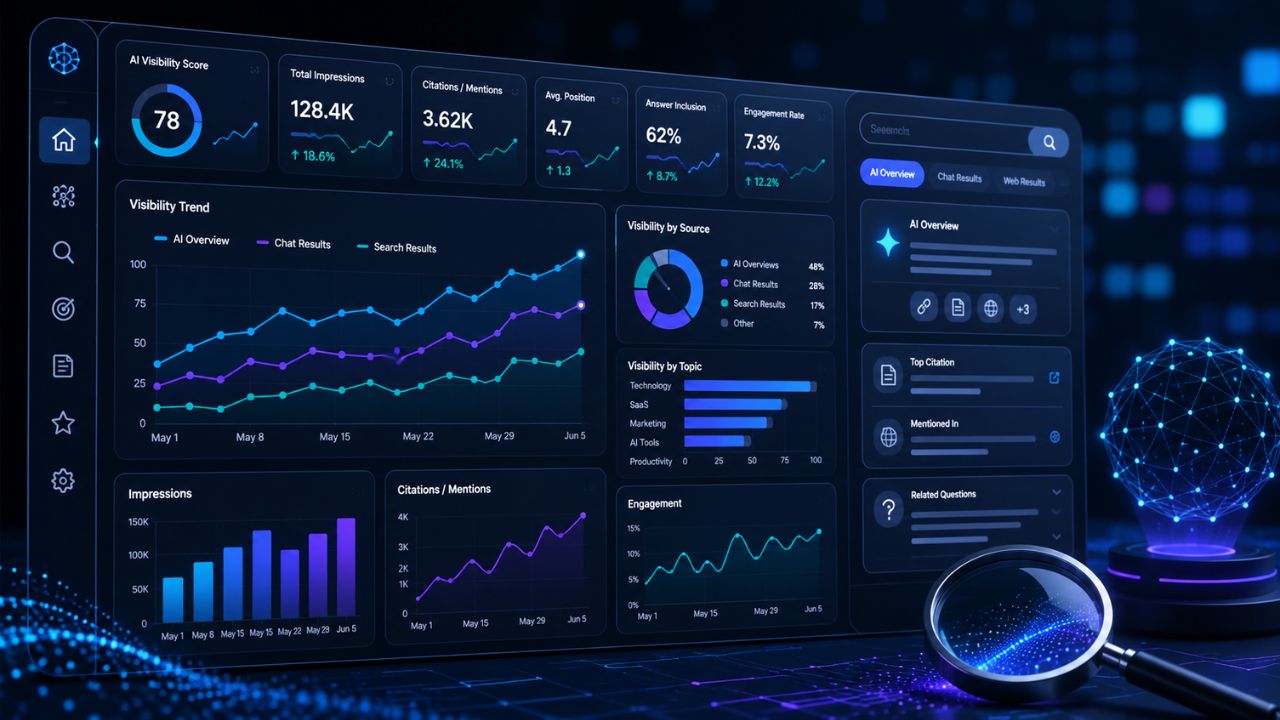
Your brand shows up in ChatGPT, Perplexity, and Google AI Overviews every day. Most teams have no idea how often or where. That blind spot is expensive. People discover your content through AI tools, then search Google for your name or type your URL straight into their browser. Google Analytics shows nothing. Your competitors track this. You don’t.
Your visibility in AI responses drives real traffic and revenue. Yet most teams measure only clicks from traditional search engines. They ignore brand mentions in AI answers, citation frequency, share of voice across AI platforms, and sentiment. These are the metrics that reveal how AI systems present your brand to millions of users.
The good news? You can measure all of it.
This guide to AI search visibility walks you through 7 concrete steps. You’ll learn which KPIs matter most, how to build dashboards with Google Analytics and Google Search Console, how to track brand mentions across ChatGPT and Perplexity, and how to watch competitor strategies. We’ll show you exactly where your brand ranks in AI responses and how that traffic converts, so you can stop guessing and start measuring.
Core AI Search Visibility KPIs
The AI search metrics that matter most track how often platforms like ChatGPT and Perplexity AI mention your brand or cite your content in their responses. These KPIs measure your AI presence across generative engines and help you connect AI visibility to revenue through AI referral traffic quality and citation frequency.
Five core metrics deserve your attention. Let’s break down each one.
Share of Voice (SOV) tracks how often your brand appears in AI-generated answers compared to competitors. It reports brand mentions as a single number, giving you a clear read on your authority across AI platforms.
Several tools measure SOV across multiple engines, including Google AI Mode, ChatGPT, Perplexity, and Gemini:
- Semrush’s AI Visibility Toolkit, which shows which platforms contribute most to your presence in generative search results
- Athena HQ, which benchmarks your brand against rivals in AI outputs
- Peec AI, which tracks visibility through prompt-based testing
A lower SOV than your competitors signals content gaps. It shows you exactly where your brand loses visibility to rivals, which makes SOV a key top-of-funnel KPI for brand discovery in AI answers.
Semrush’s Competitor Research tool lets you benchmark your brand against up to 4 competitors in one analysis. The “WEAK” label flags topics where competitors earn more mentions than you do, pointing to specific opportunities for content optimization.
Tracking SOV connects your AI visibility work to your broader search optimization efforts. It also shows you how AI models rank your content against everyone else in your market.
Citation Frequency and Prominence
Citation frequency tracks how often AI platforms cite your website across responses. This metric signals trust and authority in the eyes of large language models. Aleyda Solis confirms that testing 10 responses per entity gives accurate citation comparisons.
Your citation share grows when your domain appears more often than competitors for the same prompts. Tools like Semrush reveal which specific URLs earn the most citations, and expanding each cited page shows the exact prompts tied to those mentions. That data tells you which content resonates with AI crawlers and search engines.
Position matters as much as frequency. Appearing first in an AI answer earns far more exposure than lower placements, and prominent positioning marks your source as the primary authority on a topic.
Cited-source analysis reveals which third-party domains appear alongside yours, showing your competitive standing. You calculate citation share by comparing your domain’s mentions to competitors using the same prompt set.
Long-term citation share growth means real progress in AI search optimization. Tracking it through your AI KPI dashboard turns AI referral traffic from invisible data into measurable business outcomes.
Sentiment and Accuracy Analysis
Sentiment and accuracy analysis tracks how AI platforms represent your brand. It tells you whether AI systems show your brand positively, neutrally, or negatively, and whether the information they share is even correct.
Tools like Profound and Otterly AI monitor these factors across generative AI search engines. A single inaccurate answer damages brand trust fast, so catching problems early matters.
The stakes are higher than most teams realize. According to a Pew Research Center survey of over 5,000 U.S. adults conducted in February 2026, only 29% of AI chatbot users say they have “a lot” or “some” trust in the information chatbots provide. Roughly seven in ten users already doubt what they read, so a wrong or negative answer about your brand lands on a skeptical audience.
Negative results from fake reviews or outdated data can hurt your reputation. The upside: fixing these issues improves sentiment quickly. Track sentiment alongside mention count so you measure the quality of citations, not just the volume.
Sentiment and accuracy belong in your executive reports because they translate directly to business outcomes. Visibility means nothing if AI presents your brand poorly. Strong sentiment paired with accurate information builds credibility, drives AI referral traffic, and strengthens your position in AI-driven search.
Prompt Coverage
Prompt coverage tracks how often your brand, content, or products appear in AI responses across different search queries. You measure it by testing a fixed set of prompts throughout your reporting period, which keeps your data consistent and stops you from overreporting results.
A sample of 10 responses gives you solid data for comparing your ranking against competitors. Semrush’s Prompt Tracking tool shows gains and declines for specific queries, while the Topics & Prompts report reveals which subjects earn the most brand mentions across AI engines.
Group your prompts into categories by topic, funnel stage, and customer segment. Grouped data produces clearer patterns than tracking individual prompts alone. Test multiple variations, including long-tail queries, to get the full picture of your AI visibility efforts.
Lower prompt coverage than competitors signals content gaps and missed chances to appear in AI responses. Platforms like Promptwatch and Peec AI automate this tracking across AI queries, so you capture branded search mentions without manual work each time.
Source Attribution Traffic
LLM traffic often gets lost in your analytics. Users discover your brand through AI, then search for it directly or type your URL into their browser. That hidden path means the AI connection never shows up in your reports.
Help has arrived here. As Search Engine Journal reported when Google rolled out the update in May 2026, Google Analytics 4 now includes a native “AI Assistant” default channel that automatically classifies sessions from recognized AI referrers like ChatGPT, Gemini, and Claude. The rollout finished by June 7, 2026, though it is not retroactive. Check whether your GA4 property already shows this channel before building manual regex filters, since much of that setup may now be unnecessary.
Self-reported attribution works too. Asking your audience how they found you catches influence from every discovery channel, including LLMs. Tools like Tally let users specify the exact queries they used to find your brand, capturing AI-driven referrals that standard tracking misses.
Growth in AI visibility usually correlates with more homepage direct traffic and higher branded search volume. Your branded search queries in Google Search Console reveal this pattern: more people search for your name after seeing it in AI responses.
Pair AI visibility metrics like mentions and citations with organic search data for a complete attribution picture. Most attribution models only capture the last channel, traditional search, which skews your reporting. Tracking AI citations and search experience metrics together shows the true impact of AI visibility on your strategy and revenue.
How Do You Measure AI Search Visibility?
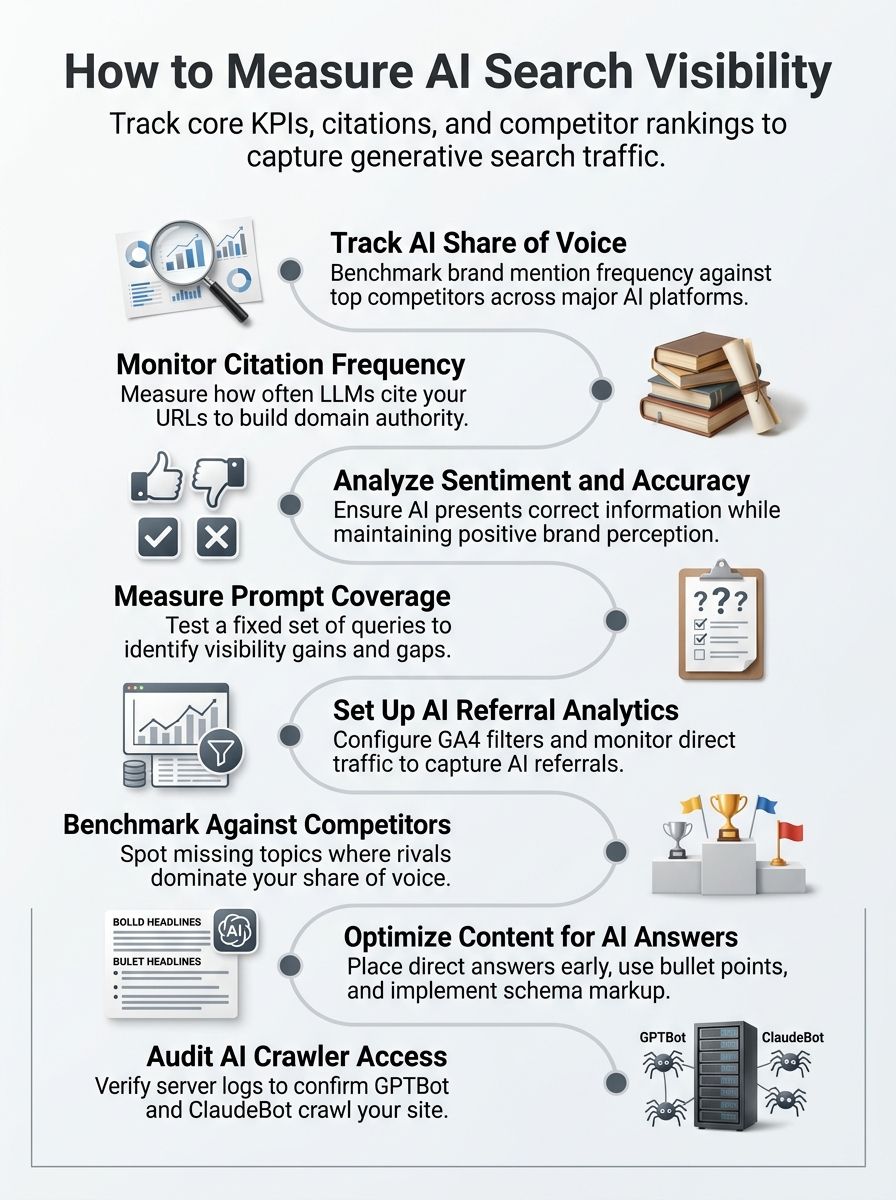
You measure AI search visibility by tracking how often AI systems cite your content and where your brand appears in AI responses. Building an AI KPI dashboard, watching prompt-level visibility, and monitoring competitor strategies shows you your real position in this new search landscape.
Setting up an AI KPI Dashboard
AI visibility dashboards track mentions, citations, and traffic from artificial intelligence platforms in one place. Semrush’s AI Visibility Toolkit provides a filtered dashboard showing platform-specific data, country distribution, and prompt-level trends, which helps you focus on the metrics that matter most for your AI search strategy.
- Choose a dashboard platform that separates AI visibility metrics from organic search traffic, so your web analytics and reporting on AI search performance stay clean.
- Filter your dashboard by platform, country, and time period to track AI referral traffic across different generative AI systems with accuracy.
- Configure prompt tracking to see which prompts mention your brand, where you rank against competitors, and which prompts you’re missing entirely.
- Set up 5 to 10 fixed prompts for consistent reporting. This prevents overreporting and gives you reliable KPIs over time.
- Connect your web crawler data to see how AI platforms cite your content, including source attribution traffic and whether AI Overviews reference your pages.
- Track citation frequency and prominence across logged-in and logged-out AI accounts, since responses differ between these states.
- Integrate sentiment and accuracy analysis tools to measure how AI systems present your information. This connects AI visibility to revenue by showing brand perception quality.
- Use tools like Athena, Peec, or Promptwatch to automate brand mention tracking across multiple AI platforms without daily manual work.
- Set baseline measurements for your AI share of voice before changing your content strategy. Baselines prove whether your work actually moves search engine results page performance.
Tracking AI Mentions and Citations
Tracking brand mentions across AI platforms reveals how often AI systems cite your content. You need concrete data to connect AI visibility to revenue and measure your return on investment.
First, confirm that AI bots can actually reach your content before launching any prompt tracking campaign.
- Use Semrush’s AI Visibility Toolkit to monitor 239 million prompts and responses across different LLMs, capturing mentions and citations across major AI search engines.
- Run custom prompts through AI Peekaboo to test how often your brand appears in AI-generated answers.
- Check crawler logs with Promptwatch to confirm that AI systems like OpenAI’s GPTBot and Anthropic’s ClaudeBot access your content regularly.
- Access server logs through your hosting provider to verify AI crawler activity and track citation potential.
- Monitor the CITED SOURCES section in Semrush to find external domains mentioned alongside your brand, then use that list for targeted outreach.
- Track brand mentions with Otterly AI to measure visibility across AI environments and watch sentiment around your citations.
- Set up alerts in Promptwatch to catch real-time signals when AI platforms cite your sources.
- Compare your citation frequency against competitors using Athena HQ to measure your share of voice and spot gaps.
- Document which prompts trigger your content in AI responses so you can improve prompt coverage and AI referral traffic.
- Check whether AI platforms credit your brand correctly, and adjust your content strategy when accuracy slips.
Measuring Prompt-Level Visibility
Prompt-level visibility shows you exactly where your content appears in AI responses. It tracks which specific prompts mention your brand, how often you show up, and where you lose ground to competitors.
- Monitor top prompts in Semrush’s Topics & Prompts report to see which queries drive your visibility gains across LLMs and AI search engines.
- Track 10 responses per prompt as your sample size. That gives you accurate estimates without checking every response.
- Flag prompts marked “MISSING” in Semrush reports. These are topics where competitors get cited and you don’t appear at all.
- Compare your performance against up to 4 competitors directly in the Topics & Prompts report.
- Expand specific topics in Semrush to see exact prompts, response data, and your citation frequency within each one.
- Include long-tail queries and broad prompt variations so you capture visibility across different search patterns.
- Test tools like Peec AI and Promptwatch for prompt-based tracking. They measure prompt-level visibility with accuracy beyond standard analytics platforms.
- Watch for declining prompt performance. Drops signal where you’re losing source attribution traffic to rivals.
- Document visibility gains and losses month over month to see which prompts drive actual referrals.
- Note which prompts surface your content in Google AI Overviews. This reveals your branded search traffic and broader AI search visibility.
Monitoring Competitor AI Visibility
Tracking competitors’ AI presence shows you where they rank across Google AI Overviews, ChatGPT, Perplexity, and Gemini. This data guides your strategy and reveals gaps you can fill.
- Use Semrush’s Share of Voice by Platform report to compare your brand against up to 4 competitors across all major AI platforms at once.
- Enter your domain into the Competitor Research tool and select 4 rival domains for detailed benchmarking data.
- Check the Topics and Prompts report to spot topics where competitors earn more mentions or control the narrative you need to own.
- Look for “WEAK” and “MISSING” labels in your dashboard. They show exactly where your brand lags in AI-generated answers.
- Analyze citation share metrics to see how often your domain gets cited compared to rivals.
- Review the cited pages dashboard to find your top URLs in AI responses, then compare them against competitor pages that rank higher.
- Study cited sources analysis to find third-party domains frequently mentioned with competitors, then target those domains for backlink outreach.
- Create fresh content around underrepresented topics your analysis reveals, which lifts your AI share of voice in those areas.
- Watch how competitors connect AI visibility to revenue by tracking their citation frequency and prominence.
- Review shifts in competitor strategies monthly. AI search changes fast, and regular tracking keeps you ahead.
Common Mistakes in AI Search Visibility Metrics KPIs
Most teams lean too hard on click-based metrics and miss how AI systems cite and amplify their content. Three mistakes come up again and again, and each one has a fix.
Overemphasis on Click-Based Metrics
Click-based metrics like traffic and referrals fail to capture AI search visibility. AI users rarely click links from ChatGPT, Google’s AI Overviews, or similar platforms. When ChatGPT recommends products like CRM software, responses often lack direct links entirely, so AI search engines never receive credit for the traffic they influence.

Your Google Analytics dashboard misses this impact because traditional click-referrer analytics cannot track AI-generated answers. The scale of the problem is now measurable. According to a 2026 Seer Interactive study analyzing 3,119 informational queries across 42 organizations, organic click-through rates fell 61% on queries where a Google AI Overview appears (from roughly 1.76% to 0.61%) between mid-2024 and late 2025, while paid CTR on those same queries dropped 68%.
In other words, clicks are collapsing even where visibility is growing.
Brands gain real value from AI visibility without seeing matching site traffic. Your homepage conversion rates may spike alongside AI visibility while referral sources stay unclear. Attribution models capture only the last-click channel, ignoring AI’s role in discovery and early-stage awareness.
Keep measuring AI referral traffic, but know that traffic alone tells an incomplete story. Track citation frequency, sentiment analysis, and source attribution too. These search metrics reveal how AI shapes customer decisions long before anyone clicks.
Ignoring Qualitative Metrics
Many teams track only numbers like mention counts and visibility percentages, missing how AI search actually affects their brand. Sentiment analysis of AI-generated answers reveals reputation issues that raw counts cannot show.
Tools like Profound and Otterly AI capture what traditional SEO metrics ignore: the tone and accuracy of your mentions in AI responses. Negative sentiment in AI results spreads fast, and brands that skip this step leave misleading content unaddressed.
Pairing sentiment accuracy with mention counts gives you real insight into AI search impact. Qualitative metrics matter for executive reports because they show brand perception shifts driven by AI.
Inaccuracies in AI answers erode trust quickly. Watching both what AI says about you and how it says it protects your reputation from damage you could have prevented.
Failing to Monitor Competitor Strategies
Your competitors shape the AI search landscape, and ignoring their strategies leaves you blind to critical gaps. Tools like Semrush’s Competitor Research let you benchmark against up to four rivals and expose where your brand falls short in AI-generated answers.
The “MISSING” and “WEAK” indicators reveal topics where competitors dominate your share of voice in AI overviews. This data shows you three things:
- Which domains get cited more often than yours
- Which prompts favor competitor content
- Which third-party sources amplify their visibility over yours
Competitive gaps demand action, not observation. Find underrepresented topics through competitor analysis, then build content around those areas to close your citation frequency deficit. Watch cited sources to see which external websites boost your rivals’ AI referrals and prompt coverage.
Skip this step and you miss chances to strengthen topic authority and connect AI visibility to revenue growth. Your competitors won’t wait for you to catch up.
Final Words
Measuring AI search visibility shapes how brands compete in the future of search. You track brand mentions, citation frequency, and share of voice across platforms like ChatGPT and Perplexity to see where your content appears.
Dashboards, competitor monitoring, and sentiment analysis reveal what works and what needs fixing. Start shaping your content for AI responses today. Use structured data well, and watch your visibility grow across the AI systems that matter most.