Many B2B buyers scroll past traditional marketing, delaying decisions and pushing deals into subsequent quarters. This stagnation highlights a deep trust and clarity deficit. Implementing authentic storytelling in B2B marketing bridges this gap, transforming complex corporate offerings into trusted solutions.
With over 60% of modern B2B buyers preferring a rep-free purchasing journey, an organizational narrative must perform heavy lifting early in the sales cycle. Research shows high-quality thought leadership prompts 75% of decision-makers to investigate unconsidered vendors.
Leveraging emotional connections, robust social proof, and clear customer success stories effectively addresses this digital self-serve shift. This structured approach directly ensures that intricate enterprise offers become significantly easier to comprehend, trust, and ultimately purchase long before the initial sales call ever occurs.
The Importance of Authentic Storytelling in B2B Marketing
Authentic storytelling matters because B2B deals are still human deals. A committee may review pricing, specs, security, and ROI, but people still need to feel confident that your team understands their risk, their pressure, and their goals.
Humanizing the Brand
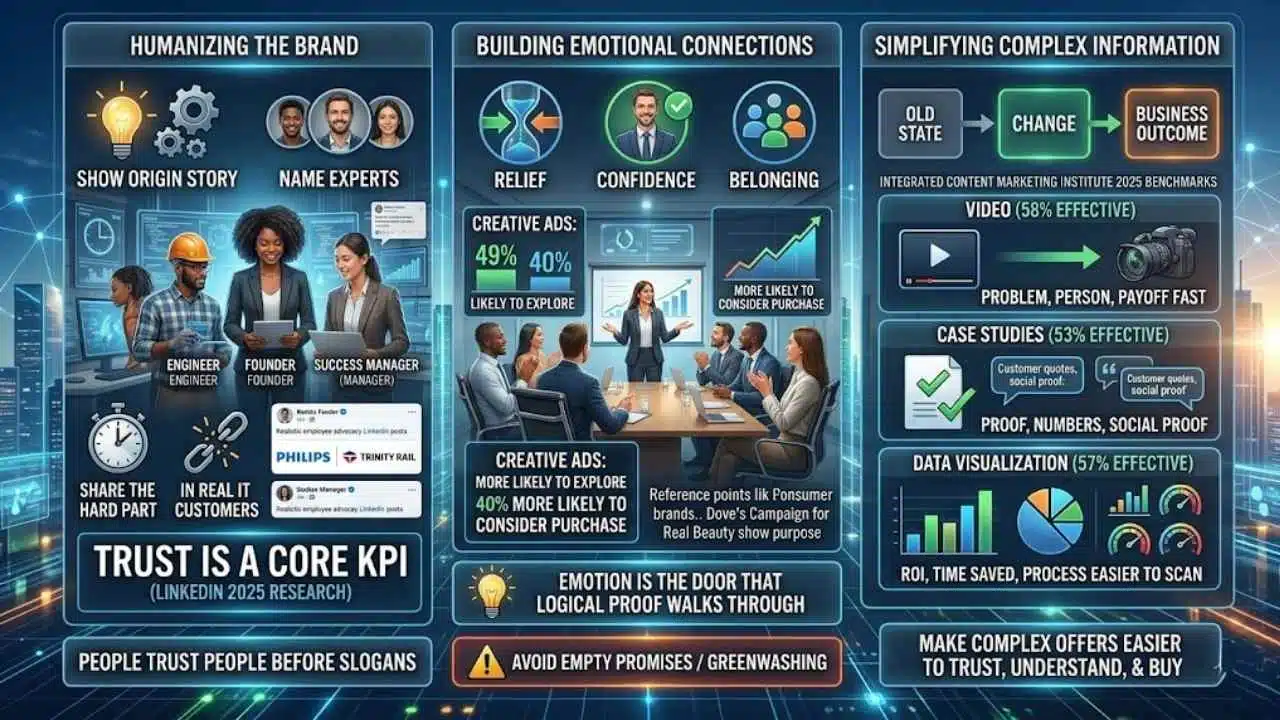
Humanizing the brand means showing the people, choices, and trade-offs behind the solution. Instead of leading with a product sheet, start with the real problem your team set out to solve and the people who do that work every day, whether that is a founder, an engineer, a customer success lead, or an operations manager.
LinkedIn’s 2025 B2B benchmark research keeps returning to one idea: trust is now a core KPI. That is why brands that put real humans on screen, or in the post copy itself, often feel more credible than polished copy that sounds like it came from a committee.
- Show the origin story: What friction or gap led your company to build this product?
- Name the experts: Let buyers hear from the engineer, analyst, or success manager who solves the problem.
- Share the hard part: A missed launch, a product change, or a lesson learned makes the story believable.
- Ground it in real customers: If you serve enterprise names like Philips or industrial operators like TrinityRail, explain what changed for them in daily work, not just in a slide.
A real story beats a polished pitch every time, because buyers trust people before they trust slogans.
Employee advocacy helps here too. A short LinkedIn post from a solutions engineer, a founder note about a product decision, or a customer success manager explaining a rollout challenge gives your brand a face, and that makes audience engagement easier to earn.
Building Emotional Connections
Emotional connections are easy to dismiss in B2B, but they shape purchasing decisions all the time. Buyers want relief from chaos, confidence in the vendor, and proof that they will not look careless in front of peers, finance, procurement, or leadership.
LinkedIn’s current research on creative performance shows why this matters: 49% of B2B decision-makers say they are more likely to explore a company if its advertising is creative, and 40% say creative ads make them more likely to consider a purchase. Emotion is not fluff here, it is often the door that logical proof walks through.
That is why famous consumer examples like Patagonia, Dove’s Campaign for Real Beauty, Nike, Apple, and Ben & Jerry’s still teach B2B teams something useful. They lead with brand purpose and values, then back that up with a consistent point of view. In B2B, the emotional version of that might be reliability, transparency, safer implementation, or less pressure on a stretched team.
- Relief: Show what life looks like after the bottleneck is gone.
- Confidence: Show why the buyer can defend the decision internally.
- Belonging: Show that your brand understands the buyer’s culture and priorities.
- Caution: Avoid greenwashing or empty value claims, because one exaggerated promise can undo months of brand loyalty building.
If you want stronger customer loyalty, your story should make buyers feel seen first, then informed.
Simplifying Complex Information
Storytelling also makes hard information easier to absorb. A before-and-after arc turns a crowded dashboard, technical workflow, or long implementation plan into something a busy reader can scan and explain to someone else.
A good rule is simple: show the old state, show the change, then show the business outcome. That is the Google-style clarity many teams need, one clear promise, one proof point, and one next step.
The Content Marketing Institute’s 2025 B2B benchmarks help explain why visual storytelling works so well. Marketers rated video as the most effective content type at 58%, followed by case studies and customer success stories at 53%, while 57% said they use data visualizations or other visual content in their mix.
| Format | Recent signal | How to use it in your story |
|---|---|---|
| Video | 58% of B2B marketers rated it most effective | Show the problem, the person, and the payoff fast |
| Case studies and customer success stories | 53% rated them most effective, and 75% said they use them | Give buying committees proof, numbers, and social proof |
| Data visualization | 57% said they use charts, infographics, or similar visuals | Make ROI, time saved, and process change easier to scan |
If your product is technical, do not fight complexity with more complexity. Use scenes, screenshots, timelines, short captions, and one or two strong numbers so the story carries the meaning.
Key Benefits of Authentic Storytelling
When authentic storytelling is done well, it does three jobs at once. It makes your marketing strategy more credible, helps your content get remembered, and gives sales teams a message that sounds human instead of rehearsed.
Builds Trust and Credibility
Trust grows when buyers see both the promise and the proof. That means showing the challenge, the friction, the timeline, and the measurable result, not just the celebratory headline.
Salesforce’s 2024 connected customer research showed that business buyers rank fair pricing and value, consistent quality, and strong data protection among the biggest trust builders. That is a helpful reminder that credibility in B2B is practical. Buyers want honesty about what they get, how long it takes, and what could go wrong.
Tell both sides, the win and the work.
Case studies, CRM records from Salesforce or HubSpot, product usage trends, and Google Analytics snapshots all help back up your claims. Even better, they help your customer success stories sound less like promotion and more like evidence.
If your offer has trade-offs, say so. A buyer is more likely to trust a story that admits the setup time, training lift, or budget line before showing the gain.
Enhances Customer Engagement
Stories hold attention because they give the reader a reason to keep going. A feature list answers what your tool does. A story answers why the reader should care right now.
In the 2024 LinkedIn and Edelman report, 55% of buyers said they move on if thought leadership does not grab their interest in the first minute, and 56% said they often save content to revisit later but never come back to it. That means your opening needs tension, relevance, and a clear payoff fast.
- Open with the buyer’s real pressure: missed revenue, slow reporting, risk, churn, or manual work.
- Add one decision-driving number early: hours saved, cycle time cut, or conversion lift.
- Use a real voice: a customer quote or a short employee insight is more memorable than generic brand copy.
- End with a clear next step: book the demo, download the case study, or share the story with procurement.
Video makes this easier. LinkedIn reports that video viewing on the platform has grown 36% year over year, and video creation is growing at twice the rate of other original post formats. If you want more audience engagement, a short customer clip or founder video usually does more than another static claim card.
Differentiates the Brand
In crowded categories, plenty of products sound similar. Authenticity is what gives your brand shape.
The LinkedIn B2B Institute’s 95-5 rule is useful here: only around 5% of category buyers are in market at a given time, while the other 95% are out of market. Storytelling helps you stay memorable with that much larger group, so your brand feels familiar when the buying window finally opens.
A values-driven story also helps buyers explain why you are different in a room where everyone claims speed, service, innovation, and ROI. If your narrative structure shows a distinct belief, a distinct method, and a distinct customer outcome, you stop sounding interchangeable.
| Weak positioning | Story-led positioning | What the buyer hears |
|---|---|---|
| “We offer advanced automation.” | “We help revenue teams cut manual reporting and give leadership a cleaner weekly view.” | This team understands the actual work. |
| “We have best-in-class support.” | “Your customer success manager joins implementation and owns adoption through the first milestone.” | This team reduces rollout risk. |
| “We drive transformation.” | “We replaced a three-day approval loop with a same-day workflow and visible audit trail.” | This change is concrete and measurable. |
Elements of Effective B2B Storytelling
Good storytelling in B2B is not theater. It is a disciplined way to turn a buyer journey into a clear, credible narrative that sales, marketing, and customer success can all use.
A Clear “Before and After” Transformation
The strongest customer success stories make change easy to picture. Before the solution, something was slow, risky, expensive, or frustrating. After the solution, the work feels cleaner, faster, safer, or more profitable.
That is why procurement teams and finance reviewers respond well to concrete transformations. They can quickly see the cost of the old way and the value of the new one.
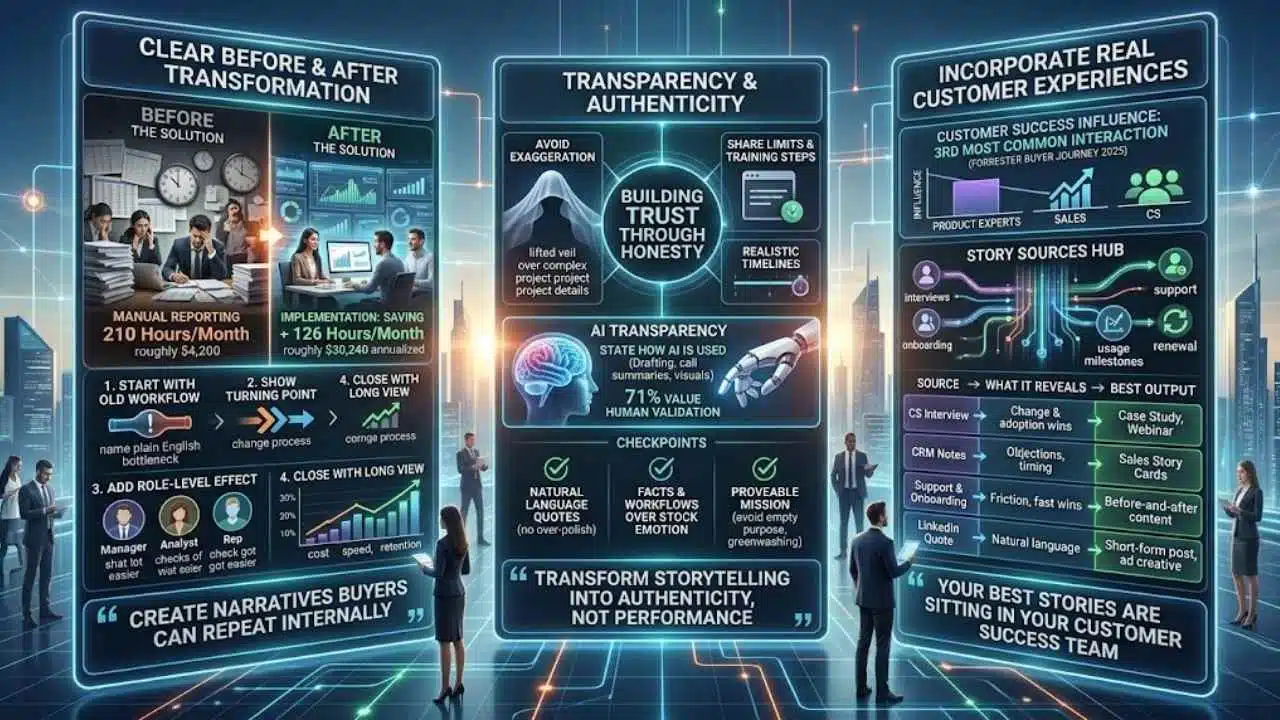
One retail operations example shows how powerful that can be. Before the change, manual reporting absorbed about 210 hours each month, or roughly $4,200 in labor at $20 per hour. After the solution was implemented, reporting time fell by 60%, saving 126 hours monthly, or about $2,520 in labor. Annualized, that reached roughly $30,240, which gave reviewers a clear financial outcome tied to a clear human pain point.
- Start with the old workflow: name the bottleneck in plain English.
- Show the turning point: what changed in the process, not just in the software.
- Add one role-level effect: what got easier for the manager, analyst, rep, or operator.
- Close with the long view: cost, speed, retention, or risk reduction over time.
That structure gives your story the kind of narrative structure buyers can repeat internally.
Transparency and Authenticity
Authenticity starts where exaggeration ends. If your story hides the training period, the data cleanup step, or the limits of the product, buyers will sense the gap.
Salesforce’s 2024 research on trust and AI is useful here because it reflects a broader buyer mindset. Transparency about how AI is used was the top factor that would increase trust in AI, and 71% said it is important for a human to validate AI output. If you use AI to draft content, summarize calls, or build visuals, say what humans reviewed and where the final judgment still sits.
- Do not over-polish customer quotes: keep their language natural.
- Do not hide the timeline: buyers care how long value takes.
- Do not use stock emotion in place of facts: show the workflow, screen, or team.
- Do not claim a mission you cannot prove: this is where greenwashing and empty brand purpose statements backfire.
If a story sounds too smooth to be real, buyers will treat it like ad copy and move on.
Transparency is what turns storytelling into authenticity instead of performance.
Incorporating Real Customer Experiences
Real customer experiences carry more weight than brand claims because they answer the buyer’s quiet question: “Did this work for someone like me?”
Forrester’s 2025 buyer journey research found that customer success was the third most commonly cited personal interaction influencing B2B purchase decisions, behind only product experts and sales. That is a big clue for marketers. Your best story source is often sitting in your customer success team, not in your brand folder.
Use interviews, onboarding notes, support themes, usage milestones, and renewal conversations to find stories that sound lived-in. Then adapt them for the places buyers already spend time, LinkedIn posts, email nurtures, sales decks, webinar slides, and short videos.
| Story source | What it reveals | Best output |
|---|---|---|
| Customer success interview | Change over time and adoption wins | Case study or webinar segment |
| CRM notes | Objections, timing, and buying triggers | Sales enablement story cards |
| Support and onboarding data | Common friction and fast wins | Before-and-after content |
| LinkedIn customer quote | Natural language and social proof | Short-form post or ad creative |
How Authentic Storytelling Impacts Sales Teams
Storytelling is not just a top-of-funnel brand exercise. It changes how sales teams explain value, handle objections, and keep everyone inside the account on the same page.
Empowers Teams with Compelling Narratives
Sales reps need a story they can actually use. If marketing hands over a beautiful asset with no tension, no customer voice, and no proof number, the rep will default to features by the second slide.
Gartner’s 2024 survey found that marketing and sales typically collaborate on only 3 out of 15 commercial activities, while 90% of marketing and sales leaders said their functional priorities conflict. A shared story fixes part of that gap because it gives both teams one message, one proof line, and one buyer problem to rally around.
- For outbound: use a short before-and-after story in the first touch.
- For discovery: use a customer example to clarify the cost of inaction.
- For demos: organize the flow around the buyer’s day, not your feature menu.
- For follow-up: send one customer success story tied to the exact objection raised.
Even a simple framework can shift sales behavior. Picture an eight-week internal pilot where reps used story-led decks and day-in-the-life videos for 10 midmarket accounts under procurement review. The story-led group reached qualified opportunity in a median of 21 days versus 47 days for the control, while meeting engagement rose from 32% to 68%. The lesson is simple: give reps one believable story, and they are far more likely to use it consistently.
Bridges the Gap Between Features and Outcomes
Feature lists rarely survive committee discussion on their own. Buyers need help translating a capability into an operational result, a financial result, or a risk result.
That translation matters even more now because Gartner’s 2025 sales survey found 61% of B2B buyers prefer a rep-free buying experience. By the time a rep joins the conversation, the buyer may already have seen your website, LinkedIn content, case studies, and competitor pages. Your story has to connect the dots before the live pitch begins.
A useful sales rule is to attach every feature to one visible business change.
- Feature: automated reporting. Outcome: managers recover hours each week.
- Feature: audit trail. Outcome: compliance reviews move faster.
- Feature: role-based access. Outcome: teams reduce security risk and approval confusion.
- Feature: dashboard alerts. Outcome: teams catch revenue or service issues sooner.
Features explain the product. Stories explain the decision.
Tips for Crafting Authentic Stories in B2B Marketing
You do not need a film crew or a giant brand budget to tell better stories. You need a clear audience, one real customer problem, and proof that helps the reader make a smarter decision.
Focus on Real-World Impact
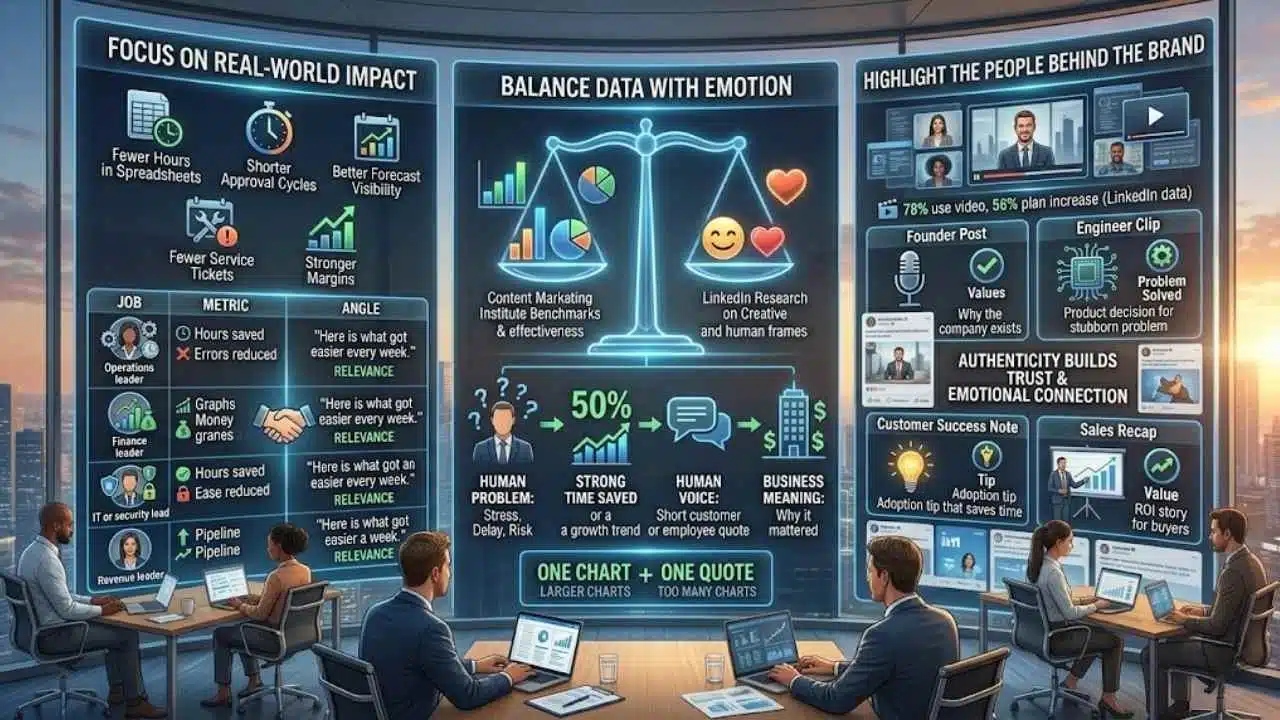
Start with a single business change your reader can recognize right away. That could be fewer hours in spreadsheets, shorter approval cycles, better forecast visibility, fewer service tickets, or stronger margins.
Then match that change to the job title reading the piece. A finance lead wants cost clarity. An operations lead wants smoother process. A sales leader wants faster movement and better win quality.
| Buyer | Metric that matters | Story angle |
|---|---|---|
| Operations leader | Hours saved, errors reduced | “Here is what got easier every week.” |
| Finance leader | Payback period, labor savings | “Here is how the numbers improved.” |
| IT or security lead | Risk reduction, control, uptime | “Here is what became safer and easier to manage.” |
| Revenue leader | Pipeline speed, close rate, adoption | “Here is how the team moved faster with more confidence.” |
That is how you turn a generic story into a relevant one.
Balance Data with Emotion
Good B2B storytelling needs proof and feeling. Too much emotion and the piece sounds vague. Too much data and the reader loses the thread.
The Content Marketing Institute’s latest benchmarks show why balance matters. Video and customer stories both rank near the top for effectiveness because they combine evidence with a human frame. LinkedIn’s research on creative also points the same way, buyers respond when the message feels human and clear, not cold and overloaded.
- Open with a human problem: stress, delay, risk, or missed visibility.
- Add one strong number: time saved, cost avoided, or revenue gained.
- Include a human voice: a short customer or employee quote.
- End with business meaning: why this mattered to the company, team, or buyer.
If you are building a slide, ad, or landing page, one chart plus one quote is often stronger than three charts and no voice.
Highlight the People Behind the Brand
Founders, engineers, consultants, customer success reps, and account managers all carry story value. Buyers want to see who they are trusting with their rollout, budget, and reputation.
LinkedIn’s 2025 benchmark series reported that 78% of B2B marketers are already using video, and 56% plan to increase that use. You do not need a glossy production to join that shift. A 30 to 60 second clip from a product expert explaining a customer pain point can feel far more authentic than a polished brand reel.
Try a simple rotation across your channels.
- Founder post: why the company exists and what it refuses to fake.
- Engineer clip: the product decision that solved a stubborn customer problem.
- Customer success note: the adoption tip that saves new customers time.
- Sales recap: the story that helped a buyer explain ROI internally.
These small human moments build authenticity, strengthen emotional connection, and give your team more raw material for brand storytelling that actually sounds true.
Final Thoughts
Authentic storytelling makes b2b marketing easier to trust and easier to act on. It gives b2b buyers a clear path from problem to proof to purchase. Pick one customer success story, add one hard number, show one real person behind the work, and turn the feature list into a before-and-after story. Do that well, and you will strengthen audience engagement, support sales, and make your brand far more memorable when the next buying cycle starts.
Frequently Asked Questions (FAQs) About Authentic Storytelling in B2B Marketing
1. What is authentic storytelling in B2B marketing?
It is using real stories from your team and customers to show value, build brand trust, and guide people through the buyer journey.
2. Why does authentic storytelling matter in B2B marketing?
Buyers pick brands they trust, plain and simple. A clear story cuts through the noise, makes complex work easy to grasp, and helps form lasting customer relationships.
3. How can I use authentic storytelling in content marketing?
Start with a short tale about a customer problem, your fix, and the result. Keep it human, let a real voice speak, skip a long sales pitch. Use that story in articles, media, and sales messages, and link it to stages of the buyer journey.
4. How do I measure the success of storytelling in B2B marketing?
Watch engagement, leads, and how content moves people from interest to action. If brand trust rises, and more deals close, you are on the right track.