

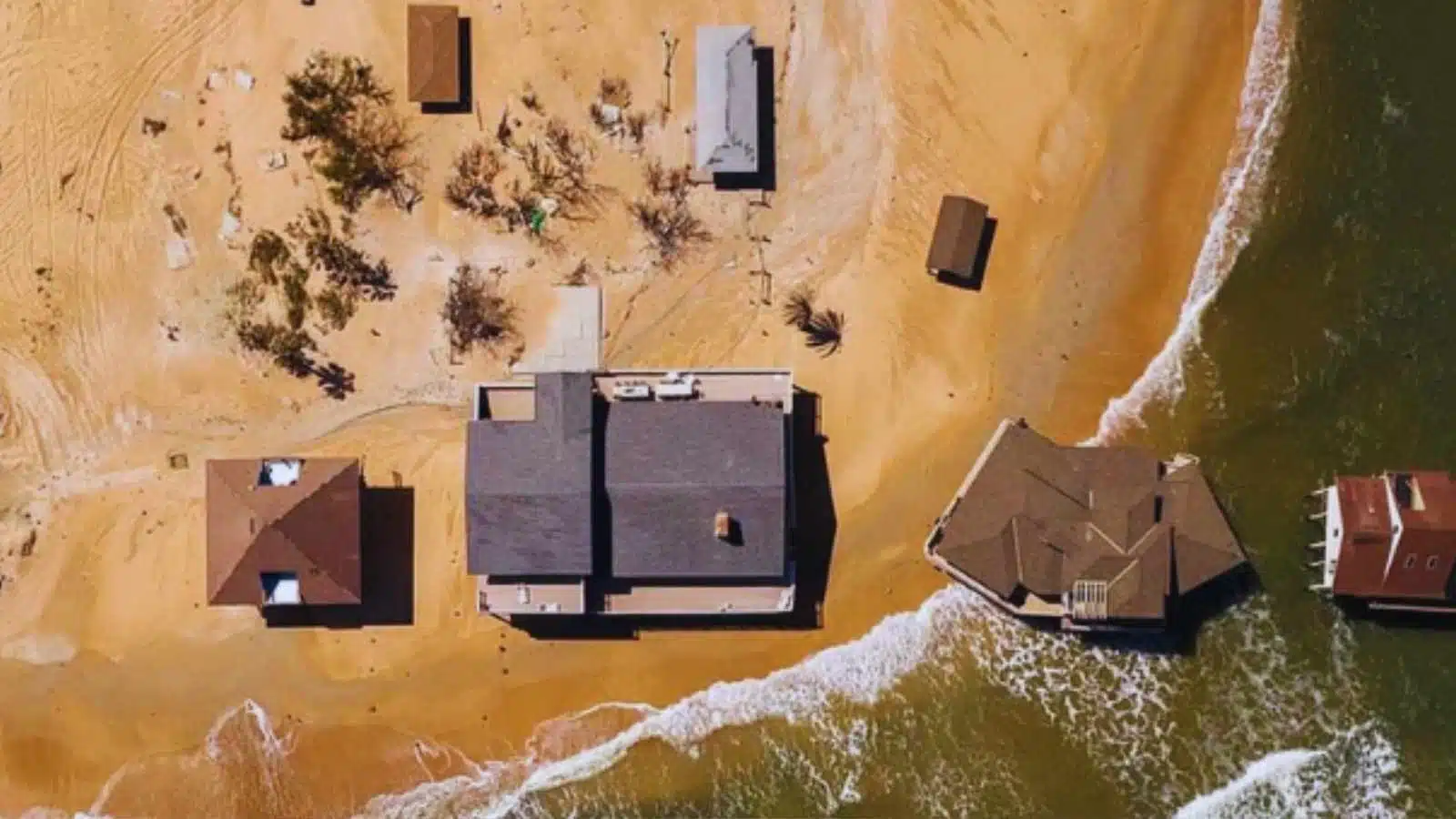
New scientific research is challenging one of the most common assumptions about sea-level rise: that the oceans rise evenly across the globe. Instead of behaving like water filling a bathtub, the world’s oceans respond to ice melt in far more complex ways. According to recent studies, Antarctica’s rapidly melting ice sheets are expected to trigger some of the most dramatic sea-level increases not near the continent itself, but thousands of miles away — particularly in the Pacific and Indian Oceans.
This surprising pattern stems from the physical laws governing gravity, Earth’s rotation, and the way the planet deforms as weight is redistributed. When Antarctica loses ice mass, its gravitational pull weakens, causing surrounding water to move away from the continent. As a result, sea levels near Antarctica may actually drop, while low-lying islands and coastal communities in regions such as the Marshall Islands, Palau, the Maldives, Sri Lanka, and even parts of the Caribbean may experience far greater increases than the global average.
A study published in late October in Nature Communications projects that by the year 2200, under a moderate emissions scenario, Antarctic melt alone could raise sea levels in affected ocean basins by as much as five feet. This would be significantly higher than the projected global mean rise of around 3.3 feet from Antarctica alone. When combined with melting from Greenland and ocean thermal expansion, the numbers become even more alarming.
Researchers warn that this uneven rise has major consequences for small island nations that have contributed little to global emissions but face the gravest risks. Densely populated coastal regions in Asia, Africa, and Central America could also see accelerated shoreline loss, more frequent flooding, and profound long-term changes to their environment and economies.
Underwater “Storms” Beneath Antarctic Ice Shelves Are Accelerating Melt at an Alarming Rate
Adding to the urgency, scientists have uncovered a previously unknown mechanism driving rapid ice loss: energetic underwater vortices, or “storms,” that form below Antarctic ice shelves. These newly identified features, known as submesoscale vortices, were documented in a November study by researchers at the University of California, Irvine and NASA’s Jet Propulsion Laboratory.
These vortices behave much like the storms we see in the atmosphere but occur deep beneath the ice, swirling with intense energy and transporting warm water upward from deeper ocean layers. This warm water then interacts with the underside of ice shelves, accelerating melting where the ice is most vulnerable. According to researchers, these underwater storms can account for nearly one-fifth of seasonal variations in Antarctic ice melt — a significant share previously unexplained by climate models.
The vortices are triggered by rapid changes in water density as ice freezes, melts, and mixes with the surrounding ocean. Their movement disrupts the stability of ice shelves, which act as natural barriers holding back the massive glaciers behind them. Once these floating shelves thin or collapse, the grounded ice upstream begins to flow more quickly into the ocean, contributing directly to global sea-level rise.
Evidence of accelerating glacier retreat is already visible. On the Antarctic Peninsula, the Hektoria Glacier underwent a dramatic collapse in late 2022, retreating roughly five miles in just two months. This is nearly ten times faster than previously documented retreat rates in that region — a sign that destabilizing processes are gaining momentum. Similar rapid retreats have been measured in parts of West Antarctica, where grounding lines, the points where glaciers lift off the land to form floating ice shelves, are retreating by up to 2,300 feet per year.
Because grounding lines play a critical role in determining how much ice enters the ocean, their retreat is among the most important warning signs for future sea-level rise. As grounding lines move inland into deeper basins, the glaciers can destabilize faster, creating the potential for runaway melt scenarios that could unfold over decades rather than centuries.
Why Distant Islands and Coasts Will Experience Higher Sea Levels Than Regions Near Antarctica
The uneven patterns of sea-level rise revealed by the research are driven by a combination of gravitational physics, Earth’s rotational shifts, and large-scale oceanographic processes. While these forces operate continuously, the rapid decline of Antarctic ice mass enhances their effects in a measurable and concerning way.
First, gravity plays a fundamental role. The Antarctic ice sheet is so massive that it pulls surrounding ocean water toward it. When this ice melts and loses mass, the gravitational pull weakens. Water that once “piled up” near the continent then redistributes itself toward the equator and mid-latitude basins. This shift contributes to sea-level decreases near Antarctica but amplifies sea-level rise in the Pacific and Indian Oceans, where many vulnerable island nations are located.
Second, the loss of ice mass affects Earth’s rotation. As the distribution of the planet’s weight changes, Earth slightly wobbles or reorients itself, similar to how a spinning top shifts when its mass changes. This subtle rotational adjustment redistributes water across the globe in a way that pushes more of it toward certain regions, again intensifying sea-level rise in places far from Antarctica.
Third, melting ice and freshwater input alter ocean circulation patterns. These changes influence how heat and salt are distributed in the ocean, which in turn affects long-term climate systems. Slowing or shifting ocean currents can cause regional changes in sea level, affecting entire coastlines differently depending on how water masses move.
Under a high-emissions scenario, the research estimates that Antarctic melt alone could add one foot to global sea levels by 2100, and nearly ten feet by 2200. But in regions affected by gravitational and rotational redistribution, actual sea-level rise could be even higher — reaching up to 14 feet in some Pacific and Atlantic locations.
Such increases would overwhelm coastal defenses, submerge entire communities, and force mass relocation. Nations such as Kiribati, Tuvalu, Jamaica, the Maldives, and Seychelles are already struggling with tidal flooding, saltwater intrusion, and erosion. The new findings suggest their long-term challenges may be far greater than previously estimated.
What These Findings Mean for the Future — and Why Adaptation Planning Must Change Now
The research underscores a critical reality: global average sea-level projections are no longer enough to guide policy. Coastal planners, governments, and climate-vulnerable nations must instead prepare for localized sea-level rise scenarios that differ dramatically from global numbers.
For island nations and low-lying regions, this means planning for the possibility that seas may rise several feet more than previously expected — even under moderate emissions conditions. This has profound implications for infrastructure planning, agricultural survival, freshwater availability, tourism, and long-term population security.
At the same time, scientists caution that projections still involve uncertainty. Ice-sheet behavior is notoriously difficult to model because it depends on complex interactions between the ocean, atmosphere, and geology beneath the ice. Small changes in melt rates, ocean temperatures, or ice-shelf stability can trigger large variations in long-term outcomes.
Despite these uncertainties, researchers agree that the overall direction is clear: Antarctic ice loss is accelerating, new melting mechanisms are being identified, and the impact on sea levels will not be evenly distributed across the world’s oceans. Reducing global emissions remains the single most important action to limit long-term sea-level rise, but adaptation efforts — from coastal defenses to community relocation strategies — must begin now.
The studies collectively create a sobering picture: as Antarctica continues to melt, the consequences will be felt most intensely in the very regions least responsible for climate change. The world’s most vulnerable coastal and island communities now face a future in which the ocean does not rise quietly or uniformly but instead reshapes entire regions with powerful, uneven force.






















