If your sprint planning feels like an archaeological dig through Slack threads, Zendesk tickets, and outdated wiki docs, you aren’t alone. For modern SaaS product teams, managing the sheer volume of inputs is often harder than building the actual product.
That’s where AI steps in. We aren’t talking about slapping a trendy chatbot onto your roadmap. The right AI stack fundamentally changes how you build, automating spec drafting, synthesizing raw feedback into thematic insights, and generating code-ready prototypes in seconds.
To help you cut through the noise, we’ve audited the landscape to highlight the 12 AI tools for SaaS product teams that actually move the needle for SaaS product managers, designers, and engineers right now.
Product Strategy and Discovery
Before writing a single line of code, modern SaaS teams use AI to validate hypotheses, quantify revenue impact, and align stakeholders around the problems most worth solving.
1. Zeda.ai
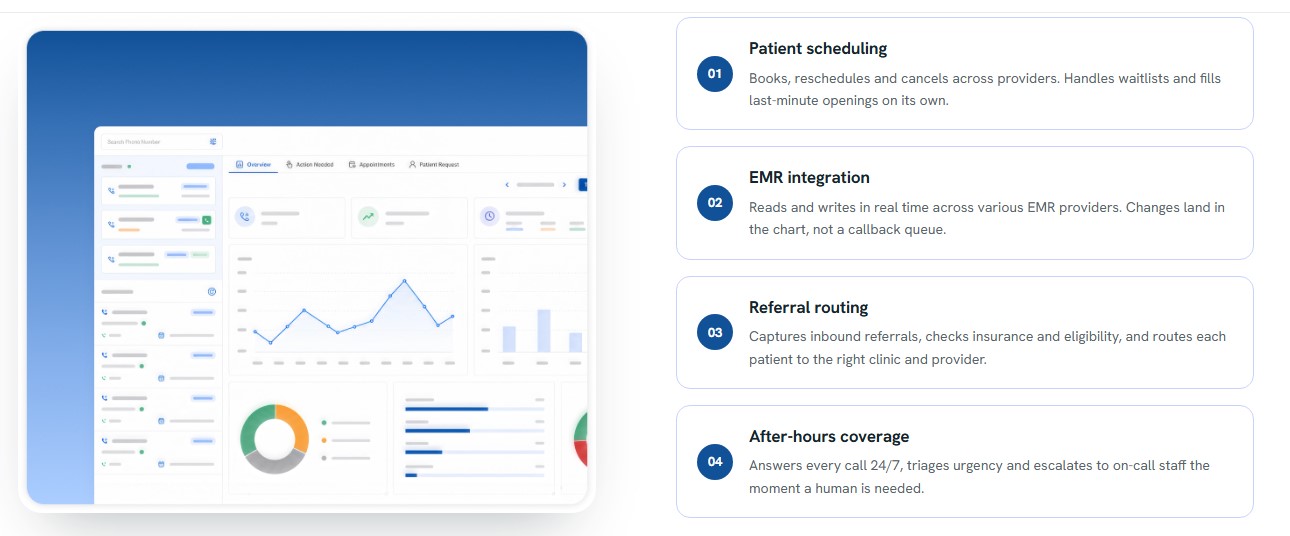
Zeda.ai takes the guesswork out of product discovery by acting as your team’s centralized intelligence layer. Instead of relying on gut feelings or the loudest enterprise customer, it aggregates data signals across your entire user base to uncover the core problems actually worth solving.
Why it stands out
Zeda’s core advantage lies in mapping revenue directly to feature requests. By connecting your CRM data with product feedback, it allows product teams to demonstrate the monetary pipeline impact of building a specific feature, aligning sales and engineering effortlessly.
2. Productboard
Already a staple in product management, Productboard’s native AI capabilities eliminate the manual grind of tagging feedback. It automatically clusters incoming customer messages, synthesizes complex feature requests, and directly links qualitative insights to your roadmap.
Where it shines
Productboard is built for teams that need rigorous prioritization frameworks. Its AI doesn’t just categorize; it helps score features against strategic objectives (like RICE or Value vs. Effort), giving PMs a mathematically sound starting point for roadmap negotiations.
Documentation and Execution
Stop spending half your workweek writing specs and summarizing sprint meetings; these tools turn rough notes into technical PRDs, structured user stories, and actionable tasks in seconds.
3. ChatPRD
Writing Product Requirements Documents (PRDs) is a notoriously massive time sink. Built specifically for product managers, ChatPRD is an AI copilot trained entirely on product management frameworks. Give it a brief contextual prompt or your messy meeting notes, and it outputs comprehensive PRDs, structured user stories, and edge-case technical specifications.
The PM Advantage
Generic AI prompts often produce overly superficial specs. ChatPRD’s core strength is its deep contextual awareness of product architecture, it anticipates technical edge cases, suggests success metrics, and formats outputs for immediate export to Jira or Linear.
4. Notion AI
Context switching kills productivity. By embedding generative AI natively into your team’s workspace, Notion AI keeps product managers in the flow. Use it to rapidly draft release notes, extract action items from chaotic sprint retrospectives, and instantly reformat messy brainstorming docs into structured sprint plans.
Key capability
Notion AI’s greatest asset is “database awareness.” It can synthesize updates across multiple project boards, allowing a PM to pull sprint blockers across engineering teams into a clean, digestible executive report in seconds.
User Research and Feedback Analysis
Ditch manual ticket tagging and endless video transcripts; leverage AI to instantly parse thousands of qualitative customer data points into clear, prioritized product insights.
5. Kraftful
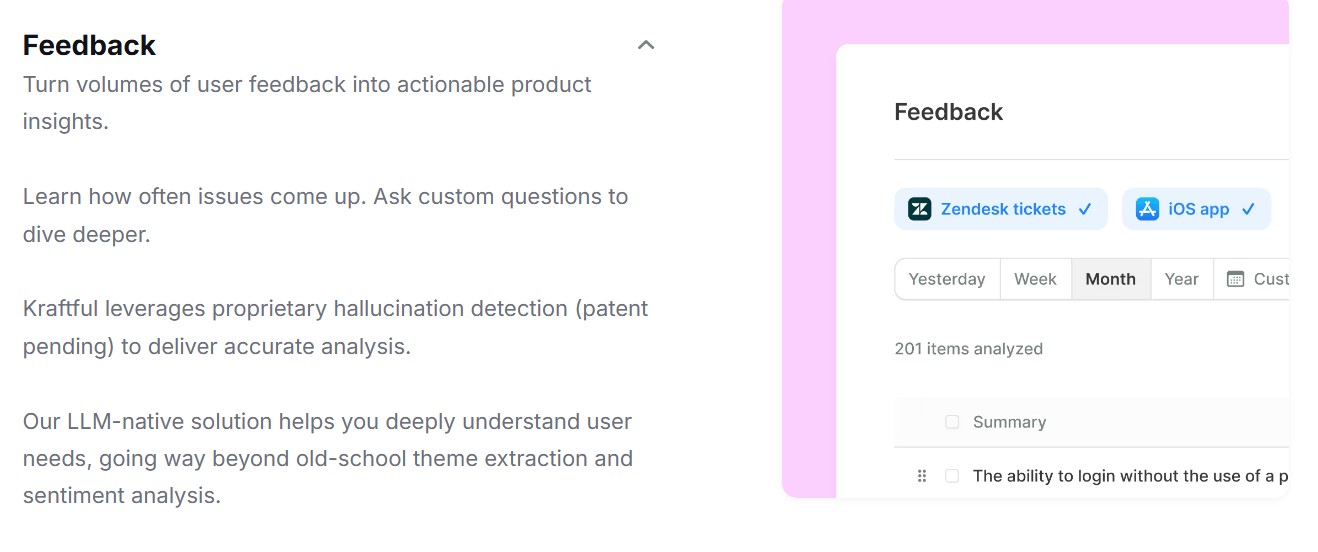
Kraftful is a lifeline for teams drowning in qualitative data. This AI copilot ingests large volumes of unstructured feedback, app store reviews, support tickets, and survey responses, and extracts actionable product insights.
The real-world impact
Kraftful acts like an always-on UX researcher. Its built-in product coach doesn’t just flag what users are complaining about, it recommends established product frameworks to solve those specific friction points, turning unstructured complaints into structured development tasks.
6. Dovetail
Think of Dovetail as your central customer intelligence hub. Its AI analyzes qualitative user research, automatically transcribing user interviews and identifying thematic patterns across dozens of conversations.
Where it shines
Dovetail has mastered the automated “highlight reel.” Instead of forcing engineers to sit through an hour-long Zoom interview recording, Dovetail’s AI clips the exact 45 seconds where multiple users stumbled over the same UI flow, making user empathy instantly scalable.
Design and Rapid Prototyping
Bridge the gap between raw concept and working software by turning natural language prompts into interactive React UI components and executive-ready pitch decks in minutes.
7. v0 by Vercel
Sometimes engineers need to see an idea before they can accurately scope it. v0 allows PMs and designers to type natural language descriptions (e.g., “A customer feedback dashboard with a dark mode toggle and filtering sidebar”) and instantly receive code-ready React interface components utilizing Tailwind CSS.
The competitive edge
v0 completely blurs the line between a design wireframe and a working MVP. Because it outputs clean, production-ready React code rather than a flat image, dev teams can wire up backend APIs directly, shrinking a multi-week design phase into a single afternoon task.
8. Canva AI (Magic Studio)
Not every product manager has a dedicated designer on standby for internal pitches or strategic planning. Canva’s Magic Studio bridges that gap, allowing PMs to quickly turn raw concepts into polished mockups, presentation decks, and visual narratives.
Why product teams love it
Product management is ultimately about storytelling and securing alignment. Canva’s generative presentation features allow PMs to turn a raw, text-based strategy document into a beautifully branded executive pitch deck in minutes.
Product Analytics and AI Observability
Move beyond static dashboards with tools that proactively flag user friction points, detect behavioral anomalies, and monitor production AI models to prevent performance drift.
9. Amplitude AI
Traditional analytics tell you what happened; figuring out why usually takes a data scientist. Amplitude AI flips this model by automatically surfacing behavioral trends and pinpointing hidden friction points in the user journey.
The strategic advantage
Amplitude AI shifts product teams from reactive querying to proactive alerts. Through automated anomaly detection, the platform flags unexpected user drop-offs or behavioral shifts before they show up on monthly retention reports.
10. Arize
If your SaaS product ships with machine learning features, AI agents, or LLM integrations, you must monitor how they perform in the wild. Arize is an enterprise-grade ML observability platform that tracks model accuracy, data drift, and output quality over time.
The core value
As SaaS platforms integrate generative features, risk management becomes critical. Arize provides real-time detection for model hallucinations, PII leaks, and performance drift, giving teams the confidence to ship AI capabilities with enterprise-grade guardrails.
Roadmapping and Task Prioritization
Keep cross-functional teams in lockstep by using AI to merge duplicate feature requests, calculate objective priority scores, and maintain direct alignment from customer feedback to shipped code.
11. Jira Product Discovery
Built to bridge the gap between discovery and delivery, Jira’s AI-assisted discovery tool streamlines the feedback-to-roadmap pipeline. It helps teams score new ideas, manage customer insights, and maintain a clear line of sight from a user’s initial request directly to the shipped code.
Why it stands out
Deep Atlassian integration is its ultimate superpower. Powered by Atlassian’s Rovo AI, teams can automatically summarize massive comment threads on Jira tickets and sync those takeaways directly into overarching product initiatives, keeping engineering and product completely aligned.
12. Aha!
A heavyweight in enterprise roadmapping, Aha! features an integrated AI assistant custom-built for product strategy. It actively helps product leaders merge redundant feature ideas, generate compelling roadmap narratives, and draft overarching strategy documents.
The enterprise advantage
Aha! is unmatched for large product portfolios. Its AI excels at multi-team governance, auditing roadmaps across multiple products to identify duplicate feature requests, conflicting timelines, or resource bottlenecks before they impact delivery.
From Tool Sprawl to True Product Velocity
AI is fundamentally rewriting the playbook for how SaaS products are built. It moves teams away from the manual grind of documentation and data sorting, pushing them toward high-velocity strategy and rapid execution.
You don’t need to adopt all 12 of these tools by next quarter. The smartest approach is to identify your team’s single biggest bottleneck, whether that’s writing specs, analyzing interviews, or spinning up UI prototypes, and introduce one AI tool to solve it. Let the machines handle the heavy lifting so your team can focus on what matters: building phenomenal products that customers actually love.
Frequently Asked Questions About AI Tools for SaaS Product Teams
1. Will AI eventually replace product managers?
No. AI is phenomenal at synthesizing data, clustering feedback, and drafting the first version of a technical spec. However, it entirely lacks customer empathy, strategic nuance, and the ability to negotiate compromises with human stakeholders. AI replaces the administrative busywork, not the strategic leadership.
2. How do I choose between a specialized tool like ChatPRD and a general AI like ChatGPT?
It comes down to workflow friction. While ChatGPT is a powerful generalist, it requires extensive prompting and context-loading to generate a good PRD. Specialized tools like ChatPRD are pre-trained on industry frameworks and integrate directly with your issue trackers. If you want ready-to-ship artifacts without becoming a “prompt engineer,” go specialized.
3. Is it safe to feed customer data into these AI feedback tools?
Data privacy is paramount. Enterprise-grade AI tools typically maintain strict SOC 2 Type II compliance and utilize data processing agreements ensuring your proprietary data isn’t used to train public models. Always verify a vendor’s security architecture, especially regarding HIPAA or GDPR compliance, before uploading sensitive user interviews.
4. How does AI actually improve product analytics?
Primarily through automated anomaly detection. Instead of manually running SQL queries to figure out why retention dropped on a Tuesday, tools like Amplitude AI proactively highlight the exact user segment and behavioral friction point causing the drop. It removes the bottleneck of waiting for the data science team.
5. What is AI observability and why does my SaaS team need it?
If you build AI features into your SaaS product (like a smart assistant, a text summarizer, or a predictive algorithm), you need to monitor them post-launch. AI observability tools like Arize track if your models are delivering accurate results, if their quality is degrading over time due to unexpected user inputs, or if they are hallucinating, allowing you to fix issues before they cause customer churn.