

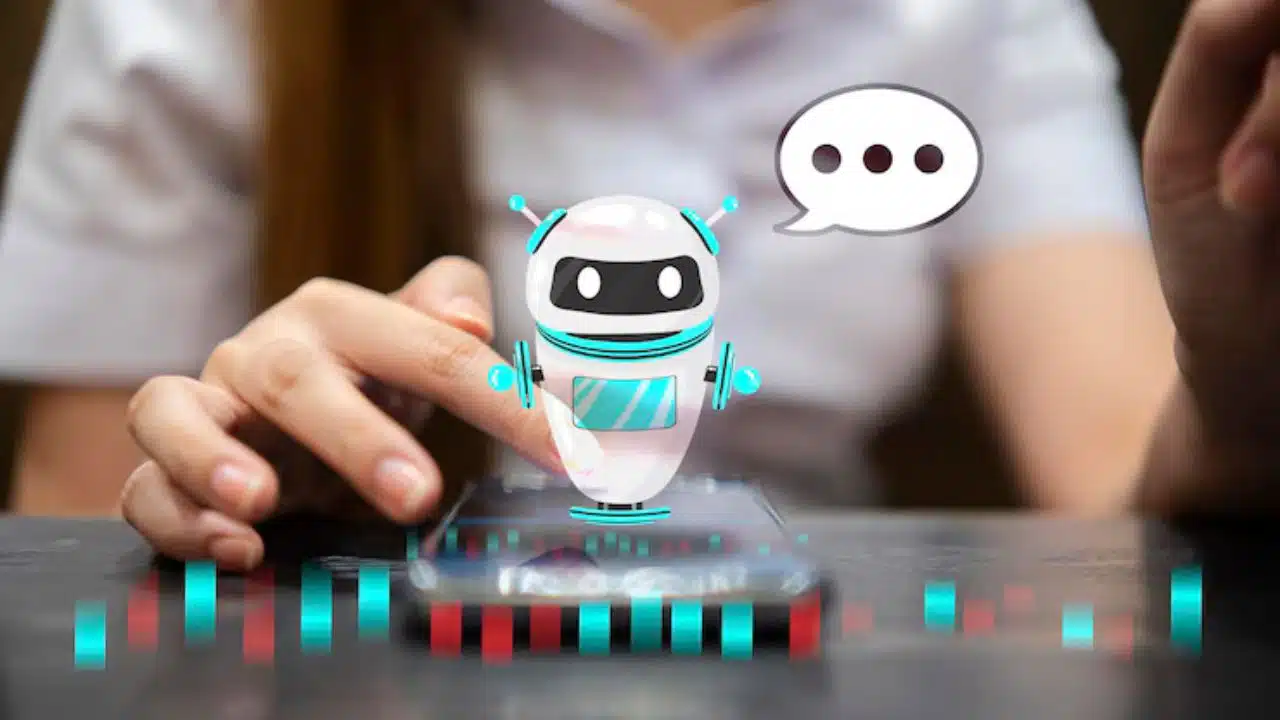
Since the early 2000s, news about introducing chatbots into work has appeared with enviable frequency. Business development is often accompanied not only by scaling the core activities but also by debugging supporting processes. Chatbots are only part of business activities within the framework of routine automation. Communication and performing simple tasks of the same type are the basis of the chatbot’s work. With its help, you can perform repetitive tasks and those that a person cannot perform, such as monitoring activity on social networks. Moreover, you can use an AI chat as a partner in a roleplay.
Basic Principles of Chatbot Functioning
The activities of chatbots are built around three main actions:
- Information is received or output through specific communication channels, such as Slack or social network conversations.
- Intent recognition is a comprehensive analysis of the information received to form a response.
- Action processing is any work done on the server side necessary to prepare the correct response. For example, if a weather forecast is requested, then a request will be made to a specific API about the weather in city N, and the results of this command will be sent to the user.
Chatbots’ main actions are combined to preserve context to create a human-like form of communication and support dialogue. The chatbot must “remember” the subject of the conversation and adapt its responses accordingly.
The issue of connecting a chatbot to social platforms is highlighted separately. Connectors to instant messengers and social networks can be implemented independently or supported within existing chatbot-creation products.
At the moment, there are many solutions offering ready-made services for automating technical support or sales processes. I will pay more attention to tools that allow you to create a service that meets the company’s internal security requirements, without complicating the development process.
Multifunctionality of Bots
The bot can handle almost any task that a person regularly solves online. It can save the user from the Outlook interface and send all letters to Telegram chat, processing them according to a specific algorithm. The same can be done with weather forecasts, table reservations, and car services. Theoretically, there are no limits to application.
For example, the company wanted to better understand what employees were doing during their working hours. This task was accomplished with the help of a Telegram bot, which tracked the location of subordinates and requested photos of their workplaces. Employees sent information to the bot, which counted working hours, and the administration controlled all this.
A chatbot can become a manager’s pocket analyst. To do this, the bot needs access to different systems to collect data, analyze it, and provide the person with already processed information. Artificial intelligence-based functionality can be integrated into a chatbot so that a person can request connected databases without using a programming language. The bot will translate the request into “machine” language, make the request itself, and answer. Such solutions have not yet become widespread, but it is a matter of time.
Chatbots are universal assistants. They can automate business processes instead of heavy-duty analysis systems or applications. It is convenient both from the point of view of usability and from the point of view of cost savings. A business only needs to pay for the work of one developer and the hosting of the bot so that it “lives” on the server.
The Art of Small Talk
Communication on a free topic is called small talk, a skill only humans possess now. However, there has long been a demand worldwide for the ability to communicate with a machine quickly. Users may want more from their smartphone than just making calls or surfing the Internet, for example, emotional intimacy. A chatbot that can talk about philosophical topics or discuss music or cinema with a person is much more attractive.
If we consider the art of communication on a free topic a separate skill, then a chatbot that can chat with a person can attract new users. It allows you to promote it on the market.
Many well-known solutions use deep neural networks that are trained on vast amounts of data. The more data, the better the neural network works—there cannot be a specific limit on the amount of data that would guarantee the quality of the system. Working with data in the process of creating any AI models is the main and challenging part. There are problems here: low-quality data that is openly accessible, a small number of datasets, and a lack of regulation in this area.
Bots for Roleplay
We have already realized that bots are often viewed from the point of view of their benefits for business. However, their ability to communicate fascinates other people. Recently, solutions have emerged that allow you to create realistic lifelike roleplay. The bot doesn’t just play a character. In fact, it is this character.
You choose one of the presented games and immerse yourself in the fascinating world of roleplaying. Your interlocutor will never leave the character. In addition, he is ready to communicate at any time, whether in the morning or late at night. Thus, the advantages of an AI companion over a real person are apparent.
Another advantage of AI is the ability to choose scenarios that suit you. The bot will happily adapt to them. You no longer need to spend hours and days searching for the right partner. Now, everything can be solved with one click of the mouse.
Conclusion
Today, chatbots are a common occurrence. They help people deal with payments for communications and the Internet, tell them how to register a car for maintenance, and resolve issues with customer service for online stores, banks, and other organizations. Increasingly, users expect systems to show humanity and emotionality towards them. It is where the skill of accessible communication on any topic comes to the rescue. Bots are already being used for AI roleplay. At the same time, users note that their interlocutor is no worse, and sometimes better, than real people. Thus, the future has already arrived.
























