

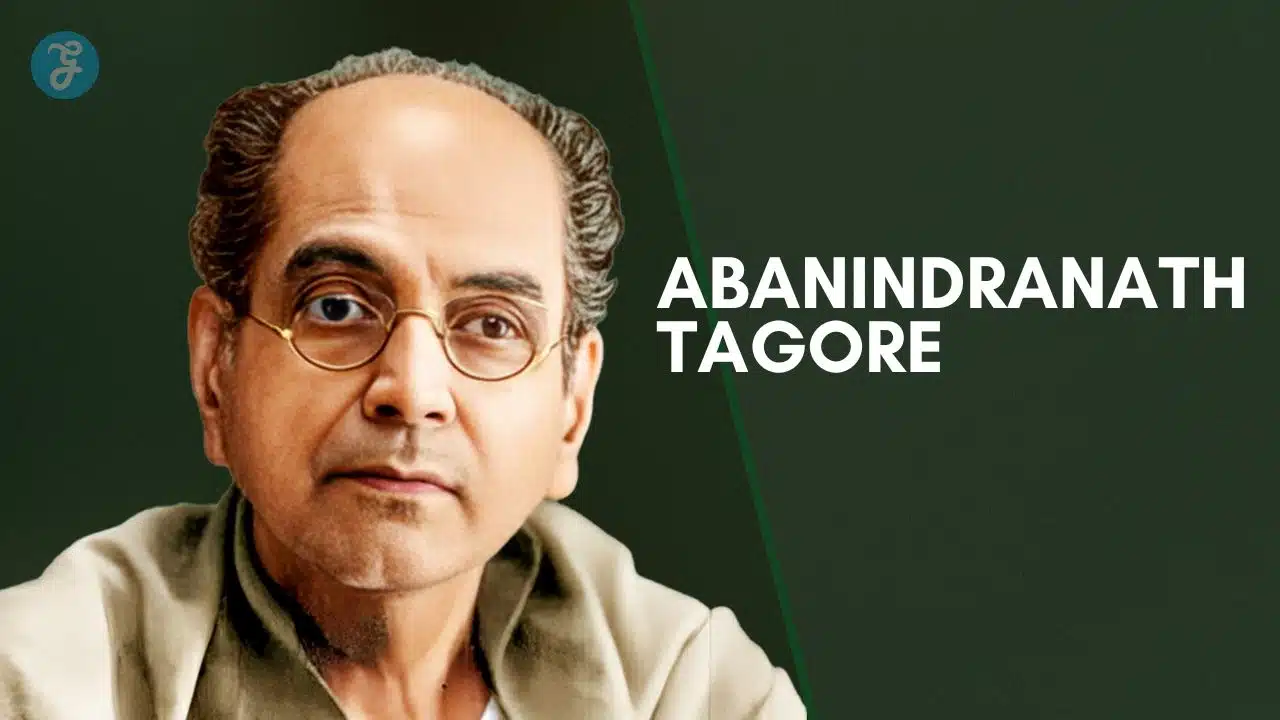
Have you ever looked at a painting and felt like it was whispering a secret history to you? That’s exactly how I felt the first time I stood in front of Abanindranath Tagore’s work. You might know him as the father of modern Indian art, but his story is about more than just brushstrokes.
He didn’t just paint; he rebelled. At a time when art schools were obsessed with European realism, Abanindranath turned the tide back to India’s roots. He asked a simple question: why copy the West when our own stories are so rich?
In this guide, I’m going to walk you through how he created the Bengal School of Art and changed the way we see ourselves. Grab a cup of tea, and let’s explore the life of the man who painted India’s soul.
Key Takeaways
- A Creative Dynasty: Abanindranath was born on August 7, 1871, at the Jorasanko Thakurbari in Calcutta. He was the nephew of Nobel laureate Rabindranath Tagore.
- The Symbol of Freedom: He painted “Bharat Mata” in 1905 during the Partition of Bengal. It wasn’t just art; it was a flag for the Swadeshi Movement.
- A New Path: Along with E.B. Havell, he founded the Bengal School of Art. They rejected the Western academic style to revive Mughal and Rajput traditions.
- The “Wash” Technique: He mastered Japanese ink techniques from Yokoyama Taikan (1902-1904), creating a signature misty style seen in the “Arabian Nights” series.
- Beyond the Canvas: He was a master storyteller for children, writing beloved Bengali classics like Khirer Putul and Buro Angla.

Early Life and Family Background
Imagine growing up in a house where poetry, music, and theater were as common as breakfast. That was the Jorasanko Thakurbari in north Calcutta. For Abanindranath, this wasn’t just a home; it was a university of culture.
His father, Gunendranath Tagore, and his uncle, Rabindranath Tagore, created an atmosphere where creativity was the air they breathed. He didn’t just learn art in a classroom; he absorbed it from the very walls of his family estate.
The Jorasanko Influence
Born into the wealthy and influential Tagore family, Abanindranath had access to the best of both worlds. His grandfather, Girindranath Tagore, was a painter, and his elder brother, Gaganendranath Tagore, later became a celebrated artist himself.
“The south verandah of Jorasanko was more than a balcony; it was the birthplace of modern Indian imagination. Here, young Abanindranath watched his family blend the best of Sanskrit heritage with Western intellect.”
This environment is crucial to understanding his work. He wasn’t fighting against Western education; he was synthesizing it. While he attended Sanskrit College for nine years, it was the informal lessons at home—watching plays, hearing folk tales, and discussing aesthetics—that truly shaped his vision.
Artistic Beginnings
You might think a master like Abanindranath started with Indian art immediately, but his training was European. This contrast is what makes his later rebellion so powerful. He knew the Western rules well enough to break them effectively.
In 1890, he enrolled at the Calcutta School of Art. Here, he learned the technical rigor of Western styles from two specific European mentors:
- O. Ghilardi: An Italian artist who taught him the delicate art of pastels.
- Charles Palmer: A British painter who trained him in oil painting and life study.
He mastered these techniques quickly. His early oils show he could paint realistic portraits just as well as any European academy student. But something was missing. The realism felt flat to him—it captured the body but missed the spirit.
The Turning Point: The Radha-Krishna Series
The shift happened when he stumbled upon a set of illuminated Irish melodies and Delhi-school miniatures. He realized that Indian art wasn’t about photographic accuracy; it was about mood and emotion.
Between 1895 and 1897, he painted the Radha-Krishna series. This was his “eureka” moment. He ditched the heavy oils for watercolors and replaced rigid anatomy with flowing, lyrical lines. This series caught the eye of E.B. Havell, the British principal of the Calcutta School of Art, who was himself looking for an Indian artist to challenge the colonial curriculum.
Bharat Mata: A Cultural Symbol
If you visit the Victoria Memorial Hall in Kolkata today, you can still see the painting that galvanized a nation. Painted in 1905, just as Lord Curzon decided to partition Bengal, “Bharat Mata” (Mother India) became an icon of resistance.
But here is a detail many people miss: Abanindranath originally titled it Banga Mata (Mother Bengal). It was Sister Nivedita, the dedicated disciple of Swami Vivekananda, who realized its power and rechristened it Bharat Mata, transforming it into a symbol for the entire country.
Decoding the Four Arms
Unlike the warrior goddesses often seen in Hindu iconography, Abanindranath’s Bharat Mata is calm and ascetic. She is dressed in saffron, like a sadhvi. The true genius lies in what she holds in her four hands. Each object represents a necessity for Indian life:

| Arm Position | Object Held | Symbolic Meaning (The Gift) |
|---|---|---|
| Upper Left | Vedas / Manuscript | Shiksha (Secular and Spiritual Knowledge) |
| Upper Right | Mala (Rosary) | Diksha (Faith and Spiritual Strength) |
| Lower Left | White Cloth | Vastra (Clothing and Industry) |
| Lower Right | Sheaf of Rice | Anna (Food and Sustenance) |
This wasn’t just a religious image; it was a political manifesto. It told the Indian people that they didn’t need to look to the British for their needs—they had their own resources, faith, and knowledge.
The Bengal School of Art
Abanindranath Tagore didn’t just paint; he built a movement. The Bengal School of Art was a direct challenge to the “Company Style” of painting and the academic realism popularized by Raja Ravi Varma. While Varma used oil paints to make Indian deities look like fleshy European figures, Abanindranath wanted to capture their ethereal spirit.
He found an unlikely ally in E.B. Havell. Together, they revolutionized art education at the Calcutta School of Art. Havell famously removed the Western paintings from the school’s gallery and replaced them with Indian miniatures, a move that caused quite a scandal at the time.
Defining the Bengal Style
So, what exactly defines this style? If you look at a painting from the Bengal School, you will notice a few distinct traits:
- Rejection of Materialism: Unlike the heavy, solid figures of Western art, these figures seem to float.
- Muted Palette: They avoided bright, garish colors in favor of soft, misty earth tones.
- Linear Grace: The focus was on the “rhythmic line,” inspired by the Ajanta murals.
This movement inspired a generation of artists, including Nandalal Bose and Asit Kumar Haldar, to look inward for inspiration. They proved that modernism didn’t have to mean westernization.
Fusion of Tradition and Modernity
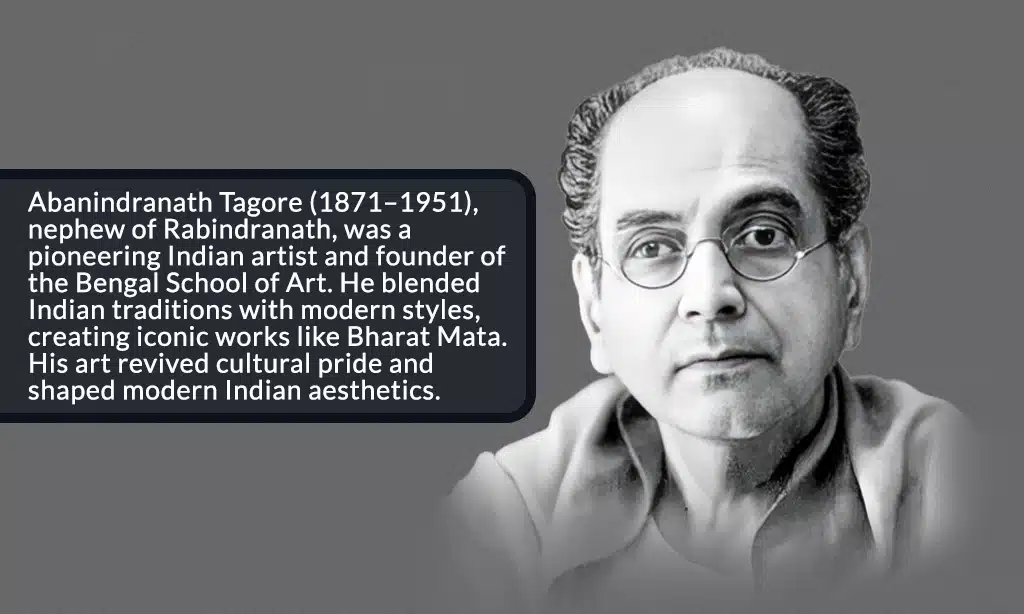
One of the most fascinating aspects of Abanindranath’s work is that while he rejected Western art, he embraced the East. He believed in a “Pan-Asian” artistic identity. This belief led to one of the most important technical innovations in Indian art history: the “wash technique.”
In the early 1900s, he met Japanese art historian Okakura Kakuzō and painters Yokoyama Taikan and Hishida Shunsō at Jorasanko. They taught him how to use ink and brush with freedom and fluidity.
The Secret of the “Wash” Technique
Abanindranath didn’t just copy the Japanese method; he modified it to create his signature dreamy effect. Here is the process he perfected, which many of his students at Kala Bhavana later adopted:
- Apply Color: He would paint a layer of transparent watercolor on the paper.
- The Dip: Unlike the Japanese, he would dip the entire paper into a trough of water.
- Wash & Dry: The water would wash away the excess pigment, leaving a soft stain. He would let it dry completely.
- Layering: He would repeat this process again and again. These multiple layers created a glowing, hazy atmosphere that gave his paintings their mystical quality.
You can see the mastery of this technique in his Arabian Nights series (1930) and The Passing of Shah Jahan (1902). The colors seem to merge into one another, creating a mood of poignant sadness and beauty.
Legacy and Notable Works
Abanindranath Tagore’s legacy isn’t just hanging in museums; it’s on the bookshelves of millions of Bengali children. He was a master storyteller who used words as skillfully as paint.
When he felt he couldn’t paint anymore, he turned to writing. His stories for children are legendary for their wit, imagination, and use of colloquial Bengali. He broke away from the stiff, formal language of the time to write the way people actually spoke.
The Master’s Library
If you want to experience his genius beyond the canvas, you should look for these titles. They remain bestsellers in Bengal today:
- Khirer Putul (The Cheese Doll): A magical fairy tale that is considered a classic of Bengali children’s literature.
- Buro Angla: A retelling of the story of Nils Holgersson, adapted seamlessly into a Bengali context.
- Rajkahini: A stirring collection of stories about the Rajput kings, illustrated by the master himself.
His influence extended to many of his students. Nandalal Bose went on to decorate the original manuscript of the Indian Constitution. Asit Kumar Haldar became the first Indian principal of the Government School of Arts and Crafts in Lucknow. Through them, Abanindranath’s vision of a self-reliant, culturally proud India lives on.
Takeaways
Abanindranath Tagore did more than just paint pictures; he painted a new identity for a nation under colonial rule. He showed us that looking backward to our roots was the only way to move forward with dignity.
From the haunting calm of Bharat Mata to the misty layers of his wash paintings, he taught India to see beauty in its own reflection. His work at the Bengal School of Art laid the foundation for every modern Indian artist who followed.
So, the next time you see a watercolor that captures the soul rather than just the surface, remember Abanindranath. He was the visionary who proved that art is not just about what you see, but how you feel.
FAQs on Abanindranath Tagore
1. Who was Abanindranath Tagore, and why is he important in Indian art?
Abanindranath Tagore is best known as the father of the Bengal School of Art, where he successfully moved Indian painting away from rigid Western realism and toward a distinct national identity. He famously adopted the Japanese wash technique to create soft, atmospheric works that revived the spirit of Mughal and Rajput traditions.
2. How did Abanindranath Tagore connect with other famous artists or thinkers?
He was Rabindranath Tagore’s nephew and often collaborated with his brother, Gaganendranath Tagore, to promote the new Indian style. He also formed a powerful alliance with E.B. Havell, the principal of the Government School of Art in Calcutta, where they worked together to replace European copybooks with Indian masterpieces.
3. What are some famous works by Abanindranath Tagore?
His most iconic work is Bharat Mata from 1905, which visualized India as a four-armed deity holding objects of self-reliance like rice, cloth, and a book. Another standout is his Arabian Nights series, which contemporary scholars like R. Siva Kumar describe as the highest point of his storytelling ability.
4. Did Abanindranath have any influence outside India?
Yes, his friendship with Japanese scholar Okakura Kakuzo at Jorasanko sparked a major exchange between Indian and Japanese modernism. This connection brought artist Yokoyama Taikan to India, who directly taught Abanindranath the wash technique that defined his later career.
5. What groups or societies did he help start or join?
He co-founded the Indian Society of Oriental Art in 1907 alongside influential figures like Lord Kitchener to create a dedicated platform for indigenous art. This society became the primary voice for the Swadeshi movement in art, challenging the dominance of Western academic trends in British India.
6. How does his legacy live on today?
His legacy was recently celebrated during the Bengal Biennale 2024 at the Victoria Memorial, proving his work remains central to the story of modern Indian art. Institutions like Visva-Bharati University continue to teach his specific methods, while historians ensure his contributions to the revival of Indian art are never forgotten.
























