
I have learned that a US company and a US bank account are two different things. A company can be properly formed, serve customers in America, and still be asked to prove what “US operations” means before a financial provider will continue its service.
That distinction is easy to flatten into a headline: “Nonresident founder has no US office, so the account closes.” My own experience has made me wary of that shorthand. The harder question is what the provider counts as an operation, which company actually conducts the sale, and where the money lands.
I am writing as a founder, not as someone who has tested every payment provider. I have not opened accounts with the alternatives discussed below or run test transfers through them. I have reviewed my own company’s closure notice, the separate notice shared by an India-resident founder, the screenshots supplied for this article, and current provider policies. The distinction between document and inference matters here.
What My Notice Says, and What It Does Not
On May 2, 2026, I received a Mercury notice confirming that the account for Editorialge Media LLC had been closed. The message explained that any remaining funds would be returned by physical check, with a US company address used if the mailing address was outside the United States. It did not tell me why the account was closed.
I cannot honestly say that the notice itself proves the reason. I can describe the disruption and the steps it forced me to consider; I cannot turn my interpretation of the circumstances into a sentence Mercury never wrote. The published Mercury eligibility and operations guidance and the notice are separate pieces of evidence.
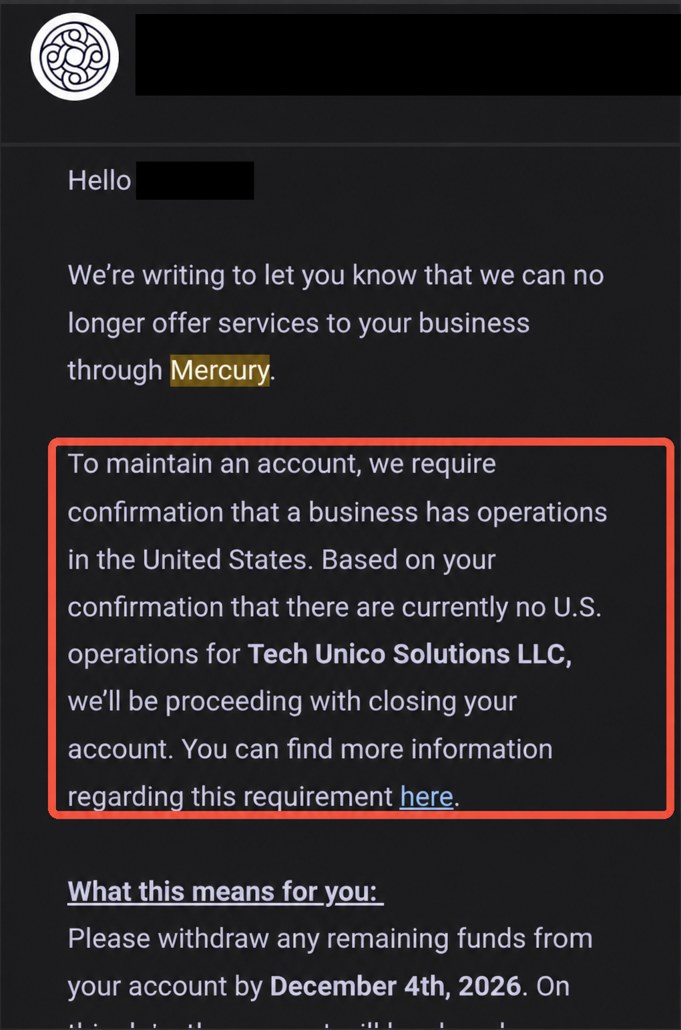
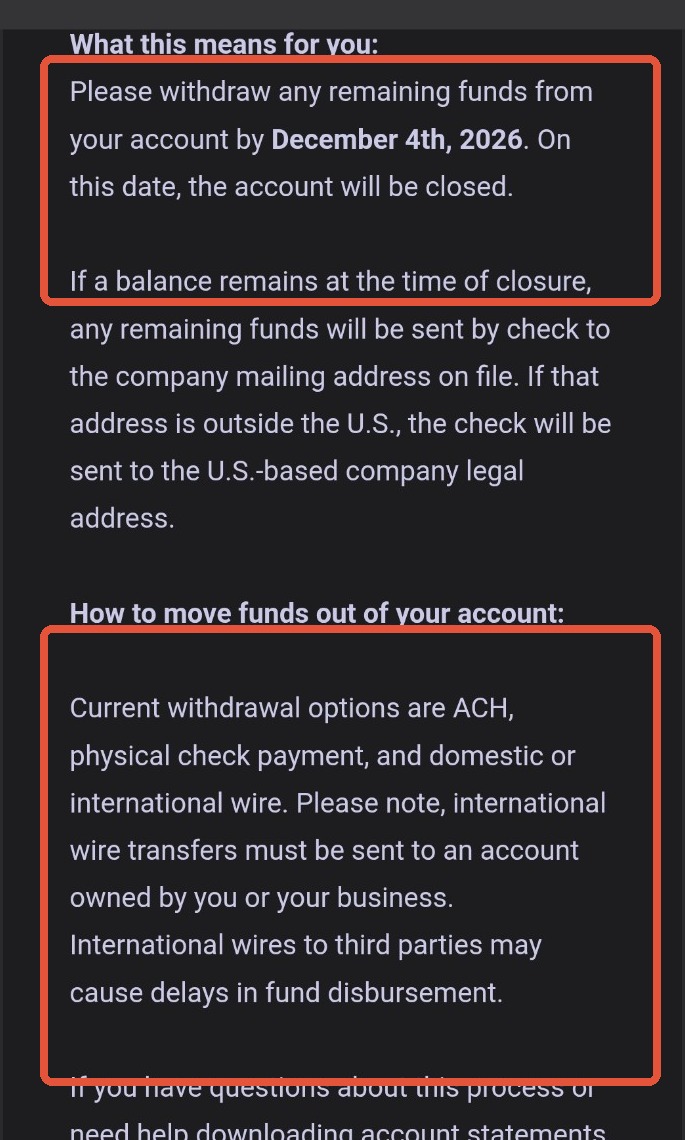
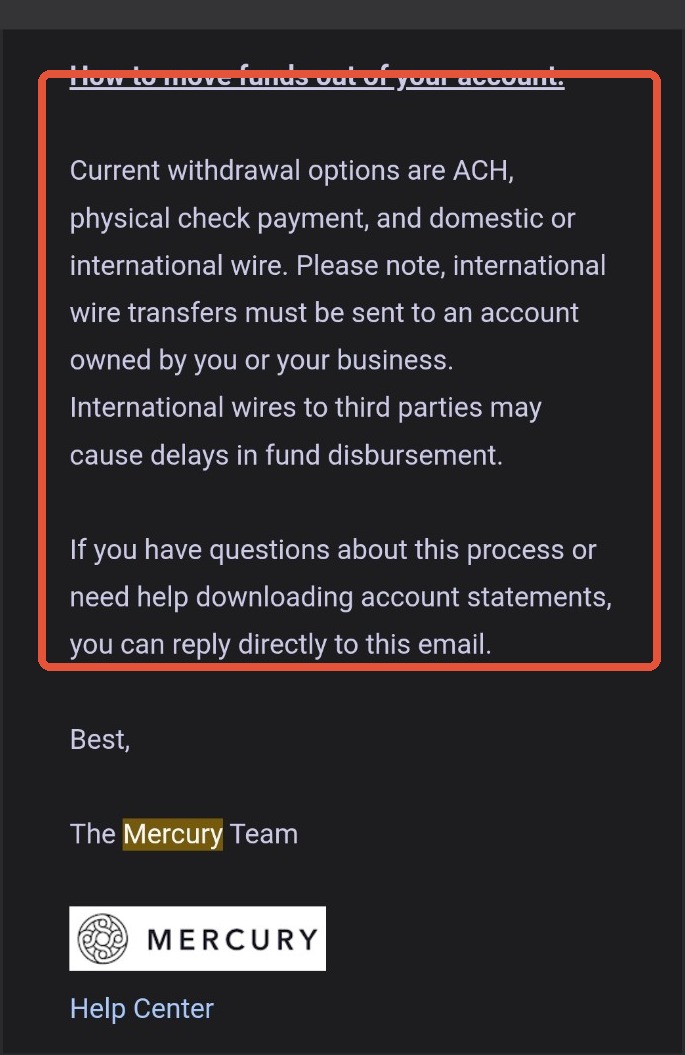
The second case is different. A November 4 notice to Tech Unico Solutions LLC says Mercury required confirmation of US operations and was proceeding with closure based on the company’s confirmation that it had none. The email set December 4, 2026 as the withdrawal deadline. That is not evidence that the account was already closed on November 19, when this article was prepared.
The India-resident founder has told us that the business has US customers and international receipts moving through an India-based account or entity. The screenshots show Mercury’s wording and deadline, but they do not show the customer contracts, invoices or account statements needed to establish which legal entity was the seller. That is the unanswered question, not a detail I should fill in on the founder’s behalf.
“US Operations” Is Not the Same as “A US Office”
Mercury’s published operations-verification criteria do not say every founder must be a US resident or rent a conventional office. They say a qualifying US company needs existing or planned US operations. Its evidence examples include a sale to a US customer, an invoice or contract with a US customer, partner or supplier, certain investment documents, US employee/payroll evidence, and a signed lease for a physical office or coworking space.
The same guidance draws a boundary around address services: a registered agent, virtual address, PO box or mailbox cannot serve as physical proof of operations. A genuine coworking or office lease is a different document. Even that is evidence for a review, not a promise that an account will remain open.
This is why “I have American customers” deserves a serious, document-based answer. It may be relevant. It may even be exactly the evidence a provider asks to see. But five facts need to line up: the client’s location, the entity named in the contract, the entity issuing the invoice, the business that performs or manages the work, and the entity whose account receives settlement.
If an Indian company signed the agreement, invoiced the customer and received the money into its own account, that is evidence of the Indian company’s export business. It does not, by itself, prove that a separate US LLC was the seller. If the US LLC signed and invoiced the customer but a related Indian company performs the work, then an agreement between those companies and a consistent accounting trail may explain the arrangement. The paperwork has to describe the real business, not repair it after the fact.
A Relative Cannot Lend Someone a Physical Presence
Could a founder appoint a cousin in the United States as a representative? A relative can hold a real authorized management role if the company gives that person genuine responsibility, discloses the arrangement and the provider accepts it. That person’s role is not a substitute for identifying the founder and other beneficial owners. A cousin’s utility bill does not make the founder a US resident.
I would be especially cautious about anyone selling an “address solution” that promises bank approval. A legally rented office or coworking place may be appropriate when the business genuinely uses it and the provider recognizes that evidence. Renting a mailbox or using a registered-agent address while describing it as a staffed workplace is a different claim. A nominal officer who has no real authority adds risk for the founder and the relative without fixing the company’s operations.
Which Payment Routes Can a Founder Actually Compare?
There is no universal gateway that accepts every US LLC owned by someone living abroad. The realistic comparison begins with the country where the seller actually operates and the legal company that will appear on the customer’s invoice.
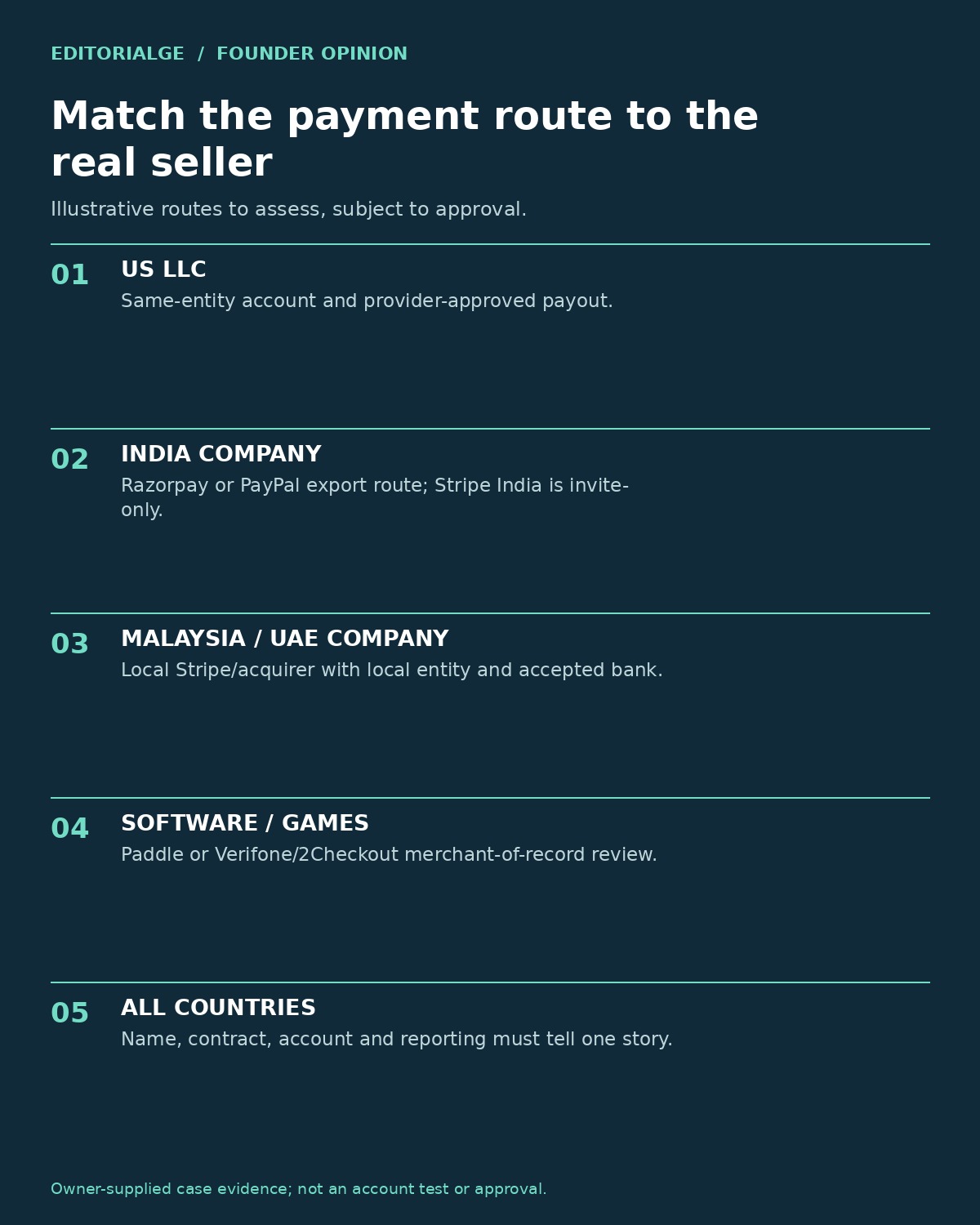
For an Indian operating company, Razorpay documents international card and bank-transfer products for Indian businesses, with settlement into the Indian business’s bank account. PayPal India describes export-payment services for Indian residents and requires a verified bank account. Stripe India is currently invite-only; its international-payment guidance describes an India-based account, KYC and export-related setup. These may be relevant when the Indian company is the contracted seller. They are not a way to enter a US LLC’s name in one place and quietly receive its money through another entity.
For a founder who has a genuine company in Malaysia or the UAE, Stripe lists those markets as supported in its global availability information. That can make local processing worth examining for the local company. The founder must still satisfy that country’s incorporation, address, identity, business and bank requirements. A UAE account, for example, must use a supported bank and an account type that fits the legal form. Having a relative or an address in the country is not equivalent to having an eligible local company.
For software, SaaS, games and other accepted digital products, Paddle or Verifone/2Checkout can be considered as merchant-of-record models. A merchant of record changes the customer-facing seller for transactions it accepts; it is not merely a new Stripe button. The provider has to approve the product and supplier, and the founder still needs a supported payout route. It will not recover funds held in a closed bank account or migrate every existing subscription automatically.
Payoneer Checkout is narrower than its general cross-border payment services can make it sound. Its current checkout eligibility information points to US or Hong Kong entities and monthly webstore volume above $20,000. That is not a general fallback for every remote founder. Enterprise processors such as Adyen or Checkout.com also verify the settlement account and may ask for more when the beneficiary bank is in a different country or belongs to another party. They are not a shortcut around account eligibility.
For a US LLC that remains the actual seller, the founder should ask a bank or processor one precise question: “Will you onboard this named LLC, with these disclosed owners and operations, and settle to this specific account held in the LLC’s legal name?” A general answer that a provider “supports international payments” does not answer that question.
What I Would Do Before Moving a Customer
First, I would map one real transaction from signed contract to usable money. I would line up the company named on the agreement, invoice, payment checkout and destination statement. If the names differ, I would write down why and find the intercompany agreement that explains the relationship.
Second, I would send the provider the real evidence and ask for a decision on the exact company. For Tech Unico, that means clarifying the November 4 statement before the December 4 deadline, if US customer records belong to that LLC. The founder should not quietly replace “no US operations” with a new story. He should explain what was confirmed, what the company actually does, and ask whether Mercury will reconsider after reviewing the contracts, invoices and matching payment records.
Third, I would compare routes by business model. An Indian company that sells the service can evaluate Indian export collection and local compliance. A Malaysian or UAE company can evaluate its own local processor and bank. A US LLC that truly remains seller can seek a same-entity business account and approved settlement path. A software company can compare a merchant-of-record offer with direct acquiring. None should be chosen solely because a founder heard that another person got through onboarding.
For India, export receipts also need proper reporting and reconciliation through the appropriate authorized-dealer bank. The Reserve Bank of India’s 2026 export and import regulations, effective October 1, 2026, and its related directions put compliance duties on authorized-dealer banks. The exact documentation depends on the real service, seller and transaction, so founders should confirm it with their bank and qualified adviser. A payment platform does not erase the company’s export, tax or reporting responsibilities. Founders with entities in multiple countries should ask qualified advisers in each relevant jurisdiction before shifting contracts or cash flows.
Editorial decision aid; it does not determine a provider’s approval decision.
The Future of the US LLC Is a Business Decision
I do not believe an account closure alone makes every nonresident-owned US company pointless. The LLC may still own intellectual property, hold contracts, work with investors or serve a market for reasons that justify keeping it. Nor does a US LLC guarantee a permanent bank account or a payment gateway.
If the company’s only continuing purpose is to obtain a checkout account, and no provider will approve a lawful, workable payout path, then the founder should ask whether the entity is earning its compliance cost. If a local company does the work and can lawfully contract with the same customers, restructuring may be more honest and resilient. If the US company remains the seller, its operations and payment trail must be legible as that company’s own.
My May notice taught me that a company number and a bank relationship are not the same promise. I also covered the wider India and Bangladesh banking context in Editorialge’s earlier report on US LLC banking after account closure; this opinion focuses on the client-to-cash chain and country-specific alternatives. The Tech Unico notice adds a sharper lesson: the words in a provider’s record matter. If a company has real US customers, it should be able to show exactly how those relationships belong to the US entity. If they belong to another company, the founder should say so and build the right structure around it.
The sensible goal is not to manufacture a US office or to find a cousin whose documents can be borrowed. It is to choose a seller, operating company, payment provider and payout account that tell one truthful story from customer to cash.