
A shipping box opens to reveal a plastic window, a protective tray, a pouch, and a bottle with a pump. A single “recyclable” message on the outside cannot tell someone what to do with all of those pieces. They may be made from different materials, and the local collection system may accept only some of them.
Clear packaging disposal instructions name the part, say what preparation is needed, and identify the appropriate collection route. A component-specific instruction does not always require a separate printed label: several parts can appear on one multi-component label. The important point is that a claim about the box should not be mistaken for a claim about its contents.
How to read packaging disposal instructions for mixed materials
Start with the component names printed on the package, then check your city or hauler’s accepted-material list. A plastic resin number identifies a material; it does not establish that your recycling program collects the item. The U.S. Environmental Protection Agency’s recycling guidance likewise directs people to check local acceptance, especially for plastic formats. If the package carries a specific disposal label, follow its preparation steps; where that label and local collection guidance differ, the local program takes precedence.
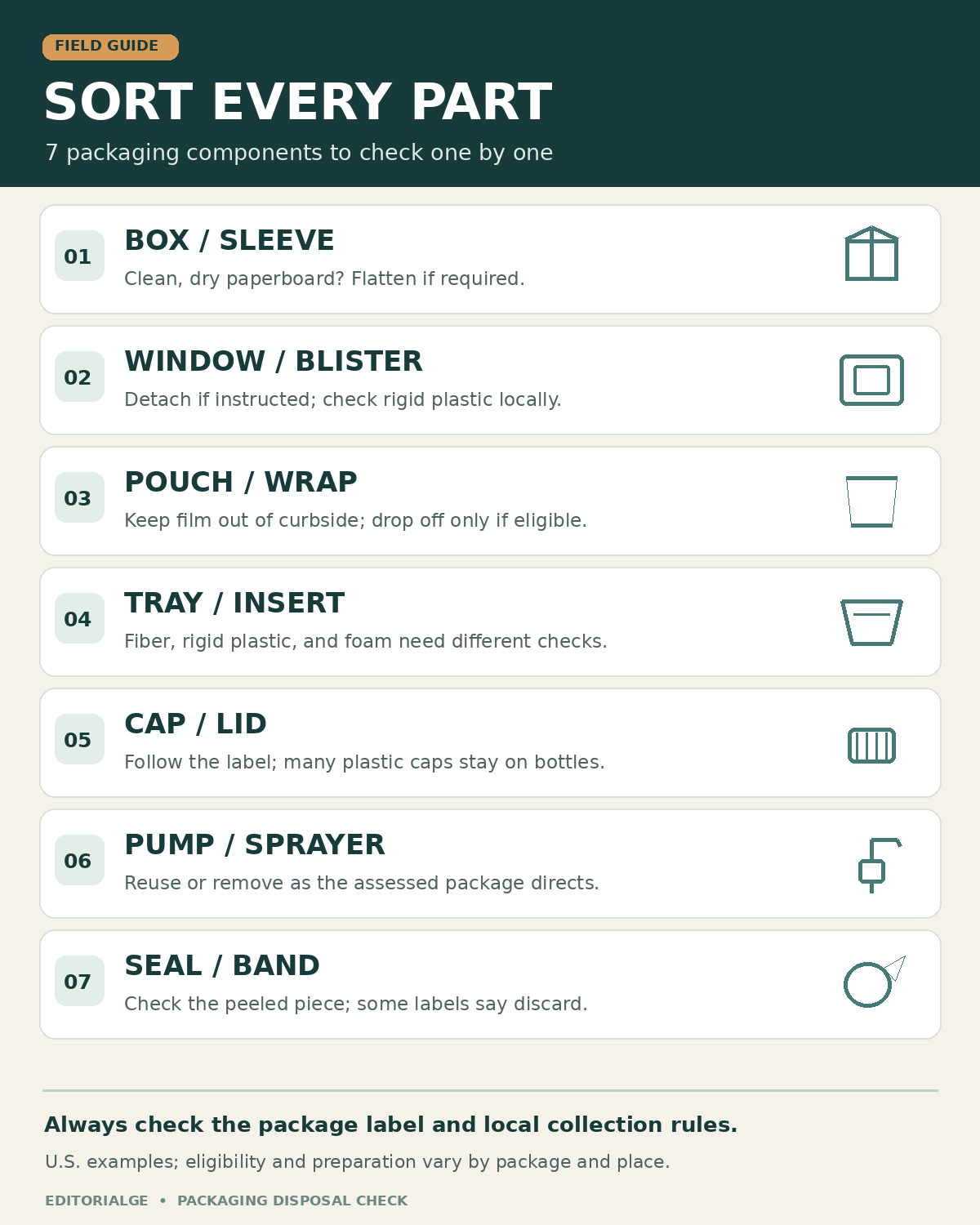
The seven parts below are common points of confusion. They are prompts to check the actual label and local service, not universal disposal directions for every package made from the same material.
| Component | The decision the instruction must settle |
|---|---|
| Outer box or sleeve | Is this clean, accepted paperboard, and should it be flattened? |
| Window or blister panel | Does it detach, and is this rigid plastic format collected locally? |
| Inner pouch or wrap | Is this eligible film for a verified drop-off route, or another structure? |
| Tray or protective insert | Is it molded fiber, rigid plastic, foam, or something else? |
| Cap or lid | Should it be replaced on the container, separated, or discarded? |
| Pump or sprayer | Can the dispenser stay with the bottle, be reused, or need removal? |
| Seal or tamper band | Does it come off during opening, and what happens to it afterward? |
1. Outer paperboard boxes and sleeves
The paperboard box is often the easiest part to recognize, which makes it tempting to put one recycling claim across the entire package. That claim may describe only the box. A paper sleeve around a plastic tub or a gift box containing a foam insert needs its own named instruction so the reader does not put every piece into the paper bin.
For an ordinary clean, dry shipping box, a local program may ask people to flatten it. A food-stained, coated, or heavily attached paper package can require a different decision. The instruction should identify the actual substrate and preparation rather than assuming that brown color or a paper texture proves acceptance. A removable insert should be named separately; a small amount of ordinary box tape is not automatically a new consumer-facing component.
For packaging teams, this is a design decision as well as a copy decision. Simplifying attachments can make the box easier to sort. That broader principle is explored in circular economy design, but the finished package still needs its own assessment.
2. Plastic windows and blister fronts
A clear window in a paper carton and a rigid blister fixed to a display card can look alike at a glance. Neither should inherit the cardboard instruction simply because it is attached to cardboard. How2Recycle’s packaging guidelines specifically call for non-paper attachments, including windows and blister trays, to be identified when a paper package is assessed.
If the panel separates easily, the label can tell the reader whether to remove it and what to do with each part. The plastic panel’s route needs a check against its actual material, size, shape, and local program. A rigid blister is not the same collection category as a flexible plastic bag, so “store drop-off” should not be copied from a film package onto it. Some attachments can be tolerated by a paper recycler; others interfere with processing. The approved instruction has to reflect the assessed construction rather than a blanket rule to tear every window out.
3. Inner pouches, bags, and flexible wraps
An outer cereal-style box may go through paper collection while its inner bag takes a different route. In the United States, most bags, wraps, and films do not belong in the household recycling bin. Some clean, dry polyethylene film packages with a qualifying Store Drop-off label can go to a participating retailer. A metallized, multilayer, or residue-filled pouch cannot be presumed eligible because it feels flexible or carries a plastic number.
Instructions for this component should say “bag,” “pouch,” or “wrap,” not merely “plastic.” They should distinguish a verified store drop-off route from curbside collection and explain any preparation, such as emptying and drying. Check the destination before printing a drop-off claim or making a special trip: a retailer must actually accept that type of film. For a plastic mailer, a paper shipping label may also need to be fully removed before store drop-off. If the film has a zipper or other attachment, its full structure needs review.
This difference between a material claim and a working collection route also matters in plastic pollution solutions.
4. Trays and protective inserts
The insert holding a product in place may be molded fiber, thermoformed plastic, or foam. It can resemble the box in function while belonging to a completely different waste stream. The word “tray” therefore needs a material and route beside it.
Clean molded fiber may be accepted with paper in some programs, but coatings and product residue can change the result. A rigid plastic tray depends on the local program’s rules for that particular shape and resin. Polystyrene foam is accepted in very few U.S. curbside programs, according to the EPA; a specialty drop-off or reuse may be possible where available. For a shipping kit, molded-paper cushioning, bubble wrap, and foam blocks should not all inherit the box’s instruction. If cushioning can be reused for another shipment, that can be a practical option before disposal.
The useful question for a consumer is simple: after lifting the product out, can I identify what this insert actually is? If the label leaves that unclear, the brand should specify the material and the verified route.
5. Caps and lids
The instruction for a cap may be the opposite of what a reader expects from the phrase “separate the parts.” Many plastic bottles are recycled with their caps screwed back on. Loose caps are small and can be lost during sorting. Yet a package-specific label may say to discard a particular cap or lid, and metal crown caps on glass beverage bottles are treated separately from the glass.
Food and beverage cartons add another case: where the local program accepts the carton, the Carton Council advises putting its cap back on or pushing its straw into the carton. The carton’s layered structure and recycling route should not be confused with an ordinary paperboard box.
Good copy names both the container and closure: “Empty bottle; replace cap,” for example, only when that instruction has been verified for that package and market. “Remove all caps” is too broad. The reader should not have to guess whether a lid belongs inside, on top of, or away from the container.
6. Pumps and trigger sprayers
A lotion pump can contain plastic, a metal spring, a dip tube, and other small parts. A trigger sprayer may have a different construction. Their fate cannot be inferred from the recyclable bottle beneath them. How2Recycle includes “empty and discard pump” among its possible preparation instructions, but that is an example of an assigned label, not a rule for every dispenser.
For a refillable product, reusing a functional pump may be the best consumer action if the refill system actually supports it. Otherwise, the package assessment should decide whether the whole dispenser can stay attached, must be removed, or has an accepted separate route. Do not ask readers to dismantle a mechanism with tools or excessive force to make a recycling claim work. The instruction should tell them what to do with the intact part.
7. Peel-off seals, lidding films, and tamper bands
The foil disk under a jar lid is easy to overlook after opening. So is the lidding film peeled from a food tray or the band around a bottle neck. These parts can be made from different materials and may carry residue. A direction for the jar or tray does not automatically cover the removed seal.
How2Recycle’s label examples include “discard seal and empty before recycling.” Its packaging guidance also asks brands to describe a tamper-evident seal’s material, location, and whether it is fully removed to access the product. That information determines whether a separate consumer action is necessary. Thin foil or film should not be slipped into metal or film collection just because one visible layer resembles an accepted material. When the correct route is disposal, say so plainly; that instruction keeps the rest of the accepted package from being contaminated.
A component inventory before the artwork is final
For a brand or packaging supplier, a short inventory prevents the outer box from speaking for every inner part. The following is a working template, not an approved disposal label. Fill it using the actual bill of materials, package assessment, and the collection routes in each sales market.
| Record for each part | Example of what to verify |
|---|---|
| Name and location | “Window on front of box,” rather than “plastic” |
| Material and attachments | Resin, coating, label, adhesive, zipper, spring, or laminate |
| Consumer action | Does the part come off during normal use without tools? |
| Route and geography | Curbside, eligible store drop-off, special collection, reuse, or trash; U.S. and Canada may differ |
| Final instruction | A short, specific action that matches the assessed package and local program |
A redesign may solve a problem that words cannot. If the only way to recycle a package is to scrape away a stubborn label or pull apart a bonded laminate, a more complex instruction may not be realistic. Check the prototype with the actual closures and attachments, then check the printed artwork against the approved assessment. At home, follow the packaging disposal instructions for each part and your local collection rules. If no route is confirmed for one component, keep it out of the recycling bin rather than assuming the symbol on another part applies to it. The same habit supports lower-waste choices at home: use less packaging where possible, then sort what remains accurately.